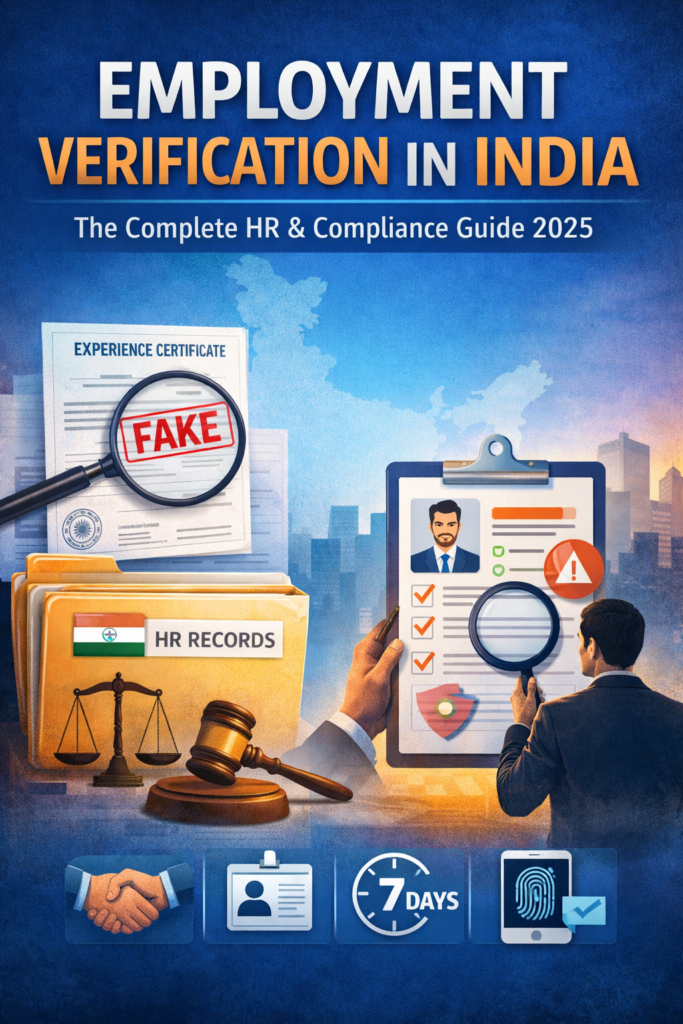
Employment verification in India has become a critical risk-control function for HR teams in 2025. Fake experience letters now look authentic, HR email IDs are fabricated, designations are inflated, and employment gaps are deliberately hidden. As a result, basic reference checks are no longer sufficient to protect organizations from hiring risk.
This guide explains how employment verification actually works in India, what HR teams often miss, and how organizations can reduce hiring risk in 2025.
What Is Employment Verification in India and How Does It Work?
Employment verification in India refers to the process of independently validating a candidate’s past employment details through authoritative and verifiable sources.
A proper employment verification confirms:
- Authenticity of the employer
- Employment tenure (start and end dates)
- Designation and role held
- Employment type (permanent / contract)
- Reason for leaving (where available)
Unlike informal reference checks, professional employment verification uses structured workflows, escalation logic, and documented outcomes.
Why Employment Verification Is Critical in 2025
Indian organisations are seeing a measurable rise in employment-related misrepresentation due to:
- Easy access to design tools and fake letterhead templates
- Creation of fake HR email IDs for verification calls
- Pressure to meet role eligibility and salary benchmarks
- Weak verification practices in fast-growing companies
These risks are highest in:
- Startups and MSMEs
- Fintech and NBFCs
- Microfinance and field-driven operations
Without structured employment verification, organisations risk:
- Compliance failures
- Financial and reputational damage
- Early attrition and poor hiring outcomes
This is why employment verification in India must be treated as a structured, auditable process rather than an administrative HR formality.
Step-by-Step Employment Verification in India: Process Explained
A robust employment verification process follows these stages:
1. Candidate Data & Consent Collection
Candidate employment details are collected along with explicit consent for verification.
2. Employer Authentication
The legitimacy of the employer is validated independently — not only through candidate-provided contacts.
3. HR or Authorised Contact Verification
Verification is conducted via official HR channels or authorised company representatives.
4. Tenure and Designation Confirmation
Employment dates, role, and designation are cross-checked for consistency.
5. Discrepancy & Risk Flagging
Any mismatch, non-response, or suspicious pattern is clearly documented in the report.
👉 For execution-level details, see Employment Verification Services in India
Common Employment Fraud Patterns HR Teams Miss
Many discrepancies are missed because they appear “reasonable” in isolation.
Common red flags include:
- HR email IDs hosted on free domains
- Letterheads reused across unrelated candidates
- Designations inflated without role clarity
- Tenure altered by a few months to meet eligibility
- Silence or delayed responses from past employers
Professional verification focuses on patterns, not just confirmations.
Why Basic HR Checks Often Fail
Internal HR checks fail when:
- Verification relies only on candidate-shared contacts
- No independent employer validation is done
- Non-responses are treated as neutral outcomes
- Reports lack context or escalation logic
Employment verification must support decision-making, not just documentation.
Industry-Specific Employment Verification Risks
Fintech & NBFCs
Hiring risks directly impact regulatory exposure and customer trust. Read more on this on our blog: Background Verification for Banks & NBFCs in India
Startups & MSMEs
Rapid hiring often outpaces internal controls, increasing misrepresentation risk.
Microfinance
Field-level hiring demands stronger address, identity, and employment validation.
Legal & Compliance Considerations in India
Employment verification must comply with:
- Candidate consent requirements
- Data minimisation principles
- Secure handling of personal information
Verification outcomes should be factual, documented, and defensible.
Employment Verification FAQs
How long does employment verification take in India?
Typically 3–7 working days, depending on employer responsiveness.
Can verification be completed if the employer does not respond?
Yes. Non-response is documented as a verification outcome and treated as a risk signal.
Is UAN verification sufficient for employment verification?
No. UAN does not confirm designation, role, or reason for leaving.
Should startups conduct employment verification?
Yes. Startups often face higher hiring risk due to limited internal controls.
What if discrepancies are found?
Discrepancies are highlighted clearly, allowing HR to make informed decisions.
Related Background Verification Services
- Employment Verification Services in India
- Address Verification Services
- Education Verification Services
- Criminal & Court Record Verification
Check our services to know more.
CTA
If your organisation is reassessing hiring risk or reviewing verification gaps, begin by understanding where current checks may fall short. A well-designed employment verification in India framework enables HR teams to make informed, defensible hiring decisions.