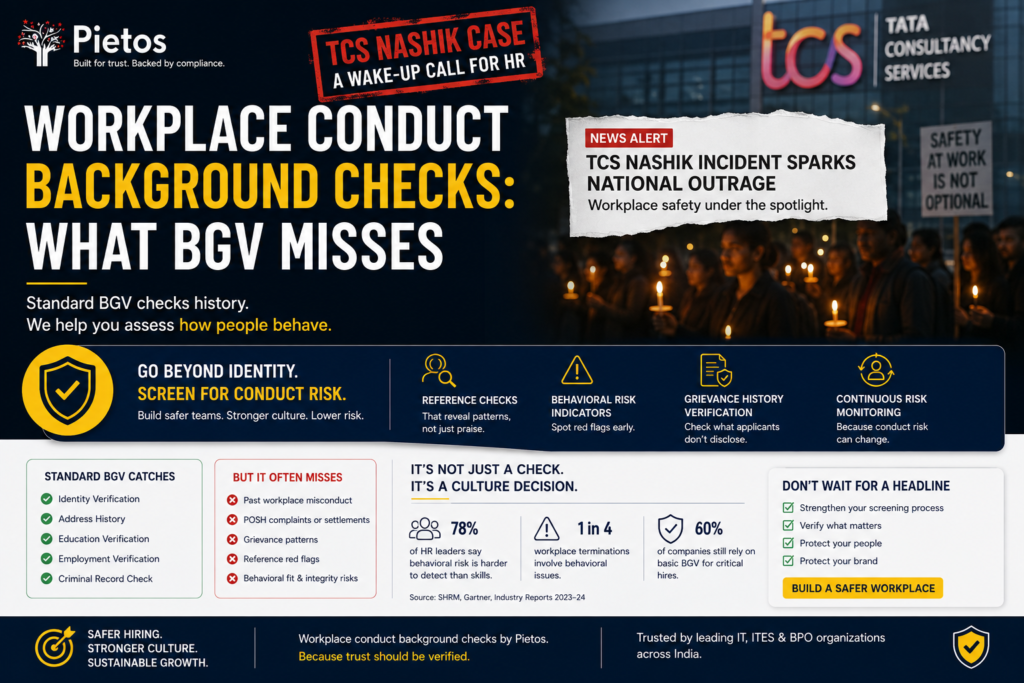
Workplace conduct background checks sit outside most companies’ standard hiring checklist. Firms verify degrees, past employers, addresses, and criminal records. Very few verify how a candidate actually behaved with people who reported to them. That gap sat at the center of one of the most closely watched HR stories of 2026.
In April 2026, multiple employees at a Tata Consultancy Services BPO campus in Nashik, Maharashtra, filed police complaints. They alleged sustained sexual harassment and coerced religious conversion by several team leads. The allegations span 2022 to 2026. As Forbes India reported, Nashik Police formed a Special Investigation Team. They ran a weeks-long undercover operation inside the facility. By mid-April, police had registered nine FIRs. They arrested seven employees, including an Assistant General Manager. TCS suspended the accused staff and brought in external investigators to review the matter. Wikipedia documents a fuller timeline for readers who want the complete background.
This blog isn’t about relitigating that case. It asks a sharper, operational question: would your screening and monitoring process have caught this risk earlier? For most organisations, the honest answer is no. That points to a background verification design problem, not a bad-luck problem.
Standard BGV doesn’t catch behavioral risk. If your current process stops at identity, education, and criminal checks, read how Pietos structures reference checks in employee screening before your next supervisory hire goes through.
What the TCS Nashik Case Reveals About Background Checks
A Pattern That Repeats at Scale
Strip away the headlines and the case exposes a pattern compliance teams see repeatedly, just rarely at this scale. Allegations against team leads went back to 2022. Multiple people appear to have known, or suspected, long before police got involved. Reports say one senior manager was arrested for allegedly ignoring a verbal complaint. That failure meant the organisation’s formal Prevention of Sexual Harassment (POSH) machinery never triggered in time.
Three structural gaps show up in that sequence. Every one touches background verification and workforce risk management, not just POSH training:
- No mechanism flagged repeat behavioral risk across a four-year window, even as reporting suggests the same names recurred.
- A verbal complaint didn’t reach the Internal Committee. The escalation path depended entirely on one manager’s judgment.
- Team-lead and supervisory hires skipped the rigor typically reserved for finance or IT-access roles, despite holding direct authority over dozens of reporting staff.
None of this means standard BGV failed. Standard BGV was never designed to catch this category of risk. Workplace conduct background checks form a distinct discipline — closer to reference-depth verification and continuous monitoring than to the identity and education checks most vendors run by default.
Why Scale Changes the Risk
This wasn’t a small team where one manager could plausibly miss a pattern. It was a large, layered BPO operation. Hundreds of employees reported through several tiers of team leads and shift supervisors before anything reached senior HR. That structure is common across India’s IT and ITES sector. It’s also precisely the structure where conduct risk hides longest, because escalation depends on trust in the layer directly above, not on any independent verification system.
TCS moved quickly once the case became public. The company suspended accused staff, brought in Deloitte and Trilegal as independent investigators, and set up an oversight committee chaired by an independent director. That response matters, and it shows how seriously large employers now treat this exposure. But it’s still a reactive response by definition. Workplace conduct background checks deliver their real value earlier — at the point a team lead is hired or promoted, long before any investigation becomes necessary.
Why This Isn’t Only a POSH Story — It’s a Background Checks Story
It’s tempting to file this under “HR policy” and move on. That framing misses where the actual exposure sits. POSH policy governs what happens after a complaint. Background verification and hiring diligence govern what you know before someone gains authority over other employees.
Consider a typical team-lead promotion or lateral hire. A candidate clears identity checks, education checks, a criminal record search, and maybe an employment history check. None of those four checks would surface a pattern of intimidating juniors, retaliating against dissent, or crossing behavioral lines with subordinates. That data almost never appears in police records unless it escalates to a formal FIR — and the Nashik case shows just how long that escalation can take.
This is exactly why workplace conduct background checks matter as a named, budgeted category. It’s not a vague aspiration folded into “culture fit.” Skipping it doesn’t just create legal exposure. It lets known-risk individuals move into positions of authority again and again, simply because no organisation in the chain asked the right reference the right question.
What Standard Background Checks Catch — and What They Don’t
HR teams often assume a “comprehensive” BGV package covers behavioral risk because it covers criminal records. It usually doesn’t. Here’s a realistic breakdown of coverage gaps across a typical enterprise screening package:
| Check type | What it verifies | Catches conduct risk? |
|---|---|---|
| Identity (Aadhaar, PAN) | Legal identity, KYC status | No |
| Education verification | Degree authenticity | No |
| Criminal record check | Court and FIR records at filing address | Only if formally reported and filed |
| Employment history / UAN check | Past employers, tenure, EPFO contributions | Indirectly, via unexplained gaps |
| Standard reference check | Role, dates, rehire eligibility | Rarely — most references are procedural |
| Structured reference / conduct check | Peer and subordinate feedback, escalation history | Yes, when designed for it |
| Continuous monitoring | Ongoing court, credit, and employment status changes | Yes, for events occurring after hire |
The table makes the gap obvious. Four of the seven check types most companies run by default never surface behavioral or conduct risk. Only structured reference checks and continuous monitoring close that gap. Most vendors still treat both as optional add-ons rather than standard practice for supervisory roles. For a broader view of what a criminal record check misses on its own, read our full breakdown of background check red flags HR teams should never ignore.
See how Pietos structures reference-depth checks for team-lead and manager-level hires — request a sample workplace conduct screening report.
The IT/BPO Sector Pattern: Why This Keeps Surfacing at Scale
India’s IT and ITES sector hires at a volume most other industries don’t attempt. Large delivery centres onboard hundreds of entry- and mid-level employees a month. They promote team leads quickly to keep pace with attrition and run 24/7 shift structures where night-shift supervisors operate with limited senior oversight. Every one of those operational realities widens the exact gap workplace conduct background checks close.
Fast promotion cycles multiply the risk. A high performer moved into a team-lead role within 12 to 18 months rarely gets the same screening depth as an external senior hire. Managers treat internal promotions as a performance decision, not a hiring decision. That’s a reasonable assumption for technical competence. It’s a dangerous assumption for conduct risk. An internal promotion carries the same new authority over subordinates as an external hire — sometimes more, since the person already holds established relationships and informal influence on the floor.
Night-shift and remote-supervision structures compound this further. A supervisor managing a shift with minimal senior staff present gets more unmonitored one-on-one contact with junior team members. Almost no other role in a typical corporate hierarchy carries that same exposure. HR and compliance teams often map risk by department or seniority alone. They should map it by structural opportunity for unsupervised authority instead — and most consistently under-invest in screening exactly the roles that carry the most exposure.
The Grievance Mechanism Gap Background Checks Don’t Cover
What the Law Requires
Background verification usually stops at the point of hire. But the Nashik case shows the real failure point can sit inside the organisation, long after onboarding. It lives in whether a grievance actually reaches the people responsible for acting on it.
India’s Sexual Harassment of Women at Workplace (Prevention, Prohibition and Redressal) Act, 2013 requires every workplace with ten or more employees to constitute an Internal Committee. Failure to do so is itself a violation carrying financial penalties. The law exists precisely because informal, verbal, manager-level awareness of misconduct has repeatedly proven unreliable as a safeguard.
Compliance and HR teams tend to treat POSH compliance as a training-and-policy exercise: publish the policy, run the annual workshop, tick the audit box. Few extend that thinking into hiring diligence. Does your screening process check whether a candidate for a leadership or team-lead role carries a documented history of escalated grievances? What about disciplinary action, or unresolved conduct complaints at a previous employer? Most vendors skip that question because most clients never specify it in their scope of work.
Where Screening Meets Compliance
This is where workplace conduct background checks intersect directly with POSH compliance. A well-designed screening process doesn’t replace the Internal Committee. It reduces the odds that a repeat offender reaches a position of authority in the first place. It also creates a documented trail that strengthens the organisation’s compliance posture if regulators or courts ever ask what due diligence happened at the hiring stage.
Regulatory attention on this exact gap keeps building. Following a Supreme Court directive in August 2025, state governments now run district-wise POSH compliance surveys. Organisations increasingly must register their Internal Committees on the government’s central SHe-Box complaints portal. That regulatory push focuses on the redressal side — making sure a complaint has somewhere documented to go. It says nothing about the hiring side, which is exactly the space workplace conduct background checks fill. A compliance program that only satisfies the redressal requirement looks compliant on paper. If it doesn’t address who gets hired into authority in the first place, it stays exposed in practice.
Reference Checks: The Missing Layer in Workplace Conduct Background Checks
Why Most Reference Checks Fail to Signal Anything
Reference checks in employee screening remain one of the most under-invested checks in the standard BGV stack. Most reference calls are procedural — they confirm dates and designation, nothing more. That’s a design failure, not a limitation of the method itself.
A structured, conduct-focused reference check asks different questions:
- How did this person manage disagreement with subordinates?
- Were there any escalated complaints, formal or informal, during their tenure?
- Would this reference feel comfortable if this person managed their own family member?
- Did the person leave voluntarily, or did the exit connect to a conduct issue resolved quietly?
Vague, non-committal answers — “they were fine,” “no issues that I recall” — carry a signal of their own. HR teams trained to treat lukewarm references as a yellow flag catch far more. Teams that treat reference checks as a formality to close before an offer letter goes out catch far less.
This is precisely the layer that separates procedural BGV from workplace conduct background checks: the former confirms facts, the latter probes behavior. Organisations hiring into supervisory or people-management roles should treat structured reference depth as a non-negotiable line item, not an optional upgrade priced separately from the base package.
Depth Beats Volume
Depth matters as much as the questions themselves. A single reference call to a listed HR contact rarely surfaces anything beyond employment dates, because that contact usually gives neutral, liability-safe answers by training. Structured conduct screening instead prioritises peer and subordinate references — people who actually worked under the candidate day to day — captured with proper consent and handled confidentially. The signal quality differs sharply. An HR reference confirms a title. A former subordinate’s reference tells you how that title was exercised.
A short illustration. Consider two candidates shortlisted for the same team-lead role at a BPO delivery centre. Candidate A’s references come back clean but generic: dates confirmed, no further comment. Candidate B’s references include one enthusiastic peer, one neutral HR contact, and one former subordinate. That subordinate pauses before answering a question about escalation history, then gives a vague, non-committal response. Standard BGV would clear both candidates. A structured conduct check would flag Candidate B for a follow-up conversation before an offer goes out — not a rejection, a conversation. That single extra step, applied consistently across supervisory hiring, is the entire value proposition of workplace conduct background checks.
Why a One-Time BGV Isn’t Enough for Large, Layered Teams
Large BPO and IT delivery campuses like the one in Nashik run deep management hierarchies — team leads, assistant managers, shift supervisors. Each layer holds real authority over the layer below. A background check run once, at the point of hire, tells an organisation almost nothing about how that authority gets exercised three or four years into the role.
Continuous background monitoring closes part of this gap. It re-checks EPFO status, court records, and credit indicators on a rolling basis instead of treating verification as a single event. It won’t independently surface a workplace harassment allegation that hasn’t been formally filed. But it does two things that matter operationally. It keeps identity and employment data current for high-turnover BPO environments, and it builds an organisational habit of ongoing diligence rather than a one-and-done compliance checkbox.
Pair continuous monitoring with a clear internal escalation audit. Periodically review how many grievances came in verbally versus formally, and how fast each escalated to the Internal Committee. Together, these two habits get an organisation much closer to catching a pattern like the one described in the Nashik FIRs. They do it years earlier than a police investigation eventually would.
Evaluating Your Vendor’s Workplace Conduct Background Checks
Five Questions Every Vendor Should Answer
Not every background verification company in India offers structured conduct screening, and most won’t volunteer that limitation. HR teams need to ask directly, ideally before signing a renewal, rather than discovering the gap after an incident.
Put these questions to your current vendor:
- Does your reference check process include structured conduct and escalation questions, or only role and tenure confirmation?
- Can you flag candidates with a documented history of disciplinary action at a previous employer, where legally available?
- Do you offer continuous monitoring for supervisory and leadership hires specifically, not just entry-level bulk hiring?
- How do you structure candidate consent for deeper behavioral reference checks under the Digital Personal Data Protection Act, 2023?
- Can your reporting distinguish between “reference unavailable” and “reference declined to comment” — the second carries a meaningfully different signal?
A vendor that can’t answer these clearly runs identity-and-education BGV with a conduct-screening label attached. That distinction matters more after a case like Nashik than it did a year ago, because boards and legal teams now expect HR to show its work.
What Pricing Sheets Hide
Price comparisons across vendors rarely surface this gap, because most BGV pricing sheets structure around check type — identity, education, employment, criminal, address — not check depth. Two vendors quoting near-identical rates for “comprehensive verification” can differ enormously. The gap shows up in how many reference calls they actually place, how those calls get scripted, and whether a declined or evasive reference triggers any follow-up at all. HR procurement teams that evaluate BGV vendors on turnaround time and per-candidate cost alone optimise for the wrong variables when the role carries supervisory authority.
Ask a vendor how they document a hesitant or negative reference, too. Some platforms simply record “reference completed” regardless of what was said, which collapses a meaningful signal into a generic status update. Others build a structured note field into every reference call. That field captures tone and specific responses, so HR has something concrete to review rather than a green checkmark that hides the nuance underneath it. That single design choice — a checkbox versus a documented note — matters. It often separates a vendor that takes conduct screening seriously from one that just added the phrase to its marketing.
Related: read our full audit on what BGV vendors typically leave out of their standard package. See also our sector-specific notes on how to pick the right BGV company for IT and BPO hiring.
A 5-Point Action Framework for Workplace Conduct Background Checks
For teams ready to move from reading about this to acting on it, follow this practical, sequenced rollout:
- Audit current coverage. Map every check your existing BGV vendor runs against the table above. Pin down exactly where conduct-risk coverage stops. Write that gap into a document your compliance team can reference, rather than leaving it as institutional knowledge in one person’s head.
- Add structured reference depth for supervisory hires. Make it mandatory for every role with direct reports, not just leadership hires above a certain band. Include internal promotions, which most organisations currently exempt from screening entirely.
- Formalise the escalation path. Give every complaint — verbal or written — a documented, auditable route to the Internal Committee, with a named owner accountable for logging it. Test this path periodically with a dry run, the way security teams test an incident-response plan.
- Introduce continuous monitoring for management-layer employees. Treat it as an ongoing risk-management function, not a one-time onboarding cost. Rolling checks on court records and employment status catch issues a static, hire-date-only check will always miss.
- Review vendor contracts annually against conduct-screening capability, not just turnaround time and pricing. Those are the two metrics vendors compete on hardest, while conduct depth quietly slips down the priority list. Put the five vendor-evaluation questions above directly into your next renewal conversation.
None of these five steps demand a large budget increase or a lengthy procurement cycle. Most fit into an existing BGV vendor relationship within a single quarter, provided HR leadership treats conduct-risk coverage as a defined deliverable rather than an assumed one.
The Cost of Treating This as Someone Else’s Problem
Direct and Indirect Costs
A workplace conduct failure carries direct costs that are easy to underestimate until they hit. Legal liability under the POSH Act, regulatory scrutiny, and, in cases involving criminal allegations, reputational damage that outlasts the news cycle by years. TCS brought in independent external investigators and an oversight committee within weeks of the Nashik case becoming public. That response signals how seriously boards now treat this exposure.
The indirect costs compound further. Attrition rises in teams where conduct risk goes unaddressed. Campus hiring pipelines, a critical channel for large BPO and IT employers, get harder to fill once a company’s name ties to a workplace safety story. Client contracts in regulated sectors increasingly include vendor-conduct clauses, so a workplace safety failure at a service provider can put revenue at risk, not just reputation.
Set against those numbers, structured reference checks and continuous monitoring for supervisory roles cost very little to add. Most HR leaders already know this. Cost has rarely been the real barrier — the barrier has been that nobody flagged that standard BGV wasn’t built to cover this risk category at all.
A Hidden Talent Cost
There’s a talent-acquisition cost too, and it’s often underweighted. EY’s employment fraud research draws on more than one million background checks across over 90 Indian companies. It found discrepancies in most employment history verifications. IT and ITES rank among the sectors carrying the highest fraud exposure for experienced hires. That data point isn’t about conduct risk directly. But it tells HR leaders something important: candidates in this sector already face screening against a baseline of high fraud and misrepresentation. Layering conduct-risk screening onto that baseline, rather than treating it as a separate initiative, is a smaller lift than starting from scratch.
Boards also ask sharper questions once cases like this go public. A compliance head who can point to a documented conduct-screening policy for supervisory hires sits in a materially different position. That policy needs annual review and a named BGV vendor scope of work behind it. Compare that to a compliance head who can only point to an annual POSH training deck. The first shows a system. The second shows a checkbox.
Common Objections, Answered
Objections About Legal Risk and Fairness
“Our BGV vendor already runs a comprehensive check.” Comprehensive usually means identity, education, employment, and criminal records. Ask your vendor directly whether structured conduct-focused reference checks are included, or priced separately — most aren’t included by default.
“We can’t screen for something that hasn’t been legally proven.” True, and no reputable BGV process should treat unproven allegations as disqualifying. The goal isn’t to blacklist candidates on rumour. It’s to feed documented disciplinary history, escalated grievances, and reference hesitation into a human hiring decision, not an automatic rejection.
“Our POSH policy already covers this.” POSH policy governs post-hire conduct and redressal. It says nothing about who gets hired or promoted into authority in the first place. The two need to work together, not substitute for each other.
Objections About Cost and Speed
“This adds cost and turnaround time to every hire.” Structured conduct screening doesn’t need to apply to every role. Scoping it to supervisory, leadership, and people-management positions keeps cost proportional to actual organisational risk.
“Won’t candidates feel we’re invading their privacy?” Structured reference checks run under the same consent framework as any other BGV check, disclosed upfront as part of the hiring process. Candidates with a clean history rarely object once the purpose is explained clearly. Organisations that skip this step to avoid an awkward conversation trade a small amount of candidate friction for a much larger downside risk.
“Isn’t this just going to slow down our hiring pipeline?” Scoped correctly, it adds a few days to reference turnaround for supervisory roles specifically, not every hire in the pipeline. Most HR teams already accept longer diligence timelines for finance and IT-access roles. Extending that same logic to people-management roles is a smaller shift than it sounds.
Each of these objections makes sense on its own. Together, they explain why workplace conduct background checks remain an underused category even at organisations that otherwise run mature, well-documented BGV programs. The fix isn’t a wholesale process overhaul. It’s a scoped addition to an existing hiring workflow, applied specifically where authority over other people is at stake.
Key Takeaways
- Standard background checks verify identity, education, and criminal records — they were never designed to catch behavioral or conduct risk.
- Structured reference checks that probe escalation history and peer feedback are the single most underused tool for surfacing conduct risk before a hire.
- POSH compliance and background verification are two different systems that need to work together — one governs what happens after a complaint, the other governs who gets hired into authority in the first place.
- Continuous monitoring matters more for supervisory and leadership roles than for entry-level hiring, precisely because authority compounds risk over time.
- Evaluate your BGV vendor specifically on conduct-screening capability, not just turnaround time and price.
The Nashik case will move out of the news cycle eventually. The underlying screening gap it exposed won’t close on its own. Every organisation running large, layered teams — IT delivery centres, BPOs, retail chains, logistics networks — carries the same structural exposure. Authority concentrates in supervisory roles that standard background checks were never designed to evaluate. Closing that gap doesn’t require waiting for the next headline. It requires treating workplace conduct background checks as a defined, budgeted line item in the hiring process. Identity and education verification already work this way. Start with our BGV checklist for Indian HR teams if you’re auditing your current process from scratch.
Don’t wait for a headline to find your screening gap. Book a free workplace conduct BGV audit with Pietos and see exactly which roles in your org chart run on identity-only checks.
FAQ
Workplace conduct background checks are structured reference and behavioral verification processes that assess how a candidate managed relationships, disagreement, and authority in previous roles, going beyond standard identity, education, and criminal record checks.
Most standard packages don’t. They typically cover identity, education, employment history, and criminal records. Conduct-focused reference depth and continuous monitoring are usually separate, purpose-built services.
Yes, when conducted with proper candidate consent and a clearly stated purpose, consistent with the Digital Personal Data Protection Act, 2023. Reputable BGV vendors build consent capture into the reference-check workflow itself.
Any role with direct reports or supervisory authority — team leads, shift supervisors, assistant managers, and department heads — carries disproportionate conduct risk compared to individual-contributor roles.
The Internal Committee handles complaints after they’re raised, as required under the POSH Act. Conduct-focused background checks operate earlier, at the hiring and promotion stage, to reduce the odds that someone with a documented conduct history reaches a position of authority.
Continuous monitoring alone can’t surface unreported behavioral risk. Combined with structured reference checks at the point of promotion and a properly audited grievance escalation path, it meaningfully closes the gap standard one-time BGV leaves open.
Yes, for any role gaining supervisory authority. Internal promotions skip most background checks by default because they’re treated as performance decisions, but the new authority over subordinates carries the same conduct-risk exposure as an external hire, sometimes more.
Treat it as a signal for a follow-up conversation, not an automatic disqualification. Vague references are one of the most reliable early indicators of an undocumented conduct issue, and a structured screening process should have a defined next step for exactly this scenario.