Call us on: 9289301161/+91 11 49074103 or email us on contact@pietos.com
Trending Today

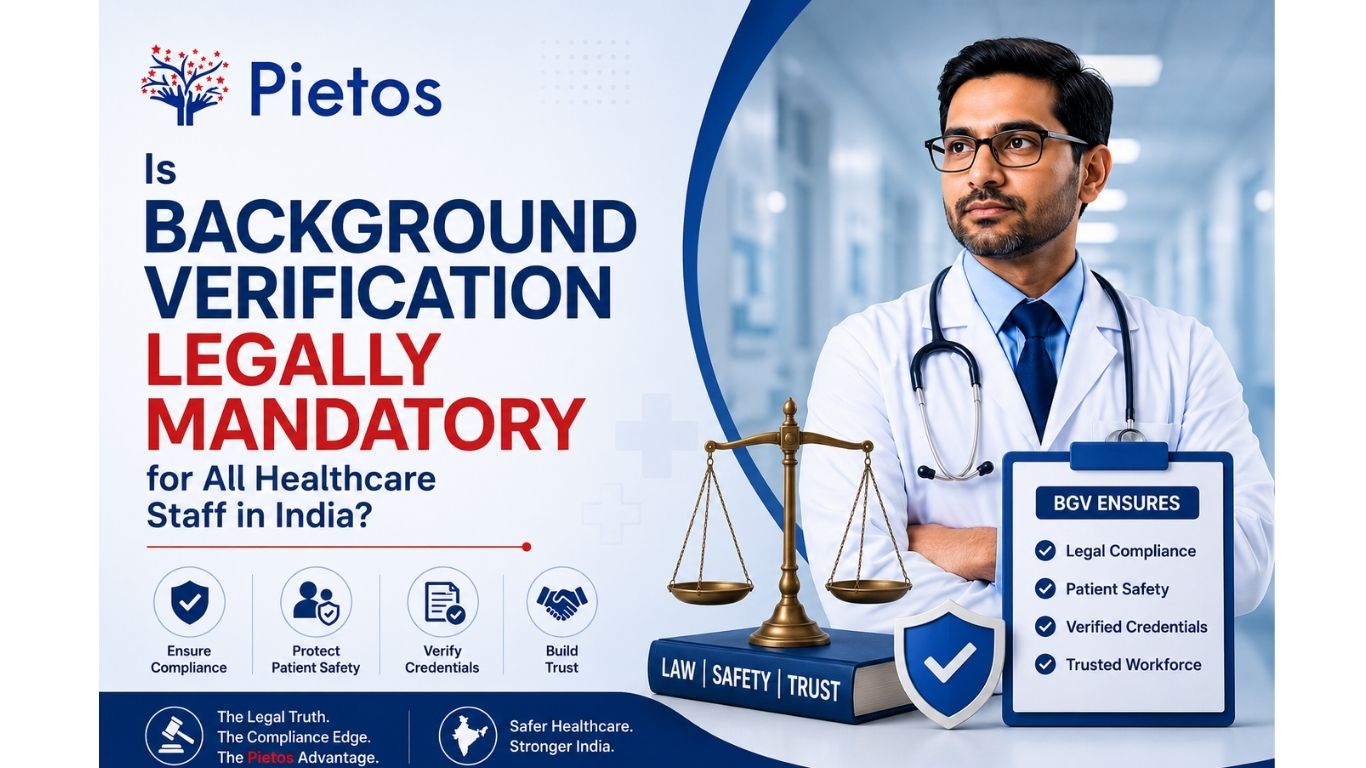
In the contemporary corporate landscape, enterprise risk management frameworks are engineered to construct impenetrable digital, operational, and financial perimeters. Scale-driven systems deploy multi-factor authentication, biometric guardrails, predictive cybersecurity scripts, and multi-tier transaction authorization protocols to protect corporate data, systemic revenue, and brand capital. Yet, a fundamental strategic blind spot persists globally, and with acute intensity within the global south: the structural fragility of the human supply chain. Nowhere is this vulnerability more stark, or the margins of error more unforgiving, than within the clinical and operational ecosystems of Indian healthcare.
The fundamental reality of this exposure lies in structural asymmetry. To understand this concept fully, consider a direct cross-industry comparison that cuts straight to the operational core of corporate risk pricing:
"In IT, a bad hire ships buggy code. In a hospital, a bad hire performs a coronary intervention. The consequences are not comparable. One is recoverable. The other is not."
— Thought Leadership on Corporate Governance
When a technology organization integrates an unverified or technically unqualified software engineer, the down-market risk curve manifests as technical debt, broken features, integration lag, or, in severe scenarios, a system breach that can be patched with post-facto engineering and insurance provisions. The liability, while financially painful, remains profoundly bounded.
Conversely, within a high-acuity hospital environment, the systemic integration of an unverified human asset represents an existential event. When a healthcare organization grants clinical or operational authority to an individual who enters via compromised vetting infrastructure, the asset interacts directly with human lives. A missed diagnosis, a falsified nursing credential, an inadequately vetted operation theater (OT) assistant, or an unverified cardiologist performing a complex percutaneous coronary intervention introduces un-reconstructible, fatal downside exposure. The human supply chain is the weakest, most porous gate in the building, primarily because healthcare enterprises frequently view verification through the legacy lens of administrative onboarding rather than as mission-critical trust infrastructure.
A perennial question echoes across boardroom tables, hospital administration suites, and human resource departments throughout the sub-continent: Is background verification legally mandatory for all healthcare staff in India?
The plain legal truth is characterized by fragmentation: There is no single, omnibus, centralized federal statute that explicitly mandates deep, multi-layered background verification (BGV) for every healthcare worker across every employment archetype in India.
Instead, India's healthcare regulatory landscape is an intricate, often bewildering tapestry of state-level enactments, central advisory frameworks, specific medical council parameters, and ambient judicial precedents. Understanding this landscape requires untangling several discrete layers of regulatory and statutory authority:
The National Medical Commission Act, 2019, alongside its precursor frameworks under the legacy Medical Council of India (MCI), establishes unambiguous protocols for the maintenance of the National Medical Register and State Medical Registers. Under these statutory terms, any individual practicing modern scientific medicine (Allopathy) must possess valid registration issued by a State Medical Council or the Central NMC.
However, a crucial distinction must be drawn between licensure registration and comprehensive institutional verification. A state medical council checks primary educational qualifications at the exact moment of initial licensing. It is structurally unequipped to execute ongoing, real-time tracking of subsequent behavioral histories, civil or criminal litigation profiles across thousands of district courts, deep past-employment misconduct records, or identity metrics across fluid geographical migrations. The state registry confirms that a document matching a specific name was validated at a point in time; it does not protect an institution from identity theft, credential impersonation, or post-licensing professional misconduct.
Because healthcare is explicitly categorized as a state subject under List II (State List) of the Seventh Schedule of the Constitution of India, primary operational compliance is dictated by state legislatures. The implementation of the central Clinical Establishments Act advisory and its custom state-level adoptions (like the Karnataka Private Clinical Establishments Act or the Delhi Nursing Homes Registration Act) shifts the legal burden squarely onto the shoulders of the hospital operator.
Under these state acts, to maintain a valid license to operate, a healthcare facility must satisfy strict criteria regarding staffing patterns, infrastructure, and the employment of qualified medical and paramedical personnel. If an institution is discovered to have employed an individual with fraudulent credentials, or someone practicing medicine without legitimate validation, the facility faces immediate statutory consequences:
Beyond explicit statutory codes, the Indian judicial system relies heavily on the common law principle of Vicarious Liability and the tort of Corporate Negligence. Under these long-established legal doctrines, a hospital is held strictly liable for the negligent actions, omissions, or malpractices of its employees, consultants, and contractual staff, provided those actions occur during the course of their employment.
In milestone judgments across the National Consumer Disputes Redressal Commission (NCDRC) and the Supreme Court of India, courts have consistently asserted that a healthcare enterprise cannot shield itself behind the error of an individual practitioner if the institution failed to implement rigorous, exhaustive credentialing and verification frameworks. In essence, the law states that if an institution fails to adequately vet its staff, it has actively breached its primary duty of care to the patient. Consequently, while BGV might not be explicitly named line-by-line in a single federal handbook, it is implicitly, absolutely mandated by the terrifying financial and criminal liabilities of the Indian judicial apparatus.
The urgency surrounding healthcare verification in contemporary India cannot be assessed in a vacuum; it must be mapped against the massive, historic expansion of the country's healthcare delivery infrastructure. Through monumental public-private integration frameworks—most notably the Ayushman Bharat Pradhan Mantri Jan Arogya Yojana (AB-PMJAY)—the scale of healthcare accessibility is expanding exponentially.
India is in the process of adding an astonishing 1.57 lakh hospital beds to its national capacity, accompanied by the creation of hundreds of new medical colleges, district hospital upgrades, and urban/rural wellness centers. This infrastructure explosion is structurally necessary to alter India's historical bed-to-population ratio. However, it creates an intense, compounding pressure on the talent procurement engine.
Consider the projected macroeconomic labor metrics: India faces an estimated 7.5 million healthcare worker demand gap by the year 2030. This deficit spans the entire ecosystem, from super-specialist surgical consultants to entry-level nursing cadres, phlebotomists, radiographers, and medical record administrators.
When an industry experiences a massive surge in demand coupled with a severe shortage of qualified supply, a predictable corporate crisis emerges: The Velocity vs. Discipline Paradox.
Hospital HR teams and talent acquisition verticals are evaluated on operational metrics like "Time-to-Fill" and "Bed-to-Staff Ratios." When a new multi-specialty wing or a regional tier-2 hospital unit is set to launch, the pressure to fill 40, 50, or 100 clinical positions within a 30-day window forces a structural trade-off. Traditional, comprehensive verification pathways—which often require manual, primary-source outreach to distant university registrars, physical verification of past residences, and exhaustive checks against judicial records—are viewed as friction points that slow down operational velocity.
This is where enterprises compromise. They transition from deep verification to rapid, checkbox-driven processes, accepting self-attested documents or shallow digital summaries at face value. But in a high-risk clinical environment, speed without verification is not efficiency; it is simply deferred liability. The systemic risk does not vanish because an HR scorecard turns green; it is merely transferred directly downstream into the operation theaters, ICU bays, and diagnostic laboratories, waiting for a catalyst to trigger institutional crisis.
To move beyond theoretical risk frameworks, we must analyze empirical, hard-data realities observed across the background verification landscape in India. The numbers compiled across extensive background screenings indicate a profound, systemic challenge in human infrastructure validation.
When we analyze the 18% to 22% discrepancy range within core healthcare credential packages (covering physicians, surgeons, and registered nurses), we are not uncovering simple, innocent typographical mistakes or misaligned dates. These figures represent material discrepancies—falsified master’s degrees, completely fabricated past-employment histories at tier-1 medical institutions, hidden terminations driven by professional malpractice, or entirely forged state medical council registration numbers.
Even more concerning is the operational vulnerability discovered within the allied and paramedical staff category, where material discrepancy rates consistently exceed 25%. This segment comprises the functional foundation of any hospital: radiographers, medical lab technicians, dialysis assistants, and operation theater (OT) technicians. These individuals operate the highly sensitive diagnostic and therapeutic machinery that drives everyday clinical decisions.
Why is this specific segment so heavily compromised? The answer lies in the unregulated nature of vocational training programs. While a physician’s educational path is relatively structured through recognized medical colleges, paramedical education is highly fragmented. Thousands of unaccredited, small-scale private institutes across tier-3 and tier-4 towns hand out diplomas and certifications with minimal regulatory oversight. This environment provides ideal conditions for credential manipulation. A candidate seeking an advanced lab technician position can easily purchase a forged diploma or inflate a 6-month internship into a 5-year senior clinical runtime experience. When these unverified profiles handle blood cross-matching, radiation dosing, or sterilization procedures, the operational safety of the entire hospital is fundamentally compromised.
To understand how a compromised background check translates into real-world institutional damage, we must analyze the specific paths through which an unverified hire impacts a healthcare ecosystem. These impacts generally fall into two categories: direct clinical failure and systemic operational disruption.
Consider a scenario where a private hospital accelerates the recruitment of an experienced intensive care consultant to satisfy critical staffing levels for a newly launched trauma wing. The candidate submits a resume detailing an impressive pedigree, including post-graduate training from a prominent institution and a glowing reference letter from a leading metropolitan hospital. Driven by the urgent need to operationalize the unit, the HR team skips primary-source academic verification and behavioral reference validation, relying instead on a quick check of the candidate's state medical council certificate.
Six months into tenure, a series of unusual patient outcomes in the ICU prompts an internal audit. The subsequent deep-dive investigation uncovers a series of systemic falsifications: the candidate had been terminated from their previous role due to severe clinical incompetence, and the post-graduate training certificate was a highly sophisticated digital forgery.
By this point, the institutional damage is already severe:
The vulnerabilities are equally severe within non-clinical and administrative support roles. Consider an unvetted ward assistant or diagnostic lab clerk with an undisclosed history of criminal theft or narcotics diversion. Without deep, multi-jurisdictional criminal record sweeps and residential verification checks, this individual gains unfettered physical access to hospital pharmacy stores, sensitive patient records, and vulnerable inpatient floors.
The resulting risks range from the theft and black-market sale of restricted clinical narcotics to severe violations of patient data privacy laws, or direct physical safety threats to patients. In this context, background verification functions as much more than an administrative hurdle; it acts as the vital, final structural checkpoint protecting vulnerable patients from unverified, unpredictable actors.
The core limitation holding back legacy verification models is an outdated reliance on simple "checklist compliance." In this obsolete approach, a background check is treated as a static administrative milestone—a collection of boxes to be quickly checked off during onboarding and then stored away forever in a legacy HR cabinet. This outdated methodology is entirely inadequate for handling the complex, fast-moving risks facing modern healthcare networks.
Verification must be treated as dynamic, foundational Trust Infrastructure.
True trust infrastructure is engineered to remain highly resilient precisely when operational pressure is highest. It is a continuous, deeply integrated risk-mitigation framework that views every clinical and non-clinical professional not merely as an isolated resume, but as a dynamic asset that requires continuous validation across multiple operational layers:
To build a truly secure healthcare environment, a hospital's screening process must look beyond basic identification documents and explore several critical vectors:
How can a large hospital system successfully navigate the intense demands of high-volume recruitment without compromising structural safety? What does an effective BGV process look like when an HR team is tasked with filling 40 complex, high-acuity positions within a tight 30-day window?
Achieving this balance requires moving away from slow, manual verification workflows and adopting a modern, technology-driven operational playbook designed specifically for high-velocity environments:
Hospitals must integrate modern risk platforms that leverage secure API connections to instantly validate foundational data points, including automated Aadhaar identity matching, PAN verification, and direct digital integration with centralized medical registers. This automation clears out low-level administrative clutter instantly, allowing expert risk analysts to focus their attention on complex credential analysis.
Not every role within a healthcare system shares the exact same risk signature. A scalable verification strategy recognizes these differences and deploys custom, tiered screening packages optimized for specific risk levels:
When urgent operational needs demand that a candidate begin onboarding before long-term, primary-source academic checks are completely finalized, hospitals must implement clear risk-containment policies. Under this model, candidates can be placed on a highly restricted, supervised probationary status. This framework strictly prevents them from exercising independent clinical authority or accessing sensitive controlled substances until their final verification clear reports are fully delivered.
Q1: Is background verification explicitly mandatory for doctors under the National Medical Commission (NMC)?
Q2: Why are discrepancy rates disproportionately higher among allied healthcare staff compared to physicians?
Q3: What specific legal penalties can a hospital face if an unverified employee is involved in medical negligence?
Q4: How can an enterprise maintain robust screening standards when a hospital needs to scale rapidly?
Q5: Can a hospital rely solely on digital DigiLocker or automated checks for full compliance?
As India undergoes this historic transformation of its healthcare infrastructure, the balance between institutional expansion and patient safety will define the success of the country's medical ecosystem. In this high-stakes environment, background verification can no longer be treated as a secondary HR function or an optional administrative step. It must be recognized as a core operational imperative.
When a hospital builds a disciplined, comprehensive approach to verification, it isn't just fulfilling a compliance requirement—it is actively constructing a secure, reliable environment for patient care. True trust infrastructure ensures that as our healthcare systems scale to meet the demands of tomorrow, they remain anchored by qualified, validated professionals who protect the safety and integrity of every patient who walks through the door.
Don't let high-velocity hiring compromise your institution's clinical integrity and legal safety. Partner to deploy advanced, scale-ready background verification solutions designed specifically for modern healthcare networks.
Explore Our BGV Solutions