
Every HR head doing volume hiring in India is asking the same question this year: can DigiLocker background verification actually replace the slow, manual document checks eating up your onboarding timeline?
The honest answer is layered. DigiLocker background verification is faster, government-backed, and harder to forge than a scanned PDF. But it isn’t a complete fraud-prevention strategy on its own.
This guide breaks down exactly what DigiLocker background verification can genuinely do, where it stops, and how compliance-first HR teams are building a verification stack around it in 2026 — without inflating claims in either direction.
Already screening hundreds of candidates a month? Talk to Pietos about where DigiLocker fits into a fraud-resistant verification stack — no obligation, just a 20-minute audit of your current process.
The Hidden Cost of Slow, Manual Background Verification
Before comparing tools, it helps to put a number on the problem DigiLocker background verification is actually solving.
Most Indian HR teams still treat document verification as a paperwork step, not a risk function. That mindset is expensive.
- A typical manual education and identity check takes 5–10 business days when it involves calling universities or RTOs directly.
- Every extra day in onboarding raises candidate drop-off risk, especially in high-volume sectors like NBFC field sales, BPO, and gig logistics, where competing offers move fast.
- A single mis-hire from a forged credential can trigger regulatory exposure, client-side reputational damage, and — for regulated entities — RBI or sectoral scrutiny.
- Compliance teams that can’t produce a clean, timestamped consent trail are now operating with direct exposure under the DPDP Rules, 2025.
None of this is hypothetical. It’s the daily reality behind the fake-degree and forged-document statistics covered below.
A mis-hire driven by a forged credential rarely shows up as a single line-item loss. The real cost stacks: recruitment spend already sunk, onboarding and training hours written off, the productivity gap while the role sits vacant again, and — in regulated sectors — the management time spent explaining the gap to an auditor or regulator. Most HR budgets account for the first cost and quietly absorb the rest.
The cost of inaction isn’t just fraud risk. It’s slower hiring, weaker audit readiness, and a verification process that can’t scale with your hiring volume.
What Is DigiLocker Background Verification?
DigiLocker background verification is the process of confirming a candidate’s identity, education, and government-issued documents directly through DigiLocker — India’s official cloud document repository — instead of relying on scanned copies or physical originals.
Because the documents come straight from the issuing authority (a university, the UIDAI, an RTO), the verifier is checking the source, not a photocopy someone could have edited.
That single shift — source-verified versus self-submitted — is why HR teams are paying attention.
Why HR Teams Are Moving to DigiLocker Background Verification in 2026
Two forces are converging right now, and together they explain why this keyword is suddenly relevant.
Government Adoption Has Crossed a Tipping Point
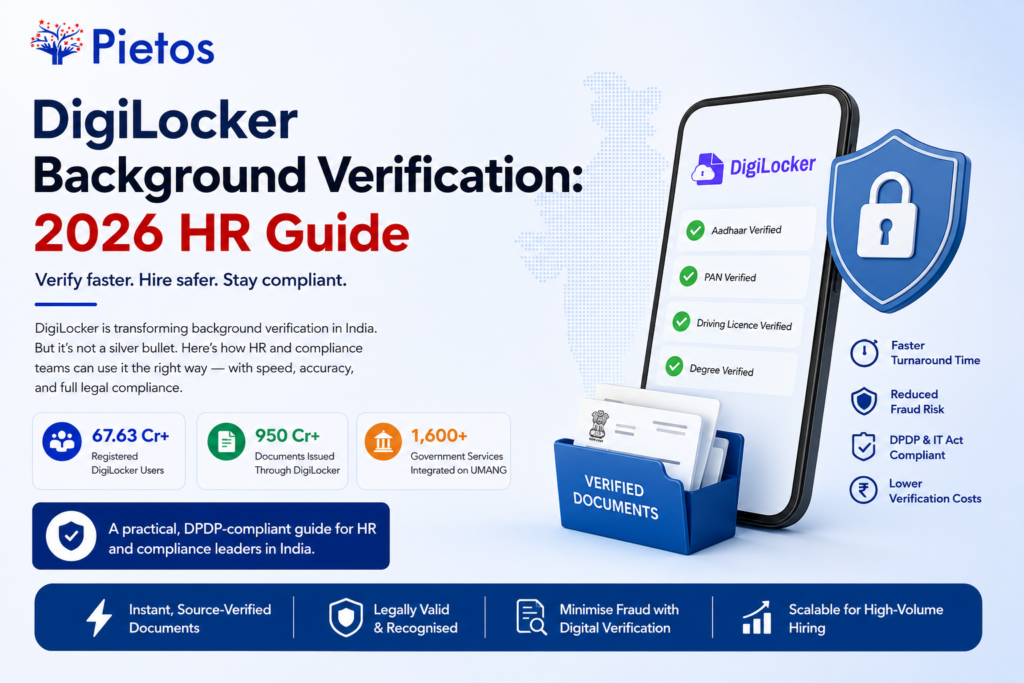
DigiLocker is no longer a niche government app. As of March 2026, the platform had 67.63 crore registered users and had issued more than 950 crore documents.
For context: that’s more users than most HR teams’ entire candidate database, combined, several times over.
The Ministry of Electronics and Information Technology has also rolled out Entity DigiLocker, an organisational version of the platform. This extends document issuance and verification beyond individuals to businesses, MSMEs, and trusts — a strong signal that B2B verification use cases are next on the roadmap.
DigiLocker has also been folded into UMANG, India’s unified governance app, giving it app-within-app reach across more than 1,600 central and state services. Separately, its integration with the Ayushman Bharat Digital Mission now lets over 130 million health-ID holders pull medical records the same way — a useful precedent for how fast new document categories can come online once an issuer integrates.
In plain terms: the candidate sitting across from your recruiter almost certainly already has a DigiLocker account with their education and identity documents loaded.
Where DigiLocker Background Verification Delivers the Most ROI
The business case isn’t identical across sectors. Three profiles see the fastest payback:
- NBFC and BFSI hiring: High regulatory scrutiny plus high hiring volume means every day shaved off identity and education verification compounds across hundreds of monthly hires — while still satisfying RBI-aligned audit expectations.
- IT/ITES and staffing firms: Candidate pools span every state and dozens of universities. DigiLocker’s nationwide issuer network reduces the “we can’t reach that registrar” delays that disproportionately hit pan-India hiring.
- Gig and blue-collar onboarding: Volume is the whole game. Shaving even one day off identity verification at 1,000+ monthly onboardings translates directly into faster activation and lower candidate drop-off.
If your hiring doesn’t fit one of these profiles, DigiLocker background verification still helps — just expect a smaller, slower-compounding return.
The Real Cost of Fake Documents Is Climbing
While DigiLocker adoption grows, so does document fraud — and the two trends are connected.
- A December 2025 Genius HRTech survey of 1,316 hiring professionals found that 74% rank fake degrees and forged documents as their single biggest hiring risk — ahead of behavioural red flags or gig-worker screening gaps.
- The same survey found 77% of respondents are extremely concerned about deepfake-enabled identity fraud and AI-generated documents.
- Independent BGV data shows roughly 17% of resumes in India contain at least one significant discrepancy, and a large share of those discrepancies trace back to fabricated or altered academic credentials.
- In early 2026, police investigations uncovered a counterfeit-degree operation spanning multiple universities, with tens of thousands of fraudulent certificates in circulation — some tied to international visa applications.
- Separately, the UGC’s 2026 list of fake universities identified 32 unauthorised institutions across 12 states — up from 22 the year before — meaning the pool of degrees that can’t survive scrutiny is actively growing, not shrinking.
- In April 2026, Delhi Police dismantled a forged-certificate racket that used telecallers and digital tools to sell fake degrees nationwide — a reminder that document fraud has industrialised into an organised, sales-driven operation, not isolated cheating.
Key takeaway: the documents your team is manually eyeballing today are exactly the documents fraudsters have gotten better at faking. DigiLocker background verification closes that gap for the document categories it covers — but only for those categories.
How DigiLocker Background Verification Works
Understanding the mechanics matters, because it determines what you can and can’t automate.
The Push-Pull Consent Model, Explained
DigiLocker runs on a federated “push-pull” architecture:
- Issuers push digitally signed documents directly into a citizen’s locker — a university pushing a degree, the UIDAI pushing Aadhaar data, an RTO pushing a driving licence.
- Requesters pull documents only with the candidate’s explicit, logged consent.
- Verification happens against the source, not a copy — using QR codes and digital signatures that confirm the issuing authority and detect tampering instantly.
There’s no step where HR is “trusting” a PDF. The system is trusting the issuer, and the candidate is the one granting access.
This matters operationally, too. Because the verification request and the consent grant both sit on DigiLocker’s own infrastructure, your recruiter never touches an unverified file. The integrity check happens before the document ever reaches your ATS.
Expert insight: Most verification failures in India don’t come from forged documents slipping through — they come from genuine documents that were never checked at all, because manual workflows skip steps under deadline pressure. A source-verified, automated pull removes that human-skip risk entirely, regardless of how careful any individual recruiter is.
What HR Teams Can Actually Verify Through DigiLocker
| Category | Available via DigiLocker | Notes |
| Identity (Aadhaar, PAN) | Yes | OTP-based consent required |
| Driving licence / RC | Yes | Recognised under MoRTH notifications |
| Degrees & marksheets | Partial | Depends on whether the issuing institution is onboarded to the National Academic Depository (NAD) |
| Employment history | No | Not a DigiLocker document category — requires direct employer verification |
| Criminal record / court checks | No | Outside DigiLocker’s scope entirely |
| Address proof | Partial | Limited to specific issued document types |
That table alone should reset expectations. DigiLocker background verification strengthens identity and education checks. It does not touch employment history, litigation records, or criminal background — the categories where most hiring risk actually lives.
Treat the “Partial” rows carefully. A degree being absent from DigiLocker doesn’t mean it’s fraudulent — it usually just means the issuing institution hasn’t onboarded to NAD yet. Building that nuance into your screening logic prevents false red flags against genuinely qualified candidates.
It’s also worth setting expectations internally before rollout. Hiring managers who hear “DigiLocker verification” often assume the entire background check just got faster across the board. Make clear, early, that the speed gain applies to identity and education specifically — so the deep-check categories don’t get unfairly judged against a benchmark they were never designed to hit.
DigiLocker Background Verification vs. Traditional BGV Methods
| Factor | Manual / Photocopy-Based Checks | DigiLocker Background Verification | Full-Spectrum BGV (DigiLocker + Verification Partner) |
| Turnaround time | 5–10 business days | Minutes, for covered documents | 2–4 business days, end to end |
| Forgery resistance | Low — easy to edit a scan | High — source-verified, QR-checked | High across all document types |
| Employment history coverage | Manual calls/emails | Not covered | Covered |
| Criminal record coverage | Manual court/DB search | Not covered | Covered |
| Consent trail for DPDP audits | Often informal or missing | Logged automatically | Logged and centrally auditable |
| Best suited for | Low-volume, low-risk hiring | Identity & education layer only | Regulated, high-volume, or high-risk hiring |
Most HR teams don’t need to choose between DigiLocker and a full verification partner — they need both, working together. See how Pietos layers DigiLocker checks into a complete, DPDP-compliant verification stack →
Is DigiLocker Background Verification Legally Valid in India?
Yes — and this is one of the most-asked questions HR teams have, so it deserves a direct answer.
Documents issued through DigiLocker carry legal recognition under Section 4 of the Information Technology Act, 2000, which gives electronic records the same standing as physical documents wherever law requires a paper form.
This is reinforced by Rule 9A of the IT (Preservation and Retention of Information by Intermediaries Providing Digital Locker Facilities) Amendment Rules, 2017, which explicitly states that documents issued or shared through the Digital Locker system stand at par with physical documents.
The University Grants Commission (UGC) has separately directed academic institutions to accept DigiLocker-issued degrees and marksheets as valid records under the National Academic Depository framework.
There’s also a useful precedent from a different vertical that shows how this plays out in practice. The Ministry of Road Transport and Highways has directed every state transport authority and traffic enforcement agency to accept DigiLocker-issued driving licences and RCs as legally equivalent to the physical originals — and has stated, in writing, that an officer refusing a valid DigiLocker document is acting against the law. The same legal logic that forced traffic police nationwide to accept digital licences applies to the documents HR teams pull for hiring.
This legal weight matters beyond domestic hiring, too. The fake-degree scandal that recently drew scrutiny into H-1B visa applications was built on forged Indian academic certificates that a source-verified check would have caught instantly. As global mobility and overseas hiring of Indian talent grows, employers and visa sponsors that build DigiLocker-sourced verification into their process gain a defensible, government-backed paper trail — one that’s considerably harder to challenge than a candidate-submitted scan ever was.
In short: a degree or ID pulled from DigiLocker’s Issued Documents section is not “a copy of the real thing.” Legally, it is the real thing. (Documents in the Uploaded Documents section, by contrast, are self-scanned and carry no such legal weight — a distinction worth training your recruiters on.)
DigiLocker Background Verification and DPDP Act Compliance
This is where DigiLocker background verification gets genuinely strategic for compliance-first HR teams — not just operationally convenient.
The Digital Personal Data Protection Rules, 2025 were notified on 13 November 2025, with phased enforcement running through May 2027. Consent-manager obligations come into force in November 2026, and full substantive compliance — including consent logging, purpose limitation, and breach reporting — lands in May 2027.
Most HR teams collecting candidate documents today have no formal, auditable consent trail. That’s a direct gap against DPDP requirements.
DigiLocker’s architecture happens to solve this almost by accident:
- Every document pull is consent-logged at the source, with a timestamp and candidate authorisation on record.
- Data minimisation is built in — requesters only see the specific document shared, not the candidate’s entire locker.
- The candidate retains the right to deny or ignore a verification request, mirroring DPDP’s consent-withdrawal principles.
For an HR or compliance head building a DPDP-ready hiring process before the May 2027 enforcement deadline, a DigiLocker-integrated verification layer is one of the few hiring-stage building blocks that’s already structurally aligned with the law.
This matters more for some employers than others. NBFCs, BFSI players, and large staffing firms that process candidate data at scale risk classification as Significant Data Fiduciaries under the DPDP framework — a status that brings extra obligations around data protection officers, audits, and breach reporting. For these organisations, every hiring-stage data flow that already carries a clean, source-logged consent trail reduces the audit burden later. Background verification, often treated as a back-office function, is quietly becoming a compliance asset when it’s built this way.
Where DigiLocker Background Verification Falls Short
A credible guide doesn’t oversell. Here’s where the platform genuinely struggles.
Documents That Aren’t on the Platform Yet
Coverage depends entirely on whether the issuer has onboarded. Many state boards, smaller private universities, and older academic records simply aren’t in the National Academic Depository yet. A candidate’s degree may be real — and still unavailable through DigiLocker.
Coverage Gaps Across Smaller Institutions
Tier-2 and tier-3 colleges, vocational institutes, and some state government departments lag well behind the integration curve. If your hiring pipeline skews toward candidates from these institutions — common in gig, blue-collar, and bulk-hiring contexts — DigiLocker alone will leave visible gaps in your verification report.
A second, less obvious gap is timing. A candidate who graduated before their institution onboarded to NAD may find their specific year’s records were never digitised, even though the institution itself now issues newer degrees through DigiLocker. Don’t assume “the university is on DigiLocker” automatically means “this candidate’s degree is on DigiLocker.”
The practical implication: treat DigiLocker as an accelerant for the documents it covers, not a single source of truth for the whole BGV process.
Buyer Objections, Answered Honestly
“Doesn’t this just shift liability onto us if DigiLocker data is wrong?” No — DigiLocker pulls directly from the issuing authority’s own database. If a record is wrong, the liability sits with the issuer, not with the verifier or the employer relying on it. This is actually a lower-liability position than trusting a candidate-submitted scan.
“Our candidates won’t know how to use DigiLocker.” 90% of DigiLocker’s user base is between 18 and 40 — precisely the demographic most companies are hiring. Adoption friction is lower than most HR teams assume.
“We already have a BGV vendor. Why add another layer?” You’re not adding a layer — you’re upgrading one. A verification partner that integrates DigiLocker into its existing workflow gives you faster identity/education checks and keeps employment history, criminal records, and address verification intact in a single report.
“Is this just a cost-cutting move that weakens our screening?” The opposite. DigiLocker reduces the time and cost of the document layer, freeing budget and turnaround time for deeper checks — criminal record searches, court record checks, reference calls — on the categories that actually carry hiring risk.
“What if a candidate simply refuses to share DigiLocker access?” That’s their right under the consent model, and it’s worth treating as useful information rather than a blocker. A refusal doesn’t mean fraud, but it does mean falling back to traditional document collection for that candidate — which your process should already support as a parallel path, not a dead end.
A 5-Step Framework for Building a DigiLocker-Ready Verification Process
- Audit your document mix. List every document type you currently verify manually. Flag which ones (Aadhaar, PAN, degrees, driving licence) are realistically coverable through DigiLocker today, based on whether your typical candidate’s issuing institutions have onboarded to NAD.
- Separate “fast-track” from “deep-check” categories. Identity and education move to a DigiLocker-accelerated path. Employment history, criminal records, and address verification stay on a dedicated deep-check track that runs in parallel, not in sequence, so neither path waits on the other.
- Build the consent capture into your ATS, not after it. Candidates should grant DigiLocker access as part of the application flow — not as a separate, easily-skipped step later. Every consent click should map to a specific, named purpose, which is exactly what DPDP’s purpose-limitation principle expects.
- Log everything for DPDP readiness. Every consent grant, document pull, and verification result needs a timestamped audit trail, ready before the May 2027 enforcement deadline. If you’re likely to be classed as a Significant Data Fiduciary, this trail should be exportable for an external audit, not just stored internally.
- Partner for the gaps. Work with a verification provider that already combines DigiLocker pulls with court record, employment, and criminal database checks — so coverage gaps don’t become hiring risk, and so one vendor relationship covers the entire stack instead of three.
Illustrative Scenario: Cutting Verification TAT in High-Volume Hiring
Consider a mid-sized NBFC hiring 400 field collection agents a month across three states — a realistic profile for many of India’s NBFC and BFSI hiring teams.
Before: Manual document collection and university confirmation calls pushed average verification TAT to 8–9 business days. Recruiters routinely lost candidates to faster-moving competitors during that wait.
After integrating DigiLocker into the verification workflow: Identity and education checks for DigiLocker-covered candidates dropped to under 24 hours. Employment history and criminal record checks — still run through a dedicated verification partner — continued on their normal 2–4 day track, but no longer bottlenecked the entire process.
Net result: Overall TAT compressed by roughly 50%, with no reduction in screening depth, because the deep-check categories never left the process — they just stopped waiting on the document layer.
A second pattern shows up in IT/ITES and staffing hiring, where candidates span dozens of universities across states. Before DigiLocker integration, education checks for out-of-state degrees were the single biggest TAT bottleneck — recruiters routinely waited a week or more for a smaller regional university to respond to a manual confirmation request. For institutions already onboarded to the National Academic Depository, that same check now completes in minutes, while non-onboarded institutions automatically route to the deep-check track instead of stalling the whole file.
This is the realistic outcome pattern HR teams should expect: DigiLocker speeds up part of the funnel. The gains compound when it’s paired with, not substituted for, full-spectrum verification.
What to Look for in a DigiLocker-Integrated Verification Partner
Not every BGV vendor that claims “DigiLocker support” has built it into the actual workflow. Before signing, check for these five things:
- Direct API integration, not a manual “we’ll check DigiLocker for you” promise that just adds a human step back into the process.
- A documented fallback path for candidates and institutions not yet covered, so coverage gaps don’t silently become missing data in your report.
- Consent logs you can export, with timestamps, tied to named purposes — the exact format an auditor will ask for once DPDP enforcement begins.
- A single consolidated report that merges DigiLocker-sourced identity and education data with employment, criminal, and address verification, rather than handing you two disconnected outputs to reconcile yourself.
- Transparent turnaround commitments that separate the DigiLocker-accelerated categories from the deep-check categories, so you can set realistic expectations with hiring managers.
A vendor that can’t answer these clearly in a sales call almost certainly hasn’t integrated DigiLocker at the workflow level. They’ve just added the word to their marketing.
Key Takeaways
- DigiLocker background verification is legally valid under IT Act Section 4 and Digital Locker Rule 9A.
- It reliably covers identity and education documents — not employment history or criminal records.
- With 67.63 crore users, most candidates already have a usable DigiLocker account.
- Its consent-logged architecture gives HR teams a head start on DPDP Act compliance ahead of May 2027.
- The biggest gains come from pairing DigiLocker with a verification partner that covers the categories it doesn’t.
Related Resources
- Can a Candidate Refuse a Background Check in India? (DPDP Act Guide) — directly extends the consent questions raised by DigiLocker’s permission-based model.
- DPDP Act Compliance Checklist for HR and Verification Teams — for teams building the audit trail this article recommends in the 5-step framework.
- Deepfake KYC and Synthetic Identity Fraud in Hiring — explains why document verification, including DigiLocker, isn’t sufficient against AI-generated fraud on its own.
- 2026 Blue-Collar and Gig Economy Onboarding Report— relevant for the high-volume hiring scenario covered above.
- Background Verification Services for NBFC and BFSI Hiring — the natural next step for readers ready to combine DigiLocker with full-spectrum checks.
Frequently Asked Questions
DigiLocker itself is free to citizens and free for issuers and requesters integrating through MeitY’s Open API Policy. Most employers access it through a verification partner’s existing workflow rather than building a direct integration in-house.
No. DigiLocker does not hold criminal record or litigation data. It covers identity and select education/government documents only.
For documents already issued into a candidate’s locker, verification is typically near-instant. Delays usually come from the candidate’s consent step, not the platform itself.
Yes, for documents in the Issued Documents section. They carry legal recognition under Section 4 of the IT Act, 2000, and Rule 9A of the Digital Locker Rules, 2017.
Verification for that document falls back to traditional methods — direct institutional confirmation through a verification partner — until the issuer onboards to the National Academic Depository.
It helps significantly with the consent-logging and data-minimisation components, but it doesn’t cover your entire DPDP obligation. You still need consent and retention policies for the data you collect outside DigiLocker.
Ready to Build a DigiLocker-Integrated Verification Process That Doesn’t Leave Gaps?
DigiLocker background verification is a genuine upgrade — but only as part of a verification stack that still covers employment history, criminal records, and DPDP-ready consent logging end to end.
The HR teams gaining the most ground in 2026 aren’t the ones choosing between “fast” and “thorough.” They’re the ones who stopped treating that as a trade-off — by routing the document layer through DigiLocker and keeping the deep-check layer intact, in parallel, with a single audit trail behind both.
Talk to Pietos → Our team will map your current verification process against Digi Locker’s coverage, flag the gaps, and show you exactly where a full-spectrum, DPDP-compliant stack saves time without cutting screening depth.




Pingback: BGV Audit Checklist for ISO & Client Reviews in India - Best Background Verification Company in India | Pietos
Pingback: Aadhaar Verification for Employment: What HR Can and Cannot Legally Do in 2026 - Best Background Verification Company in India | Pietos
Pingback: Tenant Background Verification India: What Every Landlord Must Check Before Handing Over Keys - Best Background Verification Company in India | Pietos