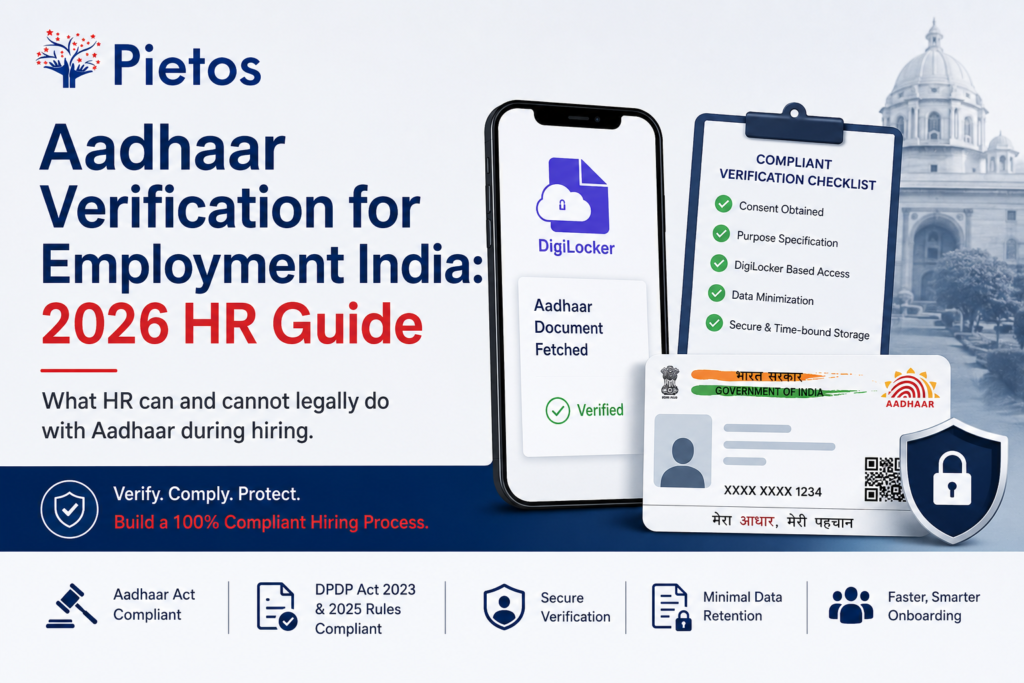
Aadhaar verification for employment sits at the center of a quiet but persistent confusion inside Indian HR teams. Most recruiters have collected an Aadhaar photocopy at some point during onboarding. Far fewer can say, with confidence, whether that step was legal. As the Digital Personal Data Protection framework matures through 2026, that gap between habit and law has become a real business risk — not a theoretical one.
This guide breaks the confusion down plainly. It covers what the Aadhaar Act actually authorizes employers to do, why the old “collect and file a copy” approach fails compliance today, and what a legally sound Aadhaar verification for employment process looks like in practice. If you’re building or auditing an onboarding flow this year, this is the reference to work from.
Not sure whether your current process holds up? Talk to Pietos’ compliance team for a free 15-minute audit of your onboarding documents.
What the Aadhaar Act Actually Permits Employers to Do
The Aadhaar Act, 2016 was built for one purpose. It helps the state deliver subsidies and welfare benefits efficiently. Private employers were never its main audience. That history still shapes what HR teams can and cannot do today.
Authentication With Consent, Not Open-Ended Collection
UIDAI lets requesting entities, including private companies, run Aadhaar-based authentication to confirm identity. <cite index=”3-1″>UIDAI offers Aadhaar-based authentication as a service that requesting entities can use to verify the identity of customers, employees, or other associates before granting access to services or business benefits</cite>. The individual must consent, and the use must serve a permitted purpose. That’s the real boundary employers work within: authenticate with consent, don’t collect and store Aadhaar data indefinitely.
Two rules follow from this. First, Aadhaar verification for employment stays legal only as authentication — matching a name, date of birth, or demographic detail against UIDAI’s records. It stops being legal the moment it turns into document-hoarding. Second, <cite index=”3-1″>all requesting entities must obtain the individual’s consent before collecting identity information for authentication</cite>. That consent must name the exact purpose. A vague line in an offer letter won’t hold up.
Authentication vs. Documentation
HR teams often blur two separate ideas: identity authentication and identity documentation. Authentication asks one narrow question. Does this person’s claimed identity match a government record? Documentation means keeping a physical or scanned copy of the ID itself.
Aadhaar verification for employment, done right, lives almost entirely in the authentication category. The moment a process starts storing scanned Aadhaar copies as a permanent HR record, it steps outside UIDAI’s protective boundary. It also steps into territory the DPDP Act regulates separately.
Keep this distinction visible everywhere — in policy documents, vendor contracts, and the ATS software itself. It’s often the single change that moves a company from non-compliant to compliant, without slowing hiring down at all.
This is also why so many BGV vendors now market DigiLocker and eKYC specifically, instead of generic “ID verification.” It isn’t a marketing trend. It’s a direct response to where the legal permission actually sits.
Who Counts as a “Requesting Entity” — and Why That Matters for HR
Not every company can plug into UIDAI’s authentication ecosystem directly. Requesting entities typically need to route Aadhaar authentication through a licensed intermediary — an Authentication User Agency (AUA) or KYC User Agency (KUA) — rather than querying UIDAI’s database on their own. In practice, this means most employers access Aadhaar verification for employment indirectly, through a BGV or HRMS vendor that already holds the relevant UIDAI licensing and API access. Before signing with any vendor claiming to offer Aadhaar-based checks, it’s worth asking a direct question: are they authenticating through a licensed AUA/KUA pathway, or are they simply asking candidates to upload a photocopy and calling that “Aadhaar verification”? The two look similar on a sales deck and are legally worlds apart.
Why HR Cannot Mandate Aadhaar the Way Many Companies Still Do
Here’s where most Indian companies go wrong. It isn’t a small technicality.
The Puttaswamy Judgment and Section 57
In 2018, the Supreme Court’s Puttaswamy ruling struck down Section 57 of the Aadhaar Act. That section had let private companies demand Aadhaar as a condition for service. One ruling changed the legal ground under every HR policy that treated Aadhaar as mandatory ID.
Government policy has since reopened limited, conditional Aadhaar use for private entities. <cite index=”2-1″>Recent amendments now allow private entities to use Aadhaar authentication under specified conditions, aimed at helping sectors including banks, fintechs, and employment verification move faster</cite>. Notice the word conditional. Employers still can’t make Aadhaar submission compulsory for hiring. They can’t refuse to hire someone solely for declining to share it either.
The Common Mistake: Photocopies in a Folder
The second failure point isn’t legal theory. It’s operational. Many HR teams still ask candidates to email an Aadhaar scan. That scan then sits in a shared drive or a physical file, often indefinitely.
This is exactly the pattern the Aadhaar Act was built to prevent. <cite index=”8-1″>The Act restricts anyone who maintains identity data from revealing information stored in the Central Identities Data Repository, and restricts sharing of core biometric information except in narrow, regulated circumstances</cite>. An HR inbox full of Aadhaar PDFs isn’t verification. It’s an unmanaged data liability sitting outside any authentication framework. It’s also the single most common gap Pietos finds during onboarding audits.
A pattern repeats across these audits. A mid-sized company runs hiring through email and a shared drive. An HR executive collects Aadhaar scans from every candidate “just to be safe.” Within a year, hundreds of full-resolution Aadhaar images sit in a folder nobody actively secures, tracks, or plans to delete.
None of this was malicious. Companies simply inherited the habit from a pre-DPDP era, when nobody asked the question. That’s exactly the gap an internal audit needs to catch — before a regulator, a former employee, or a data breach does it instead.
How Aadhaar Verification for Employment Differs Across Sectors
The legal boundary is the same everywhere, but the practical stakes shift by industry.
BFSI and NBFCs. Banks and NBFCs face the highest scrutiny, since roles here often involve handling customer money or sensitive financial data. Aadhaar verification for employment in this sector is frequently paired with credit bureau checks and criminal record searches, and RBI-adjacent expectations push most banks toward fully API-driven, auditable verification rather than manual document review.
IT and ITES. Remote and hybrid hiring across metros and tier-2 cities makes DigiLocker-based Aadhaar verification for employment especially valuable here — it removes the geographic dependency that physical document checks used to require, letting a Bengaluru-based HR team verify a candidate in Coimbatore or Ranchi with the same turnaround.
Gig and blue-collar hiring. High-volume, high-velocity hiring in logistics, delivery, and warehousing makes manual document review operationally impossible at scale. Aadhaar-based eKYC is often the only realistic verification method that keeps pace with onboarding volume, which is also why this segment sees the highest exposure to compliance gaps if the underlying authentication isn’t properly licensed.
Startups and early-stage companies. Smaller companies without a dedicated compliance function are, counterintuitively, often at the highest risk — not because they handle more Aadhaar data, but because no one owns the question of whether their process is compliant in the first place.
What Compliant Aadhaar Verification for Employment Actually Looks Like
A legally sound process replaces “collect and store” with “authenticate and discard the raw document.”
DigiLocker-Based Pulls
Instead of asking a candidate to upload an Aadhaar scan, HR platforms can request a DigiLocker-issued copy. It’s pulled directly from the source, with the candidate’s active consent built into the flow. <cite index=”17-1″>DigiLocker, operated under the Ministry of Electronics and Information Technology, lets citizens share authentic digital documents issued directly by government authorities, and because those documents are digitally signed by the issuing authority, they carry full legal validity and rule out physical forgery</cite>. This single shift — from scanned copy to DigiLocker pull — solves two problems at once: authenticity and storage liability.
Masked Aadhaar and eKYC Tokens
For pure identity authentication, platforms increasingly rely on token-based eKYC. It never exposes the full Aadhaar number to the employer’s systems. Verification happens against UIDAI’s database through a masked reference. HR only receives a match or no-match result.
In practice, this works through a Virtual ID or masked Aadhaar number the candidate generates. An OTP-based consent step pairs with it. The authenticating platform confirms identity without the employer’s own systems ever storing, or even seeing, the last eight digits of the Aadhaar number. This is the model built into Pietos’ DigiLocker-powered background verification workflow, which treats Aadhaar as a verification signal, not a stored document.
The practical effect matters. Even if attackers breached a company’s own systems, no raw Aadhaar numbers would sit there to extract — because none were ever stored in the first place. This is often the strongest argument for switching from photocopy-based collection to token-based authentication. It doesn’t just cut compliance paperwork. It removes an entire category of breach exposure.
Building this into an existing ATS is the part most internal teams underestimate. If you’d rather see it running before committing engineering time, book a Pietos platform walkthrough and we’ll show the DigiLocker consent flow live.
Aadhaar Verification for Employment vs. Traditional Document Checks
| Factor | Traditional (photocopy) verification | Aadhaar verification for employment via DigiLocker/eKYC |
|---|---|---|
| Source of document | Candidate-submitted scan | Pulled directly from issuing authority |
| Forgery risk | High — editable PDFs, photoshopped scans | Very low — digitally signed at source |
| Consent trail | Often informal or implied | Explicit, logged, purpose-specific |
| Data retention | Indefinite, often in shared drives | Time-boxed, encrypted, access-controlled |
| Turnaround time | 3–7 days manual cross-checking | Minutes to hours via API |
| DPDP Act alignment | Weak — no clear lawful basis documented | Strong — consent and purpose logged at collection |
The gap between these two columns isn’t cosmetic. A manual, photocopy-driven process fails on almost every axis that matters to both compliance teams and candidates: it’s slower, easier to forge, harder to audit, and creates an open-ended data liability the moment the file lands in a shared folder. Aadhaar verification for employment, run through DigiLocker or masked eKYC, closes each of those gaps simultaneously rather than trading one risk for another.
The Candidate Experience Side of Aadhaar Verification for Employment
It’s easy to frame this entire discussion around legal risk and forget the person on the other end of the process. Candidates increasingly notice how their identity documents are handled during hiring, and a clunky, upload-heavy verification flow creates real friction at exactly the moment a company is trying to make a strong first impression.
A DigiLocker-based Aadhaar verification for employment flow tends to feel faster and more modern to candidates precisely because it removes the manual upload step entirely — consent is captured with a tap, the document is pulled instantly from the source, and the candidate never has to hunt for a scanner or worry about file size limits on a slow mobile connection. For high-volume hiring especially, this difference compounds: a smoother verification step measurably reduces candidate drop-off between offer acceptance and Day 1, simply because fewer people abandon the process out of friction or confusion about why their Aadhaar is being requested in the first place.
There’s a trust dimension here too. When a company’s consent notice clearly states why Aadhaar-based authentication is happening and for how long the data will be retained, candidates read that as a sign of a well-run organization — not extra paperwork. The reverse is also true: a vague, boilerplate request for “identity documents” without explanation is one of the more common sources of candidate hesitation flagged in exit surveys from dropped applications.
DPDP Act 2023 and the 2025 Rules — the Consent Layer HR Can’t Skip
Aadhaar verification for employment doesn’t exist in a legal vacuum. <cite index=”21-1″>The Digital Personal Data Protection Rules, 2025 were notified on November 13, 2025 and published in the Gazette a day later, operationalizing the DPDP Act, 2023, which is India’s first comprehensive, principles-based statute governing digital personal data</cite>. For any company processing Aadhaar data during hiring, this framework now sits directly on top of UIDAI’s own rules.
What the Notice-and-Consent Model Requires
Two provisions matter most for HR. First, <cite index=”21-1″>the framework is grounded in a notice-and-consent model, requiring companies to disclose key processing details upfront and obtain valid consent before processing begins</cite>. A generic offer-letter clause won’t meet this bar. Second, <cite index=”25-1″>the notice given to a candidate must be presented independently of other information, in clear language, and must itemize the specific purpose for which the data will be used</cite>. “Verification purposes” is too vague. The notice needs to state that Aadhaar-based authentication confirms identity for employment onboarding specifically.
Companies running a DPDP-aligned consent flow already have a head start here. Pietos’ guide on DPDP compliance in digital background verification shows what a compliant notice actually looks like inside an ATS.
Company Size Doesn’t Remove the Obligation
There’s also a scale-based distinction worth flagging. <cite index=”19-1″>The DPDP Act allows the Central Government to designate certain organizations as Significant Data Fiduciaries — typically large employers processing high volumes of data at greater risk — who carry heavier compliance obligations than smaller companies</cite>. A 200-person startup and a 20,000-person enterprise aren’t held to identical operational standards. But both need a documented lawful basis before Aadhaar-linked data enters their systems. <cite index=”26-1″>The DPDP framework recognizes employment-related processing as a legitimate use case in certain circumstances</cite>, which gives HR teams a real, if narrow, lawful basis to build on — provided the notice and consent requirements above are met in full.
One nuance HR teams often miss: consent doesn’t stop once someone is hired. A candidate’s Aadhaar-linked authentication data is still personal data after they become an employee. Any downstream use — a role-change reverification, a promotion check, an internal audit — needs its own documented purpose. The original hiring consent doesn’t cover it automatically.
A 5-Step Framework for Building a Compliant Process
- Map every place Aadhaar currently touches your hiring flow. Walk the entire candidate journey — job application forms, offer letter attachments, physical HR files, background verification vendor uploads, even informal WhatsApp shares between recruiters — and list every point where an Aadhaar number or copy could enter your systems. Most companies are surprised by how many undocumented entry points show up once this exercise is done properly.
- Replace document collection with authentication. Switch from “upload a copy” to a DigiLocker pull or masked eKYC token wherever the underlying platform supports it. Where a fully digital pathway isn’t yet available for a particular role or region, treat that as a temporary exception requiring extra safeguards, not a permanent fallback.
- Rewrite consent language to be purpose-specific. State plainly that Aadhaar-based authentication confirms identity for employment onboarding, not any other use. Avoid folding this into a long, generic offer-letter clause — the DPDP Rules expect the notice to stand on its own, in language a candidate can actually read and understand in under a minute.
- Set a retention and deletion policy — and actually automate it. Raw Aadhaar data, where it’s unavoidably received, should be deleted once authentication is confirmed, not archived “just in case.” A written policy that isn’t enforced by the system itself tends to fail quietly over time as staff turn over and shortcuts creep back in.
- Audit vendor contracts. Any BGV or HRMS vendor touching Aadhaar data needs a signed data-processing agreement that mirrors your own DPDP obligations, not a generic MSA. Ask specifically whether they authenticate through a licensed AUA/KUA pathway, where their servers are hosted, and how long they retain data after a check is completed.
- Train the people actually running hiring day to day. Recruiters and HR coordinators are usually the first point of contact with candidate documents, and they’re rarely given more than a one-line instruction about Aadhaar handling. A short, recurring training — even 20 minutes a quarter — closes most of the human-error gaps that policy alone can’t reach.
The Cost of Getting This Wrong
The risk here isn’t abstract. Under the DPDP Rules, penalties scale with severity. <cite index=”20-1″>Failure to notify a data breach properly can draw a penalty of up to ₹200 crore per incident</cite>. Beyond direct penalties, an Aadhaar mishandling incident creates three compounding costs: legal exposure under both the Aadhaar Act and DPDP Act, reputational damage, and operational drag from retrofitting consent language across every open role.
Why the Retrofit Costs More Than Doing It Right the First Time
Fixing a non-compliant process after the fact usually means five things at once. Auditing every existing employee file. Deciding what to keep versus delete. Rewriting and re-collecting consent. Renegotiating vendor contracts. Documenting all of it for a potential audit.
Each step alone is manageable. Running all five under time pressure — usually after some external trigger forces the issue — is where companies lose the most time and money. Building the process correctly the first time avoids nearly all of this.
The Cost That Doesn’t Show Up on a Compliance Memo
There’s a quieter cost too: internal trust. Employees sometimes learn, informally, that their own Aadhaar data sat in an unsecured folder for years. That knowledge erodes confidence in HR more broadly, well beyond the specific incident. It’s hard to quantify. It’s even harder to repair.
Common Objections HR Teams Raise (and the Real Answers)
“Can we just make Aadhaar mandatory to speed things up?” No — post-Puttaswamy, Aadhaar cannot be made a compulsory condition of hiring. Offer an alternative ID path (PAN, passport, voter ID) alongside the Aadhaar-based option.
“Isn’t a scanned copy good enough if we store it securely?” Storage security alone doesn’t solve the underlying problem — collecting and retaining a raw Aadhaar copy without a documented, purpose-specific consent trail is itself the compliance gap, independent of how well the file is encrypted.
“Our HRMS already has a consent checkbox — isn’t that enough?” A generic checkbox rarely meets the DPDP Rules’ requirement for an independent, itemized, purpose-specific notice. It needs review, not just existence.
“We’re a small company — does any of this really apply to us?” Yes. DPDP obligations scale with the sensitivity and volume of data processed, not company size alone. A 50-person startup collecting Aadhaar copies without a documented lawful basis carries real exposure, even if the odds of an active audit feel low today.
“Can we keep using manual verification for now and switch later?” You can, but every month of manual collection adds to a backlog of unmanaged Aadhaar data that eventually needs to be cleaned up anyway. Switching earlier is almost always cheaper than retrofitting later.
Edge Cases HR Teams Often Overlook
A few situations don’t fit neatly into the standard Aadhaar verification for employment workflow, and each deserves its own answer rather than a default assumption.
Candidates without a linked mobile number. DigiLocker and eKYC authentication typically depend on an OTP sent to the mobile number linked with a candidate’s Aadhaar. Where that link is outdated — common among candidates who’ve recently changed numbers — the digital path breaks down, and HR needs a documented fallback (typically a secondary ID plus manual verification) rather than simply rejecting the candidate outright.
Contract-to-hire and manpower agency staff. When a candidate moves from a staffing agency’s payroll onto direct company rolls, it’s tempting to skip re-verification since “they were already checked.” But the original consent and authentication was typically obtained by the agency, not the hiring company — meaning the new employer usually needs its own consent and verification cycle to have a clean lawful basis.
Cross-border and NRI candidates. Aadhaar is specific to Indian residents, and candidates without one need an entirely separate verification path (passport, OCI documentation) rather than a workaround that tries to force Aadhaar-style authentication onto a document it wasn’t designed for.
Internal transfers and promotions. Reverification triggered by a role change — moving into a finance-sensitive or customer-facing position, for example — needs its own purpose-specific consent under the DPDP framework, even though the employee’s Aadhaar was already verified once at hiring.
What to Look for When Choosing an Aadhaar Verification Partner
Not every BGV or HRMS vendor offering “Aadhaar verification for employment” is doing the same thing under the hood. Before signing a contract, HR and procurement teams should confirm four things directly with any vendor: whether authentication runs through a licensed AUA/KUA pathway rather than manual document review; whether raw Aadhaar numbers are ever exposed to your own systems or stay masked throughout; what the vendor’s documented data retention and deletion timeline actually is; and whether their consent notice language has been reviewed against the DPDP Rules’ notice requirements specifically, rather than a generic privacy policy template. A vendor that can answer all four clearly, with documentation, is worth far more than one offering the fastest turnaround time alone.
Why Companies Partner with Pietos for Aadhaar Verification for Employment
Building a DigiLocker-integrated, DPDP-aligned Aadhaar verification workflow in-house means coordinating legal, IT, and HR simultaneously — and getting all three right before a single candidate is onboarded. Pietos Solutions Private Limited runs this as a packaged, API-driven layer inside your existing ATS: consent capture that matches DPDP Rules language, DigiLocker-based pulls instead of manual uploads, and masked eKYC authentication that never exposes raw Aadhaar numbers to your systems.
Schedule a compliance walkthrough with Pietos and see exactly how Aadhaar verification for employment can run inside your current hiring stack — usually live within a two-week rollout window.
Measuring Whether Your Process Is Actually Working
Once a compliant Aadhaar verification for employment process is live, it’s worth tracking a small set of numbers rather than assuming it’s working because nothing has gone wrong yet. Turnaround time per candidate is the most obvious one — a DigiLocker or eKYC-based flow should complete in minutes to hours, not days, and a creeping increase in that number usually signals a technical or consent-flow issue worth investigating. Drop-off rate between offer acceptance and document submission is a second useful signal; a sudden spike often traces back to confusing consent language or a broken mobile OTP step rather than candidate reluctance. Finally, it’s worth periodically auditing how much raw Aadhaar data — if any — is still sitting in company systems past its intended retention window, since this tends to accumulate quietly even in an otherwise well-designed process, particularly as new HR staff join and old habits resurface. Reviewing these three numbers quarterly catches most process failures long before they become compliance incidents.
Where Aadhaar Verification for Employment Fits Into a Broader BGV Strategy
It’s worth stepping back and placing Aadhaar verification for employment in context. Identity authentication is almost always the first check in a background verification sequence — everything downstream, from education verification to employment history to criminal record checks, depends on first confirming that the person being screened is who they claim to be. A weak identity check at the start of the process doesn’t just create risk on its own; it undermines the reliability of every check that follows, since a mismatched or fraudulent identity can invalidate an otherwise thorough BGV report entirely.
This is why HR teams auditing their onboarding process are usually better served starting with identity verification rather than treating it as an afterthought bolted onto a broader BGV checklist. Get the Aadhaar-based authentication layer right — consent-driven, DigiLocker or token-based, properly retained and deleted — and the rest of the verification stack becomes both faster and more trustworthy by extension. Get it wrong, and no amount of rigor in later checks fully compensates for an identity layer built on unmanaged photocopies and informal consent.
Key Takeaways
- Aadhaar verification for employment is legal only when it’s consent-based authentication — not mandatory document collection.
- Section 57 of the Aadhaar Act was struck down in 2018; Aadhaar cannot be made compulsory for hiring.
- DigiLocker pulls and masked eKYC tokens are the compliant technical path, replacing photocopy collection.
- The DPDP Rules, 2025 layer a separate, purpose-specific consent requirement on top of UIDAI’s own rules.
- Retention policy matters as much as collection policy — delete raw Aadhaar data once authentication is confirmed.
FAQ SECTION
Yes, in specific and significant ways. Under the Contract Labour (Regulation and Abolition) Act, 1970, and its successor, the OSH Code, 2020, the principal employer must step in if the contractor fails to pay wages or provide welfare amenities, and must actively ensure the contractor is licensed and compliant.
EPFO circulars place ongoing compliance responsibility on the principal employer, even when the contractor has an independent PF code. Court rulings have gone both ways depending on the specific facts, which makes independent verification of contractor PF remittance the safer practice.
It applies to both, and arguably matters more for contract workers, since the principal employer has less direct control over how the contractor screens its workforce, while still carrying legal exposure for that workforce’s conduct and compliance.
Partially. An indemnity clause lets a company recover costs from a defaulting contractor after the fact, but it doesn’t prevent a labour authority, EPFO, or the Data Protection Board of India from holding the principal employer accountable in the first instance.
At minimum: contractor license validation, worker identity and criminal-record checks, UAN-level PF verification, and a documented consent trail for personal data handling under the DPDP Act.