Call us on: 9289301161/+91 11 49074103 or email us on contact@pietos.com
Trending Today

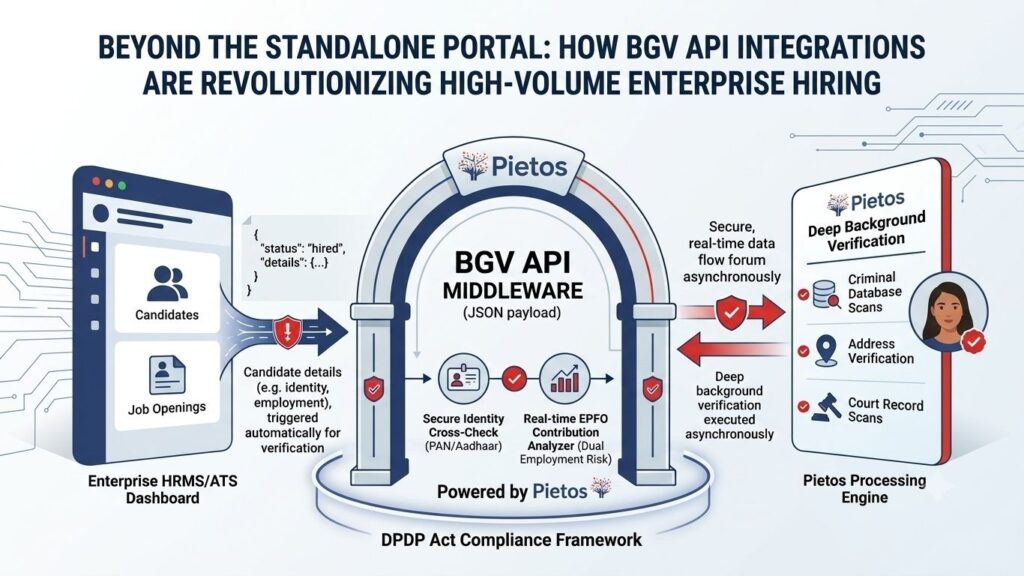
In massive hiring hubs like Noida, Gurgaon, and Bangalore, enterprise HR teams face a massive challenge: speed vs. accuracy. You find the perfect candidate, issue an offer letter, and then the onboarding pipeline grinds to a halt. Why? Because of traditional, manual background verification. Setting up a native BGV API integration is the modern solution; it isn’t just about switching to a different verification agency, it’s about shifting to automated screening middleware.
This manual paradigm introduces “dashboard fatigue,” heightens data-entry vulnerabilities, expands compliance exposure under the Digital Personal Data Protection (DPDP) Act, and expands your Turnaround Time (TAT).
The remedy is not merely contracting a different screening agency; it is a structural architectural shift. True velocity requires embedding an intelligent background verification (BGV) API engine directly into your pre-existing HR systems.
This deep-dive guide explores the mechanics of automated BGV API integrations, the elimination of manual portals, and how enterprise leadership can leverage middleware technology to transition background screening from an operational bottleneck into an invisible, continuous compliance layer.
A BGV API (Background Verification Application Programming Interface) integration is a secure, automated data bridge that links an enterprise’s primary HR management ecosystems (such as an ATS or HRMS) directly with an advanced verification engine. Rather than requiring human operators to download candidate documentation from one platform and manually upload it to another, a BGV API transforms the screening pipeline into a programmatic, machine-to-machine exchange.
Through structured Restful JSON payloads, an API integration allows an ATS or HRMS to trigger background checks automatically based on real-time candidate lifecycle changes. The integration handles document parsing, identity verification, court record checks, and employment tracking behind the scenes. It then securely feeds structured, color-coded risk flags back into the recruiter’s native dashboard view.
+-------------------------------------------------------------------------------------------------------------------------+
|                                                                                                                         |
|    Beyond the Standalone Portal: How BGV API Integrations Are Revolutionizing High-Volume Enterprise Hiring            |
|                                                                                                                         |
|   [ Company HRMS Dashboard ]                  API GATEWAY                 [ Pietos BGV Processing Engine ]              |
|   +--------------------------+         Secure, Real-Time Data Flow        +-----------------------------------+         |
|   | Candidates               |       ==============================>      |  [EPFO] Real-time Tracking        |         |
|   |  • Rahul Sharma : Hired  |                                            |         (Dual Employment Risk)    |         |
|   |                          |                [ Pietos ]                  |                                   |         |
|   | Job Openings             |           [ BGV API Middleware ]           |  [PAN]  Instant verification      |         |
|   |                          |                (JSON Data)                 |  [ID]   Aadhaar Authentication    |         |
|   +--------------------------+       <==============================      +-----------------------------------+         |
|                                                RESULTS SYNC                                                             |
|                                      Verified Compliance (Green Flag)                                                   |
|                                                                                                                         |
|   +-----------------------------------------------------------------------------------------------------------------+   |
|   |  Talent Acquisition Dashboard (Acme Tech)                                                     Logged in: HR     |   |
|   +-----------------------------------------------------------------------------------------------------------------+   |
|   |                                                                                                                 |   |
|   |   [Candidate Profile]  Priya Patel — Software Engineer                                                          |   |
|   |                                                                                                                 |   |
|   |   +---------------------------------------------------------------------------------------------------------+   |   |
|   |   |                                                                                                         |   |   |
|   |   |    [ GREEN FLAG ]   COMPLIANCE STATUS: CLEAR (Verified via Pietos API Middleware)                        |   |   |
|   |   |                                                                                                         |   |   |
|   |   |    ✔ Identity Check (PAN/Aadhaar)  : VERIFIED                                                           |   |   |
|   |   |    ✔ Past Employment Verification : VERIFIED                                                           |   |   |
|   |   |    ✔ Real-time EPFO History check  : NO OVERLAPPING CONTRIBUTIONS (No Moonlighting Detected)            |   |   |
|   |   |                                                                                                         |   |   |
|   |   +---------------------------------------------------------------------------------------------------------+   |   |
|   |                                                                                                Powered by:  |   |
|   |                                                                                                [ Pietos ]   |   |
|   +-----------------------------------------------------------------------------------------------------------------+   |
+-------------------------------------------------------------------------------------------------------------------------+
Many legacy operations continue to rely on external vendor dashboards. While these portals may offer digital file management, they act as functional data silos that compromise efficiency.
An HR specialist managing 150 parallel open requisitions must constantly hop between different windows: an ATS (e.g., Zoho Recruit) for candidate sourcing, a core system (e.g., Darwinbox) for offer generation, and an independent BGV portal for verification initiation. This constant app-switching fragments focus, disrupts clean tracking, and complicates progress monitoring.
Every instance where a recruiter manually ports data—such as copy-pasting a candidate’s legal name, permanent account number (PAN), or Universal Account Number (UAN)—introduces human error. Typographical mistakes can lead to mismatched queries in municipal court networks or national tax registries, causing false positives or artificial verification friction.
When background checks require manual initiation, requests naturally stall during high-volume periods or administrative gaps. A delay of 24 to 48 hours at the front end can create a domino effect down the line, increasing the risk of candidate drop-off as top talent accepts alternative offers.
With candidate information scattered across multiple external platforms, maintaining unified consent records and data-deletion logs becomes incredibly difficult. This siloed architecture introduces compliance exposure under evolving data privacy rules, making it tough to generate a clean, single-point audit trail if requested.
How a Unified BGV API Integration Streamlines Your Workflow
Shifting to an API-driven architecture removes manual intervention from the data pipeline, allowing your core business platform to trigger background checks programmatically based on lifecycle events.
[Candidate State Changes to "Hired" in ATS/HRMS]
                      │
                      ▼
[Programmatic JSON Payload Dispatched via Pietos API Gateway]
                      │
                      ▼
 ┌────────────────────┴────────────────────┐
 │  Instant Real-Time Verification Checks  │
 ├─────────────────────────────────────────┤
 │  • UIDAI Aadhaar Vault Biometric Check  │
 │  • NSDL/CBDT PAN Registry Match         │
 │  • Instant EPFO Timeline Contribution   │
 └────────────────────┬────────────────────┘
                      │
                      ▼
 ┌────────────────────┴────────────────────┐
 │  Asynchronous Multi-Threaded Deep Checks│
 ├─────────────────────────────────────────┤
 │  • E-Courts National Database Parsing   │
 │  • Academic Verification Engine Query   │
 │  • On-Ground GPS-Tagged Address Scan    │
 └────────────────────┬────────────────────┘
                      │
                      ▼
[Real-Time JSON Webhook Status Sync Back to Core HRMS Dashboard]
The lifecycle begins when an HR manager updates a applicant’s status to a specific trigger point—such as “Offer Extended” or “Background Check Initiated”—within their primary platform. The host system detects this status change and automatically prompts its integration engine to build a secure outbound request.
The host system compiles the candidate’s core details (legal name, phone number, email address, national identity numbers, and relevant file attachments like uploaded resumes or degree scans) into a structured JSON payload. This data package is encrypted in transit using TLS 1.3 protocols and dispatched via a secure HTTPS POST request to the Pietos API Gateway.
JSON
{
  "api_version": "2026.2.0",
  "client_id": "client_acme_prod_99182",
  "request_timestamp": "2026-06-27T12:30:00Z",
  "candidate_profile": {
    "first_name": "Priya",
    "last_name": "Patel",
    "email": "priya.patel@example.com",
    "phone_country_code": "+91",
    "phone_number": "9876543210"
  },
  "verification_suite": {
    "identity_kyc": {
      "pan_number": "ABCDE1234F",
      "aadhaar_masked": "XXXX-XXXX-1234"
    },
    "employment_history": {
      "uan_number": "100987654321",
      "trigger_realtime_epfo": true
    },
    "compliance_flags": {
      "dpdp_consent_captured": true,
      "consent_timestamp": "2026-06-27T12:28:45Z"
    }
  }
}
Upon receiving the payload, the verification engine reads the candidate details and processes any uploaded files using OCR (Optical Character Recognition) tools to verify document authenticity. The system instantly cross-references identity data against primary official registries:
pietos.com
For checks that require querying external databases, the platform runs multiple automated processes in parallel:
As each check concludes, the verification system does not wait for a final consolidated PDF report to be manually sent. Instead, it dispatches continuous webhook alerts back to the host system. The HR platform catches these updates and instantly displays status tags (e.g., Identity: VERIFIED, EPFO Check: ACTIVE, Court Records: CLEAR) right inside the internal candidate profile card.
As modern workplaces shift toward remote and hybrid setups, background verification has transformed from a simple credential check into a vital asset protection measure. Companies face increasingly sophisticated hiring fraud, including AI-inflated resumes and undisclosed parallel employment.
pietos.com
Traditional employment verification typically involves contacting a previous employer’s HR department via email or phone. While this step remains valuable for gathering qualitative reference data, it is inherently slow and vulnerable to fake HR contact schemes.
Integrating a real-time EPFO API check solves this problem by directly evaluating objective, government-managed financial records. When a company pings this API with a candidate’s UAN, the system analyzes the exact monthly provident fund contribution history across their entire career timeline.
pietos.com
Traditional Verification: ──[Send Email to HR]──> [Wait 5-7 Days]──> [Receive Response]
Real-Time EPFO API Check:  ──[Secure Government DB Query]──> [Instant Cross-Match (1 Sec)]
This automated timeline evaluation helps companies instantly catch:
With generative AI tools making it incredibly easy to craft flawless resumes, companies are seeing a rise in “ghost resumes”—profiles that look perfect on paper but contain fabricated past employers or inflated job roles.
An advanced BGV API protects against this by combining automated data validation with rigorous verification steps. When a resume lists experience at a defunct or untraceable startup, the system automatically checks Ministry of Corporate Affairs (MCA) registration data to confirm the company’s operational history. It then pairs these digital registry sweeps with verified payroll and tax documentation, giving enterprise HR teams a highly accurate tool to spot fraud early in the hiring process.
In India’s current regulatory landscape, data security is just as important as screening accuracy. The Digital Personal Data Protection (DPDP) Act places strict responsibilities on organizations handling candidate data, classifying background checks as processing activities that require robust oversight.
pietos.com
Under this legal framework, hiring companies act as Data Fiduciaries, while their background verification vendors serve as Data Processors. If a screening provider mishandles sensitive personal information, uses unauthorized tracking tools, or suffers a security breach, the hiring organization can face severe financial penalties and significant reputational damage.
       ┌────────────────────────────────────────────────────────┐
       │             ENTERPRISE (Data Fiduciary)                │
       │  • Captures explicit, granular candidate consent.      │
       │  • Manages secure data-sharing permissions.            │
       └──────────────────────────┬─────────────────────────────┘
                                  │
                  Secure HTTPS REST API Integration
             Encrypted via TLS 1.3 Protocols & Token Auth
                                  │
                                  ▼
       ┌────────────────────────────────────────────────────────┐
       │               PIETOS (Data Processor)                  │
       │  • Processes data purely for background screening.     │
       │  • Enforces automated data-purging timelines.           │
       │  • Maintained within an ISO 27001 secure environment.  │
       └────────────────────────────────────────────────────────┘
An integrated API approach helps businesses maintain strict compliance through built-in security features:
The API requires explicit, time-stamped proof of candidate consent before initiating any verification sweep. This consent documentation is converted into a tamper-proof digital log, ensuring the organization has a clear audit trail ready for review if needed.
A dedicated middleware link ensures candidate data is processed solely for its intended verification purposes. It prevents sensitive background information from being pooled, repurposed, or leaked outside the approved screening workflow.
Once the screening process wraps up and the final verification status syncs with your primary platform, the API can trigger automated data-purging schedules. This ensures personal records are cleanly erased from the vendor’s processing environments according to your company’s data retention policies, eliminating long-term data liabilities.
Top-tier verification frameworks rely on secure hosting within local cloud facilities, keeping data protected using AES-256 encryption at rest and TLS 1.3 protocols in transit. Maintaining an ISO/IEC 27001 certified environment ensures your screening pipeline satisfies rigorous enterprise security requirements.
Modern middleware platforms are designed to connect easily with your existing software stack, eliminating the need for a total infrastructure overhaul.
      ┌───────────────────────────────────────────────────────────┐
      │                  Enterprise HRMS / ATS                    │
      └──────┬────────────────────┬────────────────────┬──────────┘
             │                    │                    │
             ▼                    ▼                    ▼
     ┌──────────────┐     ┌──────────────┐     ┌──────────────┐
     │   Workday    │     │  Darwinbox   │     │  Zoho/Keka   │
     └──────┬───────┘     └──────┬───────┘     └──────┬───────┘
            │                    │                    │
            └────────────────────┼────────────────────┘
                                 │
                         Pietos API Gateway
                                 │
                                 ▼
                 [ Core BGV Verification Engine ]
For large-scale operations running comprehensive core systems, the API functions as a background compliance bridge. The integration maps seamlessly to your platform’s custom lifecycle steps, allowing HR teams to trigger deep verification routines—like criminal database sweeps or employment history checks—the moment an applicant moves to a formal hiring stage.
For rapidly expanding companies utilizing mid-market recruitment platforms, the integration focuses on reducing turnaround times and simplifying candidate communication. The API can automatically send out branded data collection links to candidates, gather necessary files, and update recruitment pipelines with color-coded verification results without requiring manual step-by-step oversight.
If your organization runs a bespoke internal system, developer-friendly RESTful endpoints make it straightforward to build custom data links. With comprehensive documentation and standardized JSON schemas, your engineering team can quickly set up tailored triggers and webhook listeners to connect your proprietary platform with our screening engine.
| Operational Parameter | Traditional Standalone Portal System | Automated API Middleware Architecture (Pietos) |
|---|---|---|
| Data Initiation Mechanics | Manual copy-pasting of candidate profiles by an HR specialist. | Programmatic payload generation triggered instantly by system status changes. |
| Turnaround Time (TAT) | 5 to 7 operational days due to administrative gaps and batch processing. | Instant database match updates, with deeper checks synced via live webhooks. |
| Data Entry Discrepancies | Highly vulnerable to manual typos, leading to false positives and validation delays. | Near-zero error rates because data pulls directly from primary candidate records. |
| Candidate Onboarding Experience | Fragmented; users must log into external forms and upload repetitive documents. | Fully integrated; candidates interact with a single, continuous corporate interface. |
| Regulatory Risk Management | Disconnected data records that complicate consent tracking and compliance auditing. | Structured, time-stamped consent logs that align with DPDP Act requirements. |
| System Visibility | HR teams must log into external accounts to manually monitor case progress. | Real-time status tags update automatically right inside your main HR dashboard. |
Moving your company from manual screening dashboards to an automated API-driven setup is a straightforward process when handled methodically.
Map out your recruitment pipeline to identify where data movement slows down. Check if your current ATS or HRMS supports external integrations, and locate the exact lifecycle stages where background screening should ideally trigger.
Work with your screening partner to align data structures. Map core candidate fields (such as full names, government IDs, and document uploads) from your primary software to the corresponding inputs required by the verification API to ensure seamless communication.
[Host HRMS Field: "curr_emp_uan"]  ──────>  [Pietos API Input: "uan_number"]
[Host HRMS Field: "cand_pan_id"]   ──────>  [Pietos API Input: "pan_number"]
Deploy the integration within a secure testing environment to evaluate performance. Run mock candidates through the pipeline to verify that triggers function correctly, JSON payloads transfer securely, and webhooks properly update your dashboard with mock verification statuses.
Roll out the live integration across your recruitment teams. Monitor core operational metrics—such as onboarding speed, data accuracy, and system adoption rates—to measure efficiency gains and fine-tune your automated hiring workflows.
Background screening should no longer function as a disjointed administrative chore. Relying on disconnected external portals creates unnecessary friction, increases data-entry vulnerabilities, and complicates regulatory compliance in an era of strict data protection rules.
Shifting to an API-driven architecture transforms background verification into a seamless, automated compliance layer inside your primary HR software. This technical evolution eliminates operational bottlenecks, protects your organization from hiring risks like dual employment, and drastically cuts down onboarding turnaround times.
The top-performing enterprise hiring operations of tomorrow are those that eliminate manual steps today. By building a direct, secure data bridge between your core HR platform and an advanced screening engine, you can streamline your onboarding pipelines, secure your talent data, and scale your business with absolute confidence.
As one of the leading employee background verification companies in Noida and across India, Pietos specializes in providing developer-friendly API integrations built for high-volume enterprise screening
Ready to move past manual vendor dashboards and accelerate your talent acquisition? Connect with our engineering and solutions team at Pietos today to review our detailed API documentation, explore our integration frameworks, and see how our middleware engine can seamlessly transform your enterprise HR tech stack.
No. An API integration functions as a software middleware bridge. It connects directly with your existing infrastructure (such as Workday, Darwinbox, Zoho, Keka, or proprietary setups), adding automated screening features without forcing you to change your primary software stack.
Traditional screening requires manual data entry, batch uploads, and regular login checks to track case statuses, which creates built-in delays. An API pipeline instantly transmits candidate information the moment they are marked as hired, triggers digital registry checks immediately, and feeds status updates back to your platform in real time via secure webhooks.
Instead of relying solely on written or verbal references that can be easily fabricated, the platform pings official provident fund registries using the candidate’s verified UAN. The system automatically analyzes contribution history to highlight overlapping employment timelines or undeclared parallel income streams instantly.
Under the DPDP Act, organizations are legally responsible for how candidate information is managed. An API integration minimizes data handling risks by ensuring all checks require digital, time-stamped consent logs, automating data retention schedules, and keeping information securely protected within ISO 27001 certified processing environments.
Yes. While digital verifications (like PAN, Aadhaar, or EPFO tracking) complete almost instantly, deeper checks—such as physical address scans or court database lookups—are handled asynchronously. The API registers the request, coordinates with field verification networks using GPS-tagged documentation, and updates your dashboard automatically as soon as the results are finalized.