
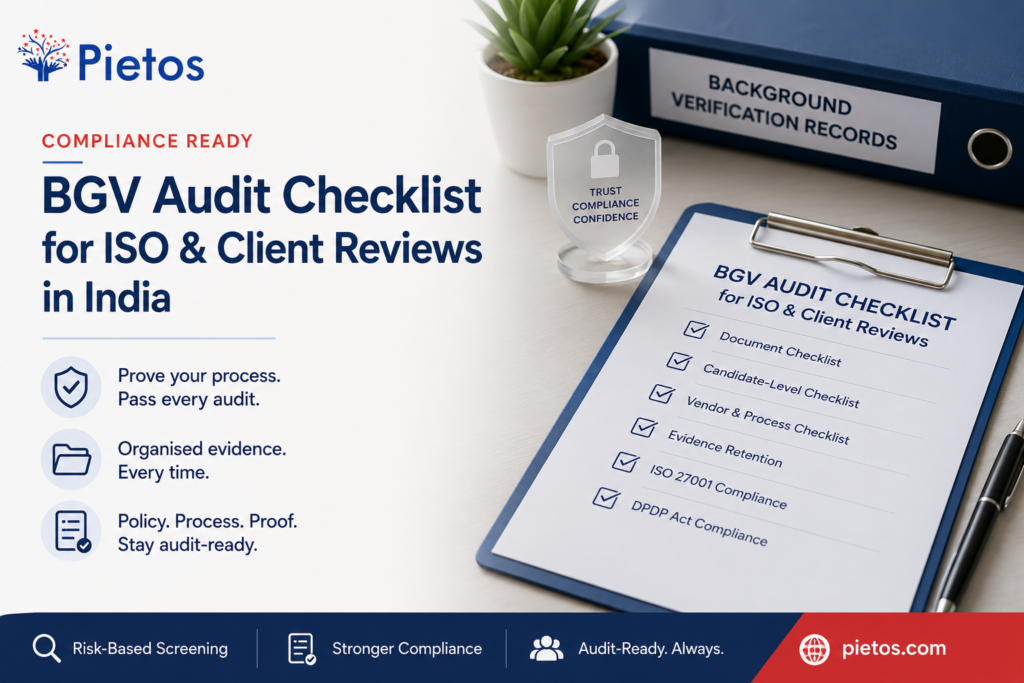
Auditors do not ask if you run background checks. They ask for proof.
Most Indian HR teams run background verification. Far fewer can hand an auditor a clean, timestamped evidence trail for every hire, on demand, in the format the auditor wants. That gap is what fails ISO 27001 audits and stalls client compliance reviews — not the absence of screening, but the absence of provable screening.
This checklist exists to close that gap. It is built for HR heads and compliance managers who have an ISO 27001 surveillance audit, a recertification audit, or a client vendor-risk review on the calendar and need their BGV house in order before the auditor walks in.
You will get a documentation checklist, a candidate-level checklist, a vendor-process checklist, a 30-day readiness framework, and the exact non-conformities auditors flag most often in Indian BGV programs. Everything here maps to ISO/IEC 27001:2022 Annex A 6.1 and to the data-handling obligations under India’s Digital Personal Data Protection Act. Work through it once, properly, and the next audit — ISO or client-side — becomes a formality rather than a fire drill.
Key Takeaway: An audit does not test whether you screened a candidate. It tests whether you can prove it, consistently, for every role tier, with evidence that survives scrutiny.
Why Your BGV Records Decide Whether You Pass the Next Audit
Background verification used to sit quietly inside HR. ISO certification and enterprise client contracts changed that.
ISO/IEC 27001:2022 made employee screening a named control under Annex A 6.1. Auditors now treat your BGV file as primary evidence, not a footnote. They expect a documented policy, consistent application across roles, and retained proof for every person in scope — full-time staff, contractors, and selected suppliers.
Client-side reviews raise the bar further. BFSI clients, global capability centres, and large enterprises increasingly run their own vendor due-diligence audits before onboarding a staffing or BPO partner. They want to see your BGV evidence directly, not just a policy statement.
This is no longer a paperwork exercise. Pre-employment screening is a mandatory requirement for ISO 27001:2022 certification, and certification auditors require evidence that screening was completed before system access was granted. Auditors commonly find undocumented screening processes, inconsistent application across roles, and unclear evidence retention — and these are exactly what trigger non-conformities.
The good news: every one of these gaps is fixable before an audit, if you know precisely what to check.
Need a second pair of eyes before your auditor arrives? Pietos runs a free BGV audit-readiness review for HR teams preparing for ISO or client reviews — we map your current process against Annex A 6.1 and DPDP requirements, then flag the gaps in writing. Talk to a Pietos compliance specialist →
What Auditors Actually Check During a BGV Audit
Auditors do not re-verify your candidates. They verify your process. Two distinct audit types apply different lenses to the same BGV file.
ISO 27001 Annex A 6.1 Screening Requirements
Annex A 6.1 does not prescribe a fixed checklist of checks. It expects organisations to apply risk-based, lawful, and transparent screening aligned to the information individuals will access. In practice, auditors look for three things:
- A written, board-approved screening policy.
- Consistent application of that policy across comparable roles.
- Retained evidence — for every person in scope, not only senior hires.
A defensible baseline for most roles typically includes verification of identity through a government-issued document, confirmation of the right to work, verification of claimed academic and professional qualifications, recent employment history, and at least two independent references. However, risk-based, proportionate screening means that not every role requires the same level of scrutiny. For example, a receptionist may only need an identity check, whereas a finance director or database administrator will likely require additional criminal and credit checks because these positions have greater access to sensitive systems, financial information, or critical business data. Therefore, the depth of screening should always align with the level of risk associated with the role.
Auditors also check that screening connects to adjacent controls. Employee screening directly supports acceptable-use policies, the disciplinary process, confidentiality agreements, and identity management — together forming the people-security lifecycle from hiring to exit. If your BGV file sits disconnected from these, expect a question about it.
Client and Vendor Due-Diligence Reviews
Client reviews look different. The client’s security or procurement team is assessing you as a vendor, not auditing your ISMS line by line. They typically ask for:
- A sample of recent BGV reports for staff assigned to their account.
- Your candidate consent and data-handling process under the DPDP Act.
- Your vendor agreement with your BGV provider, including data-processing terms.
- Evidence of role-based screening depth — especially for staff with access to the client’s systems or data.
For NBFC, BFSI, and fintech clients specifically, this scrutiny goes further. Many demand sector-specific evidence tied to RBI outsourcing expectations and DPDP compliance — a requirement covered in depth in Pietos’s NBFC Background Verification 2026 Guide.
How Auditors Expect Evidence to Be Organised
Most BGV audit findings are not about missing checks. They are about checks that exist somewhere, in an inbox or a shared drive, but cannot be produced cleanly when asked.
A strong evidence folder is organised by candidate, not by check type. For every individual, an auditor expects to open one file and find, in order: the consent record with timestamp, the identity document used, the verification reports for each check completed, any discrepancy and its documented resolution, and the date access was granted.
Three habits separate teams that pass smoothly from teams that scramble:
- Evidence is retrievable within minutes, not days. If your HR team needs to email a vendor and wait for a file, that delay itself reads as a control gap to an auditor.
- File naming is consistent across the organisation. “Candidate name, role, hire date” beats ad hoc naming every time a sample is pulled.
- Nothing lives only in a recruiter’s personal inbox. Auditors specifically probe for single points of failure in evidence custody.
None of this requires new technology. It requires a folder structure decided once and followed consistently — which is itself the kind of control an auditor is checking for.
The Real Cost of Failing a BGV Audit
A failed BGV audit rarely shows up as one dramatic event. It shows up as three compounding costs.
Certification Delays and Non-Conformities
A major non-conformity in Annex A 6.1 does not automatically fail your ISO 27001 certification. It does mean a corrective action plan, a follow-up audit, and a delay — often eight to twelve weeks — before the certificate is issued or renewed. For companies that need the certificate to bid on enterprise contracts, that delay has a direct revenue cost.
Lost Contracts and MSA Exits
Client vendor-risk reviews are less forgiving than ISO surveillance audits. A staffing firm or BPO that cannot produce clean BGV evidence on request risks losing the account entirely, not just receiving a corrective-action note. For GCCs and BFSI clients, background-verification gaps are increasingly treated as a contractual breach, not a recommendation.
The economics make the risk easy to underestimate. A standard BGV check typically costs a few thousand rupees per candidate. Industry estimates put the cost of a single bad hire — recruitment, training, lost productivity, and replacement — at two to five times that role’s annual cost to company. Against an enterprise client contract, the maths shifts further: one terminated MSA over a screening gap can erase years of BGV spend in a single quarter.
DPDP Act Penalty Exposure
Background verification involves processing sensitive candidate data, including identity documents, employment history, and, in some cases, criminal records. Consequently, organisations must ensure this information is handled securely and lawfully throughout the verification process. Unlike GDPR, the DPDP framework includes structural and operational differences, particularly in how organisations are expected to implement privacy notices, oversee vendors, and manage internal grievance mechanisms. Furthermore, the consequences of non-compliance can be significant. For instance, penalties for failing to implement reasonable security measures to prevent data breaches can reach ₹250 crore, while other violations, including mishandling sensitive data categories, can attract fines of up to ₹200 crore. Therefore, maintaining a compliant background verification process is no longer just a best practice—it is a critical business and regulatory requirement.
Most day-to-day employer obligations, including notice and consent, breach notification, and individual rights handling, become enforceable through an 18-month implementation phase running to mid-2027. That window is closing, not opening. A BGV audit that ignores DPDP consent evidence is checking only half the file.
Pietos perspective: We have walked into BGV audits where the screening itself was sound, but the candidate consent trail could not survive a regulator’s question. Under DPDP, that gap is now as serious as a missing criminal check. See how Pietos structures DPDP-aligned consent collection →
The Complete BGV Audit Checklist Every Indian HR Team Needs
Use this checklist exactly as written. Each section maps to a category of evidence an auditor will request.
Documentation-Level Checklist
- [ ] A written, approved background-screening policy, version-controlled and dated.
- [ ] A defined risk-tiering model mapping role categories to screening depth.
- [ ] A Statement of Applicability entry covering Annex A 6.1, with justification.
- [ ] Contractual screening clauses for suppliers and third-party staff.
- [ ] A documented data-retention and deletion schedule for candidate records.
- [ ] A DPDP-compliant privacy notice issued to candidates before screening begins.
- [ ] A signed Data Processing Agreement with your BGV vendor.
- [ ] An escalation procedure for unresolved or delayed screening at offer stage.
Candidate-Level Checklist
For every individual in scope, confirm and retain proof of:
- [ ] Identity verification against a government-issued document.
- [ ] Explicit, itemised, unbundled consent — not a blanket clause in the offer letter.
- [ ] Employment history verification, including UAN or EPFO cross-checks where applicable.
- [ ] Education and qualification verification against the issuing institution.
- [ ] Address verification, digital or physical, appropriate to the role.
- [ ] Criminal and civil litigation checks, tiered to role risk and data access.
- [ ] Reference checks completed through structured, recorded questionnaires.
- [ ] A documented risk decision where the screening returned a discrepancy.
Vendor and Process-Level Checklist
- [ ] Evidence that your BGV provider’s process is consistent across all hiring locations.
- [ ] Turnaround-time records showing screening completes before, or with controlled access pending, system onboarding.
- [ ] An audit trail showing who approved each hire despite a pending or flagged check.
- [ ] Periodic re-screening cadence for high-risk and long-tenured roles.
- [ ] A named internal owner for Annex A 6.1, typically HR with security/compliance sign-off.
Featured-snippet note: This three-part checklist structure — documentation, candidate-level, vendor-level — is written to be lifted directly into a featured snippet or AI Overview answer for “BGV audit checklist.”
Build a Role-Based Screening Depth Matrix Before the Audit
Auditors reward proportionality. They expect a receptionist and a finance director to go through different depths of screening — and they expect that difference to be documented, not improvised case by case.
A screening depth matrix solves this in one document. It maps role tiers to required checks, so every hire is screened consistently against a written standard rather than a recruiter’s judgement on the day.
| Role Tier | Example Roles | Minimum Checks | Typical TAT |
| Tier 1 — Low data access | Office support, facilities, entry-level non-client roles | Identity, address | 1–2 days |
| Tier 2 — Standard hire | Associates, executives, most client-facing roles | Identity, address, employment, education | 3–5 days |
| Tier 3 — Elevated access | Finance, IT admin, HR, candidate-data handlers | Tier 2 + criminal, civil litigation, UAN/EPFO cross-check | 5–7 days |
| Tier 4 — Senior/leadership | CXOs, directors, signing authorities | Tier 3 + credit check, media and litigation search, reference depth increased to three contacts | 7–10 days |
Two things make this matrix audit-proof rather than decorative.
First, the tiering logic itself needs a clear, one-line written rationale for each screening level. For example, “Tier 3 includes criminal checks because these roles have standing access to production systems.” This simple explanation demonstrates that screening decisions are based on role-specific risks rather than arbitrary choices. As a result, auditors can easily understand why certain checks apply to specific roles. After all, auditors ask why a tier was set, not just what it contains. Therefore, documenting the reasoning behind each tier strengthens both compliance and audit readiness.
Second, the matrix has to be applied retroactively to existing staff, not just to new hires going forward. Otherwise, organisations risk creating inconsistencies between employees performing similar roles. In fact, a common audit finding is a screening matrix that looks correct on paper but was only enforced from the policy’s publication date onward. As a result, a group of existing employees in elevated-access roles may remain unscreened to the required standard. Therefore, organisations should review and align the screening status of current employees with the same risk-based matrix to eliminate compliance gaps before an audit.
This matters more at senior levels than most HR teams assume. In fact, an EY study analysing over a million pre-employment screenings across more than ninety Indian organisations found that most candidates flagged for discrepancies were not fresh entrants. For example, 96% in healthcare, 88% in financial services, and 79% in IT/ITeS had already spent several years in the workforce. Therefore, seniority and tenure alone should not be treated as indicators of lower fraud risk. Instead, organisations should apply the same risk-based screening standards to experienced lateral hires as they do to other high-risk roles. Otherwise, a screening matrix that quietly relaxes checks for senior candidates can create exactly the kind of gap an auditor is trained to identify.
BGV Checklist by Audit Type: ISO 27001 vs Client Review
| Checklist Item | ISO 27001 Audit Focus | Client/Vendor Review Focus |
| Screening policy | Required, version-controlled, board-approved | Often requested as a summary document |
| Consent evidence | Reviewed for documentation completeness | Reviewed for DPDP compliance specifically |
| Role-based screening depth | Assessed against your own risk-tiering | Assessed against the client’s own risk appetite |
| Sample evidence requested | Across all role tiers, including low-risk roles | Usually limited to staff assigned to that client |
| Vendor agreements | Checked for screening clauses with suppliers | Checked for data-processing terms with your BGV provider |
| Non-conformity outcome | Corrective action plan, certificate delay | Contract risk, possible MSA termination clause trigger |
| Audit frequency | Annual surveillance, triennial recertification | Ad hoc, often pre-contract or annual |
Both audit types reward the same underlying habit: treating BGV as a governed process with retained evidence, not a one-time hiring task.
Although most Indian HR teams complete background screening, many struggle to maintain the documentation auditors expect. As a result, consent trails, evidence retention, and role-tiering often become the biggest points of scrutiny during a review. So if your last audit raised questions in any of these areas, Pietos’s compliance team can run a gap assessment against ISO 27001 and DPDP requirements before your next review date — helping you close documentation gaps with confidence. Book a readiness call →
Common BGV Non-Conformities
A mid-sized IT services firm in Gurugram learned this the hard way. Their ISO 27001 surveillance audit raised a major non-conformity: screening records existed for new hires, but not for contractors deployed on a client project six months earlier. The contracts predated the firm’s current BGV vendor relationship, and no one had backfilled the records.
The fix took three weeks and a corrective action plan the certification body had to formally close before renewal. It was avoidable.
Here are the non-conformities Pietos sees most often in Indian BGV programs, and how to close each one before an auditor finds it.
1. Screening applied inconsistently across role tiers. Fix: Document your risk-tiering model in writing, and apply it identically across departments. Auditors specifically check for inconsistency between business units.
2. Contractors and third-party staff excluded from screening scope. Fix: Extend your screening policy contractually to suppliers and contractors before they start, not retroactively.
3. Consent collected through a blanket clause, not itemised consent. Fix: Replace any single “I agree to background verification” line with itemised, unbundled consent covering each check category separately — a requirement that has sharpened considerably since the DPDP Rules took effect. Pietos’s guide on candidate consent under the DPDP Act breaks down exactly what unbundled consent needs to contain.
4. No documented decision trail when a discrepancy surfaced. Fix: Every flagged check needs a recorded outcome — proceed, escalate, or withdraw — signed off by a named approver. An auditor will ask what happened after a flag, not just whether one occurred.
5. UAN or employment-history checks skipped for cost or speed. Fix: Employment verification is one of the highest-fraud categories in Indian hiring and one of the easiest to evidence through EPFO data. Pietos’s EPFO/UAN verification guide covers how to build this into your standard process without adding days to turnaround.
6. No retention or deletion schedule for candidate data. Fix: Set a defined retention window, document it, and apply automated deletion past that point. DPDP obligations and ISO data-minimisation expectations point the same direction here.
7. Screening matrix exists but applies only to new hires, not existing staff. Fix: Run a one-time retroactive sweep against your role-based matrix for anyone currently in an elevated-access tier. Auditors specifically test whether policy publish dates left a screening gap behind.
8. Re-screening cadence for long-tenured, high-risk roles is undefined. Fix: ISO 27001 expects ongoing suitability checks for critical roles, not a one-time screen at hiring. Set a fixed re-screening interval — annually is common for Tier 3 and Tier 4 roles — and document it as policy, not as an ad hoc decision.
A 30-Day Pre-Audit BGV Readiness Framework
If your audit is scheduled within the next month, work through this sequence rather than the full checklist at once.
Week 1 — Inventory. Pull every BGV record for the audit period. Identify gaps by role tier: who has no record, who has an incomplete record, who has an unresolved flag.
Week 2 — Documentation. Draft or update your screening policy, risk-tiering model, and Statement of Applicability entry. Confirm your BGV vendor agreement includes a current data-processing clause.
Week 3 — Remediation. Backfill missing checks for anyone still active in a role requiring screening. Resolve any open discrepancy with a documented decision. Reissue consent where the original wording was a blanket clause rather than itemised consent.
Week 4 — Dry run. Pick five files at random across different role tiers. Ask, for each: could this survive an auditor pulling it cold, with no context from you? If the answer is no for any file, that gap is your priority before audit day.
Treat this dry run the way an external auditor would. Hand the file to a colleague who was not involved in that hire and ask them to find the consent date, the check completion date, and the approval decision within two minutes, using only what is in the folder. If they cannot, the file fails — regardless of whether the underlying screening was actually completed correctly. An auditor will draw the same conclusion from the same friction.
Key Takeaway: Most audit failures trace back to inconsistency, not absence. Teams that screen well but document poorly fail more often than teams with a thinner but consistently evidenced process.
“We Already Do BGV In-House” — Addressing the Objection
This is the most common pushback HR leaders raise, and it deserves a direct answer rather than a sales line.
Objection: “We already run background checks. Why would we need a partner for this?” Running checks and producing audit-grade evidence are different skills. Most in-house teams can confirm a candidate’s identity and employment history. Far fewer can produce a consistent, DPDP-compliant consent trail, role-based risk tiering, and retention schedule that survives an external auditor’s questions on demand.
Objection: “Our BGV vendor already handles this.” Worth checking directly: does your vendor’s report include a consent log with timestamps, or just a pass/fail result? Many BGV reports confirm a candidate cleared screening without documenting how consent was obtained or how long the data will be retained — both of which an ISO 27001 or client auditor will ask about specifically.
Objection: “This feels like overkill for our company size.” ISO 27001 and client due-diligence requirements scale with risk, not headcount. A 40-person fintech handling customer financial data faces the same Annex A 6.1 expectations as a 4,000-person enterprise. Smaller teams without dedicated compliance staff are, in practice, more exposed — not less.
Objection: “We’ll fix the documentation gap after this audit cycle.” That decision usually costs more the second time. A repeated non-conformity in the same area signals a systemic control failure to a certification body, and client vendor-risk teams increasingly track audit history across renewal cycles.
If any of these objections sound familiar, the fix is usually smaller than it feels. Pietos works with Indian HR and compliance teams to close exactly these gaps — building DPDP-aligned consent flows, role-based screening tiers, and retained evidence that holds up under both ISO and client scrutiny. Request a BGV audit-readiness assessment →
Key Takeaways
- Auditors assess your evidence of screening, not the screening event itself.
- Annex A 6.1 requires risk-based, consistently applied, retained proof — for every role tier in scope.
- DPDP Act consent must be itemised and unbundled; a blanket offer-letter clause is no longer defensible.
- Client vendor reviews focus narrowly on staff assigned to that account and your data-processing terms.
- Most non-conformities come from inconsistency and missing documentation, not absent screening.
- A 30-day readiness sprint, run in sequence, closes most gaps before audit day.
Related Resources
- Can a Candidate Refuse a Background Check in India? (DPDP Act Guide) — the legal grounds for consent that an auditor or the Data Protection Board will examine first.
- NBFC Background Verification 2026 Guide — sector-specific checklist extensions for BFSI and NBFC client reviews.
- Moonlighting Detection India: EPFO/UAN Guide — closing the employment-verification gap auditors flag most often.
- DigiLocker Background Verification: 2026 HR Guide — what DigiLocker can and cannot evidence for your audit trail.
- Enterprise Background Verification India: The Complete Guide — scaling BGV governance across a multi-location, multi-tier organisation.
Frequently Asked Questions
An ISO 27001 auditor checks for a documented screening policy, consistent application across role tiers, and retained evidence for each person in scope — covering identity, employment, education, and criminal checks where the role’s risk profile requires them.
Yes. ISO 27001:2022 Annex A 6.1 requires organisations to screen employees, contractors, and selected suppliers before granting access to information systems, applied proportionately to role risk.
HR should keep the screening policy, consent records, sample BGV reports for staff assigned to that client, the vendor agreement with the BGV provider, and the data-processing terms governing candidate data.
The DPDP Act requires explicit, itemised consent before screening, a defined data-retention schedule, and documented vendor data-processing agreements — all of which auditors now expect to see alongside the screening results themselves.
Inconsistent application of screening across role tiers and missing or blanket-style consent documentation are the most frequent causes, more often than the absence of screening itself.
Thirty days is typically enough to inventory existing records, fix documentation gaps, remediate missing checks, and stress-test a sample of files before the audit date.
Usually not on its own. Auditors expect to see the consent trail, retention policy, and risk-based decision record behind the result, not just a cleared or flagged status.
Screening depth should differ by role. ISO 27001 explicitly calls for a proportionate, risk-based approach, so a low-access role and a finance or IT-admin role should sit on different tiers within a documented screening matrix.
Annually is a common cadence for roles with standing access to sensitive systems or data, since ISO 27001 expects ongoing suitability monitoring for critical positions, not a one-time check at the point of hire.
Ready to make your BGV process audit-proof before your next ISO surveillance audit or client review? Pietos Solutions Private Limited helps Indian HR and compliance teams build DPDP-aligned, audit-ready background verification — from consent design to evidence retention, across every role tier in your organisation. Talk to a Pietos compliance specialist today →




Pingback: Pre-Employment Medical Checks in India: What Every HR Team Must Know - Best Background Verification Company in India | Pietos