
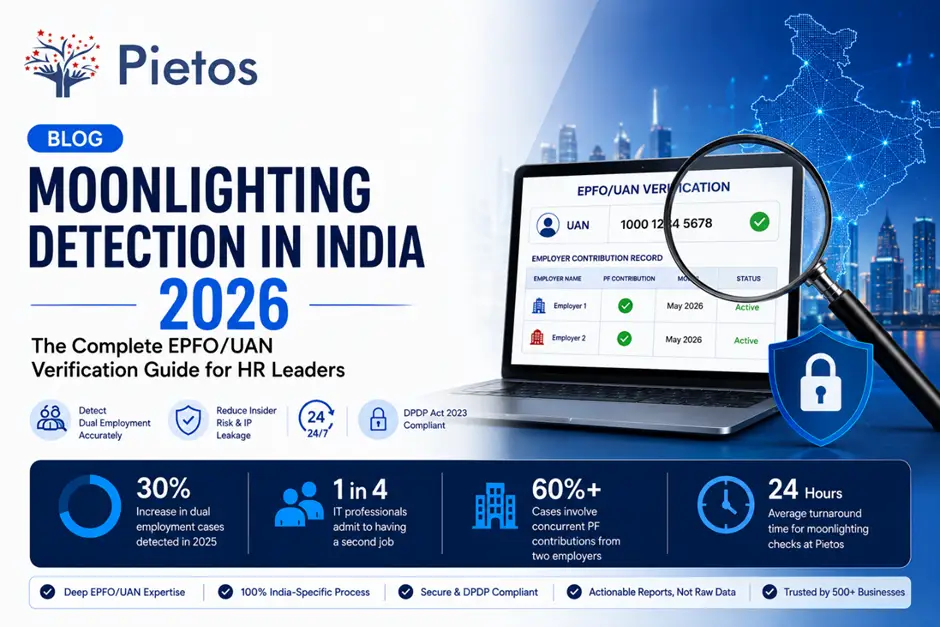
Introduction: The Employee Sitting in Your 10 AM Stand-Up Is Also in Someone Else’s 10 AM Stand-Up
Deploying a foolproof framework for moonlighting detection India corporate ecosystems rely on has become a top priority for HR leaders managing hybrid and remote teams in 2026. Let us look at how much the landscape has evolved: just five years ago, employee moonlighting India wide meant a software developer taking on minor weekend freelance projects for extra pocket money. It was informal, low-risk, and mostly ignored by management under the philosophy that as long as standard deliverables were met, it was fine to look the other way.
In 2026, that picture has changed entirely. Securing a foolproof framework for moonlighting detection India corporate setups need is no longer optional. Today, dual employment means a senior developer simultaneously employed full-time by two Noida IT firms — appearing in both companies’ stand-ups, accessing both companies’ codebases, drawing two full salaries, contributing PF with two employers, and managing the deception with AI scheduling tools that keep the calendar conflicts invisible.
It means a Gurgaon BFSI analyst who is on your payroll and simultaneously consulting for a direct competitor, with access to your client data and theirs. It means a GCC employee in Delhi who is sending your proprietary code to a second employer overseas.
This is not a side-hustle story. This is an IP leakage story, a data sovereignty story, and increasingly, a legal liability story.
At Pietos, we specialize in the exact corporate moonlighting detection India businesses require to safeguard their assets. We run dual employment verification India checks every working day. We see what these cases actually look like in EPFO data — the timestamps, the contribution patterns, the gaps — in a way that purely theoretical guides do not capture. This guide is written from that operational vantage point. By the end of it, you will know exactly how an EPFO moonlighting check works, what it definitively catches, where its limits lie, how to structure the check within a DPDP-compliant framework, and what to do when you find a discrepancy.
🛡️ Protect Your Organization Today: Want to instantly spot dual employment before onboarding? Book a Free BGV Consultation with Pietos Ltd.
Section 1: What Moonlighting Actually Looks Like in 2026 — It Is Not What You Think
The word “moonlighting” still carries its original connotation: working a second job at night, in the dark, after regular hours. That image is dangerously outdated.
The active cases we encounter during standard moonlighting detection India workflows fall into four distinct categories, and only one of them is the classic “extra freelance work” scenario:
- Type 1 — Concurrent Full-Time Employment: The most serious and fastest-growing type. The candidate holds two full-time salaried positions simultaneously, both with proper employment contracts, both with PF contributions, and both drawing full salaries. This is exactly what an EPFO dual employment check catches with absolute precision. Both employers contribute PF for the same month under the same UAN. In our moonlighting BGV India practice, this type has grown significantly since remote work became normalized.
- Type 2 — Undisclosed Active Employment:The candidate has declared resignation from their previous employer, but the PF contributions from that employer have not stopped. This happens either because the previous employer has not processed the exit in the ECR (Electronic Challan cum Return) yet, or because the candidate has not actually resigned and is stringing both employers along. This is extremely common in moonlighting detection Noida IT corridors, where 90-day notice periods prompt candidates to join new employers prematurely
- Type 3 — Ghost Employment: The candidate claims to have been employed at a company for a given period, but EPFO shows zero contributions. Either the employer was an unregistered entity (under 20 employees), or the employment was completely fabricated. While not traditional moonlighting, it is caught by UAN verification India pipelines and must be flagged.
- Type 4 — Consulting Under a Shell Entity: The most sophisticated type, and the hardest to catch via EPFO alone. A senior professional is employed full-time with your organization while simultaneously receiving regular consulting payments from a competitor through an LLP or registered company they own. Since this income is not salary, there is no PF contribution. This requires supplementary checks beyond EPFO — including PAN-linked TDS analysis and directorship database searches — which Pietos incorporates for senior or sensitive hires.
Understanding which type you are dealing with determines which verification method you need. While EPFO checks form the core of moonlighting detection India protocols, a multi-layered approach is required to eliminate all blindspots.
Section 2: The Numbers — Moonlighting Data Every HR Leader Should Know
The scale of the problem is heavily documented by industry data:
| Metric | Insight & Impact | Source |
| 25% to 30% | Increase in moonlighting activity across the Indian IT sector over a three-year period. | Randstad India |
| 43% | Percentage of Indian IT employees who find moonlighting favorable. | Business Standard |
| 9.46% | Overall discrepancy rate among screened candidates in the IT/ITES sector. | Pietos BGV Data |
| 21.89 Lakh | Record new members added to EPFO in a single month (June 2025), a 13.46% year-on-year growth. | EPFO Official Data |
The corporate consequences are permanent landmarks in HR history. Wipro terminated 300 employees after discovering they were working directly for competitors. Infosys issued firm warnings that dual employment violates their Employee Handbook and Code of Conduct, threatening termination, while TCS declared it a definitive ethical violation.
As SHRM‘s 2026 Talent Trends Report confirms, quality of hire has completely overtaken speed-to-hire as the defining metric of talent acquisition success. A candidate who is simultaneously on a competitor’s payroll the week they join your company is an extreme quality-of-hire failure. This structural risk explains the surging industry demand for standardized moonlighting detection India platforms
Section 3: The Legal Position — Is Moonlighting Illegal in India?
This question comes up in every HR conversation about moonlighting detection India practices, and the honest answer is: it depends, and the law is less clear than most HR teams assume.
- The Factories Act, 1948 (Section 60): Provides a strict statutory prohibition stating a factory worker cannot be required or allowed to work in two factories on the same day. This makes a dual employment check India workflow critical for industrial sectors like Faridabad, not just IT.
- Employment Contracts & Exclusivity Clauses: This is the primary legal mechanism for white-collar sectors. Major tech companies include explicit exclusivity clauses prohibiting secondary employment without prior written permission. Breach of these clauses is a valid, legally enforceable ground for termination.
- The Industrial Employment (Standing Orders) Act, 1946: Applies further regulatory restrictions depending on the nature of the industrial establishment.
Ultimately, moonlighting that violates a signed contract is grounds for immediate termination and, in cases involving data theft, potential criminal prosecution. However, you cannot rely on self-disclosure; you need a definitive government-sourced evidence trail to act.
Section 4: The EPFO/UAN System — How It Works From the Inside
To execute a flawless moonlighting detection India strategy, you must understand why the Universal Account Number (UAN) system is effectively unfalsifiable.
What is UAN and What Does It Record?
The UAN is a unique 12-digit identifier issued by the Employees’ Provident Fund Organisation (EPFO) under the Ministry of Labour and Employment. It remains constant for an employee’s entire working life across all job changes.
Each time an employee joins an EPFO-registered company, a new Member ID is generated under their permanent UAN. The official system (accessible via epfindia.gov.in) records:
- Employer name and specific EPFO establishment code.
- Exact contribution timelines (joining date to exit date).
- Monthly contribution amounts verified against actual payroll.
- Component breakups for EPF, EPS (pension), and EDLI (insurance).
Why It Cannot Be Spoofed
Candidates can fabricate experience letters, forge degree certificates, or coach fake references, but they cannot retroactively insert or delete statutory records from the government’s secure database.
Furthermore, the EPFO Portal 3.0 requires Aadhaar-based Face Authentication Technology (FAT) via the UMANG app for UAN activation, completely discontinuing website-based activation to eradicate identity tampering.
The Concurrent PF Contribution Check
The foundational mechanism of reliable moonlighting detection India pipelines rely on is the concurrent PF contribution check
. If Employer A (a Noida IT firm) and Employer B (a Gurgaon tech company) both deposit monthly PF contributions to the exact same UAN during matching calendar months, the system triggers an unavoidable dual employment alert
[UAN: 1000 XIIX XX78]
├── Member ID 1: Employer A (Noida IT)   --> PF Contributed: Jan 2026 - May 2026 [Active]
└── Member ID 2: Employer B (Gurgaon Co) --> PF Contributed: Mar 2026 - May 2026 [Active]
                                              ⚠️ CONCURRENT OVERLAP DETECTED
Section 5: How Pietos Ltd Runs a Moonlighting Detection Check Step by Step
At Pietos, our corporate moonlighting detection India framework bridges direct digital APIs with expert human analysis inside a strict, DPDP-compliant consent framework.
┌─────────────────────────┐     ┌─────────────────────────┐     ┌─────────────────────────┐
│ Step 1: DPDP Consent    │ ──> │ Step 2: UAN & Aadhaar   │ ──> │ Step 3: Direct EPFO API │
│ Separated, plain-lang   │     │ Cross-match & verify    │     │ Multi-member scan       │
└─────────────────────────┘     └─────────────────────────┘     └─────────────────────────┘
                                                                             │
┌─────────────────────────┐     ┌─────────────────────────┐                  │
│ Client HR Delivery      │ <── │ Step 4: Gap & Timeline  │ <────────────────┘
│ Clear 24-48 hr report   │     │ Overlap Analysis        │
└─────────────────────────┘     └─────────────────────────┘
- Step 1 — Candidate Consent Collection (DPDP-Compliant): We collect explicit, unbundled, plain-language consent from the candidate over WhatsApp and email specifically for EPFO/UAN access. Under the law, a candidate’s refusal to grant consent is itself a critical risk signal worth escalating.
- Step 2 — UAN Capture & Deduplication: The candidate provides their UAN. Pietos verifies that it is Aadhaar-seeded and active. Per EPFO guidelines, an individual must hold exactly one UAN; we execute deduplication checks to catch candidates attempting to run dual careers via split UANs.
- Step 3 — Direct EPFO API Query & Scan: Pietos utilizes a secure API bridge to pull the entire history of the UAN passbook. We immediately flag three categories:
- Twin-Payroll Alert: Multiple employers contributing within the same calendar month.
- Undisclosed Active Employment: Active contributions continuing from a previous employer long past the claimed resignation date.
- Ghost Tenure: Total absence of PF data for a timeline claimed as full-time employment.
- Step 4 — Service History Gap Analysis: We parse the entire timeline to flag major undocumented employment gaps (e.g., a 14-month missing window) which frequently hide legal disputes or unmapped parallel jobs.
- Step 5 — Discrepancy Report Delivery: Your HR team receives an actionable, structured report within 24 to 48 hours via our secure platform, complete with a verified DPDP-compliant audit trail.
📈 Accelerate Onboarding Safely: Stop waiting weeks for background data. See How Our Dual Employment Verification India Infrastructure Delivers Results in 24 Hours.
Section 6: What EPFO Catches — and What It Misses
An honest moonlighting detection India strategy requires acknowledging exactly what an EPFO check can and cannot isolate.
What EPFO/UAN Checks Catch Definitively
- Concurrent full-time employment across any EPFO-registered establishments.
- Active payroll status at a previous employer during a claimed new tenure.
- Fabricated employment durations and unrecorded timeline gaps.
- Deliberate attempts to utilize multiple UANs to hide background histories.
What EPFO/UAN Checks Cannot Catch
- Small Establishments & Early Startups: Under the EPF & MP Act 1952, registrations are mandatory only for entities with 20 or more workers. Pre-Series A startups or boutique agencies below this scale do not generate UAN records.
- Independent Freelancing & Gig Work: Freelance professional fees have no PF components. Side-consulting for a competitor without standard payroll enrollment is invisible to basic EPFO queries.
- Corporate Shell Entity Directorships: If a senior leader registers an independent LLP or Private Limited firm to receive consulting retainers, it routes as standard business income.
The Pietos Solution: To close these blindspots for leadership, high-risk, or sensitive hires, Pietos supplements standard EPFO checks with MCA directorship database searches (ROC checks), PAN-linked TDS analysis, and comprehensive reference verification.
Section 7: The 2026 Problem — AI-Assisted Moonlighting
If your management teams believe they can spot dual employment purely through dropping performance or missed deadlines, they are underestimating 2026 technology.
Modern moonlighters leverage sophisticated AI setups to stay completely under the radar:
- AI Scheduling Tools: Cross-sync independent Outlook, Google Calendar, Slack, and Teams systems across separate physical laptops, dynamically masking calendar clashes invisibly.
- AI Meeting Clones: Attend secondary stand-ups simultaneously, generating automated minutes and transcripts without requiring the active presence of the human employee.
- AI Coding Companion & Email Agents: Produce high-volume, contextual code and culturally tailored emails rapidly, enabling developers to easily fulfill the output demands of two roles in half the time.
Traditional visual or behavioral oversight cannot keep pace with AI-masked schedules. The only element an AI tool cannot falsify, alter, or spoof is the statutory monthly deposit line item in the government’s EPFO database. This makes the EPFO moonlighting check an absolute baseline requirement for modern talent acquisition.
Section 8: Moonlighting by Sector — Where the Risk Is Highest
Our operational background screening data shows that moonlighting risk inside India concentrates heavily within specific business models and geographical clusters:
IT and Technology (Noida, Gurgaon, Bengaluru)
The highest risk cluster by volume. High demand for niche skills, remote/hybrid job setups, and standardized project delivery modules make it easy to manage concurrent contracts. With IT sector discrepancy rates sitting at a significant 9.46%, running automated UAN verification at the offer stage is mandatory to avoid major onboarding risks.
BFSI (Gurgaon)
Dual employment here rarely involves simple coding; it typically means an analyst or consultant simultaneously servicing a competing financial institution. This introduces immediate regulatory, SEBI, and RBI compliance violations. Given that employment falsifications constitute nearly 29% of BFSI background check issues, deep EPFO verification mixed with MCA directorship data is essential.
Global Capability Centres (GCCs & MNCs — Delhi NCR)
GCCs handling international codebases, proprietary software architectures, and global client datasets face severe data sovereignty risks from dual-employed personnel. Under the updated DPDP Act framework, GCCs hold severe personal liability for personnel data governance, necessitating specialized combined verification packages.
Section 9: DPDP Act 2023 and Moonlighting Checks — What Every Employer Must Know
The Digital Personal Data Protection (DPDP) Act 2023, notified formally by MeitY and enforced nationwide, has fundamentally rewritten the compliance playbook for background verification. Because EPFO/UAN details represent protected personal data, your screening protocols must adapt to these strict parameters:
- No More Blanket Clauses: You cannot execute an EPFO dual employment check using a vague, catch-all line in an offer letter. Consent must be explicit, itemized, plain-language, and unbundled. It must clearly identify the specific data source (EPFO), the explicit purpose, and the definitive data retention timelines.
- Surveillance Requires Fresh Consent: Running a surprise check on existing employees without obtaining separate, fresh consent for that specific instance violates the law.
- Mandatory BGV Data Processing Agreements (DPA): Organizations must maintain formal Data Processing Agreements with their background verification vendors to satisfy statutory Data Fiduciary compliance.
⚠️ The Cost of Non-Compliance: The Data Protection Board of India (DPBI) is fully operational. Businesses executing unauthorized employee data tracking face sweeping statutory penalties reaching up to ₹250 crore per violation.
Pietos Ltd has built full DPDP-compliant protocols directly into our systems, ensuring automated candidate notifications, granular consent withdrawal switches, and secure 180-day data deletion routines with complete digital audit logs to protect your business.
Section 10: What to Do When You Find a Moonlighter
If a candidate’s automated background report returns a concurrent contribution flag, HR leaders must handle the situation through a structured, legally defensible framework:
- Step 1 — Avoid Knee-Jerk Reactions: Terminating an employee or revoking an offer instantly without validating the context exposes your firm to wrongful termination liabilities or compliance challenges.
- Step 2 — Identify Common Innocent Explanations: Not every overlap equals active deception. Pietos’s advanced discrepancy modeling filters out common administrative anomalies:
- Notice Period Overlap: A previous employer continuing statutory contributions through a standard 30, 60, or 90-day notice timeline while the employee has already joined your firm.
- System ECR Lag: Administrative processing delays where an ex-employer takes 30 to 60 days to formalize the exit date inside the EPFO portal.
- Exempted Trusts: Organizations managing independent corporate PF trusts operating on unique reporting schedules.
- Step 3 — Initiate Formally Documented Opportunity to Explain: If the concurrent overlap covers multiple consecutive months with no system lag explanation, issue a formal inquiry. This establishes necessary due process records.
- Step 4 — Trigger Supplementary Verifications: If explanations are contradictory, activate supplementary validation tiers—including direct corporate verifications, MCA directorship sweeps, or PAN-linked professional income checks.
Section 11: Building a Moonlighting Policy That Actually Works
Relying solely on detection is reactive. To mitigate workforce dual-employment risks long-term, combine robust screenings with a modern, clear corporate policy:
- Upfront Verification Disclosure: Tell candidates transparently during early interview and offer cycles that your onboarding workflows include strict, API-based UAN verification India checks. This transparency naturally deters high-risk candidates from proceeding further.
- Define Granular Boundaries Clearly: Avoid rigid blanket bans that frustrate top-tier talent. Explicitly prohibit concurrent full-time corporate employment while defining clear disclosure routes for separate academic work, non-competing freelance projects, or advisory positions.
- Enforce Strict Self-Disclosure Fields: Require candidates to sign an explicit declaration regarding any active secondary or consulting contracts during offer execution. Finding a false declaration provides clean legal leverage for swift termination based on active misrepresentation.
- Establish Regular Audits for High-Risk Sub-Teams: For personnel holding sensitive systems access, protect your infrastructure by programming routine, periodic compliance audits supported by fresh, compliant consent collection.
FAQ: Moonlighting Detection India
With Pietos Ltd’s deep API integrations, standard concurrent contribution analysis scans deliver comprehensive verification results within 24 to 48 hours of candidate consent. This is significantly faster than traditional BGV components like manual education or physical address checks.
No. Generating multiple UANs violates strict EPFO operational guidelines. While candidates historically attempted this via minor spelling variations, the current ecosystem enforces Aadhaar-linked verification and PAN seeding. Pietos’s workflows include extensive UAN deduplication tracking to automatically surface secondary accounts tied to a single identity.
No. UAN histories track formal corporate jobs making statutory provident fund contributions. Freelancing, LLP consulting models, and independent gig work do not involve PF deductions. For these profiles, Pietos deploys targeted MCA directorship verifications, GST corporate checks, and verified client reference workflows.
Yes, provided you obtain fresh consent. You cannot monitor active staff using old onboarding forms or general employment contract clauses. Under DPDP Act rules, running mid-employment EPFO sweeps requires an unbundled, separate consent form detailing the specific lookup instance.
Conclusion: The Only Background Check That Holds Up Under Pressure
Behavioral signals like dipping productivity, calendar overlaps, or distracted meeting presence can be easily masked by modern AI assistants. EPFO data cannot be spoofed. It remains an unalterable, government-backed, and timestamp-verified record of truth.
However, maximum protection comes from professional interpretation — knowing the line between system administrative lags and intentional fraud, maintaining rock-solid compliance, and scaling verification depths seamlessly.
At Pietos , headquartered in Delhi with complete Pan-India operational infrastructure, we protect corporate pipelines daily with high-speed, legally bulletproof screening answers.
Ensure your next key hire belongs exclusively to your organization.
🚀 Secure Your Onboarding Pipeline Today
Don’t let data leakage or split focus compromise your organizational integrity. Get accurate, DPDP-compliant dual employment insights in 24 to 48 hours.
- 🌐 Visit Us: www.pietos.com
- 📧 Email Our Specialists:
contact@pietos.com - 👉 Click Here to Request Your Custom Enterprise BGV Quote Now




Pingback: Continuous Background Monitoring India: Why One-Time BGV Isn't Enough - Best Background Verification Company in India | Pietos
Pingback: EY Employment Fraud Report: Lessons From 1 Million Background Checks - Best Background Verification Company in India | Pietos
Pingback: GCC Overseas Staffing Fraud: Why HR Teams Must Re-Verify Before Onboarding - Best Background Verification Company in India | Pietos