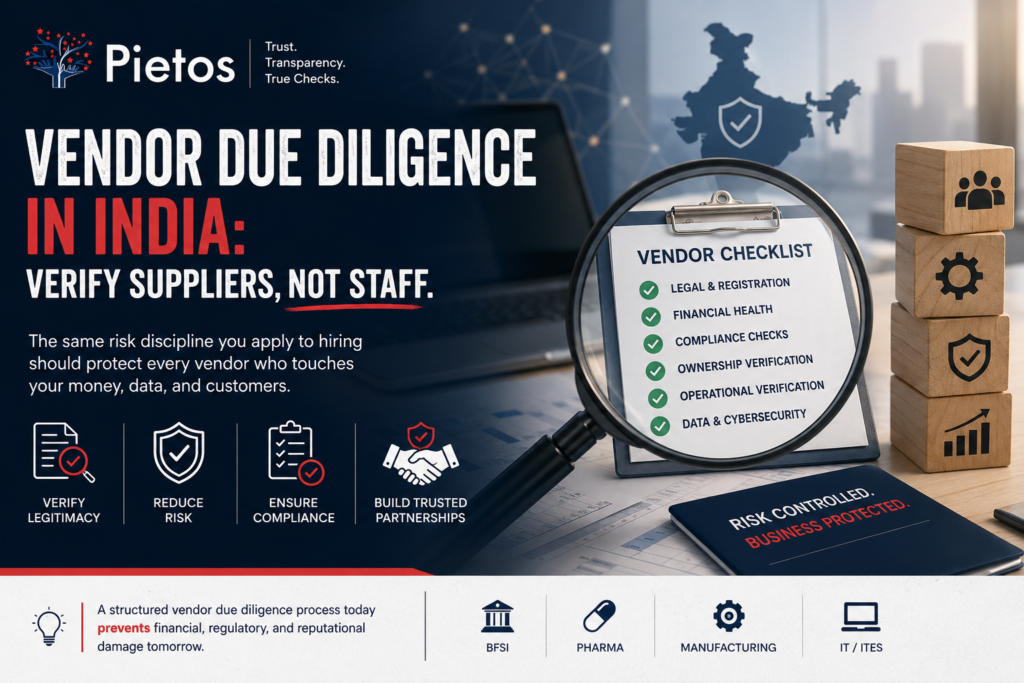
Every large enterprise runs background checks on new hires. Far fewer run the same discipline on the vendors who touch their money, data, and customers. Vendor due diligence in India closes that gap — it verifies suppliers, contractors, and service partners with the same rigor procurement teams already apply to employees, before a single purchase order goes out.
That gap is not accidental. Vendor onboarding usually sits with procurement, while background checks sit with HR. The two functions rarely share a risk framework, so a supplier can pass a commercial evaluation — price, delivery timeline, references — without anyone confirming its legal existence, ownership structure, or regulatory standing. For a company managing dozens or hundreds of active vendors, that blind spot compounds fast.
If your procurement team is still relying on GST certificates and a Google search to clear new vendors, talk to our compliance team about what a structured vendor screening process actually covers.
Why Vendor Due Diligence in India Needs Its Own Playbook
Employee background verification and vendor due diligence look similar on the surface — both confirm identity, legal standing, and history. In practice, they solve different problems.
An employee background check protects you from one person’s misrepresentation. A vendor due diligence check protects you from an entire organization’s practices — its subcontractors, its financial stability, its data handling, and its ownership chain. A single vendor failure can disrupt production, trigger a regulatory notice, or expose customer data across thousands of records at once.
Indian supply chains add three layers of complexity that a generic checklist misses:
- Fragmented registries. Company data sits across MCA, GST, EPFO, and state-level registrations, rarely in one place.
- Layered subcontracting. A vendor you onboard may outsource fulfillment to a second, unverified party you never see.
- Regulatory overlap. BFSI, pharma, and IT/ITES vendors each answer to sector-specific regulators on top of general corporate law.
This is why treating vendor due diligence in India as “employee BGV with a different form” leads to gaps that surface only during an audit, a fraud investigation, or a customer data breach.
The Real Cost of Skipping Vendor Due Diligence in India
Procurement teams that skip formal screening rarely notice the cost until it lands as a line item they cannot explain to the board.
Financial Exposure
Shell vendors, inflated invoicing, and duplicate billing are among the most common findings when enterprises finally audit their supplier base. A vendor with no verifiable operating history or physical premises can still clear a purchase order if no one checks. Industry estimates from fraud examiner bodies consistently place vendor and procurement fraud among the costliest categories of occupational fraud globally, often exceeding losses from any other single fraud scheme.
Regulatory Exposure
Indian regulators increasingly hold the principal company accountable for third-party failures, not just the vendor itself.
- RBI-regulated entities (banks, NBFCs) must extend outsourcing risk management to every vendor handling customer data or core processes.
- The DPDP Act, 2023 makes data fiduciaries responsible for how processors and sub-processors handle personal data — including data a vendor mishandles.
- GST law exposes buyers to input tax credit reversal if a supplier turns out to be non-compliant or fictitious.
Reputational Fallout
A vendor caught in a labor violation, environmental breach, or data leak drags your brand into the story, regardless of contract language. For BFSI and consumer-facing brands, that association is often harder to repair than the financial loss itself.
This is precisely where a structured vendor due diligence India process pays for itself — catching the shell vendor, the undisclosed subcontractor, or the lapsed compliance certificate before it becomes a board-level incident.
What a Complete Vendor Due Diligence Process in India Covers
A defensible vendor due diligence process in India goes well beyond a GST number and a company PAN. Procurement and compliance teams typically structure it across six verification layers.
Legal and Registration Verification
Confirms the vendor is a legally incorporated, active entity — checked against MCA records, GST registration status, PAN validity, and any applicable trade licenses. This step alone eliminates shell entities and defunct companies still circulating old paperwork.
Financial Health and Credit Checks
Reviews financial statements, credit ratings, litigation history, and payment default records. A vendor in financial distress is a supply continuity risk even if every document is technically valid.
Compliance and Regulatory Screening
Checks the vendor against sanctions lists, PEP (politically exposed persons) databases, EPFO and labor law compliance, and sector-specific regulatory requirements relevant to BFSI, pharma, or manufacturing clients.
Beneficial Ownership and Related-Party Checks
Identifies the actual individuals who own or control the vendor entity, and flags any undisclosed relationship to your own employees or leadership — a common source of conflict-of-interest fraud.
Operational and Site Verification
Confirms the vendor’s physical premises, manufacturing capacity, or service delivery infrastructure actually exist and match what was represented during sourcing.
Cybersecurity and Data Handling Checks
Assesses how the vendor stores, processes, and secures any data you share, mapped against DPDP Act obligations — critical for IT/ITES, BPO, and any vendor with system access.
Key takeaway: A vendor that passes only legal and financial checks is still an unverified data and operational risk. All six layers matter, weighted by how much access and exposure the vendor actually has.
Vendor Due Diligence vs Employee Background Verification: Key Differences
| Dimension | Vendor Due Diligence | Employee Background Verification |
| Subject | An entity — legal, financial, ownership structure | An individual — identity, history, credentials |
| Owner in most orgs | Procurement / Compliance | HR / Talent Acquisition |
| Core risk | Financial, regulatory, supply continuity, data | Misrepresentation, fraud, workplace safety |
| Refresh cycle | Ongoing / contract renewal-based | Typically one-time, pre-hire |
| Regulatory anchor | RBI outsourcing norms, DPDP Act, GST law | DPDP Act, labor law, sector HR guidelines |
| Failure impact | Can affect entire customer base or supply chain | Typically contained to one role or team |
Both processes protect the organization, but a single BGV vendor built for hiring volume rarely has the entity-level, financial, and ownership-verification depth that vendor due diligence in India demands.
A Practical Framework: Tiered Vendor Risk Assessment
Not every vendor needs the same depth of screening. A tiered framework lets procurement teams allocate due diligence effort where risk actually concentrates.
Tier 1 — Critical vendors (data access, core operations, high spend): Full six-layer verification, refreshed annually, with continuous monitoring for adverse media and regulatory flags.
Tier 2 — Moderate-risk vendors (limited data access, mid-spend, replaceable supply): Legal, financial, and compliance checks at onboarding, refreshed at contract renewal.
Tier 3 — Low-risk vendors (no data access, low spend, easily substituted): Basic legal and GST verification at onboarding only.
This tiering does two things a flat checklist cannot: it keeps due diligence cost proportional to exposure, and it gives auditors a documented rationale for why each vendor was screened the way it was — a detail that matters during ISO or RBI compliance reviews.
Industry-Specific Vendor Risk in India
- BFSI and NBFCs: Outsourcing to a vendor without RBI-aligned due diligence can itself become a regulatory finding, independent of any actual vendor misconduct.
- Manufacturing: Subcontractor layering hides labor and environmental compliance gaps several tiers deep in the supply chain.
- IT/ITES and BPO: Data access makes cybersecurity and DPDP Act alignment the single highest-weight verification layer.
- Pharma and healthcare: Regulatory licensing and quality certification gaps carry both compliance and patient-safety consequences.
Common Objections to Formal Vendor Due Diligence — Answered
“Our vendors are all long-term relationships; we already trust them.” Trust is not a compliance control. Auditors and regulators require documented verification, not tenure. A long relationship also means more time for a vendor’s ownership or financial position to change unnoticed.
“This will slow down procurement.” A tiered framework screens high-risk vendors thoroughly and low-risk vendors quickly, so overall onboarding speed rarely drops once the process is calibrated correctly.
“We already do a financial check through our bank.” A bank’s credit check does not cover beneficial ownership, regulatory sanctions, or DPDP-aligned data handling — three of the six layers that create the most exposure.
“It’s an added cost with no clear ROI.” The cost of one shell-vendor fraud, GST input credit reversal, or DPDP Act penalty typically exceeds years of due diligence spend on the full vendor base.
Building a Vendor Due Diligence Checklist for Your Procurement Team
A working checklist your team can apply at onboarding and renewal:
- Confirm active MCA registration and PAN validity
- Verify GST registration status and filing consistency
- Check litigation history and financial distress signals
- Screen against sanctions, PEP, and adverse media lists
- Identify beneficial owners and check for internal conflicts of interest
- Validate physical premises or delivery infrastructure
- Assess data handling practices against DPDP Act requirements
- Document risk tier and refresh cycle for audit trail
- Flag subcontractors the vendor plans to use
- Set a review trigger tied to contract renewal or risk-tier change
How Pietos Solutions Approaches Vendor and Third-Party Due Diligence
Pietos Solutions Private Limited built its vendor due diligence India process specifically for procurement and compliance teams — not as an extension of a hiring-focused BGV product. Verification covers legal and registration checks, financial and credit screening, beneficial ownership mapping, regulatory and sanctions screening, and DPDP Act-aligned data handling assessments, structured across the same tiered framework outlined above.
Reports are built for audit defensibility, with documented methodology procurement and compliance teams can present directly to regulators or ISO reviewers.
If your organization is formalizing a vendor risk program, or preparing for an RBI or ISO audit that touches third-party risk, get in touch with the Pietos Solutions team to see how the framework maps to your existing vendor base.
Key Takeaways
- Vendor due diligence protects against entity-level risk; employee BGV protects against individual risk. They need separate frameworks.
- Six verification layers matter: legal, financial, compliance, ownership, operational, and data/cybersecurity.
- A tiered approach keeps due diligence proportional to vendor risk and spend.
- RBI, DPDP Act, and GST law all extend liability to the principal company for vendor failures.
- Formal vendor due diligence in India is now an audit expectation, not an optional add-on.
Frequently Asked Questions
Vendor due diligence in India is the process of verifying a supplier’s legal standing, financial health, ownership structure, regulatory compliance, and data handling practices before and during a business relationship.
RBI outsourcing guidelines for BFSI entities, the DPDP Act, 2023 for data processors, and GST law’s input credit provisions all create direct or indirect requirements for verified vendor relationships.
RBI outsourcing guidelines for BFSI entities, the DPDP Act, 2023 for data processors, and GST law’s input credit provisions all create direct or indirect requirements for verified vendor relationships.
Critical, high-risk vendors should be reviewed annually or at every contract renewal. Lower-risk vendors can be reviewed at onboarding only, based on a documented risk tier.
Yes, but at a lighter tier. A tiered framework applies full six-layer checks only to critical vendors, and lighter legal/GST checks to low-risk ones.
Related Resources
- DigiLocker for background verification → https://pietos.com/blog/digilocker-bgv (anchor: DigiLocker-based document verification) — relevant for the document-verification layer of vendor onboarding.
- BGV audit checklist for ISO reviews → https://pietos.com/blog/bgv-audit-checklist-iso (anchor: BGV audit checklist) — directly supports the audit-defensibility theme of this piece.
- DPDP Act compliance for background checks → https://pietos.com/blog/dpdp-act-compliance (anchor: DPDP Act compliance guide) — expands on the data-handling verification layer.
- NBFC and RBI background verification obligations → https://pietos.com/blog/nbfc-rbi-bgv-obligations (anchor: RBI outsourcing compliance) — supports the BFSI regulatory section.
- Remote employee verification in India → https://pietos.com/blog/remote-employee-verification (anchor: remote workforce verification) — relevant for vendors with remote or distributed teams.