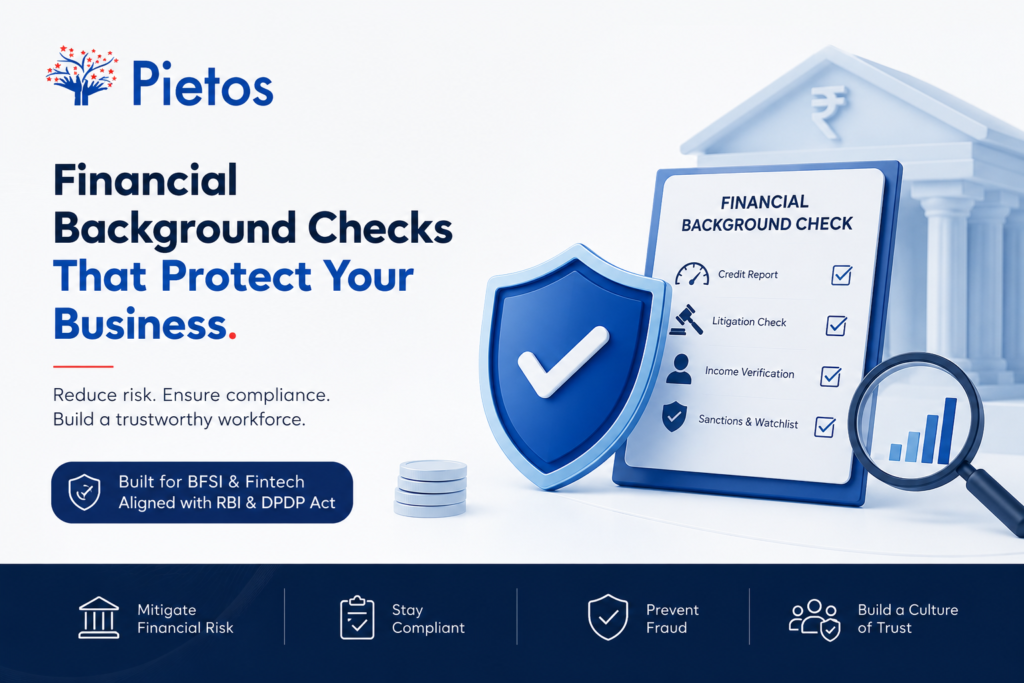
A financial background check in India verifies a candidate’s credit history, financial conduct, and money-related red flags before you hand them access to funds, loans, or customer accounts. For banks, NBFCs, and fintech lenders, this isn’t a nice-to-have. It’s the check that catches the risks a standard employment verification misses.
Most HR teams run PAN checks, education checks, and past-employment checks by default. Far fewer run a proper financial background check India-wide, even for roles where a candidate handles disbursals, approves loans, or manages collections. That gap is where fraud slips through.
This guide breaks down what a financial background check covers, which roles genuinely need one, and how to build a process that satisfies RBI expectations without breaching the DPDP Act.
Building or auditing your BFSI hiring policy? Talk to Pietos about a financial background check India program built for your risk profile.
What Is a Financial Background Check in India?
A financial background check India employers use typically combines three layers: a credit bureau pull, a litigation and fraud-record search, and a verification of declared income or existing financial obligations. Together, they answer one question: does this candidate’s financial history create risk for a role involving money or credit decisions?
This is different from a routine employment BGV. A standard check confirms who someone says they are. A financial background check confirms whether their money history makes them a liability in a role that touches yours.
Financial vs. Credit vs. Criminal Checks — What’s the Difference?
HR teams often use these terms interchangeably. They shouldn’t.
- Credit check — Pulls a candidate’s credit score and repayment history from a bureau like CIBIL, Experian, or CRIF High Mark. Shows loan defaults, credit card delinquency, and overall credit behaviour.
- Financial background check — Broader than a credit check. Includes litigation records tied to financial disputes, cheque-bounce cases, insolvency filings, and sometimes income verification.
- Criminal background check — Covers court records for criminal offences, unrelated to credit. Often run alongside a financial check for BFSI roles, but it answers a different question.
A candidate can have a clean criminal record and a poor credit history — or the reverse. BFSI and fintech employers usually need both checks, not one instead of the other.
Why BFSI and Fintech HR Teams Can’t Skip This Check
Banks and NBFCs operate under the Reserve Bank of India‘s “fit and proper” expectation for staff in positions of trust. That expectation doesn’t stop at the boardroom. It extends to any employee who can move money, approve credit, or access customer financial data. A relationship manager with unmanageable personal debt, or a collections agent with a fraud-linked litigation history, is exactly the profile regulators expect you to have screened out.
Roles That Legally Warrant a Credit Background Check
Not every hire needs a financial background check India-wide. Running one for a marketing executive or a support engineer is disproportionate and can raise data-minimisation concerns under the DPDP Act. Reserve it for roles with financial accountability:
- Loan officers and underwriters
- Collection and recovery agents
- Branch cashiers and tellers
- Relationship managers with disbursal authority
- Treasury and finance team members
- CFOs, controllers, and accounts heads
- Compliance and risk officers who audit financial controls
- Fintech engineers with direct access to payment or lending systems
The Real Cost of Skipping It
Skipping the check doesn’t remove the risk. It just delays when you find out about it.
A collections agent hired without a financial background check can quietly run a parallel recovery racket, pocketing cash payments meant for the company. A loan officer with hidden debt has a personal incentive to approve high-risk applications for a kickback. A relationship manager with an undisclosed cheque-bounce case brings exactly the credibility risk your customers are trusting you not to have.
These aren’t rare edge cases. They’re the recurring pattern behind insider fraud losses that show up in RBI’s periodic fraud monitoring data — losses that trace back to a hiring decision made without a financial screen.
Not sure which roles in your organisation need a mandatory financial background check India rules cover? Pietos maps this against your role matrix in a free 20-minute consult.
What a Financial Background Check in India Actually Covers
A well-built financial background check India process pulls from four distinct sources. Skipping any one of them leaves a blind spot.
Credit Bureau and CIBIL Report Checks
This is the core of most financial screening. A credit bureau report — commonly a CIBIL report, though Experian and CRIF High Mark are also used — shows:
- Credit score and score trend
- Active loans and credit cards
- Repayment history and any defaults
- Written-off or settled accounts
- Number of hard inquiries in recent months
A single missed EMI isn’t automatically disqualifying. What matters is pattern: repeated defaults, settled-not-paid accounts, or a score trajectory that suggests financial distress in a role where that distress creates an incentive to misappropriate funds.
Litigation and Financial Fraud Record Checks
Court record searches surface civil litigation tied to money — cheque-bounce cases under Section 138 of the Negotiable Instruments Act, recovery suits, and any financial fraud proceedings. This layer catches disputes that never show up on a credit report because they involve private parties, not registered lenders.
Income and Bank Statement Verification
For senior finance roles, employers often verify declared income against salary slips, Form 16, or bank statements. This confirms the candidate hasn’t misrepresented their financial standing and flags any undisclosed side income that could signal a conflict of interest.
Existing Loan, Default, and Guarantor History
Beyond the candidate’s own loans, some BFSI employers check whether a candidate has stood as a guarantor for defaulted loans. A guarantor obligation on a written-off account is a liability that doesn’t always surface in a standard credit pull, depending on how the bureau records it.
The Legal Framework: RBI, CICRA, and the DPDP Act
Running a financial background check India employers rely on isn’t just a policy choice. It sits inside a specific legal framework, and getting the sequence wrong creates real exposure.
RBI’s Fit and Proper Expectations
RBI’s fit and proper norms require banks and NBFCs to assess the integrity, financial soundness, and background of people in positions of trust. While this language was written primarily for directors and key managerial personnel, regulators and internal audit teams increasingly expect the same standard to cascade down to any staff role with financial accountability. Outsourcing directions on financial services also require that third-party vendors accessing customer data are properly vetted — which extends the same expectation to your BGV partner, not just your direct hires.
CICRA and Why You Can’t Pull a Credit Report Without Consent
The Credit Information Companies (Regulation) Act, 2005 (CICRA) governs how credit bureaus like CIBIL can release data, and to whom. Employers cannot request a candidate’s credit report as a matter of routine. It must be tied to a role with genuine financial accountability, and it requires the candidate’s explicit, informed consent before the pull happens — not after.
Pulling a credit report for a role that doesn’t need one — say, a customer support hire with no disbursal authority — isn’t just poor practice. It risks a data-minimisation challenge under privacy law, and it weakens your position if a candidate ever disputes the check.
DPDP Act 2023 — Consent, Purpose Limitation, Retention
The Digital Personal Data Protection Act, 2023 layers three more obligations on top of CICRA:
- Explicit consent — The candidate must know exactly what’s being checked and why, before you check it.
- Purpose limitation — Financial data collected for hiring can’t be repurposed later without fresh consent.
- Retention limits — Adverse reports for candidates you don’t hire shouldn’t sit in your systems indefinitely. Best practice is to purge or anonymise within a defined window — typically 90 to 180 days — unless a specific regulatory requirement says otherwise.
Get this sequencing wrong — pull the credit report, then ask for consent, then decide the role didn’t need it — and you’ve created a compliance liability instead of a hiring safeguard.
A Step-by-Step Financial Background Check Framework
Use this sequence to keep your process both compliant and efficient:
- Classify the role first. Confirm the position has genuine financial accountability before triggering any financial or credit check.
- Disclose and obtain consent. Give the candidate a clear, written explanation of what will be checked and why. Get signed consent before initiating any bureau pull.
- Run the credit bureau check. Pull the report through an authorised channel — never through informal or personal access to bureau systems.
- Run the litigation and fraud-record search. Cover civil courts relevant to the candidate’s work and residence locations.
- Cross-verify income documentation for senior finance and treasury roles.
- Apply a documented risk matrix, not a gut call. Define in advance what score range, default pattern, or litigation type triggers further review versus automatic rejection.
- Give the candidate a chance to respond to any adverse finding before a final decision — this procedural fairness step matters if the decision is ever challenged.
- Record the decision rationale, not just the outcome. Auditors and courts increasingly ask why a red flag led to a specific action.
- Set a retention and purge schedule for reports on candidates who weren’t hired.
In-House vs. Outsourced Financial Screening
| Factor | In-House Team | Outsourced to a BGV Partner |
| Bureau access | Requires direct bureau agreements and compliance setup | Partner already holds authorised access |
| Turnaround time | Often 10–20 days, depending on internal bandwidth | Typically 5–10 working days for standard checks |
| DPDP/CICRA compliance | HR team must build and maintain consent workflows | Compliance workflow is pre-built and audit-ready |
| Cost at scale | Lower per-check cost, high fixed overhead | Higher per-check cost, near-zero fixed overhead |
| Audit trail | Depends on internal documentation discipline | Standardised, exportable for regulatory audits |
| Best fit | Very large BFSI players with dedicated compliance teams | NBFCs, fintechs, and banks without a dedicated screening desk |
For most NBFCs and fintech lenders, the fixed cost of building compliant in-house bureau access — plus the ongoing DPDP consent infrastructure — outweighs the savings, especially below a few hundred hires a year.
Common Objections HR Leaders Raise (and Straight Answers)
“Won’t candidates see this as intrusive?” Framed correctly, most don’t. Disclose the check as standard for the role category, explain the regulatory reason, and give candidates a channel to explain any flagged item. Resistance usually drops once candidates understand it’s role-specific, not a blanket policy.
“Isn’t a credit check illegal without consent?” Yes — which is exactly why consent has to come first, in writing, before any bureau pull. This isn’t a grey area under CICRA.
“We’re a small NBFC. Do we really need this?” Size doesn’t change your regulatory exposure. A single insider fraud case at a 50-person NBFC can be more damaging, proportionally, than at a large bank. Smaller teams often benefit more from outsourcing, since building compliant in-house infrastructure isn’t worth it at low hiring volume.
“What if we find something after the person is already hired?” Build this into your BGV timeline, not as an afterthought. If a serious financial fraud finding surfaces post-hire, your employment contract should already specify grounds for termination tied to undisclosed or misrepresented financial history.
Building a Compliant Financial Background Check Policy — Checklist
Use this before your next hiring cycle:
- [ ] Role matrix defining which positions trigger a financial/credit check
- [ ] Standardised consent form referencing CICRA and DPDP Act obligations
- [ ] Approved bureau or vendor for credit report access
- [ ] Documented risk matrix for score thresholds and red-flag categories
- [ ] Process for candidate response to adverse findings
- [ ] Retention and purge policy for non-hire reports
- [ ] Audit trail covering consent, findings, and decision rationale
- [ ] Annual policy review against updated RBI and DPDP guidance
Have a hiring cycle coming up and no financial screening policy in place yet? Pietos builds and runs a compliant financial background check India program end to end — from role mapping to bureau access to audit-ready reporting. Get a scoped quote in one call.
RELATED RESOURCES
| Anchor Text | Destination Page | Reason to Link |
| background verification for banks and NBFCs | https://pietos.com/background-verification-banks-nbfcs/ | Direct topical parent — covers the broader BFSI BGV framework this article sits inside |
| DPDP Act candidate consent requirements | https://pietos.com/dpdp-act-candidate-consent/ | Deepens the consent/legal section without re-explaining it in full |
| executive and CXO background verification | https://pietos.com/executive-cxo-background-check/ | Natural next read for HR screening senior finance hires (CFO, controller) |
| BGV audit checklist for compliance teams | https://pietos.com/bgv-audit-checklist/ | Supports the policy checklist section with a deeper operational resource |
| remote and field employee verification | https://pietos.com/remote-employee-background-check/ | Relevant for NBFCs with distributed collections/field agent teams |
Frequently Asked Questions
A financial background check in India verifies a candidate’s credit history, financial litigation record, and sometimes declared income, before hiring them into a role with money or credit accountability.
It isn’t mandated for every role, but RBI’s fit-and-proper expectations and internal risk policy make it standard practice for roles with financial accountability, such as loan officers, treasury staff, and collection agents.
Yes, but only with the candidate’s explicit written consent, and only for roles where the check is relevant to financial accountability. This is a requirement under CICRA, not a courtesy
Standard credit and litigation checks typically take 5 to 10 working days through an authorised BGV partner. In-house processes without direct bureau access often take longer.
A single default isn’t automatically disqualifying. Employers should apply a documented risk matrix and give the candidate a chance to explain before making a final decision.
For candidates who aren’t hired, best practice under the DPDP Act is to purge or anonymise reports within 90 to 180 days, unless a specific regulatory retention requirement applies