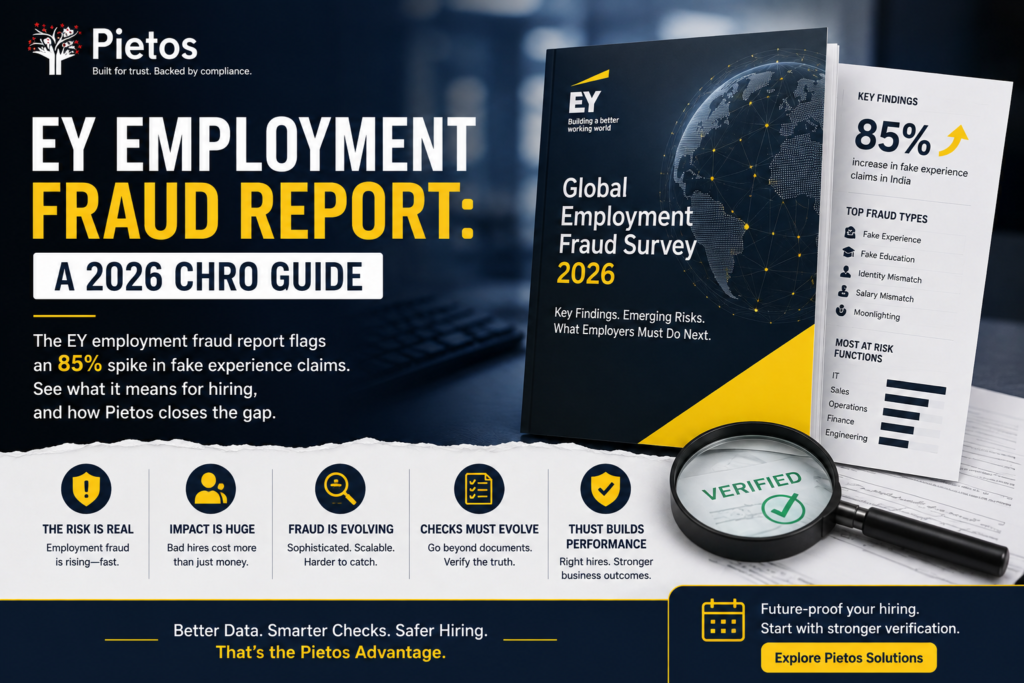
The EY employment fraud report India study should change how your HR team reads every resume that lands on its desk. Released in May 2025, EY’s “The First Firewall” study reviewed more than one million background checks across 90-plus Indian companies. The headline finding is simple. Fraud showed up in 85% of employment history checks. That number is not a rounding error. It is a pattern that repeats across sectors, cities, and job levels.
Most HR leaders already assume resumes get polished here and there. Few expect fraud at this scale. The candidates involved were not fresh graduates either. Experienced professionals made up most of the fraud cases the study flagged. That single detail should reshape how your team screens senior and mid-level hires, not just entry-level ones.
This guide breaks down what the EY employment fraud report India data actually found, why the findings matter for CHROs specifically, and what a realistic response looks like heading into 2026. It also covers sector-by-sector risk, the specific tactics fraudsters use, and a practical rollout plan HR teams can start on this quarter rather than filing away for later.
Want a second opinion on your current screening gaps? Book a free BGV audit with Pietos and see exactly where your process stands today.
What the EY Employment Fraud Report India Study Measured
Study Methodology and Sample Size
EY built this study on real verification data, not a survey or a panel of opinions. Researchers analysed background checks run across more than 90 mid-to-large Indian organisations. The sample spans over one million individual checks, making it one of the largest employment fraud datasets published for the Indian market to date.
This scale matters. Smaller studies can get skewed by one industry or one region. A dataset this large, pulled from real verification workflows, gives HR leaders something closer to ground truth. It also means the findings apply broadly, not just to a single sector or city.
Why This Data Is Different From Past Studies
Most background verification statistics in India come from vendor marketing pages or small internal surveys. Sample sizes rarely cross a few thousand candidates. EY’s dataset is different because it draws on actual verification outcomes, not self-reported opinions from HR managers.
This distinction changes how much weight the numbers deserve. A survey asks people what they believe about fraud. A verification dataset shows what fraud actually looked like once someone checked. The EY employment fraud report India findings sit firmly in the second category, which is why business journalists and compliance teams have treated the study as a credible benchmark rather than another marketing statistic.
The study also spans a wide range of company sizes, from mid-sized firms to large enterprises. That range matters for HR leaders at smaller organisations who sometimes assume fraud only targets large, high-profile employers. The data says otherwise.
The Headline Number: 85% Fraud Rate
The EY employment fraud report India findings show discrepancies in 85% of cases flagged for review during employment history checks. Forged resumes, fabricated documents, dual employment, and even deepfake-assisted interviews all featured among the tactics EY documented. Technology is making fraud easier to commit. At the same time, the right technology is making fraud far easier to catch.
Arpinder Singh of EY’s Forensic and Integrity Services team called employment fraud a “longstanding menace” in Indian hiring. His point lands harder once you see the sector breakdown below.
Sector-by-Sector Breakdown
The EY employment fraud report India data does not spread fraud evenly. Some sectors carry far more risk than others, and the gap is wide enough to demand different screening strategies by industry. HR leaders comparing budgets across sectors should treat this breakdown as a starting checklist, not just background context.
Healthcare: 96% Fraud Among Experienced Hires
Healthcare topped the list. Ninety-six percent of flagged fraud cases in this sector involved experienced professionals, not junior staff. Patient safety sits directly downstream of hiring integrity here. A fabricated credential in a hospital or diagnostics chain is not a paperwork issue. It is a patient-safety issue.
Financial Services: 88% and Rising
Financial services followed close behind at 88%. Banks, NBFCs, and fintech firms handle sensitive financial data and, in many roles, direct access to customer funds. A single bad hire in a loan processing or relationship management role can expose an organisation to both fraud losses and regulatory penalties.
IT/ITeS: 79% and the Remote-Work Factor
IT and ITeS came in at 79%. Remote and hybrid work models make this sector especially exposed to dual employment, sometimes called moonlighting. A developer working two full-time jobs at once creates real risk: split attention, conflicts of interest, and possible leaks of proprietary code between competing employers.
| Sector | Fraud rate among experienced hires | Primary risk |
|---|---|---|
| Healthcare | 96% | Patient safety, license fraud |
| Financial services | 88% | Regulatory exposure, fund access |
| IT/ITeS | 79% | Dual employment, IP leakage |
If your organisation sits in any of these three sectors, this report is not background reading. It is a direct signal about your own applicant pool.
Other Sectors Also Carry Real Exposure
The three sectors above topped the list, but the EY employment fraud report India data does not stop there. Manufacturing and logistics firms face a different flavour of the same problem: field staff whose credentials are harder to verify in person, and whose reference checks often route through informal networks rather than official HR channels.
Retail and gig-economy hiring add another layer. High-volume, fast-turnaround hiring leaves less time per candidate for manual review, which is exactly the environment where forged documents pass through unnoticed. Startups scaling quickly fall into the same trap, often without a dedicated compliance function to catch what recruiters miss.
None of this means every sector faces identical risk. It does mean that treating background verification as a checkbox for regulated industries only misses where fraud is actually spreading.
The Global Context: How India Compares
India’s numbers do not exist in isolation. The ACFE’s 2024 Report to the Nations studied nearly 2,000 occupational fraud cases across 138 countries and found that organisations lose an estimated 5% of annual revenue to fraud worldwide. That figure covers all forms of occupational fraud, not hiring fraud alone, which makes India’s 85% employment-check discrepancy rate look especially sharp by comparison.
Global background screening providers report similar directional trends. First Advantage’s 2025 Global Trends Report, covering 80,000 organisations across more than 200 countries, pointed to accelerating automation in screening and a rising adoption of digital identity fraud tools as employers respond to more sophisticated fake-document tactics.
The pattern across these reports is consistent: fraud tactics are evolving faster than manual verification processes can keep up with, everywhere, not just in India. What makes the EY employment fraud report India findings distinct is the scale and the sector-level granularity, which gives Indian HR leaders a far more specific starting point than a global average ever could.
Why This Should Alarm Every CHRO
A single bad hire rarely stays a single problem. It becomes a compliance gap first, then a legal exposure, and sometimes a headline. Regulated employers face extra scrutiny here, especially in sectors that answer to bodies aligned with the Reserve Bank of India.
The timing makes this worse. India’s Digital Personal Data Protection framework is now fully active. HR teams that mishandle candidate data during verification carry direct legal exposure under the DPDP Act, 2023. Screening candidates properly is no longer a nice-to-have. It is a compliance requirement with real consequences attached.
See how the risk categories in this report map to Pietos’ own verification framework. Book a Demo and get a side-by-side comparison.
The Real Financial Cost of a Bad Hire
Industry estimates put the cost of a single bad hire at roughly four times that person’s annual salary, once training, severance, and lost productivity are counted. That figure excludes reputational damage. It also excludes the cost of a compliance investigation, which can run for months.
Global fraud data backs this up. The ACFE’s 2024 Report to the Nations found that organisations lose close to 5% of annual revenue to occupational fraud, much of it traceable back to weak pre-employment screening. The EY employment fraud report India numbers simply confirm the local, sharper version of a global problem.
Cost of Inaction vs. Cost of Prevention
Delaying a stronger BGV process feels cheap in the short term. It rarely stays cheap. Consider a mid-sized NBFC hiring 500 employees a year. Even a conservative 10% fraud rate at entry, left uncaught, translates into dozens of compromised hires annually. Prevention costs a fixed amount per check. Inaction costs an unpredictable amount per incident, and that unpredictability is exactly what makes budgeting for risk so hard.
Brand and Investor Risk
A fraud incident rarely stays internal for long. Once a fabricated-credential case becomes public, whether through a lawsuit, a regulatory notice, or simple word of mouth, it attaches itself to the employer’s name in every future hiring conversation. Candidates research employers before applying. Investors and enterprise clients do the same during due diligence.
For companies preparing for funding rounds, IPOs, or enterprise contracts, a documented hiring integrity framework is fast becoming part of the trust package investors expect to see. Weak screening, by contrast, becomes a red flag in exactly the kind of diligence process that decides whether a deal closes.
Five Fraud Tactics the Report Documents
The EY employment fraud report India findings name specific tactics HR teams are up against right now. Each one defeats a different part of a traditional screening process.
- Forged experience letters — Digitally altered documents that copy real company letterheads, seals, and signatures with near-perfect accuracy. A decade ago, these forgeries left obvious traces under close inspection. Today’s versions often survive a visual check without issue, which is why forensic-level scanning has become necessary rather than optional.
- Fabricated employment history — Inflated job titles, stretched tenures, and invented responsibilities that never existed. This tactic is harder to catch than outright forgery because the underlying employer may be real. Only a direct call or database cross-check against the former employer’s HR system reveals the gap.
- Dual employment — Candidates drawing salaries from two employers at the same time, usually without telling either one. Remote work has made this tactic dramatically easier to sustain, since neither employer can observe the candidate’s actual working hours.
- Degree mill credentials — Qualifications issued by institutions with no real accreditation. The UGC’s official fake universities list currently names 32 such institutions across India, a number that has grown year over year as new fraudulent operators appear.
- Deepfake interview proxies — AI-generated faces or voices standing in for the real candidate during a virtual screening call. This is the newest tactic on the list, and the hardest for a human interviewer to catch without a technical identity-matching step built into the process.
A resume review alone catches almost none of these reliably. That gap explains why layered, tech-enabled verification is fast becoming the baseline, not the upgrade.
The Technology Behind Modern Hiring Fraud
AI-Generated Documents
Photoshop-era forgery used to leave obvious traces: mismatched fonts, blurry seals, odd spacing. Generative AI tools have closed most of those gaps. A synthetic experience letter today can carry a convincing digital signature, a matching watermark, and metadata that looks plausible at first glance. Only structural, pixel-level analysis reliably tells these documents apart from the real thing, which is exactly what Pietos’ document forensics AI layer is built to catch.
Deepfake Interview Proxies
Virtual hiring made deepfake fraud possible in a way in-person interviews never allowed. A candidate can now hire a stand-in, or use real-time face-swapping software, to sit a technical interview on their behalf. Detecting this requires more than a gut check from the interviewer. It requires identity verification steps that cross-reference the interview session against government-issued ID data.
From Manual Review to AI Pipelines
Five years ago, most Indian BGV workflows ran on a mix of phone calls, physical document review, and email confirmations from former employers. That process worked reasonably well against basic forgery. It struggles badly against AI-generated fraud, simply because a human reviewer cannot spot a pixel-level manipulation or a metadata mismatch by eye.
The shift underway now mirrors what happened in fraud detection across banking a decade earlier. Manual review gave way to automated, database-driven checks once fraud volume and sophistication both increased past what human teams could realistically catch. HR verification is going through the same transition, just a few years behind.
This does not mean removing human judgment from the process entirely. It means giving HR teams a first-pass filter powerful enough to flag the cases that actually deserve a closer human look, instead of asking recruiters to catch everything unaided.
What a 2026-Ready Verification Framework Looks Like
Layer 1: Identity and Document Forensics
Every check should start with identity confirmation against PAN, Aadhaar, or passport data, followed by a forensic scan of any submitted document. Manual review alone misses a large share of high-quality fakes. AI-driven document forensics checks font structure, file metadata, and pixel-level consistency instead of relying on a human eye under time pressure.
Layer 2: Employment History and Moonlighting Checks
Dual employment deserves specific attention here, since it is one of the exact tactics the EY employment fraud report India data calls out. Pietos’ moonlighting detection framework cross-references EPFO contribution data to flag candidates drawing PF from two employers in the same month. A related check, dual employment verification, extends this into a full concurrent-employment scan for high-risk roles.
Layer 3: Education and Credential Verification
Every degree claim should get checked directly against the issuing institution, or via a national registry such as DigiLocker. Pietos’ DigiLocker background verification guide explains how this step closes gaps that manual document review cannot catch, especially for candidates from smaller or lesser-known institutions.
Layer 4: Continuous Post-Hire Monitoring
Fraud does not stop at the offer letter. A candidate’s risk profile can change after joining. Pietos’ continuous background monitoring approach re-checks EPFO status and other fast-changing data points on a rolling basis, rather than treating verification as a single event that happens once and never again.
Two other checks close the loop at the front end. First, run every resume against a structured fake resume detection process instead of trusting the document at face value. Second, train recruiters to recognise the specific BGV red flags that correlate most strongly with fraud, including unexplained gaps and vague reference feedback.
Layer 5: Vendor Due Diligence and Field Verification
Digital checks cover most fraud tactics, but address verification and certain reference checks still benefit from a field presence, especially for roles that involve customer visits, cash handling, or remote work locations. Not every BGV vendor actually sends someone on-site, despite claiming to. Ask for geo-tagged photo proof and time-stamped visit logs before trusting any vendor’s field verification claims.
This layer also covers vendor accountability more broadly. A BGV partner that cannot produce audit-ready logs for its own checks creates the same compliance exposure as skipping verification altogether, just one step removed.
A 90-Day Implementation Roadmap for HR Teams
Reading the EY employment fraud report India findings is one thing. Acting on them is another. A phased rollout keeps the change manageable instead of overwhelming an HR team already stretched across hiring targets.
Days 1–30: Audit and prioritise. Map your current BGV process against the five fraud tactics above. Identify which ones your existing vendor already catches, and which ones slip through untouched. Prioritise document forensics and moonlighting checks first, since these two address the tactics the report flags most often.
Days 31–60: Pilot the gaps. Run a pilot batch of new hires through an upgraded verification layer, ideally in the sector or role type carrying the highest fraud exposure at your organisation. Compare pilot results against your historical baseline to quantify the difference in catch rate.
Days 61–90: Roll out and train. Extend the upgraded process across all hiring, and train recruiters on the red-flag patterns that deserve escalation. Build a simple internal dashboard tracking fraud catch rate over time, so the business case stays visible to leadership well beyond the initial rollout.
This roadmap keeps the change achievable without asking HR to rebuild its entire hiring process overnight.
Sector-Specific Guidance for BFSI and NBFC Hiring
Financial services need a sharper version of all four layers above. Loan officers, relationship managers, and field collection staff carry direct access to customer money and data, which raises the stakes of any single bad hire. Pietos’ background verification guide for banks and NBFCs covers the sector-specific checks this segment needs, including credit history review and FIR record checks across district and state courts.
Payslip fraud deserves its own mention in this context. Candidates in BFSI roles sometimes submit doctored salary slips to inflate their compensation history or hide employment gaps. Pietos’ breakdown of fake degrees and fake payslips walks through exactly how this fraud gets constructed, and how a verification partner catches it before onboarding.
Gig and High-Volume Blue-Collar Hiring
BFSI and NBFC hiring get the most regulatory attention, but high-volume gig and blue-collar hiring carry a different, equally real exposure. Delivery, logistics, and field-service roles often skip formal BGV altogether because of hiring speed pressure. That gap becomes dangerous fast in roles involving home visits, vehicle access, or handling of customer property.
A lighter, faster verification layer, focused on identity and address confirmation rather than a full BFSI-grade check, closes most of this gap without slowing down high-volume onboarding.
What Happens When Verification Fails: A Composite Scenario
Consider a composite scenario built from patterns common across the sectors above, not any single real case. A mid-sized fintech hires a senior credit risk analyst. The candidate’s resume lists eight years at a well-known bank, backed by an experience letter that looks entirely legitimate on the surface.
Six months into the role, an unrelated audit uncovers that the candidate’s actual tenure at the listed bank ran under two years, with the remaining experience fabricated using a forged letter built from a template circulating on messaging apps. By the time the discrepancy surfaces, the analyst has already approved several high-value credit decisions without the seniority the role assumed.
This pattern matches almost exactly what the EY employment fraud report India study documents in financial services. A document forensics check at the hiring stage would have flagged the letter’s metadata inconsistencies within minutes, long before the fraud caused any downstream damage.
Objections HR Leaders Raise, and Honest Answers
“Our current vendor already runs standard checks.” Standard checks were built for a slower fraud landscape. AI-generated documents and deepfake interviews did not exist when most legacy BGV workflows were designed five or ten years ago.
“This will slow down our hiring.” Tech-enabled verification usually runs faster than manual processes, not slower, since database checks replace phone calls, paperwork, and waiting on third parties to respond.
“We haven’t seen fraud ourselves.” Most fraud goes undetected precisely because it was never designed to be caught. The absence of a reported case is not proof of the absence of risk.
“Our budget doesn’t stretch to a full framework right now.” Layered verification can roll out in phases. Start with document forensics and moonlighting checks, since these two catch the tactics the EY employment fraud report India study flags most often.
“Candidates will feel distrusted.” A transparent, consent-based process actually builds trust rather than eroding it. Genuine candidates have nothing to hide and often welcome a fast, digital verification experience over slow manual calls.
“We already had a bad experience with a BGV vendor.” A slow or unreliable past vendor is a reason to evaluate providers more carefully, not a reason to abandon verification entirely. Ask any new vendor for sample reports and audit logs before signing, so the evaluation happens on evidence rather than trust alone.
“Isn’t this just an HR problem, not a leadership priority?” The EY employment fraud report India data shows otherwise. Fraud at this scale touches compliance, finance, and brand risk simultaneously, which makes it a leadership-level conversation rather than a purely operational one.
Building the Business Case for Your Leadership Team
CHROs pitching a stronger BGV budget to leadership need numbers leadership actually cares about. Frame the conversation around three points: the cost of a single bad hire, the regulatory exposure under DPDP for mishandled data, and the sector-specific fraud rate this report documents for your industry. A short, cited summary of the EY employment fraud report India findings, alongside your own hiring volume, turns an abstract risk into a concrete number a CFO can act on.
Trust-building matters here too. Cite an external, credible source like EY rather than only internal claims, since board members and finance leaders weigh third-party research more heavily than vendor pitches alone.
Build the pitch around a simple before-and-after framing. Show current screening coverage against the five fraud tactics in this report, then show what changes with each proposed layer added. A visual gap analysis like this tends to land better with a finance-minded audience than a narrative argument alone, since it turns the pitch into a decision about closing specific, named gaps rather than an open-ended request for more budget.
How to Read This Report If You’re a Founder, Not Just a CHRO
Founders and early HR leaders at growing companies sometimes assume background verification is a large-enterprise concern. The EY employment fraud report India findings suggest the opposite. Smaller organisations often have fewer internal checks and less compliance bandwidth than large enterprises, which can make them more exposed to fraud rather than less.
A 20-person startup hiring its first finance lead carries just as much downside risk from a fabricated credential as a 2,000-person bank hiring a branch manager, proportionally speaking. The startup simply has less room to absorb the loss. Building verification into the hiring process early, before headcount scales past what a founder can personally track, avoids a much harder retrofit later.
Investors increasingly ask about hiring integrity practices during due diligence, particularly for fintech and BFSI-adjacent startups. A documented BGV process, even a lightweight one, signals operational maturity that goes beyond the immediate fraud-prevention benefit.
Measuring the ROI of Stronger Verification
A stronger BGV framework needs a way to prove its value beyond “we feel safer.” Three metrics work well for tracking this over time.
Fraud catch rate. The percentage of flagged candidates caught before onboarding, measured against your historical baseline before the upgrade. This is the most direct measure of whether the new layers are working.
Time-to-hire impact. Track whether verification turnaround time improved or worsened after moving to a more automated process. Most organisations see turnaround improve, since database checks replace slower manual calls, but this should be measured rather than assumed.
Cost avoided per bad hire prevented. Multiply the number of fraud cases caught pre-onboarding by the estimated cost of a bad hire in your sector. This turns a compliance activity into a number finance teams can weigh against the verification budget itself.
Reporting these three metrics quarterly keeps the business case alive well past the initial rollout, and gives HR leaders a concrete answer the next time leadership asks whether the investment is paying off.
A Checklist: Questions to Ask Your Current BGV Vendor
Before deciding whether your current process needs an upgrade, put these questions directly to your existing vendor. The answers usually reveal the gap faster than any internal audit.
- Does the process include AI-driven document forensics, or only visual review? Visual-only review misses most high-quality forgeries the EY employment fraud report India study documents.
- Can the vendor cross-check EPFO data for dual employment? Not every vendor has this integration, and it is one of the highest-value checks against moonlighting fraud.
- What proof does the vendor provide for field verification visits? Ask for geo-tagged photos and time-stamped logs, not just a written confirmation.
- How is candidate consent captured and stored? This directly affects your DPDP Act compliance posture, since the Data Protection Board can request audit trails.
- What is the average turnaround time, and how is it measured? Ask for data from the last quarter, not a general estimate from a sales conversation.
- Does the vendor offer any post-hire monitoring, or only a one-time check? Point-in-time checks miss risk that develops after onboarding, which the report’s dual-employment findings make especially relevant.
A vendor that answers all six questions clearly and with evidence is likely already close to the framework this report recommends. A vendor that struggles with more than two of these questions is worth re-evaluating this quarter, not next year.
Key Takeaways
- The EY employment fraud report India study found fraud in 85% of employment history checks, across more than 1 million verifications.
- Healthcare, financial services, and IT/ITeS carry the highest fraud exposure among experienced hires, at 96%, 88%, and 79% respectively.
- Forged documents, dual employment, and deepfake interviews are now standard fraud tactics, not rare edge cases.
- DPDP Act obligations make careless candidate data handling a direct legal risk, not just an HR headache.
- A layered, AI-assisted framework, covering identity, employment, education, and continuous monitoring, catches what manual resume review misses.
The EY employment fraud report India study will keep circulating in HR and business media through 2026, and for good reason. It puts a hard number on a risk most HR teams already sensed but rarely quantified. Reading it once is useful. Building it into how your team actually screens candidates is what turns the data into protection rather than just a headline everyone forgets by next quarter.
Related Resources
| Anchor text | Destination page | Reason for linking |
|---|---|---|
| moonlighting detection framework | pietos.com/moonlighting-detection-india-epfo-uan-guide-2026 | Deepens the dual-employment tactic named in the report |
| document forensics AI | pietos.com/document-forensics-ai-hiring-fraud | Explains the AI layer that catches forged documents |
| fake resume detection process | pietos.com/detect-fake-resumes-hr-guide | Gives HR a practical resume-screening checklist |
| BGV red flags | pietos.com/background-check-red-flags | Trains recruiters on early warning signs |
| NBFC background verification playbook | pietos.com/nbfc-background-verification-2026-guide | Sector-specific guidance for the highest-risk segment |
| DigiLocker background verification guide | pietos.com/digilocker-background-verification-2026-hr-guide | Covers the education-verification layer in depth |
| continuous background monitoring | pietos.com/continuous-background-monitoring-india | Extends the framework beyond point-in-time checks |
FAQ Section
The EY employment fraud report found discrepancies in 85% of employment history checks, based on more than one million verifications across 90-plus Indian companies.
Healthcare, financial services, and IT/ITeS showed the highest fraud rates among experienced professionals, at 96%, 88%, and 79% respectively
Forged experience letters, fabricated employment history, dual employment, degree mill credentials, and deepfake interview proxies all feature in the findings.
A layered verification process — identity, employment, education, and address checks backed by AI document forensics — closes most of the gaps a manual review misses.
Yes. The DPDP Act, 2023 requires documented consent and secure handling of candidate data during any verification process, making compliant BGV a legal necessity, not just best practice.