
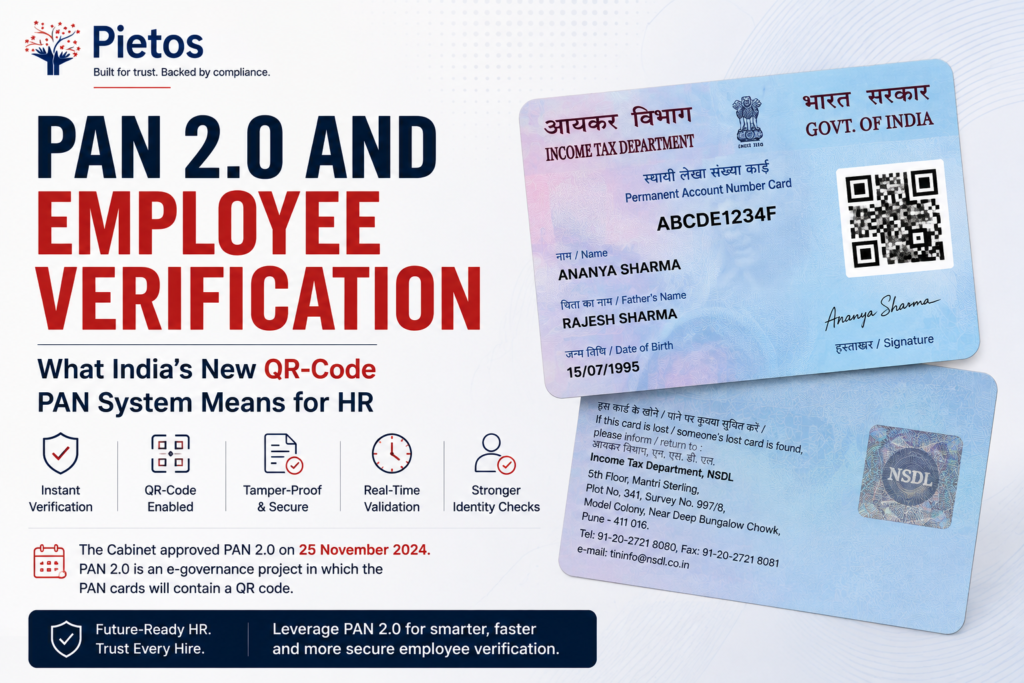
India’s Permanent Account Number system is getting its biggest upgrade in over two decades. The Cabinet Committee on Economic Affairs cleared the ₹1,435-crore PAN 2.0 project in November 2024, and by mid-2026 new and reprinted PAN cards carry a dynamic QR code. For most Indians, this sounds like a tax department update with nothing to do with hiring. For HR and compliance teams, that assumption is a mistake.
PAN 2.0 employee verification is becoming a real operational question, not a hypothetical one. Nearly every mid-size and large Indian employer checks a candidate’s PAN card during onboarding, and each of those organisations now faces two card formats circulating at once. Some candidates hold the old static PAN. Others hold the new QR-enabled version. HR teams need a process that handles both, verifies each correctly, and doesn’t slow down onboarding while the transition plays out.
This guide explains what PAN 2.0 changes, why it matters for background verification, and what a compliance-ready HR team should do before the unified portal goes fully live.
If your onboarding process still relies on a human visually checking a PAN card photo, this is a good moment to see how automated identity verification handles PAN 2.0 alongside Aadhaar and DigiLocker checks.
Why PAN Matters in Background Verification Today
Before looking at what’s changing, it helps to remember why PAN sits inside almost every Indian background verification workflow in the first place.
PAN is one of the few identity documents that ties directly into India’s financial and tax system. That makes it useful for HR teams in ways an address proof or a photo ID cannot match.
- Identity anchoring. PAN links a candidate’s name, date of birth, and photograph to a single government-issued number, which helps confirm someone is who they claim to be.
- Financial history signals. Salary verification, past employer TDS filings, and payroll onboarding all route through PAN, so a mismatched or fraudulent PAN can surface inconsistencies elsewhere in a candidate’s story.
- Regulatory requirement. BFSI, NBFC, and several other regulated sectors require PAN capture as part of statutory KYC-adjacent onboarding.
- Fraud deterrence. A PAN check makes it harder for a candidate to use a fabricated identity across multiple job applications, since PAN numbers are unique and traceable.
Because PAN already carries this weight, any structural change to how PAN cards work — like PAN 2.0 — has a direct downstream effect on verification quality. HR teams that treat PAN 2.0 as purely a tax department update risk missing that connection entirely.
What PAN 2.0 Actually Is
PAN 2.0 is not a new PAN number. Your existing PAN, and every candidate’s existing PAN, stays exactly the same. What changes is the infrastructure behind it.
Today, PAN and TAN services sit across three separate platforms: the Income Tax e-Filing portal, the UTIITSL portal, and the Protean e-Gov portal. The Cabinet Committee on Economic Affairs, chaired by the Prime Minister, approved PAN 2.0 as an e-governance project to re-engineer taxpayer registration through a technology-driven transformation of PAN and TAN services. The project folds all three platforms into one unified portal.
The other headline change is the QR code. The upgrade adds an enhanced dynamic QR code to the physical card for instant verification, and it moves PAN services from three separate systems into a single unified, paperless platform. LTIMindtree was confirmed in 2025 as the Managed Service Provider building this out.
A few facts matter most for HR teams:
- Your existing PAN number does not change. No candidate needs to reapply.
- Old PAN cards remain fully valid. There is no expiry or forced replacement.
- The upgrade is free. Candidates can request a QR-enabled reprint at no cost.
- Not every candidate will have the new card yet. Rollout is phased, so both formats will coexist for a while.
That last point is the one that actually affects verification teams. A process built only for the old static card, or only for the new dynamic QR card, will fail on roughly half the PAN cards HR sees this year.
Why the Government Built PAN 2.0
The core problem PAN 2.0 solves is fragmentation. Existing PAN-related services are spread across three different platforms — the e-Filing Portal, UTIITSL Portal, and Protean e-Gov Portal — and the project consolidates them into one unified system. It also establishes PAN as a common identifier across the digital systems of specified government agencies. For a country with a PAN database well into the hundreds of millions, that fragmentation created real friction for taxpayers requesting corrections, reprints, or updates.
There’s also a security dimension. The upgrade introduces a PAN Data Vault that protects personal and demographic data through enhanced security measures, alongside a dedicated call centre and helpdesk for user queries. For HR teams, this matters indirectly: a more secure backend reduces the odds of the underlying PAN database becoming a fraud vector that undermines verification checks built on top of it.
The PAN Data Vault and What It Means for Employers
The PAN Data Vault stores demographic and personal data more securely than the current system, which reduces the risk of large-scale data leaks. Employers don’t interact with the vault directly, but it explains why the government frames PAN 2.0 as a security upgrade rather than a cosmetic one. A more secure source database can, in theory, make any verification check built on top of PAN more trustworthy over time — provided HR’s own process actually queries that source instead of trusting a printed card at face value.
The PAN 2.0 Rollout Timeline
Understanding where the rollout stands helps HR teams plan rather than react. Here is the sequence so far.
| Stage | Date | What happened |
|---|---|---|
| Cabinet approval | November 2024 | CCEA clears the project with a ₹1,435 crore outlay |
| MSP confirmed | August 2025 | LTIMindtree appointed to build and maintain the system |
| QR rollout begins | Early 2026 | Most newly issued and reprinted cards start carrying the dynamic QR code |
| New application forms | April 2026 | Six new PAN forms replace the older Form 49A/49AA, with an added date-of-birth proof requirement |
| Unified portal target | Mid-2026 (projected) | Full cutover to the single portal, with legacy portals staying accessible through a transition |
By mid-2026, the rollout is still unfolding in phases. Every new or reprinted card now carries a dynamic QR code that stores live cardholder data rather than a static snapshot, and both legacy portals should stay accessible through a transition period once the unified portal completes its rollout.
Large government IT migrations often run behind schedule, and PAN 2.0 is no exception so far. HR teams should treat the mid-2026 unified portal date as a planning target, not a hard deadline, and should build a verification process that works regardless of exactly when the cutover finishes.
What Each Stage Means for HR, Practically
The Cabinet approval in late 2024 mattered mostly for planning purposes. It told employers a change was coming, without changing anything operationally yet. The MSP confirmation in August 2025 signalled the build was real and moving, and it gave HR teams roughly a year of lead time before day-to-day impact.
The early-2026 QR rollout is the stage that actually touches HR workflows. From this point, a meaningful share of new hires started arriving with QR-enabled cards, even though the unified portal itself wasn’t fully live yet. The April 2026 form changes affected candidates applying for a fresh PAN, not existing holders, but HR teams supporting first-time job seekers should know the application process itself has changed too.
The projected mid-2026 unified-portal cutover is the milestone worth tracking going forward, since it determines when online PAN validation moves fully onto the new single platform. Until that transition settles, expect some inconsistency in how quickly PAN data updates propagate across systems. Treat any single verification check as one data point, not a final answer.
What Changes on the QR-Code PAN Card
The physical card looks similar at a glance. The difference sits in the QR code itself.
Old PAN cards carry a static QR code — a fixed snapshot of whatever data existed when the card was printed. If a cardholder’s details changed later, the code on the card stayed outdated.
New PAN 2.0 cards carry a dynamic QR code. Scanning it pulls the cardholder’s current name, date of birth, photograph, and PAN number directly from the government database, in real time. If details were updated after the card was printed, the QR code still reflects the latest record.
This is a meaningful upgrade for verification purposes. A dynamic QR code is harder to forge convincingly, because it depends on a live database lookup rather than a static image or printed string a bad actor can replicate. It also means verification teams checking a QR-enabled card get current data, not a snapshot that might already be stale.
Static QR vs Dynamic QR: A Quick Comparison
| Feature | Old Static QR (Legacy PAN) | New Dynamic QR (PAN 2.0) |
|---|---|---|
| Data source | Fixed snapshot at print time | Live government database lookup |
| Reflects recent updates | No | Yes |
| Forgery resistance | Lower | Higher |
| Verification method | Scan and compare to printed text | Scan and cross-check against source record |
| Card reissue needed | N/A | Free, optional reprint |
How to Actually Verify a Dynamic QR Code
Scanning a QR code is only step one. The verification value comes from what happens next. A sound check compares the scanned output against the candidate’s submitted application details — name, date of birth, and PAN number — and flags any mismatch for review instead of auto-approving a match. Teams doing this manually should use a dedicated, trusted scanning tool rather than a generic phone QR reader. Generic readers won’t necessarily surface every data field the code contains, and they won’t validate it against a live source.
Why PAN 2.0 Employee Verification Matters for HR
Most HR software and manual checklists were built around a single PAN card format. PAN 2.0 employee verification introduces a second format that behaves differently, and every recruiter, TA coordinator, and verification vendor now needs to recognise both.
Three Risks HR Teams Are Exposed To
Three specific risks show up here:
Mismatched verification logic. A workflow that only checks the printed PAN number against a candidate’s application form misses what a QR-enabled card can now confirm — live identity data, not just a static number.
Inconsistent candidate experience. Some candidates will proactively request a QR reprint. Others won’t know the option exists. HR teams that don’t account for this will handle otherwise identical candidates through different verification steps, without meaning to.
A false sense of security. Teams sometimes assume a QR code on a document automatically means it’s been verified. It hasn’t — until someone or something actually scans it and cross-checks the result against a trusted source.
Why Regulated Sectors Feel This First
Employers hiring across BFSI, NBFCs, fintech, or any RBI-regulated sector already treat identity verification as a compliance requirement, not a formality. Indian organisations increasingly face fake employment records, forged payslips, address manipulation, and non-disclosure of criminal or civil records. Rising regulatory expectations have turned background verification into a risk and compliance necessity, not an optional courtesy. PAN 2.0 doesn’t remove that pressure — it adds a new variable HR must manage inside it.
This is exactly the kind of transition where a mid-process check-in with a verification partner saves rework later. Talk to Pietos about auditing your current identity verification flow before the unified portal fully launches.
The Cost of Doing Nothing
It’s tempting to file PAN 2.0 under “not urgent” because no candidate’s PAN number is changing. That reasoning misses the actual exposure.
Verification gaps widen during transitions, not after them. The riskiest window for any system migration is the period when two formats coexist and staff aren’t yet trained to handle both. That window is happening now, through 2026.
Manual review teams inherit the ambiguity. If HR hasn’t defined how to treat a QR-enabled PAN differently from a legacy one, whoever handles manual checks that day makes the call inconsistently and without an audit trail.
Regulators don’t grade on effort. BFSI and NBFC compliance frameworks expect documented, consistent identity verification. “We were still figuring out PAN 2.0” is not a defence during an audit.
Fraud actors move faster than internal process updates. Any period of process ambiguity is an opportunity. Fraud rings that exploit identity verification gaps typically test new document formats early, before employers adapt their checks.
None of this requires alarm. It requires a documented process, built before the transition finishes rather than after something goes wrong.
A Realistic Scenario
Picture a mid-size NBFC onboarding forty new hires in a single week, split across two cities. Half arrive with legacy static-QR PAN cards, half with the new dynamic-QR version. Nobody briefed the HR coordinator handling manual checks on the difference, so they treat both the same way — a quick visual glance, no actual scan.
Three weeks later, a routine internal audit flags one hire whose PAN details don’t match payroll records. Because no documented verification step distinguished card types, no clear record shows what check actually happened at onboarding — only that “PAN was verified.” That gap, not the mismatch itself, turns a routine audit finding into a compliance headache.
This is a manageable problem to prevent. It’s a much harder one to explain after the fact.
How PAN 2.0 Changes Identity Verification Workflows
For teams running structured background verification, PAN 2.0 employee verification fits into a wider identity stack rather than replacing anything. Here’s how a sound workflow should now look.
Step 1: Detect the Card Format
A verification process should recognise, at intake, whether a candidate’s PAN card carries a static or dynamic QR code. This can be as simple as a checkbox on the onboarding form, or as sophisticated as an automated scan that detects the code type instantly.
Step 2: Verify Against Source, Not Appearance
A QR code is only useful once someone actually scans it and cross-checks it against the government’s live record — not just visually confirms it’s present. A printed QR code proves nothing on its own; the scan and cross-check is where the real verification happens.
Step 3: Cross-Reference With Other Identity Signals
PAN should never be the only identity check. Pairing it with DigiLocker-based checks, which pull education, identity, and government-issued documents directly from the issuing authority instead of relying on scanned copies, closes gaps a single document can’t cover alone. A candidate who produces a valid PAN but fails a DigiLocker-based identity cross-check is a signal worth investigating, not ignoring.
Step 4: Flag Mismatches for Human Review
Automated checks should escalate discrepancies rather than silently pass or fail them, so a trained reviewer makes the final call. This matters most during the PAN 2.0 transition, when data propagation delays between old and new systems could occasionally produce false mismatches that need human judgment rather than automatic rejection.
Step 5: Keep an Audit Trail
Every verification decision, and the data source it was based on, should get logged. This matters most during exactly the kind of system transition PAN 2.0 represents, since regulators and internal auditors will want to see not just that PAN was checked, but how, and against which version of the system.
Step 6: Review and Recalibrate Quarterly
Because the rollout itself is still moving, a verification process built in early 2026 may need adjustment by late 2026 once the unified portal stabilises. Building a scheduled review into the process, rather than treating it as a one-time fix, keeps the workflow current.
This is the same layered logic that applies across modern identity verification generally. Instant validation via NSDL registries ensures clear matching of Permanent Account Numbers and helps prevent onboarding individuals who use stolen or mismatched financial credentials — and that principle holds whether the PAN card in front of a verifier is the old format or the new one.
PAN 2.0 by Sector: What Changes for BFSI, NBFCs, Fintech, and Startups
Not every employer feels PAN 2.0 the same way. Here’s how the impact differs by sector.
BFSI and NBFCs. These sectors already run PAN checks as part of KYC-adjacent compliance for staff in customer-facing or financial-handling roles. PAN 2.0 raises the bar slightly — verification teams now need to confirm which card format a new hire holds and apply the right check accordingly, especially for roles governed by RBI-aligned KYC expectations. Given how tightly regulated onboarding already is in this sector, documenting a PAN 2.0-aware process is less an operational nicety and more an extension of existing compliance obligations.
Fintech. Fast-scaling fintechs often onboard in high volume, sometimes across multiple cities in the same week. A verification process that hasn’t accounted for two PAN formats creates friction exactly where these companies can least afford it — at the point of rapid, distributed hiring. Fintechs also tend to run the leanest verification teams relative to hiring volume, which makes automating the format-detection step particularly valuable here.
Series A/B startups. Smaller HR teams frequently rely on manual document checks rather than an automated verification partner. That setup is precisely the one most exposed to PAN 2.0 confusion, since no system flags format differences automatically. A founder or early HR hire juggling ten other priorities is unlikely to have PAN 2.0 on their radar at all — which is exactly why it’s worth putting there now, before headcount and hiring pace both increase.
GCC and shared services setups. Global Capability Centres hiring at scale in India need standardised, defensible verification records for reporting back to overseas compliance teams. A documented PAN 2.0-aware process supports that reporting cleanly, and it avoids the awkward position of explaining an India-specific document transition to a headquarters team unfamiliar with it.
Across every sector, the fix looks similar: build one process that handles both card formats correctly, rather than patching exceptions as they surface.
PAN 2.0 and Data Privacy: What HR Must Also Track
PAN 2.0 doesn’t just change how a card looks. It changes what data a QR scan surfaces, and that carries data-privacy implications HR teams shouldn’t overlook.
A dynamic QR code exposes more live personal data than a static one did — name, date of birth, and photograph, pulled fresh each time it’s scanned. Under India’s data protection framework, employers collecting and processing this data still carry the same consent and storage obligations they always have, regardless of how the data was captured.
Two practical points follow. First, verification vendors and internal HR systems should retain PAN-derived data only for as long as the verification decision genuinely needs it, not indefinitely by default. Second, tell candidates, in plain language, what a PAN scan captures and why — consent language written for the old static card doesn’t automatically cover a dynamic QR scan that pulls additional live fields. Updating consent forms alongside the verification process itself closes this gap before it becomes a finding in a data-protection audit.
A Practical PAN 2.0 Readiness Framework for HR
Use this as a working checklist rather than a one-time project.
1. Audit your current PAN verification step. Does it visually check the card, or does it actually validate against a source? Most manual processes only do the former. Walk through your last five onboarding files and check what evidence exists of an actual PAN check, versus a checkbox someone ticked.
2. Update onboarding forms to capture card type. A simple field asking whether a candidate’s PAN card has a QR code helps route verification correctly from the start, and it creates a data point for tracking how the transition is progressing across your candidate pool over time.
3. Train verification staff on both formats. Anyone doing manual review needs to recognise a dynamic QR code and know what scanning it should confirm. A short internal briefing, even a single-page reference sheet, closes most of this gap quickly.
4. Pair PAN checks with DigiLocker or Aadhaar-based verification. A single document should never be the sole basis for identity confirmation, regardless of format. This layered approach also absorbs any short-term inconsistency while the PAN 2.0 rollout continues.
5. Update candidate consent language. As covered above, consent forms written for the old card format may not adequately cover what a dynamic QR scan captures. Review and refresh this alongside the process change itself.
6. Set a review date for Q3 2026. Given the projected mid-2026 unified portal cutover, plan a formal process review once the rollout stabilises rather than assuming today’s workaround is permanent.
7. Document everything. Write down every process change, and the reasoning behind it, for audit purposes. This single habit turns a reactive scramble into a defensible, repeatable compliance process.
Key Takeaways
- PAN numbers don’t change under PAN 2.0 — only the card format and verification infrastructure do.
- New and reprinted cards carry a dynamic QR code that pulls live data, unlike the static code on older cards.
- Old cards stay valid indefinitely, so two formats will coexist through the transition.
- HR teams need a process that correctly verifies both formats, not just the newer one.
- The unified portal is targeted for mid-2026, but large government migrations commonly slip, so plan for a longer transition window.
- PAN should always sit alongside other identity signals like DigiLocker or Aadhaar-based checks, never as a standalone verification step.
What Good PAN 2.0 Employee Verification Looks Like in Practice
It helps to see the readiness framework translated into a day-to-day workflow, rather than a checklist alone.
A candidate submits their PAN card image during onboarding, along with a quick self-declaration of whether it carries a QR code. The verification system, or a trained analyst, scans the QR code where present and checks the returned data against the candidate’s application details in seconds. Where no QR code exists, the analyst falls back to a manual cross-check against NSDL records, treating the older format with the same rigour rather than less.
In either case, the analyst logs the result — match, mismatch, or unable to verify — with a timestamp and the specific method used. If a mismatch appears, it routes automatically to a senior reviewer rather than blocking or approving the candidate outright. The candidate’s DigiLocker-based identity and education checks run in parallel, so PAN is never the single point of failure in the decision.
This is what “layered, documented, format-aware” verification looks like when it’s built into daily operations rather than left as an aspiration. None of it requires exotic technology — it requires a process deliberately designed for two PAN formats instead of one.
A Short Comparison: Ad-Hoc vs Structured PAN Verification
| Ad-hoc manual check | Structured, format-aware verification | |
|---|---|---|
| Detects card format | Rarely | Always, at intake |
| Validates against source | Inconsistent | Every time |
| Audit trail | Minimal or none | Logged decision and method |
| Handles mismatches | Ignored or guessed | Escalated to review |
| Paired with other identity checks | Sometimes | By design |
Employers running the ad-hoc version today aren’t necessarily doing anything wrong yet — PAN 2.0 simply raises the cost of staying there.
Objections HR Teams Raise About PAN 2.0
“Our candidates mostly still have old PAN cards, so this doesn’t affect us yet.” That’s true today for many employers, but the rollout is accelerating through 2026. Building the process now costs far less than retrofitting it under audit pressure later.
“We already outsource PAN verification, so this isn’t our problem.” Confirm your vendor has explicitly updated their process for the QR-enabled format — don’t just assume the old checks still apply.
“This feels like a lot of process change for a card redesign.” The card redesign itself is minor. The verification logic behind it is not, particularly for regulated employers where documented, consistent identity checks are a compliance requirement rather than a preference.
“Government portals like this always run late — why act now?” Even a delayed rollout means two formats are already circulating. Acting early avoids scrambling later, and updating a checklist today costs nothing.
“Won’t our HRMS or ATS just handle this automatically?” Only if it’s been specifically updated to detect and route PAN 2.0’s dynamic QR format. Most HR tech wasn’t built with this distinction in mind, so confirm directly with your platform vendor rather than assuming.
FAQ
No. Your existing PAN number stays the same under PAN 2.0. Only the card format and the backend verification infrastructure change.
No. Old PAN cards remain fully valid with no expiry date. Employees can request a free QR-enabled reprint if they want the updated card, but it isn’t mandatory.
The new dynamic QR code pulls a cardholder’s current name, date of birth, photograph, and PAN number from the government database in real time. Older static QR codes only showed a fixed snapshot from when the card was printed.
The current projected target is mid-2026, though large government IT rollouts frequently run behind schedule. Legacy portals are expected to stay accessible through a transition period regardless.
Yes. A dynamic QR code should be scanned and cross-checked against the live government record, not just visually confirmed. This is a stronger check than what static cards allowed, but only if the verification process actually uses it.
No. PAN should always be paired with other checks, such as DigiLocker-based document verification or Aadhaar-linked checks, as part of a layered identity verification process — regardless of which PAN card format a candidate holds.
Both, in different ways. Existing employees’ PAN details don’t need updating, but if any of them request the free QR reprint, HR records should reflect the new card format for consistency in future audits or re-verification cycles.
It’s worth reviewing them. A dynamic QR scan can surface more live personal data than older static-code checks did, so consent language should clearly cover what’s collected and why.
Where This Leaves HR Teams
PAN 2.0 is a genuine upgrade to India’s identity infrastructure, and it’s rolling out in phases rather than all at once. That gives HR and compliance teams a real window to get ahead of it, instead of reacting after a verification gap causes a problem.
The employers who benefit most will be the ones who treat this as a process update now — training staff, updating onboarding forms, and pairing PAN checks with other identity signals — rather than the ones who wait for the unified portal to fully launch before adjusting anything.
Treat PAN 2.0 employee verification the way you’d treat any other regulatory or infrastructure shift that touches onboarding: worth a documented process update, not worth ignoring, and not worth panicking over either. The organisations that get this right in 2026 will be the ones with a verification process built for whichever PAN card format walks through the door next — old or new — without needing to reinvent anything when the unified portal finally goes fully live.
Ready to make sure your PAN 2.0 employee verification process is audit-ready before the transition finishes? Book a walkthrough with Pietos and see how QR-enabled PAN checks fit into a layered identity verification stack built for Indian hiring at scale.




This blog offers valuable insights into modern HR management. Businesses can simplify daily HR operations by adopting the best HRMS software in India, helping manage payroll, attendance, employee records, recruitment, and workforce processes more efficiently. A reliable HRMS solution can improve productivity, accuracy, and overall employee management.