India’s deal market is moving fast again. Grant Thornton Bharat’s Q2 2026 Dealtracker recorded a 127% jump in combined M&A and private equity value, reaching $36.3 billion for the quarter. M&A alone accounted for 240 transactions worth $27.9 billion. Deal teams are moving quickly to close before windows shift. Business Standard
Financial due diligence gets full attention in every one of these deals. Legal due diligence gets a dedicated workstream too. M&A workforce due diligence, by contrast, often gets a single line item in a checklist, owned by nobody in particular. That gap is expensive. It surfaces after signing, when the acquirer already owns the liability.
This guide sets out what M&A workforce due diligence actually covers in an Indian context, who should own it, and the checklist a buyer needs before signing. It draws on the same verification discipline Pietos applies to employee background checks, extended to deal-stage workforce audits.
Considering a deal? Run a workforce audit before you sign — talk to Pietos about M&A due diligence screening.
What M&A Workforce Due Diligence Actually Covers
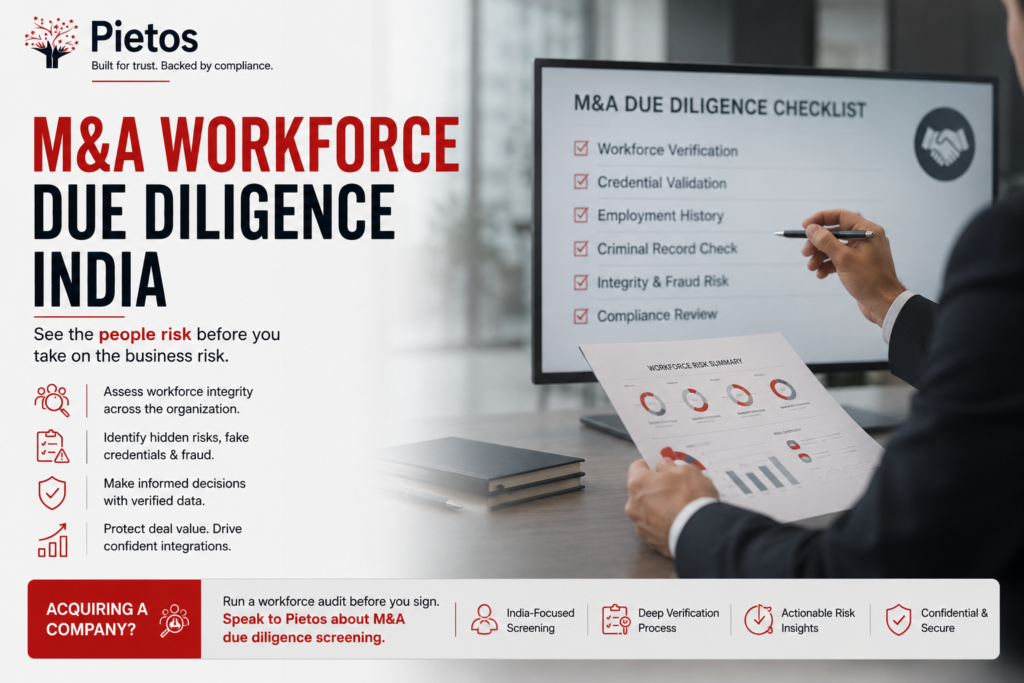
M&A workforce due diligence verifies the people you’re acquiring, not just the balance sheet you’re acquiring. It answers three questions. Who exactly is on the payroll? What do you legally owe them? What risks travel with them into your organization?
This is different from a standard employee background check. A pre-hire BGV verifies one candidate against their own claims. Workforce due diligence verifies an entire existing organization against its own records, at scale, under time pressure, before a signing date that won’t move.
The scope typically includes five layers:
- Headcount verification. Confirming the target’s stated employee count matches payroll records, PF filings, and ESI registrations — not just an HR-provided spreadsheet.
- Contract and classification audit. Checking employment contracts, consultant agreements, and gig arrangements for misclassification risk.
- Compensation and benefits liability. Gratuity, leave encashment, bonus obligations, and any deferred compensation that transfers with the deal.
- Key personnel screening. Identity, credential, and litigation checks on leadership and key managerial personnel who will stay on post-close.
- Compliance exposure. Pending labour disputes, POSH complaints, EPFO notices, and any unresolved regulatory action tied to the workforce.
Each layer needs a different verification method. A payroll reconciliation isn’t the same exercise as a KMP litigation check. Treating workforce due diligence as one checklist item collapses five distinct risk categories into a task nobody executes properly.
Why Indian Deals Skip This Step
Financial and legal due diligence have established playbooks in India. Workforce due diligence doesn’t, and that gap has a specific cause. Procurement teams run vendor checks. HR teams run new-hire checks. Neither function naturally owns an existing target company’s workforce during a live acquisition.
The consequence shows up in global research, and it applies directly to Indian dealmaking. Roughly 70% of M&A deals fail to achieve their expected value, and people-related challenges — cultural misalignment, key talent loss, and low engagement — are major drivers of that failure. McKinsey research found that 44% of M&A leaders cite cultural misfit as the top reason deals underperform. InterimExecsCura HR
The pattern repeats across sectors. A target’s HR team presents clean numbers. The acquirer’s finance team validates revenue and EBITDA. Nobody independently verifies that the 340 employees on the org chart actually match 340 active PF contributions. Nobody checks whether the CFO’s listed qualifications hold up under scrutiny before that CFO’s name appears in your board minutes.
Key takeaway: Financial due diligence tells you what the company is worth today. Workforce due diligence tells you what it will cost you after signing.
The gap widens further in cross-border and outbound deals, where outbound M&A drove much of Q2 2026’s deal value through billion-dollar cross-border transactions. Verifying a distributed, sometimes multi-jurisdiction workforce takes more than a data room review.
The Pre-Signing Workforce Audit Checklist
A structured workforce audit runs alongside financial and legal due diligence, not after it. Build it around four verification blocks.
Block 1: Payroll and Headcount Reconciliation
Cross-check the target’s stated headcount against three independent sources: EPFO contribution records, ESI filings, and bank payroll disbursement data. Discrepancies here flag ghost employees, unreported contractors treated as full-time staff, or headcount inflation ahead of a valuation event.
Block 2: Key Managerial Personnel Screening
Every KMP who stays on post-close needs identity, education, employment history, and litigation screening — the same rigor Pietos applies in <a href=”https://pietos.com/pre-ipo-due-diligence-hiring-india/”>pre-IPO due diligence hiring</a>, where SEBI’s 2025 ICDR amendments already require disclosure of criminal and regulatory action involving senior management. An acquirer inherits reputational exposure the moment a flagged executive signs on as part of the merged entity’s leadership.
Block 3: Contract and Classification Review
Misclassified gig or contract workers create back-dated liability the moment ownership changes. Review every non-payroll worker category against India’s labour codes and flag anyone functioning as a de facto employee.
Block 4: Vendor and Third-Party Workforce Exposure
Many Indian targets run security, housekeeping, and facilities staff through third-party vendors. This workforce transfers with the deal even though it never appears on the target’s own payroll. Pietos’ <a href=”https://pietos.com/vendor-due-diligence-india-supplier-verification/”>vendor due diligence framework</a> applies directly here: confirm the vendor’s legal standing, its own compliance record, and whether its staff were ever individually verified.
Key takeaway box:
- Reconcile headcount against EPFO and ESI, not HR spreadsheets alone
- Screen every KMP who stays post-close, not just the CEO
- Audit gig and contract classification before it becomes your liability
- Extend the audit to third-party vendor workforce, not just direct payroll
Who Owns Workforce Due Diligence Inside the Deal Team
Ownership ambiguity is the single biggest reason this workstream gets skipped. Assign it explicitly, before due diligence begins, across three roles.
The deal lead sets the timeline and decides what triggers a walk-away or a price adjustment. HR or People Ops executes the audit itself — payroll reconciliation, contract review, KMP coordination. An external verification partner runs the independent checks that internal teams can’t complete objectively or fast enough: identity verification, litigation screening, EPFO cross-referencing, and vendor workforce audits.
That third role matters more than most deal teams assume. An internal HR function reviewing its own soon-to-be-acquired peers rarely surfaces uncomfortable findings. Pietos’ <a href=”https://pietos.com/continuous-background-monitoring-india/”>continuous monitoring framework</a> shows why: ongoing verification only works when it’s structurally independent from the team being verified.
Regulatory Triggers Unique to India
India layers specific statutory obligations onto workforce transfers that don’t exist in most other jurisdictions. Three deserve direct attention during due diligence.
Companies Act, Sections 230–232. Mergers structured as schemes of arrangement require workforce continuity provisions under the Ministry of Corporate Affairs’ framework. Employee terms can’t be unilaterally worsened without triggering statutory review.
EPFO transfer of establishment rules. When a business transfers, EPFO treats it as continuity of service, not a fresh employment relationship, for provident fund purposes. Unresolved PF arrears follow the acquired entity, not the seller, unless the transaction documents allocate that liability explicitly.
RBI outsourcing directions, for BFSI-adjacent targets. If the target is an NBFC, fintech, or handles financial data on behalf of a regulated entity, RBI’s outsourcing framework requires the acquirer to verify that third-party staff meet the same fit-and-proper standards the regulator expects of direct employees.
Missing any of these three doesn’t just create financial exposure. It creates a compliance gap the acquirer inherits on day one, often before integration planning has even started.
What Workforce Gaps Look Like After Close
The pattern is consistent across mid-market Indian deals that skip structured workforce due diligence. A logistics company acquires a regional distributor and inherits 40 warehouse staff whose PF contributions stopped eight months before the deal closed. A fintech acquires a smaller lending platform and discovers, three weeks post-close, that two “verified” KMPs never completed the education checks their own HR team claimed were done.
These aren’t edge cases. They’re the direct, predictable result of skipping independent verification during due diligence. A Grant Thornton study on deal value found that only about 22.6% of respondents believed HR systems received adequate due diligence attention during M&A planning — lower than nearly every other function assessed. Acquisition Stars
The cost of inaction compounds after signing. Undiscovered PF arrears become the acquirer’s liability. Misclassified contractors become the acquirer’s labour dispute. A flagged KMP becomes the acquirer’s governance problem, discovered after that person already has board access.
<em>Skipping this step doesn’t remove the risk. It just moves the discovery date to after you’ve already signed.</em>
Where Workforce Audit Fits in a 90-Day Deal Cycle
Most Indian mid-market deals move from term sheet to signing inside 60 to 90 days. Workforce due diligence needs to run in parallel with financial and legal workstreams, not sequentially after them.
In the first two weeks, request payroll, EPFO, and ESI data alongside financial statements. By week four, complete KMP screening and vendor workforce mapping. By week six, reconcile findings against the target’s own HR disclosures and flag discrepancies for the deal lead. In the final two weeks before signing, finalize any price adjustments or indemnity clauses tied to workforce findings.
Building this into the existing 90-day cycle costs the deal team almost nothing in additional time. Retrofitting it after signing costs considerably more — in legal exposure, in integration delay, and in the acquirer’s own credibility with the acquired workforce.
Buyer Objections and Responses
“Our legal team already reviews employment contracts.” Legal review confirms what’s on paper. It doesn’t independently verify that payroll records match headcount claims, or that a KMP’s credentials hold up against primary sources. These require a different verification methodology than contract review.
“This will slow down a deal that’s already moving fast.” A structured workforce audit runs in parallel with existing workstreams, using the same 60–90 day window. It doesn’t add a sequential step. It closes a gap inside the timeline that already exists.
“Our target is too small for this level of scrutiny.” Deal size doesn’t reduce workforce risk proportionally. A 40-person target with undisclosed PF arrears creates the same category of post-close liability as a 400-person one — just at a smaller absolute number that’s easier to overlook and just as easy to inherit.
“We’ll catch issues during integration anyway.” Integration-stage discovery means the acquirer already owns the liability. Pre-signing discovery means the acquirer can price it, indemnify against it, or walk away.
FAQ
M&A workforce due diligence verifies a target company’s actual headcount, compensation liabilities, key personnel, and compliance exposure before an acquisition closes. It runs alongside financial and legal due diligence.
Under EPFO’s transfer-of-establishment framework, provident fund continuity follows the acquired entity unless transaction documents explicitly allocate historical liability to the seller. Buyers should confirm this allocation in writing before signing
Yes. Deal size affects the absolute value of workforce risk, not whether the risk exists. Smaller targets with informal HR practices often carry proportionally higher undisclosed liability.
A background check verifies one candidate against their own claims before hiring. Workforce due diligence verifies an entire existing organization’s payroll, compliance, and leadership at scale, under deal timelines.
Acquiring a company means acquiring its people, its liabilities, and its compliance gaps — whether or not anyone verified them first. Pietos runs pre-signing workforce audits built around EPFO reconciliation, KMP screening, and vendor workforce verification, scoped to your deal timeline.
Speak to Pietos about M&A workforce due diligence before your next signing date.