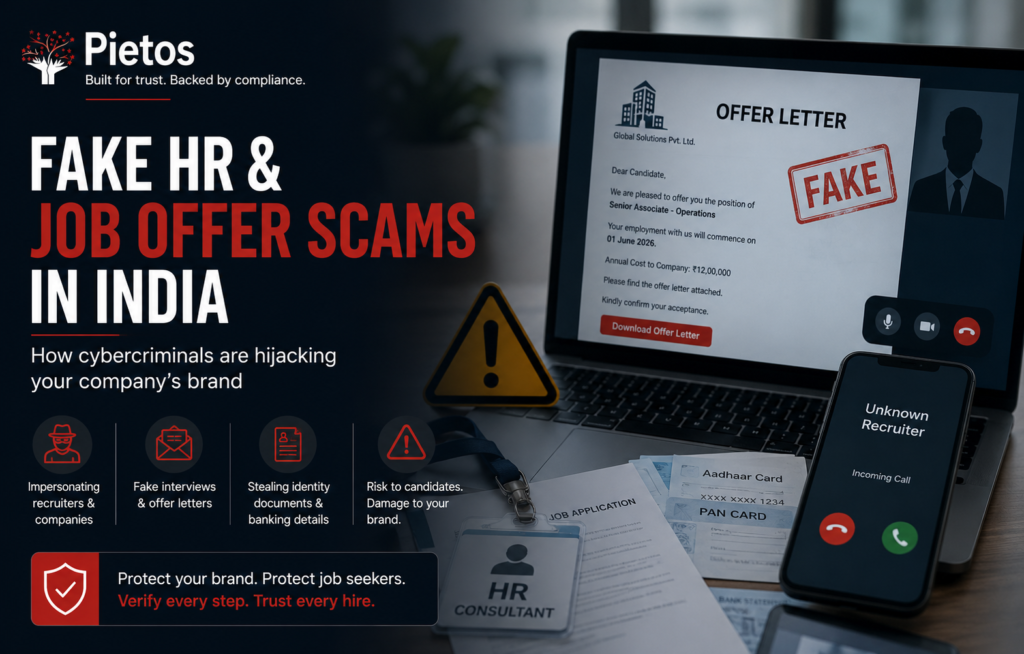
A fake job offer scam India HR incident starts the same way almost every time. A candidate gets a message from someone claiming to work in your HR team. The logo looks right. The tone sounds professional. Then the candidate loses money, or worse, hands over biometric data, and your company’s name is the one attached to the crime.
This is not a rare event anymore. The Ministry of Home Affairs issued a fresh advisory in May 2026. Its cyber wing had tracked a sharp rise in criminals who pose as recruiters, multinational firms, and HR consultants. These fraudsters run fake video interviews to pull biometric data, identity documents, and bank details from job seekers. Your brand did nothing wrong. However, it still absorbs the reputational hit, the flooded inbox, and sometimes the legal exposure.
This guide breaks down exactly how the fake job offer scam India HR pattern works. It also covers what the pattern costs a business, and what HR leaders can do to shut it down before it spreads.
What Is a Fake Job Offer Scam in India?
A fake job offer scam happens when a criminal poses as an HR professional from a real, established company to trick a job seeker. The scammer sends a message through WhatsApp, Telegram, LinkedIn, or email. It claims a real company shortlisted the candidate for an opening they never applied to, or barely remember applying to.
The message usually includes a real company name, a fabricated HR contact, and a salary figure that sounds believable but slightly too generous. From there, the fraudster runs a fake interview, issues a forged offer letter, and asks for money, biometric data, or both.
Crucially, the target of the scam is the job seeker. But the tool the scammer uses is your company’s identity. That distinction matters, because it means your brand carries the consequences even though your HR team never sent a single message.
Why Cybercriminals Impersonate Real HR Teams
Fraudsters don’t invent fake companies anymore. Building trust from scratch takes too long, and skeptical candidates now Google every company before replying. Impersonating a company that already has a website, a LinkedIn page, and a hiring history skips that step entirely. The candidate does the trust-building for the scammer, simply by recognizing your brand.
The MHA Advisory Changed the Conversation
In May 2026, the National Cybercrime Threat Analytics Unit of I4C issued a public warning after a spike in fake-hiring reports. This unit sits under the Ministry of Home Affairs. Cyber officials described the scammers’ process as deliberately crafted to snare job seekers and pull personal and biometric data from them at each stage. The advisory specifically flagged AI-generated voice calls, manipulated video interactions, and fraudulent websites built to resemble real recruitment portals. That last point should worry every HR leader. It means fraudsters are not just faking messages anymore. They are cloning entire hiring journeys, down to the interview format.
How Fraudsters Choose Which Brand to Fake
Scammers gravitate toward companies with three traits: strong brand recognition, active hiring, and a large digital footprint they can scrape for logos, employee names, and email formats. Mid-sized and fast-growing companies are often easier targets than giant conglomerates. They hire quickly, post openly on LinkedIn, and rarely have a dedicated brand-protection team watching for impersonation. If your company fits that description, no fraudster considers you too small to target. In fact, fraudsters often find you an easier target than a company ten times your size.
[Key Takeaway] Scammers don’t need to build trust. They borrow it from your brand, then walk away before anyone notices.
Which Sectors Face the Sharpest Exposure
Not every industry gets targeted equally. IT services and GCCs sit at the top of the list. Their brand names are widely recognized, and their hiring volume is high enough that one more “shortlisted” message doesn’t raise suspicion. BFSI and NBFCs follow closely, because a finance-sector job offer sounds credible with a modest signing bonus attached, and fraudsters know candidates rarely question a bank-linked recruiter. Logistics and gig-economy platforms round out the top tier. They hire in bulk, communicate mostly over WhatsApp already, and rarely run a formal interview process candidates could use to spot the fake version. D2C and consumer brands are catching up fast too, as they scale hiring quickly without building brand-protection processes to match.
Why Remote and Hybrid Hiring Made This Easier
A decade ago, most interviews happened in person, which made impersonation nearly impossible. Remote hiring removed that natural checkpoint. Today, a candidate can complete an entire “hiring journey,” from first message to signed offer, without ever speaking to a human they can independently verify. Fraudsters exploit exactly that gap. As long as a video call looks professional and a PDF looks like a real letterhead, most candidates struggle to confirm who they’re actually talking to. This is precisely why India’s cybercrime authorities have started treating recruitment fraud as a distinct, fast-growing category rather than a subset of general phishing.
Campus hiring adds another layer of risk. First-time job seekers rarely have a reference point for what a genuine offer process looks like. That gap makes them more likely to trust an unusually fast timeline or an unusually generous package. Colleges and placement cells are increasingly becoming an unofficial early-warning channel, since students often compare notes about suspicious messages before any single victim reports the fraud formally. HR teams that maintain a relationship with campus placement offices can use that channel both ways, warning students proactively and hearing about impersonation attempts sooner.
Anatomy of a Fake HR Job Offer Scam, Step by Step
Understanding the mechanics helps HR teams recognize the pattern early, both from the candidate side and the brand side.
Step 1 — The First Message
The scam usually opens on a messaging app rather than email, because messaging apps feel more personal and harder to trace. A message such as “This is HR Anjali from [Company] Pvt Ltd, your CV matches our requirement” arrives out of nowhere. The role sounds plausible. The salary sits just above market rate, enough to excite, not enough to trigger obvious suspicion.
Step 2 — The Fake Interview
Next comes a video call, sometimes even a genuinely professional one. Fraudsters have learned that a sloppy fake interview gets reported fast, while a polished one buys them days of trust. Some scammers now use AI-generated voices or manipulated video to sound more convincing, exactly the pattern the MHA advisory called out.
Step 3 — The Biometric and Document Trap
Once the fraudster builds trust, they ask for “verification steps.” Officials say scammers typically run a convincing online interview first. Then they ask for Aadhaar details, PAN information, passport copies, photos, or a facial verification video, framing it all as routine onboarding. Candidates rarely question this step, because legitimate onboarding does ask for similar documents. That similarity is exactly what makes the scam work.
Step 4 — The Money or Biometric Ask
The scam closes in one of two ways. Either the fraudster demands a “registration fee,” “security deposit,” or “training charge” before confirming the offer. Or they walk away with enough biometric and identity data to commit identity fraud later. Some victims lose both. By the time the candidate realizes something is wrong, the fraudster’s number is already disconnected.
Step 5 — The Aftermath
Once the fraudster disappears, the fallout lands on two doorsteps at once. The candidate is left chasing a disconnected number, often out of money and increasingly worried about identity theft. Meanwhile, your real HR inbox starts filling up with confused messages from people asking why “your team” never responded after taking a fee. Neither side gets closure quickly, and both sides now associate the entire experience with your company name.
Every one of these steps hides behind your company’s name. Pietos helps HR teams close the identity gap that makes brand impersonation possible — talk to us about verified hiring channels.
Real Cases That Show the Scale of the Problem
This is not a hypothetical risk. In late 2025, the Ministry of External Affairs coordinated the repatriation of hundreds of Indian citizens. Fraudsters had lured them into cybercrime centres along the Myanmar-Thailand border using fake job offers. Most victims came from Maharashtra, Gujarat, Punjab, Andhra Pradesh, and Uttar Pradesh. The government explicitly urged citizens to verify recruiters and companies before accepting any offer. That advice was a direct acknowledgment that impersonation had become a national-scale problem, not an isolated incident.
Closer to everyday hiring, fraud researchers have documented Telegram-based scams that impersonate IT majors. These scams pair fabricated HR names and believable CTC figures with forged offer letters on company letterhead. The pattern repeats across sectors: BFSI, IT services, logistics, and now increasingly D2C and consumer brands as they scale hiring. No industry is naturally immune.
This mirrors a wider pattern industry researchers have already flagged on the candidate side. Employment fraud studies covering large volumes of Indian background checks routinely find discrepancies in a large share of profiles. These range from forged experience letters to fabricated employment history. Fake job offer scams are simply the same fraud economy working in reverse, aimed at candidates instead of employers.
What This Costs Your Company, Not Just the Victim
HR teams often assume impersonation fraud is “not our problem” because the company never sent the fraudulent message. That assumption is expensive, and it usually shows up across four separate cost centers at once.
Brand Trust Damage
Every scammed candidate now associates your company name with fraud, whether or not you were involved. Many post about it publicly on LinkedIn or Glassdoor, tagging your brand directly. Once that story spreads, genuine candidates start hesitating before they reply to your real recruiters. Employer-review sites amplify this further, since a handful of impersonation complaints can sit alongside your genuine reviews for years, quietly shaping how future applicants read your brand.
Legal and Regulatory Exposure
Under India’s evolving data protection framework, companies face growing scrutiny over how candidate data is collected and verified. If a scam using your name leads to misuse of a candidate’s data, your company can get pulled into the resulting complaint, even as a victim of impersonation rather than a perpetrator. Regulators and courts increasingly expect companies to show they acted quickly once impersonation surfaced, not just that they were technically blameless. Keep a clear internal log of every impersonation report you receive, along with every action you took in response. This small habit becomes valuable evidence if a formal inquiry ever follows.
The Hidden HR Workload
Every impersonation incident generates a wave of confused emails, LinkedIn messages, and phone calls to your real HR inbox. Recruiters end up spending hours confirming to worried candidates that the offer they received is fake. That is time your team should be spending on actual hiring, interviewing genuine applicants, and closing open roles faster.
Recruitment Marketing Waste
Every rupee you spend building employer brand on LinkedIn, job boards, and campus drives gets diluted the moment a scam using your name goes viral. Candidates who see the fraud story first often never make it to your genuine job posting at all. That quietly erodes the return on your entire recruitment marketing budget.
A Simple Litmus Test for Candidates and Recruiters
Ask three questions before trusting any recruitment message: Does the domain match the company’s real website exactly? Is there any request for payment at any stage? And can the recruiter be found on the company’s official careers page or verified LinkedIn presence? A “no” to the first, a “yes” to the second, or a “no” to the third is reason enough to stop. Verify independently before sharing anything further.
Don’t Forget Your Recruitment Vendors and Agencies
Many mid-sized companies route part of their hiring through external staffing agencies or freelance recruiters. Every one of those partners is also a potential entry point for impersonation, since a fraudster can just as easily pose as “a recruiter working with [Company] through an agency.” Extend your official-channel policy to cover every third party your brand authorizes to represent it in hiring. Require agencies to identify themselves clearly on every candidate-facing message.
Real HR Outreach vs. Fake Job Offer Scam: A Side-by-Side Comparison
| Signal | Genuine HR Outreach | Fake Job Offer Scam |
|---|---|---|
| First contact channel | Company email or verified LinkedIn recruiter profile | Random WhatsApp or Telegram number |
| Interview process | Multiple structured rounds, scheduled through official calendars | One rushed video call, urgency to “confirm today” |
| Payment requests | Never asks candidates for money | Demands “registration” or “training” fees |
| Offer letter | Issued after formal HR review, on verified letterhead | Sent within hours, generic template, minor formatting errors |
| Data requests | Collected through a secure portal, with clear consent | Requested informally over chat, no consent trail |
| Verifiability | Contact traceable through the official company website | Number or email disappears after payment |
How HR Teams Can Detect and Prevent Impersonation Fraud
You cannot stop every fraudster from typing your company’s name into a message. However, you can make the scam far harder to pull off, and far easier for candidates to catch.
Lock Down Your Official Channels
Publish a clear, single list of official recruiter emails and domains on your careers page. Candidates should be able to check in seconds whether the person messaging them actually works for you. Ambiguity is the fraudster’s biggest advantage, so remove it wherever you can. Add a short line to every real job posting stating that your company never asks candidates for payment at any hiring stage. That single sentence pre-empts the most common scam pattern.
Train Recruiters and Candidates Together
Your recruiters should know the exact scam patterns circulating in your industry, since they are often the first to hear about it from a confused candidate. Share a short “how to verify us” note with every shortlisted candidate as standard practice, not just a reactive step you take after someone reports a scam. Equip your recruitment team with a ready response for when a candidate forwards a suspicious message. They can then confirm or deny authenticity within minutes, rather than escalating through multiple approvals.
Monitor the Internet for Your Own Brand
Set a recurring alert for your company name alongside terms like “job offer,” “HR,” and “registration fee.” Fraudulent postings often surface on job forums, Telegram channels, or fake LinkedIn pages well before they reach your inbox as a complaint. Review these alerts weekly, rather than only after a candidate flags an issue, to give your team a meaningful head start.
Build Verification Into Every Step
The same document forensics and identity checks that catch a candidate’s fake resume also harden your hiring process against outside spoofing. Pietos’ AI-powered document forensics flags manipulated offer letters and identity documents before they ever reach a hiring manager. This strengthens the same verification trail that protects your brand from impersonation claims. A verified, auditable hiring process also gives you something concrete to point to. It answers a regulator or an affected candidate who asks how your company screens for fraud.
[Key Takeaway] Prevention is not one control. It is a layered system: clear public information, trained recruiters, active monitoring, and verified data flows working together.
What to Do If Your Brand Is Already Being Impersonated
Move fast once you learn a fraudster is using your name. First, report the incident on the National Cyber Crime Reporting Portal at cybercrime.gov.in, or call the national cybercrime helpline at 1930. Authorities have named this route as the fastest way to get a fraud case on record.
Second, post a clear, dated warning on your official careers page and LinkedIn account. State plainly that the offer in question did not come from your company, and list your real hiring channels. Third, loop in your legal team early, since a documented, timely response protects you if regulators or affected candidates raise questions later. Finally, keep a record of every fraudulent posting or message you find, since patterns of impersonation strengthen any law enforcement complaint.
If the impersonation used a fake website or a cloned domain, also report the domain directly. India’s cybercrime authorities have worked with the National Internet Exchange of India before to take down malicious “dot in” domains. A documented complaint against a fake careers page can push the registry to take it offline, not just flag it.
The Cost of Waiting
Companies that wait until a scam goes viral before responding pay a steeper price than those who build defenses early. A single unaddressed impersonation case can sit at the top of Google search results for your company name for months. It keeps deterring genuine applicants long after the original fraud ended. Compare that to the cost of a verified hiring process and a public “how to verify us” page. Both take a fraction of the time and cost of managing a reputational crisis after the fact.
A 30-60-90 Day Framework for HR Teams
Days 1-30 — Audit and publish. List every real recruiter, email domain, and hiring channel your company uses today. Publish that list clearly on your careers page, since this single step removes most of the ambiguity fraudsters rely on. Search your own company name alongside “job offer” and “HR” to check whether impersonation is already happening.
Days 31-60 — Train and monitor. Brief every recruiter on the current scam patterns in your sector, and give them a short script to use when a confused candidate calls in. Set up a recurring search alert for your brand name paired with common scam terms. New impersonation attempts then surface early, rather than after a candidate complains publicly.
Days 61-90 — Verify and formalize. Fold document forensics and identity checks into your actual hiring workflow, so your real process is airtight and easy to distinguish from a fraudulent one. Draft a standing response template for impersonation incidents. Cover the cybercrime.gov.in report, the public LinkedIn notice, and the legal escalation path. That way, your team can act within hours instead of days the next time it happens.
Common Objections, Answered
“We’re too small to be a target.” Fraudsters prefer mid-sized, fast-hiring companies precisely because they lack a dedicated brand-protection team. Size offers little protection once your name and logo are public.
“This is a candidate problem, not an HR problem.” The scam targets candidates, but your company absorbs the reputational and regulatory fallout. Treating it as someone else’s problem only delays the response.
“We don’t have budget for brand monitoring right now.” A basic Google Alert and a public “verify us” page cost nothing and catch a large share of impersonation attempts. Formal verification tooling becomes worth the investment once hiring volume or fraud reports increase.
“Reporting to cybercrime.gov.in feels like it won’t achieve anything.” A single report may feel small, but patterns matter to investigators. Each documented complaint, including yours, feeds into the same national database authorities used to justify the May 2026 advisory. It also helps build the case for wider takedown action against repeat offenders.
Key Takeaways
- A fake job offer scam India HR case uses your brand as the trust signal, not a fabricated company.
- The May 2026 MHA advisory confirms fraudsters are now using AI voice and video tools to run convincing fake interviews.
- Impersonation costs your company brand trust, HR time, and potential regulatory exposure, even though your team never sent a single fraudulent message.
- Clear official channels, recruiter training, brand monitoring, and verified data flows together make impersonation far harder to pull off.
- Report active impersonation immediately through cybercrime.gov.in or the 1930 helpline, and publish a dated warning for candidates.
Frequently Asked Questions
Direct legal liability is uncommon when your company is genuinely unaware of the impersonation. However, regulators and affected candidates may still expect a documented, timely response, so acting quickly protects your position.
Most candidates realize something is wrong when they are asked for money, or when the “recruiter” goes silent after receiving documents or payment. Some only find out when they contact your real HR team to follow up on an offer.
Not directly, since impersonation targets candidates rather than your internal hiring process. However, strong document forensics and verified hiring workflows make your real process easier to distinguish from a fraudulent one, which helps candidates catch the scam faster.
Candidates should report the incident through the National Cyber Crime Reporting Portal at cybercrime.gov.in or call the 1930 helpline. Companies should also report the impersonation directly, since a documented complaint from the affected brand strengthens the case.
Biometric data, including facial scans and voice recordings, can be reused with AI tools to bypass identity verification systems elsewhere. The MHA’s May 2026 advisory specifically flagged this shift as a growing risk beyond simple financial fraud.
Verify the sender’s email domain against the company’s official website, cross-check the recruiter’s identity on the company’s verified LinkedIn page, and never pay any fee to accept a job offer. Genuine employers do not charge candidates for registration, training, or verification.
IT services, GCCs, BFSI, NBFCs, and logistics see the highest volume, largely because they hire at scale and communicate heavily through WhatsApp and Telegram, channels fraudsters already use to impersonate recruiters.
A fake resume scam deceives an employer during hiring. A fake job offer scam deceives a candidate using an employer’s identity. Both exploit gaps in verification, just from opposite directions of the same hiring relationship.
Related Resources
| Anchor Text | Destination Page | Reason for Linking |
|---|---|---|
| AI-powered document forensics | /document-forensics-ai-hiring-fraud/ | Forged offer letters power scam interviews — direct technical connection to how fraud documents get caught |
| detect fake resumes | /detect-fake-resumes-hr-guide/ | Fake job postings and fake resumes sit on opposite sides of the same fraud ecosystem |
| background check red flags | /background-check-red-flags/ | Connects brand-impersonation fraud to the candidate-side red flags HR teams already track |
| DPDP rules for HR in India | /dpdp-rules-for-hr-india/ | Fraudsters harvest candidate data through fake HR contact — ties directly to HR’s data protection duties |
| proxy candidate detection | /proxy-candidate-detection-india/ | The reverse-direction version of this fraud — impersonation inside a real interview, not outside one |
Is your company’s brand being used to scam job seekers? Talk to Pietos about employer-brand protection and verified hiring channels. Book a free consultation →