Call us on: 9289301161/+91 11 49074103 or email us on contact@pietos.com
Trending Today

If you are building a high-growth venture, setting up a robust framework for background verification startup india operations is critical to protect your company from day one. While early-stage companies often focus entirely on scaling code architectures, closing institutional investment rounds, and onboarding early builders, an invisible threat looms over fast-paced engineering and operations environments: unverified talent acquisition workflows. Resume discrepancies, fabricated professional lineages, and hidden compliance red flags cost Indian businesses thousands of crores annually. Because early-stage companies shift rapidly and frequently scale before establishing formal HR infrastructure, they are highly exposed to these systemic risks.
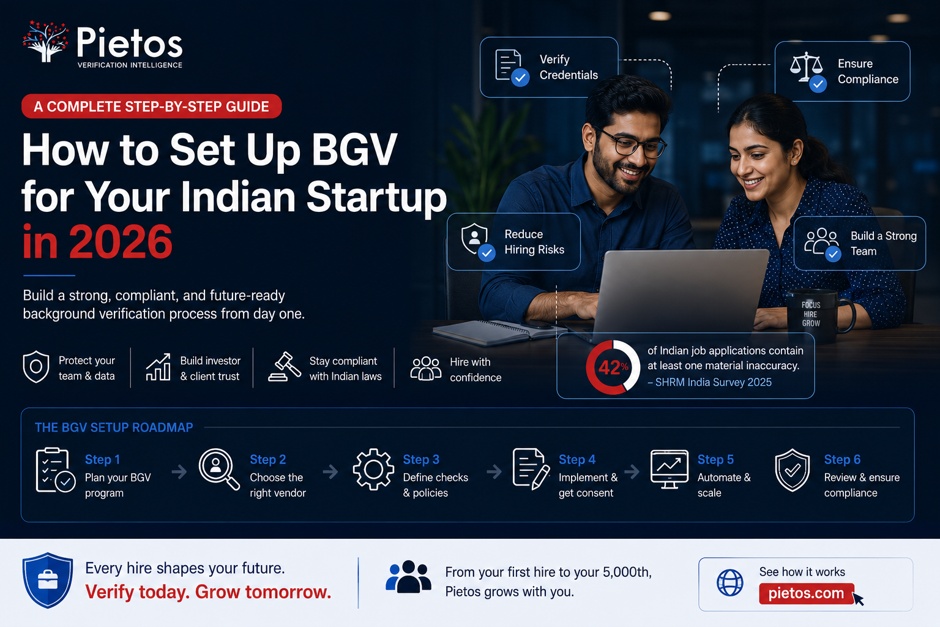
Figure 1: The Pietos Automated Startup BGV Roadmap Framework. Industry metrics from the SHRM India Survey highlight that up to 42% of screening runs flag critical discrepancies in candidate-submitted resumes.
Executive Summary for Founders: Moving fast and breaking things shouldn't include your hiring compliance. A single compromised credential or identity mismatch can destroy investor trust during due diligence, expose proprietary IP, or trigger severe regulatory penalties under the DPDP Act. When optimizing your onboarding pipeline, implementing an adaptive background verification startup india strategy helps you screen with integrity without delaying key strategic hires.
India’s startup ecosystem continues to grow rapidly, with thousands of DPIIT-recognized ventures launching across tech hubs like Bengaluru, Delhi-NCR, Mumbai, and Hyderabad. In this hyper-competitive market, velocity is everything. Startups scale from seed teams to hundreds of employees in months. However, this speed creates an acute vulnerability: the absence of formalized HR controls during early growth stages makes startups prime targets for candidate misrepresentation.
Data indicates that over 42% of Indian corporate applications contain at least one material inaccuracy. These are not minor resume padding errors; they are structural falsifications designed to bypass hiring filters.
When an unvetted hire slips through, the downstream costs can severely impact an early-stage company's operations:
Navigating background checks requires strict adherence to Indian employment and data privacy laws. Running unvetted background screening checks exposes your enterprise to immense civil and criminal liability.
The DPDP Act reshapes corporate data collection. As an employer, your organization acts as a Data Fiduciary, while the job applicant is the Data Principal. Your BGV vendor operates as a Data Processor. The regulatory framework managed by the Ministry of Electronics and Information Technology (MeitY) enforces strict compliance on consumer and employee data processing pipelines alike.
Section 43A mandates that corporations processing Sensitive Personal Data or Information (SPDI)—which includes financial metrics, biometric records, and password details—must maintain "Reasonable Security Practices and Procedures." Storing candidate documents in unprotected cloud folders violates this statute and invites hefty compensation claims.
| Industry Sector | Governing Body / Standards | Mandated Verification Protocol |
|---|---|---|
| Fintech / WealthTech / InsurTech | RBI / IRDAI | Comprehensive criminal record sweeps, credit checks, and global sanctions list parsing for operational and executive roles. |
| HealthTech / DeepTech / Pharma | CDSCO / National Boards | Licensing validation, professional body registry lookups, and specialized academic credential source verification. |
| SaaS / B2B Enterprise Vendors | SOC 2 Type II / ISO 27001 | Enforced, unalterable background check trails for any technical resource maintaining production environments. |
A common mistake is applying a uniform, heavy-duty verification package to every single individual. This approach inflates recruitment costs, slows turnaround times, and frustrates candidates. When mapping out a scalable **background verification startup india** matrix, risk-tiering roles protects your operational runway. Deploy a Risk-Tiered BGV Framework built on specialized background screening services.
| Risk Tier | Target Roles & Profiles | Mandated BGV Verification Modules | Rationale & Focus Areas |
|---|---|---|---|
| Tier 1: High | CXOs, VP Engineering, Financial Controllers, DevOps leads | Identity, Education, UAN-EPFO Employment Sweep, 7-Yr Professional History, e-Courts Criminal Record Check, Credit (CIBIL), Global Sanctions Lists | Safeguarding core intellectual property, source code, corporate bank accounts, and sensitive infrastructure. |
| Tier 2: Medium | Account Managers, Full-Stack Engineers, Inside Sales Executives, HR Specialists | Identity, Education, 5-Year Employment History Check, Standard Civil & Criminal Court Search, Reference Validation | Minimizing operational leakage, protecting customer-facing interactions, and ensuring cultural alignment. |
| Tier 3: Standard | Administrative Staff, Interns, Temporary Contingent Workers, Facility Personnel | Digital Identity Authentication, Highest Educational Degree Verification, Regional Criminal Record Review | Ensuring foundational workplace security, basic credentials integrity, and overall physical safety. |
To build an automated hiring pipeline, your BGV framework must plug directly into India’s central digital infrastructure. Manual verification processes are outdated; modern BGV relies on secure API connections.
Your BGV engine should tap directly into the authorized central identity verification ecosystem to verify names, dates of birth, and record consistency. This instantly flags profile mismatch risk before a candidate proceeds to subsequent screening rounds.
Choosing a BGV partner is a high-stakes decision. The wrong provider will delay your onboarding pipelines, drop candidates due to poor UX, and expose you to regulatory scrutiny. Selecting the ideal provider ensuring optimized workflow rules allows you to scale up without operational boundaries.
Setting up your BGV program requires careful coordination across legal, talent acquisition, and operations teams. This phased execution blueprint helps you get up and running smoothly.
What should you do when a verification check returns a red flag? Handling discrepancies haphazardly opens your startup up to discrimination claims, unfair termination disputes, and legal liabilities.
The modern workplace relies on decentralized talent networks, full-time remote engineers, contingent workers, and on-demand gig workforces. Each model requires a distinct approach to verification.
Relying on manual data entry to trigger background checks becomes a massive operational bottleneck once your startup hits its growth phase. Scaling efficiently requires moving toward an integrated, API-driven workflow.
Below is an example of an optimized, privacy-masked JSON payload structure used to programmatically trigger a Tier-1 validation run upon candidate confirmation:
{
  "event": "candidate.offer_accepted",
  "timestamp": "2026-06-04T14:15:00Z",
  "company_id": "pietos_startup_client_091",
  "candidate": {
    "first_name": "Rohan",
    "last_name": "Sharma",
    "email": "rohan.sharma@example.com",
    "phone": "+919876543210"
  },
  "package_tier": "Tier_1_Critical_Tech",
  "consent_obtained": true,
  "consent_metadata": {
    "ip_address": "192.168.1.52",
    "timestamp": "2026-06-04T14:14:22Z",
    "consent_form_version": "v2.1_DPDP_Compliant"
  },
  "identifiers_provided": {
    "identity_token": "id_tok_88492019481",
    "uan_token": "uan_tok_77492018311"
  }
}
By connecting your verification systems directly to your central HR platform, your HR teams don't have to spend time manually chasing down documents, sending emails, or updating spreadsheets. Background verification runs efficiently in the background, updating candidate statuses and storing final encrypted compliance reports automatically.
A: Turnaround times vary depending on the type of check being conducted. Digital identity verifications, database lookups, and UAN history retrievals can be processed instantly or within 24 hours. Verification of professional employment records usually takes 2 to 4 business days. Comprehensive civil and criminal record checks across court registries typically take 5 to 9 business days, while confirming international degrees or employment history can take 10 to 14 business days.
A: While there isn't a single blanket law requiring all private businesses to run background checks, industry-specific regulations make it essential for many. The RBI requires background checks for fintech and NBFC platforms, and healthcare tech firms must comply with medical licensing verifications. Beyond regulations, maintaining a robust screening process is practically mandatory if your startup wants to win enterprise clients, pass security audits like SOC 2, or secure institutional venture capital.
A: Yes, job applicants have the right to decline consent under data protection regulations. However, your startup can make successful background clearance a formal condition of employment in your offer letters. If an applicant chooses to withdraw or refuse consent, your organization has the legal right to rescind the offer.
A: International verifications require working with a partner who can interface directly with overseas employers and global credential evaluation networks. These checks should also include screening against global enforcement databases, such as the UN Security Council, EU sanctions lists, and OFAC, to ensure complete compliance for cross-border teams.
A: Yes, running credit checks through bureaus like CIBIL or Experian is entirely legal, provided you obtain explicit, separate consent from the applicant. These checks should be reserved for roles with direct financial responsibility or access to corporate cash flows, as running them for unrelated positions can be difficult to justify under data minimization guidelines.
A: The depth of your background checks should always be guided by the level of system and data access a role has, rather than their employment contract or duration. If an intern has administrative access to production code, sensitive customer data, or internal financial accounts, they should go through the same rigorous screening as a full-time engineer.
Prioritizing a modern **background verification startup india** pipeline ensures long-term institutional value and compliance safety. Waiting until something goes wrong to set up a background check process is an expensive mistake for growing startups. The financial, legal, and cultural costs of a bad hire far outweigh the investment of setting up an efficient, automated system from the start.
Building a secure, compliant, and scalable verification pipeline is simpler than ever. By establishing clear risk tiers, using automated digital databases, and choosing a verification partner aligned with modern data laws, early-stage ventures can implement the same high-quality screening standards as global enterprises—without slowing down their hiring momentum.
Ready to scale your team safely? Connect with the Pietos team today to build a modern, automated background verification system tailored to your startup's growth.
Book a Demo