
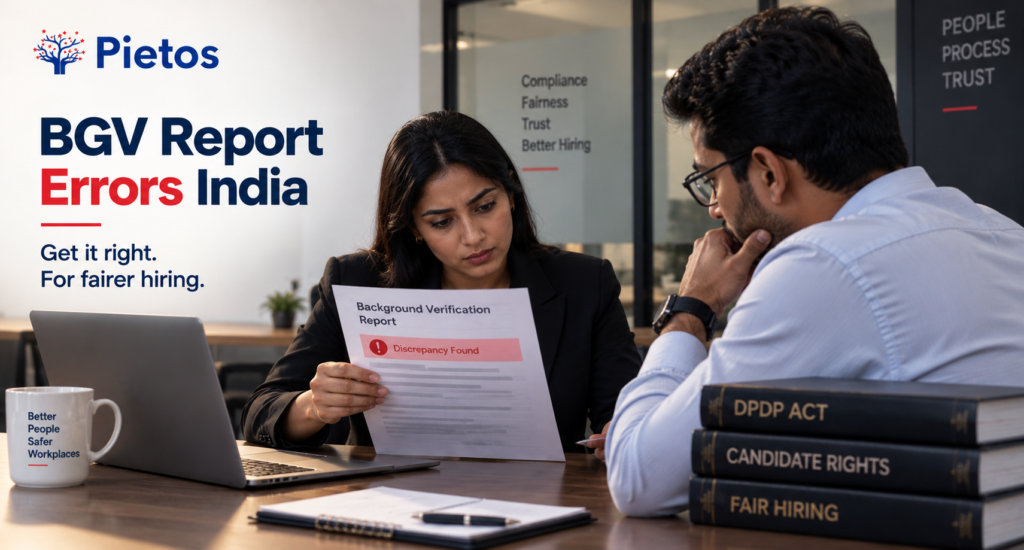
Every HR team budgets for the cost of running background verification. Almost none budget for the cost of a background verification report that turns out to be wrong.
That gap is becoming expensive. As background checks move deeper into blue-collar hiring, gig staffing, and high-volume campus recruiting, the odds of a mismatched record, a stale court filing, or a same-name confusion also go up. When that happens, the company doesn’t just have a data quality problem — it has a candidate rights problem, a DPDP Act compliance problem, and, if the error caused the rejection, a wrongful rejection problem.
This piece walks through why BGV report errors happen, what candidates are legally entitled to do about them, and what a defensible correction process looks like for a company that runs verification at scale.
A disputed BGV report is a legal liability the moment a candidate can show the rejection relied on it. Pietos’ error correction process is documented, DPDP-compliant, and built to close disputes in days, not weeks.
Why BGV Report Errors Happen
Background verification in India runs through a chain of sources: police record checks, court database searches, employer HR systems, education boards, address verification agents, and increasingly, digital identity layers like DigiLocker and Aadhaar-linked checks. Every link in that chain is a place an error can enter.
Common root causes include:
- Same-name mismatches. India has a limited surname pool relative to its population. Court record databases frequently return hits against a different person who shares a name and rough date of birth.
- Stale records. A case courts dismissed, settled, or expunged years ago can still surface in a database nobody ever updated.
- Manual data entry errors. Field verification agents transcribing physical documents introduce typos in dates, employer names, or designations.
- Fragmented court digitization. Not every district court has a fully digitized record system, so verification vendors sometimes rely on partial or outdated feeds.
- Employer non-response treated as a red flag. When a former employer’s HR team doesn’t respond to a verification request within a set window, the system sometimes tags it “unable to verify,” which reads as suspicious even though it usually just reflects a slow HR desk.
None of these causes are exotic. They are the ordinary friction of verifying millions of records against fragmented Indian government and institutional databases. The problem isn’t that errors exist — it’s that many BGV vendors don’t have a fast, documented way to catch and fix them before they cost a candidate an offer.
The Legal Stakes: DPDP Act and Candidate Data Rights
The Digital Personal Data Protection (DPDP) Act, 2023 changed the legal weight of this issue. Under the Act, a candidate has a statutory right to seek correction, completion, updating, and erasure of any personal data a verification report uses. A background verification report is personal data. An error inside it is not just an HR mistake — it’s a data accuracy failure the DPDP Act directly addresses.
For an HR team, this matters in three concrete ways:
- The correction obligation is not optional. Once a candidate raises a credible correction request, the data fiduciary (in most structures, the employer or its BGV vendor acting as data processor) has to act on it within the timelines the DPDP Rules specify.
- Liability follows the decision, not the vendor. If an inaccurate report drove a hiring decision, the employer — not just the BGV vendor — carries exposure. Courts and labour tribunals in India have shown willingness to treat rejection based on unverified or disputed adverse findings as procedurally unfair.
- Documentation is the defense. The strongest protection an HR team has is a paper trail: when the error surfaced, when the team investigated it, and when the team corrected it. Vendors without a documented dispute-resolution workflow leave their client companies exposed.
Every week a disputed finding sits unresolved is a week of open legal exposure. DPDP rules for HR India break down exactly what the correction timeline requires.
Six Types of BGV Errors HR Teams Actually See
Not every disputed report is the same kind of error. Recognizing the pattern early speeds up the resolution.
- Identity mismatch — a criminal or civil record belonging to someone else with a similar name and demographic profile.
- Employment history discrepancy — dates, designation, or reason-for-leaving mismatched against what the former employer’s records actually show.
- Education verification failure — a genuine degree flagged as unverifiable because the institution’s records office is slow or the board hasn’t digitized older certificates.
- Address verification gaps — especially common in tier 2/3 cities where formal addressing systems are inconsistent and physical verification agents may visit an outdated address.
- Outdated legal record — a case a court has since resolved, quashed, or settled, but the source database hasn’t caught up.
- Social media and public record misattribution — a shared handle, common name, or outdated profile that wrongly ties content or activity to a candidate.
Each of these has a different resolution path, but they share one requirement: a vendor that can re-verify against a primary source quickly, rather than treating the original report as final.
The Cost of Ignoring a Disputed Report
A slow or absent error-correction process doesn’t just annoy a candidate. It compounds into measurable business risk.
- Wrongful rejection exposure. If a candidate can show the rejection relied on an inaccurate report and the company had no correction mechanism, that’s a credible claim in front of a labour court or consumer forum.
- DPDP penalties. Non-compliance with data correction obligations under the DPDP Act carries financial penalties that scale with the severity and pattern of the violation.
- Reputational damage at hiring scale. In high-volume hiring — gig platforms, BFSI branch staffing, blue-collar workforce onboarding — a pattern of unresolved disputes becomes visible on review platforms and candidate forums, raising the cost of every future hire.
- Re-hiring cost. If an error causes a company to lose a strong candidate who accepts a competing offer while the dispute drags on, that’s a direct cost with no line item to point to.
None of this shows up in a standard BGV vendor SLA. Most vendor contracts measure turnaround time to deliver the original report. Almost none measure turnaround time to resolve a disputed one.
What Candidate Rights Look Like in Practice
Under the DPDP framework, a candidate who believes their BGV report contains an error can:
- Request access to the specific data point flagged as inaccurate
- Formally request correction, with supporting documentation
- Escalate to the Data Protection Board if the vendor doesn’t action the correction within the required window
- Pursue consumer redress if an employer’s decision caused demonstrable harm based on incorrect data
This is a meaningfully different landscape from a few years ago, when a candidate’s only real option was an informal appeal to HR with no statutory backing. HR teams that still treat a BGV report as a closed, final document are operating against a legal framework that has moved on.
Middle-of-funnel HR teams often ask whether a candidate can simply refuse a background check outright rather than dispute a finding. The distinction matters legally — see Can a candidate refuse a background check in India for how refusal, dispute, and correction differ under the DPDP Act.
Refuse vs. Dispute vs. Correct: A Comparison
| Candidate Action | What It Means | Employer Obligation |
|---|---|---|
| Refuse consent | Candidate declines to undergo BGV at all | Employer can decline to proceed with hiring, per policy, but cannot process data without consent |
| Dispute a finding | Candidate contests the accuracy of a specific reported item | Employer/vendor must investigate and respond within the DPDP-mandated window |
| Request correction | Candidate provides evidence the data is inaccurate | Data fiduciary must correct, complete, or update the record and inform the candidate |
The three are often conflated in practice, but they carry different legal weight. A refusal is a consent issue. A dispute is a due-process issue. A correction request is a statutory obligation with a clock attached. Vendors and HR teams that don’t distinguish between the three end up applying the wrong response — and the wrong response is what turns a routine correction into a formal complaint.
Pietos’ Error Correction Framework
A defensible correction process has four stages, and each one needs a timestamp.
- Intake. We log the dispute the moment it’s raised — not when someone gets around to reviewing it. This timestamp becomes the start of the compliance clock.
- Re-verification against a primary source. Not a re-check of the same database that produced the error — a fresh pull from the original source: the court registry, the employer’s HR system, the education board, the government ID database.
- Resolution and documentation. The team either confirms, corrects, or removes the finding, and preserves the evidence trail. This is what protects the employer if anyone ever challenges the decision.
- Candidate notification. We inform the candidate of the outcome in writing, closing the loop and creating the record that shows the team met the obligation.
This is the structure Pietos runs on every disputed report, and we built it specifically around the DPDP Act’s correction timelines rather than an internal SLA that ignores them.
This is where most vendors fall short — they can generate a report fast but can’t re-verify one fast. Pietos’ error correction process is documented, compliant, and built for exactly this scenario. Talk to us about how it plugs into your existing BGV workflow.
Buyer Objections, Answered
“Our current vendor already has a dispute process.” Ask them for the average time-to-resolution on a disputed finding, in writing. Most vendors can tell you their report turnaround time. Very few can tell you their dispute resolution time, because they don’t track it as a separate metric.
“This seems like a rare edge case.” Same-name mismatches alone affect a measurable share of high-volume Indian hiring, given the country’s limited surname diversity relative to population size. At blue-collar and gig hiring scale, it stops being an edge case and starts being a recurring operational cost.
“Switching vendors mid-cycle is disruptive.” A correction-process audit doesn’t require a vendor switch. It requires asking your current vendor to document their re-verification workflow and DPDP-timeline compliance. If they can’t produce that documentation, that’s the actual risk — not the audit itself.
“Legal will flag this as low priority.” Frame it in terms legal already tracks: DPDP penalty exposure and wrongful rejection litigation risk. Both have real, escalating cost, and both are directly tied to how fast a disputed report gets resolved.
A Practical Checklist for HR Teams
- Confirm your BGV vendor tracks dispute resolution time as a distinct SLA metric, separate from report turnaround time
- Require a documented, timestamped correction workflow — not an informal email thread
- Verify your vendor re-checks against primary sources, not the same database that produced the error
- Confirm candidates receive written notification when a dispute is resolved
- Review your last 12 months of disputed reports for any pattern by role type, city, or verification category
- Make sure your internal rejection decisions reference the final, corrected report — not the original flagged version
Conclusion
A BGV report error is not a rare glitch in an otherwise reliable system. It’s a predictable outcome of running verification against fragmented, sometimes outdated Indian institutional records at scale. What separates a manageable HR issue from a legal liability is how fast and how documented the correction process is.
The DPDP Act has made that process a statutory obligation, not a courtesy. Companies that treat a disputed BGV finding as final, rather than correctable, are carrying risk they don’t need to carry.
A disputed BGV report doesn’t have to become a legal problem. Talk to Pietos about how our error correction process closes disputes fast, keeps you DPDP-compliant, and protects every hiring decision that depends on an accurate report.
Yes. Under the DPDP Act, 2023, a candidate can request correction of inaccurate personal data used in a background verification report, and the data fiduciary is obligated to act on that request within the prescribed timeline.
Refusing means declining to undergo verification and withholding consent. Disputing means the verification happened, but the candidate is contesting the accuracy of a specific finding within the resulting report.
The DPDP Rules set specific timelines for responding to correction requests. The exact window depends on the nature of the request, but the obligation to act — not just acknowledge — is time-bound.
The employer carries legal exposure, including potential wrongful rejection claims, particularly if there was no documented process to investigate the disputed finding before the rejection decision was made.
Yes. Given India’s population size relative to surname diversity, identity mismatches against court and criminal record databases are one of the more frequent error categories in verification reports.
Both can carry exposure, but the employer typically bears the direct legal risk if a hiring decision relied on the inaccurate data, which is why vendor accountability and documentation matter at the point of hiring, not just at the point of report generation.




Pingback: Time-Barred Offences India: What HR Can Legally Act On - Best Background Verification Company in India | Pietos