
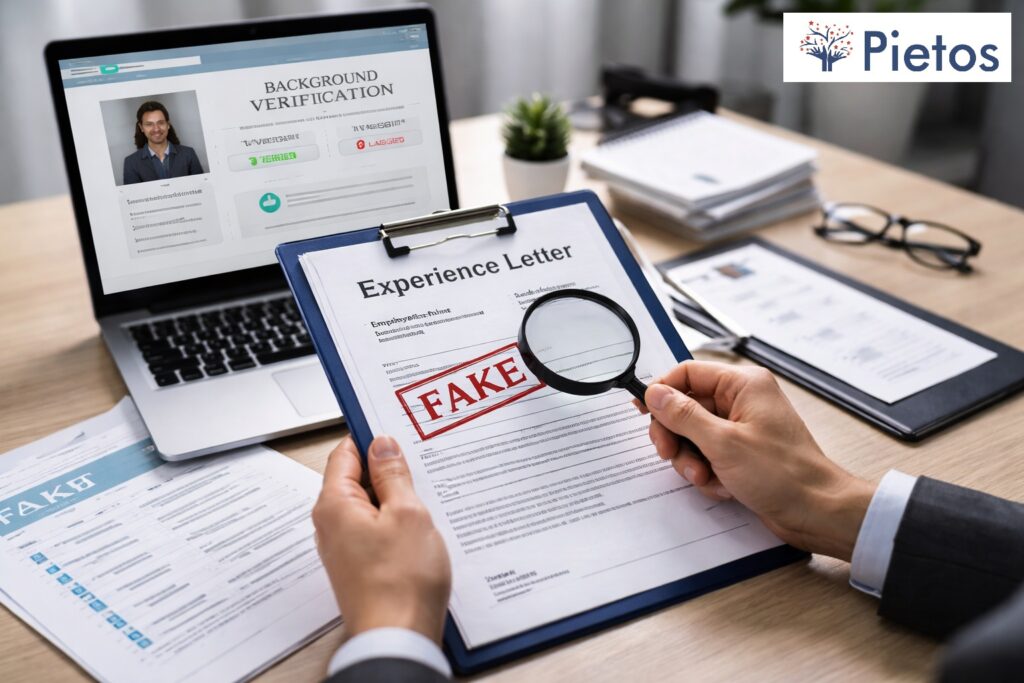
Fake experience letters in India have become one of the most common and damaging hiring frauds faced by HR teams today. What makes this problem dangerous is not just how frequently it occurs — but how convincingly fake documents are created.
From fabricated company letterheads to self-created HR email IDs and inflated job titles, employment fraud has evolved faster than most internal hiring checks.
This blog explains:
- Why fake experience letters are rising in India
- Common red flags HR teams miss
- How employment verification fraud actually works
- What HR leaders should check before onboarding
- How professional background verification helps prevent these risks
If you are hiring in India in 2026, this is a problem you cannot afford to ignore.
Fake Experience Letters India: Why This Hiring Fraud Is Increasing
Several factors have contributed to the rise of fake experience letters:
High Attrition & Competitive Hiring
With frequent job changes, candidates often feel pressured to:
- Hide short tenures
- Inflate designations
- Cover employment gaps
Fake experience letters become a “quick fix”.
Weak Verification Practices
Many organisations still rely on:
- Email confirmations from unknown HR IDs
- Candidate-shared contact details
- Informal reference calls
These gaps are easily exploited.
Remote & Hybrid Hiring
Remote hiring has reduced face-to-face scrutiny, making document-based fraud harder to detect without structured verification.
What Is a Fake Experience Letter?
A fake experience letter is a fabricated or manipulated document that falsely represents a candidate’s employment history.
Common forms include:
- Completely fake companies created only for verification
- Genuine companies with altered tenure or designation
- Self-generated letters using fake HR email IDs
- Forged signatures and stamps
In many cases, the document looks legitimate — which is why manual checks fail.
Common Red Flags HR Teams Miss
HR teams often miss fake experience letters because the red flags are subtle.
How HR Teams Can Detect Fake Experience Letters India
1. Generic Language & Formatting
- No specific role responsibilities
- Overly generic wording
- Inconsistent fonts or alignment
2. Unofficial HR Email IDs
Examples:
hr.companyname@gmail.comcompany.hr@outlook.com
Legitimate organisations rarely use free email domains for official verification.
3. Inflated Designations
Titles like:
- “Senior Manager” after 6 months
- “Lead” roles without team size clarity
Designation inflation is a common manipulation tactic.
4. Salary Mismatch
Experience letters that don’t align with:
- Payslips
- Offer letters
- Market benchmarks
This often indicates partial fabrication.
5. Employer Not Traceable
- Company website inactive
- No LinkedIn presence
- Address unverifiable
These are major red flags.
How Employment Verification Fraud Actually Happens
Understanding the fraud mechanism helps HR teams prevent it.
Most fake experience letter fraud follows one of these patterns:
Pattern 1: Fake Company Setup
Candidates create:
- A basic website
- Fake HR contact details
- Branded email IDs
Verification requests are “confirmed” internally.
Pattern 2: Friendly Reference Manipulation
A friend or former colleague poses as:
- HR representative
- Reporting manager
Calls are answered convincingly but falsely.
Pattern 3: Partial Truth Manipulation
The candidate worked at the company but:
- Stayed for a shorter duration
- Left on adverse terms
- Held a junior role
Documents are altered to hide this.
Why Internal HR Checks Are Not Enough
Even experienced HR teams struggle because:
- Verification is not their core function
- Source access is limited
- Time pressure exists during hiring
This is where structured employment verification becomes critical.
How Professional Background Verification Prevents Fake Experience Letters
Professional background verification companies use independent, multi-source verification methods rather than relying on candidate-provided information.
A robust employment verification process includes:
- Direct verification with official HR channels
- Cross-checking tenure and designation
- Validating company legitimacy
- Secondary verification where responses are unavailable
At Pietos, employment verification is conducted using documented, audit-ready processes designed to detect exactly these fraud patterns.
What HR Teams Should Check Before Onboarding
Before onboarding a candidate, HR teams should ensure:
- Employment details are independently verified
- HR responses come from official company domains
- Designation and tenure are corroborated
- Any discrepancies are clearly documented
Ignoring “small mismatches” often leads to bigger operational issues later.
Pre-Employment vs Post-Employment Verification in Fraud Cases
Many organisations ask whether verification should be done before or after joining.
Pre-Employment Verification
- Best for leadership and sensitive roles
- Prevents fraud upfront
Post-Employment Verification
- Common for bulk hiring
- Requires strong internal controls
The right approach depends on role risk, not convenience.
Real Business Impact of Fake Experience Letters
Hiring based on fake experience letters can lead to:
- Poor performance
- Early attrition
- Compliance failures
- Client dissatisfaction
- Reputational damage
The cost of a bad hire is far higher than the cost of verification.
Frequently Asked Questions
How common are fake experience letters in India?
Industry estimates suggest employment discrepancies appear in 25–35% of profiles, with fake or manipulated experience being a major contributor.
Can HR teams detect fake experience letters internally?
Basic checks help, but structured verification is needed to detect well-fabricated fraud.
Is employment verification legally allowed in India?
Yes, with candidate consent and ethical processes.
Final Thoughts: Trust Should Be Verified, Not Assumed
Fake experience letters are not always created with malicious intent — but their impact on organisations can be severe.
In today’s hiring environment, trust must be supported by verification, not assumptions.
Organisations that treat background verification as a strategic safeguard consistently make better hiring decisions.
📌 Need Help Verifying Employment History?
If your HR team is dealing with suspected experience letter fraud or wants to strengthen employment verification, Pietos can help with structured, compliant background verification services tailored to Indian hiring realities.




Pingback: Employment Verification Services India: HR Process Explained