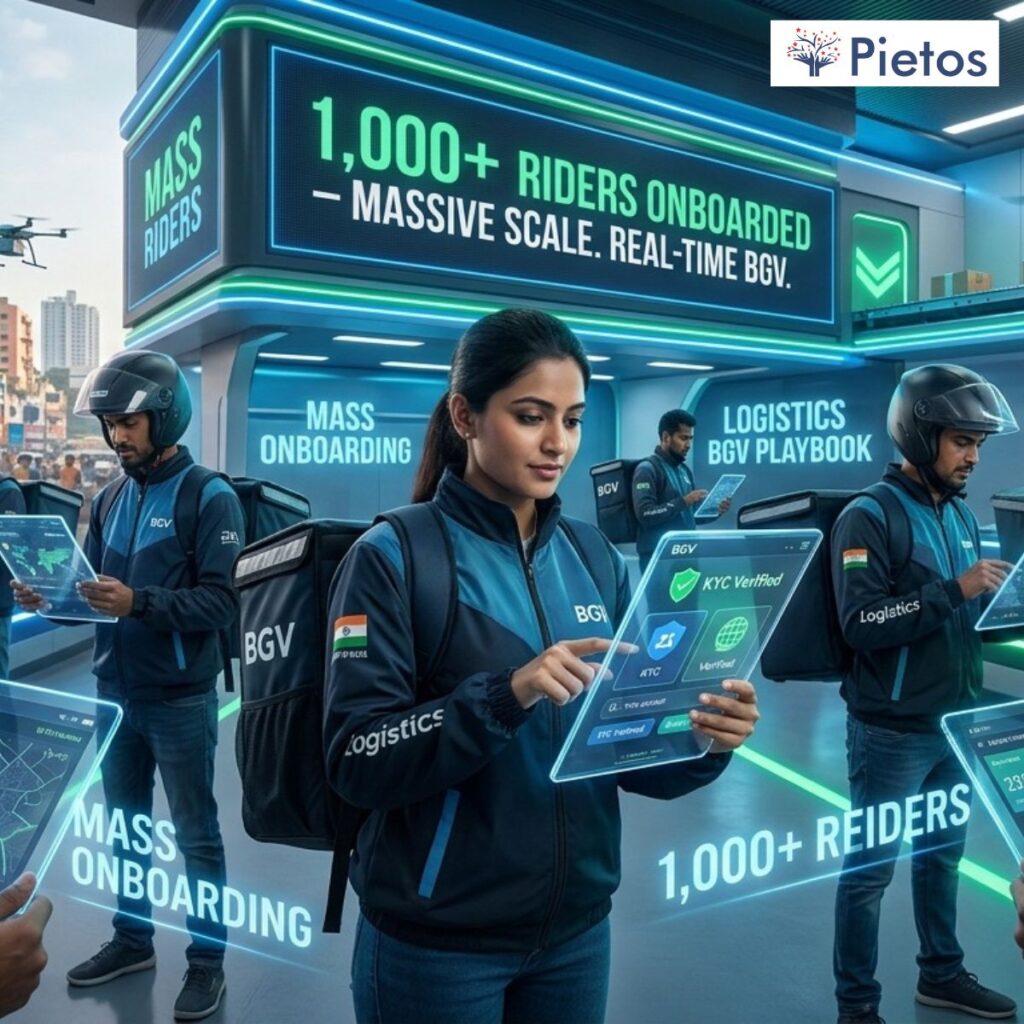
In 2026, mass onboarding for logistics has become the defining challenge for India’s rapid-delivery economy. From the dense hubs of Delhi NCR to the tech corridors of Bangalore, the ability to scale a fleet overnight is no longer a luxury—it is a survival requirement. However, rapid growth must not come at the cost of security. Implementing a robust strategy for mass onboarding for logistics requires a sophisticated blend of AI-driven identity checks and strict legal compliance to protect your brand from rising fraud and regulatory penalties.
Why Mass Onboarding for Logistics Requires a 2026 Strategy
The traditional methods of background verification (BGV) are failing under the pressure of modern scale. When your HR team is tasked with mass onboarding for logistics in cities like Mumbai or Hyderabad, a manual 7-day turnaround time results in high candidate drop-off and lost market share. To win in 2026, your verification must be as fast as your delivery promise.
Navigating Regional Challenges in India
Every major metro presents unique hurdles for mass onboarding for logistics:
- Delhi & Noida: High candidate volatility requires instant DL and criminal checks to keep pace with “spot-hiring” demands.
- Bangalore & Pune: Tech-savvy gig workers expect a seamless, WhatsApp-integrated onboarding experience.
- Mumbai & Chennai: High-density residential zones demand verified “Trust Badges” for riders to gain entry into gated communities.
Table of Contents
- The 2026 Logistics Landscape: Speed vs. Trust
- City Spotlight: Delhi, Mumbai, Bangalore & The Metro Hubs
- The Regulatory Fortress: DPDP Act 2026 & Social Security Code
- Technical Warfare: Fighting AI Deepfakes & Document Forgery
- The EPFO & ESIC Challenge: Verifying Masked Data
- Operational Excellence: The 4-Hour TAT Blueprint
- Case Studies: Success Stories from the Ground
- City-Specific BGV FAQs
1. The 2026 Logistics Landscape: Speed vs. Trust
In 2026, the Indian logistics sector is no longer just about moving goods; it is about moving data safely. With “Quick-Commerce” now the standard, companies in Delhi, Noida, and Gurgaon are locked in a race to onboard riders in under 24 hours. However, this speed creates a “Trust Gap.”
A single unverified rider can lead to more than just a late delivery, they can lead to a ₹250 Crore penalty under the new Digital Personal Data Protection (DPDP) Act or a catastrophic brand hit on social media. The 2026 playbook is built on one principle: Verify at the speed of hire.
2. City Spotlight: Delhi, Mumbai, Bangalore & The Metro Hubs
2.1 Delhi NCR (Delhi, Noida, Gurgaon, Ghaziabad)
Delhi NCR remains the world’s densest logistics corridor. In Noida and Gurgaon, high-density warehouses require “spot-hiring” for festive surges.
- The Challenge: High candidate volatility. A rider may apply in Noida today and move to a hub in Gurgaon tomorrow.
- The 2026 Strategy: Implement “Portable BGV.” Once a rider is verified in the Delhi cluster, their digital trust score follows them across your regional hubs, preventing redundant costs.
2.2 Mumbai & Pune: The High-Rise Security Hubs
In Mumbai, where 10-minute delivery is expected in vertical high-rises from Colaba to Borivali, and in Pune’s tech corridors like Hinjewadi, security is the primary metric.
- The Challenge: Residential societies in Mumbai now frequently demand proof of BGV before allowing riders past the gate.
- The Strategy: Focus on criminal record checks that scan 3,000+ district courts. Digital “Verified” badges for riders increase delivery success rates in high-security zones.
2.3 Bangalore & Hyderabad: The Digital Gold Standard
In Bangalore (Bengaluru) and Hyderabad, the workforce is the most tech-savvy in the country.
- The Strategy: Use WhatsApp-integrated onboarding. Riders in Indiranagar or Gachibowli are 40% more likely to complete BGV if it happens inside their messaging app.
2.4 Chennai, Kolkata & Ahmedabad: The Growth Corridors
Chennai’s manufacturing surge and Kolkata’s role as the gateway to East India require localized address verification that understands regional nuances and language-specific documentation.
3. The Regulatory Fortress: DPDP Act 2026 & Social Security Code
The most significant change in 2026 is the legal weight of hiring. Background verification is no longer an HR “option”—it is a compliance “shield.”
3.1 The DPDP Act 2026 (Operationalized)
As of early 2026, the Data Protection Board (DPB) is fully active.
- Itemized Consent: You cannot bundle BGV consent into an offer letter. You must show the rider in Ahmedabad or Chennai exactly what is being checked (ID vs. Criminal vs. DL).
- Data Minimization: Under 2026 rules, you cannot “hoard” documents. Once a background verification company in India confirms a check, the raw images of IDs should be purged or anonymized to reduce breach risk.
3.2 The Social Security Code & “Aggregator” Status
The Social Security Code 2020 (fully enforced in 2026) formally recognizes gig workers.
- Mandatory Registration: Every rider must be registered on the e-Shram portal with a unique UAN.
- The Compliance Hook: To qualify for the Social Security Fund (where aggregators contribute 1-2% of turnover), a rider’s identity must be 100% verified via Aadhaar-linked e-KYC.
4. Technical Warfare: Fighting AI Deepfakes & Document Forgery
The “Identity” threat of 2026 is synthetic. Fraudsters in Delhi and Kolkata are now using Gen-AI to create “Perfect Identities.”
4.1 3D Liveness Detection
Static selfies are dead. In 2026, ID verification must include 3D Liveness Detection. The system requires the rider in Bangalore to perform a random action (blink, smile, or turn) to ensure it isn’t a deepfake video injection.
4.2 Pixel-Level Document Forensics
Using AI to fight AI, Pietos’ 2026 engine scans uploaded Driving Licenses for “digital noise.” We catch microscopic edits in fonts and security holograms that indicate a forged document from a “Photoshop hub” in Noida or Chennai.
5. The EPFO & ESIC Challenge: Verifying Masked Data
Today, the EPFO has increased data masking to protect privacy. Traditional “portal-scraping” by BGV vendors is now illegal and technically impossible.
5.1 Verified Source-Based Checks
In 2026, the only way to confirm a rider’s past work history (to check for “bad exits” or dual employment) is through direct API handshakes with the EPFO database. This ensures you see the actual contributions made by previous employers in Pune or Hyderabad, not just what is written on a fabricated experience letter.
6. Operational Excellence: The 4-Hour TAT Blueprint
How do you verify 1,000+ riders in a single day? Legacy systems fail here. You need an “API-First” workflow:
- Phase 1: Instant ID & DL Check: The moment a rider hits “Apply” in Delhi, the system pings the Sarathi and Aadhaar databases.
- Phase 2: Digital Address Validation (DAV): We use GPS triangulation to verify a rider’s home in Noida instantly, rather than sending a field agent on a bike.
- Phase 3: Automated e-Court Scan: Real-time hits on criminal records using the national e-Courts database.
7. Case Studies: Success Stories from the Ground
Case A: Scaling in Bangalore
A leading grocery-delivery startup needed 2,000 riders for their Bangalore launch. By switching from manual checks to Pietos’ API-integrated suite, they reduced onboarding time from 6 days to 5 hours, capturing market share before their competitors could even finish their BGV.
Case B: Safety in Mumbai’s High-Density Zones
A logistics firm in Mumbai faced high theft rates. After implementing mandatory criminal record checks for all riders in the Andheri and Bandra hubs, in-transit theft dropped by 31% within one quarter.
8. City-Specific BGV FAQs
Q: Best BGV for delivery boys in Bangalore?
A: In Bangalore, use WhatsApp-based BGV to reduce candidate drop-off. Tech-savvy riders prefer it.
Q: How to handle BGV for North India (Delhi/Noida)?
A: In Delhi NCR, prioritize DL (Driving License) validation via Sarathi API to mitigate high traffic-violation risks.
Q: Is BGV mandatory for riders in Mumbai?
A: While not a “law,” the Mumbai Police and various residential associations in South Mumbai increasingly mandate BGV for last-mile delivery personnel entering premises.
Final Conclusion: The Pietos Roadmap for 2026
Whether you are a startup in Ahmedabad or a multinational logistics firm in Chennai, the goal remains the same: Build a workforce of trust. In 2026, background verification is a sophisticated blend of AI technology, legal expertise, and local geographic knowledge.
Ready to verify 1,000+ riders today? Talk to our Regional Experts in Delhi, Bangalore, or Mumbai Today