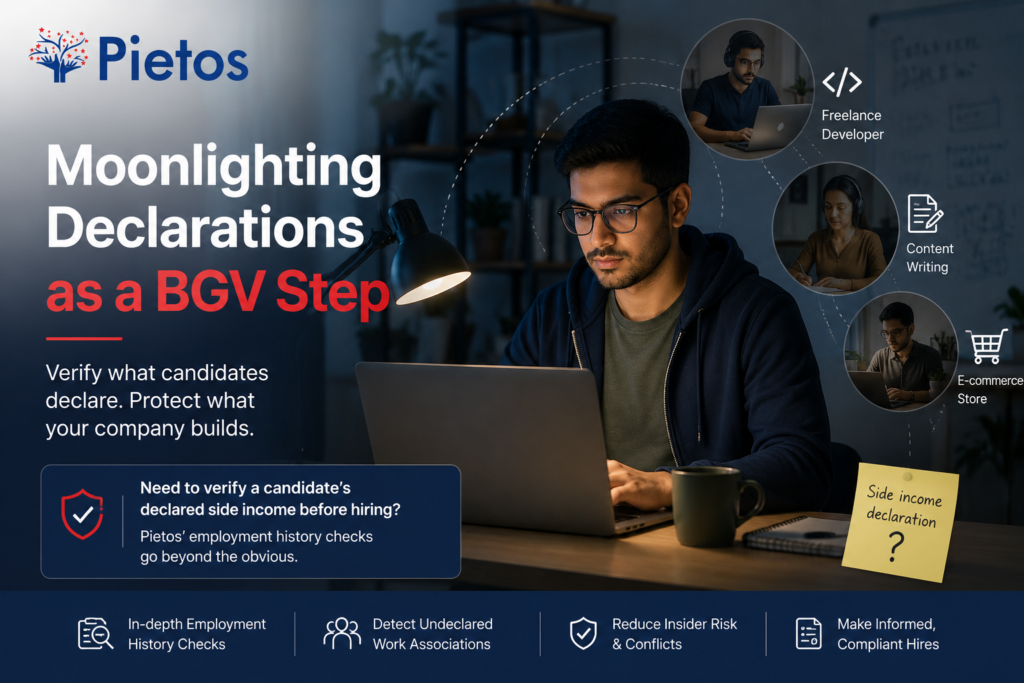
Moonlighting declaration verification is fast becoming a standard checkpoint in Indian IT hiring. Candidates now declare side gigs, freelance contracts, and secondary employment during onboarding. But a declaration is only a claim. Without verification, HR teams have no way to confirm it is true. This gap creates real risk for IT and ITES employers, especially as remote and hybrid work make undisclosed second jobs easier to hide.
This article breaks down what moonlighting declaration verification actually involves, why it matters right now, and how HR teams can build it into their background verification workflow without slowing down hiring.
Most Indian IT and ITES employers already ask candidates to declare secondary employment somewhere in their onboarding paperwork. Very few employers actually check whether that declaration is accurate. That gap between asking and verifying is where risk accumulates quietly, deal by deal, hire by hire, until it surfaces as a client escalation or a compliance audit finding. Closing that gap is the entire point of moonlighting declaration verification.
Not sure where moonlighting checks fit into your current BGV process? Talk to Pietos about a compliance-first BGV workflow built for IT hiring at scale.
What Is Moonlighting Declaration Verification?
Moonlighting declaration verification is the process of cross-checking a candidate’s or employee’s stated secondary employment against independent data sources. It answers a simple question: does the declared side job match reality?
A candidate might disclose a small consulting engagement. An existing employee might mention a weekend freelance project. Moonlighting declaration verification takes that statement and tests it against employment records, income data, and payslip trails. The goal is not to police every side hustle. The goal is to catch material misrepresentation — a second full-time job, a competing engagement, or undisclosed income that changes the employment relationship.
For IT and ITES companies, this check has moved from optional to necessary. Remote work erased the physical cues that once made a second job obvious. A verification step restores that visibility. In an office setting, a manager would notice an employee constantly stepping away for calls or missing deadlines tied to a second commitment. Remote work removed those cues entirely, which is exactly why a data-based verification step has become necessary rather than optional.
It also protects honest employees. A declared, disclosed side project should not carry the same suspicion as an undisclosed second full-time role. Verification lets HR teams tell the two apart quickly, instead of treating every declaration as equally uncertain. That distinction matters for morale as much as it matters for risk management.
Moonlighting declaration verification is not a one-time hiring gate either. Many companies run it at onboarding and again at defined intervals during employment, since a candidate’s situation at the offer stage can change six months into the role. Building the check into both moments closes a gap that a single point-in-time verification would miss.
Why Indian IT Employers Need This BGV Step Now
The Post-Pandemic Moonlighting Surge
Remote work reshaped how employees think about their time. Once companies stopped tracking physical presence, some employees started taking on parallel roles. Surveys from staffing firms through 2022 and 2023 repeatedly flagged IT and ITES as the sectors most affected. Employers discovered mid-project that a “full-time” resource was splitting hours across two employers.
This surge did not fade with return-to-office mandates. Hybrid arrangements persist, and so does the incentive to moonlight. Declaration verification gives employers a way to manage this risk without banning all secondary work outright.
Salary pressure plays a role too. Junior and mid-level IT talent often cite rising living costs as a reason to take on a second project. That pressure is not going away. Employers who treat moonlighting purely as a disciplinary issue miss the underlying driver. Employers who build a clear, verified declaration process address the risk without pretending the economic pressure behind it doesn’t exist.
The result is a sector-wide shift: fewer blanket bans, more structured disclosure-and-verify policies. Moonlighting declaration verification is the operational backbone that makes disclosure-and-verify policies work in practice rather than on paper.
NASSCOM’s Position and Industry Response
NASSCOM, the apex body for India’s IT industry, has weighed in publicly on moonlighting. Its position acknowledges that undisclosed dual employment breaches trust and can violate contractual terms, while also recognising that outright bans on all secondary income are hard to enforce and can feel punitive. This nuanced stance pushed many IT employers toward a middle path: allow declared secondary work under policy, and verify what gets declared.
That middle path only works if verification is real. A declaration policy without a verification mechanism is just a form. Moonlighting declaration verification is what turns the policy into an enforceable control.
Industry associations can set direction, but they cannot verify a single candidate’s UAN record. That work sits with individual HR and compliance teams, and it requires a repeatable process rather than a one-off legal opinion. Employers who wait for a definitive industry-wide rulebook will likely wait a long time. The more practical path is building a verification step now, inside whatever policy the company already has.
Building or revisiting your moonlighting policy? See how Pietos structures pre-hire and post-hire moonlighting checks for IT and ITES clients.
How Moonlighting Declaration Verification Works
A reliable moonlighting declaration verification process runs through four steps. Each step adds a layer of independent evidence, so no single data point carries the whole decision.
Step 1 — Self-Declaration at Onboarding
The process starts with a structured declaration form. Candidates list any active secondary employment, freelance contracts, or advisory roles. This form should ask for specifics: employer name, engagement type, hours committed, and whether the role is ongoing or project-based. A vague checkbox invites vague answers.
Frame the form as routine, not accusatory. Candidates who feel targeted are more likely to under-disclose. A short cover note explaining why the company asks — usually tied to confidentiality and working-hours policy — tends to produce more complete, honest answers than a bare legal clause buried in the offer letter.
Step 2 — UAN and EPFO Cross-Verification
The Universal Account Number (UAN) is the single most useful data point in this entire process. Every EPFO-registered employer contributes to an employee’s UAN. If a candidate declares one employer but the UAN shows active contributions from two, that mismatch is worth investigating immediately. UAN verification does not require the candidate’s cooperation once consent is obtained, which makes it a strong independent check.
This step also catches a subtler pattern: overlapping contribution periods. A candidate might have left one employer and joined another in quick succession, which is normal. But overlapping contributions from two employers in the same month point to concurrent, active employment — exactly the scenario a moonlighting declaration is meant to surface. HR teams should read UAN history for overlap, not just for the current employer listed.
Step 3 — Form 26AS Income Cross-Check
Form 26AS, maintained by the Income Tax Department, consolidates tax deducted at source across all income sources. A candidate with two active employers or client contracts will typically show TDS entries from multiple deductors. This cross-check catches secondary income that might not route through EPFO, such as consulting fees or contract payments.
This is the step that catches freelance and consulting arrangements UAN alone would miss. A contract role paid against invoices, with TDS deducted under Section 194J rather than as salary, never shows up in EPFO data. Form 26AS closes that blind spot, which matters most for the IT sector, where consulting and advisory side work is common.
Step 4 — Payslip and Employment History Match
Payslips can be forged, but patterns in payslip data — inconsistent formatting, mismatched employer registration details, or salary structures that don’t match market norms — often expose fabricated documents. Cross-referencing payslip claims against UAN and 26AS data closes most of the gaps a candidate might otherwise hide behind.
A trained verification analyst can usually spot a fabricated payslip in minutes: font inconsistencies, incorrect statutory deduction math, or an employer PAN that doesn’t match public records. These are small details, but they are exactly the details a busy in-house recruiter rarely has time to check line by line.
Together, these four steps convert a one-line declaration into a verified fact. No single step is conclusive on its own. Combined, they give HR a defensible, evidence-backed picture of a candidate’s actual employment status.
Red Flags That Signal Undisclosed Secondary Employment
HR and TA teams don’t need to investigate every candidate with the same intensity. A few signals reliably indicate that a closer look is warranted.
Documentation Red Flags
- UAN records show two active employer contributions in the same period
- Form 26AS lists TDS from an employer or client the candidate never disclosed
- Payslip formatting or employer PAN details don’t match the stated company
- Salary structure on the payslip doesn’t match publicly known pay bands for the stated role
Documentation red flags are the strongest evidence, because they come from independent government or statutory sources rather than from the candidate directly. They are also the hardest for a candidate to explain away with a simple conversation.
Behavioural Red Flags
- The candidate is unusually resistant to signing a moonlighting declaration
- Reference checks reveal inconsistent working hours or availability
- Bank statement patterns show recurring credits from an unlisted source
- A current employee suddenly becomes unreachable during core working hours without explanation
Behavioural red flags rarely stand alone as proof. They work best as a trigger — a reason to run the documentation checks sooner rather than later, not as a basis for action by themselves.
None of these signals alone proves wrongdoing. Together, they build a case strong enough to raise directly with the candidate or employee. HR teams should always give the individual a chance to explain a flagged discrepancy before treating it as confirmed. Some mismatches turn out to be timing issues — a UAN update lag, or a payslip run before a formal exit was processed.
Legal and Compliance Considerations Under New Labour Codes
India’s new labour codes are reshaping how secondary employment gets treated legally. The codes tighten definitions around working hours, rest periods, and employer obligations, which indirectly affects how moonlighting clauses in employment contracts should be worded. Employers can no longer rely on generic, boilerplate non-compete language and expect it to hold up.
A moonlighting declaration verification process needs to sit inside a contract that clearly states what secondary employment is permitted, what must be disclosed, and what happens on non-disclosure. Without that contractual foundation, even a confirmed case of undisclosed dual employment can be hard to act on. Compliance teams should review moonlighting clauses against the updated labour code provisions before rolling out any verification programme.
What a Defensible Moonlighting Clause Needs
A clause that will hold up needs four things: a clear definition of what counts as secondary employment, an explicit disclosure requirement with a deadline, a stated consequence for non-disclosure, and a reference to how verification will be carried out and by whom. Contracts that skip the fourth point often run into trouble later — an employee can reasonably argue they were never told their declaration would be checked.
Data Privacy in the Verification Process
Verification touches personal financial and employment data, so consent matters as much as the check itself. Candidates and employees should sign explicit, informed consent before UAN or Form 26AS data gets accessed on their behalf. This isn’t just good practice — it’s what keeps the verification process legally sound and audit-ready.
Uncertain if your current contracts hold up under the new labour codes? Pietos’ BGV team can flag compliance gaps alongside your moonlighting checks.
How Large Employers Are Responding
Large Indian IT services firms have already moved from debate to policy. Tata Consultancy Services took a public, firm stance on moonlighting, treating undisclosed secondary employment as a serious violation of its code of conduct rather than a grey area. That stance has become something of a benchmark: mid-market firms often reference how the majors handled moonlighting when they draft their own policy.
The lesson for smaller and mid-market IT employers is not to copy the policy word for word. It is to notice that the largest, most sophisticated HR functions in the country treat this as something worth a formal, enforced process — not an informal conversation.
Mid-market IT and ITES firms often assume moonlighting enforcement is a large-company problem, with the resources to run detailed checks that smaller HR teams can’t match. In practice, the opposite risk applies. A 200-person IT firm loses proportionally more when a key engineer is quietly splitting hours across two clients than a 20,000-person firm does. Smaller teams have more reason to verify, not less — they just need a process that doesn’t require an in-house compliance department to run.
A Practical Framework for Rolling Out Moonlighting Declaration Verification
HR teams considering this step don’t need to build everything at once. A phased rollout works better than a single, sweeping policy change.
- Update the employment contract first. Add clear disclosure language before introducing any verification step, so the process has a legal foundation from day one.
- Pilot on new hires only. Start moonlighting declaration verification with new candidates rather than retrofitting it onto the existing workforce. This limits scope and lets HR refine the process before wider rollout.
- Set clear escalation ownership. Decide in advance who reviews a flagged discrepancy — usually a joint sign-off between HR and legal — so investigations don’t stall waiting for a decision-maker.
- Extend to periodic checks for existing employees. Once the new-hire process is stable, apply a lighter-touch version at defined intervals, such as annually or at promotion cycles.
- Review outcomes quarterly. Track how many declarations get flagged, how many resolve as false positives, and how many confirm actual undisclosed employment. Use that data to tune the process rather than leaving it static.
This sequencing keeps the rollout manageable and gives HR real data to justify expanding the programme, rather than asking leadership to approve a full-scale process on faith.
Building Moonlighting Checks Into Your BGV Workflow
Once a company decides to verify moonlighting declarations, the next decision is who runs the process. Two paths exist: build the capability in-house, or bring in a specialist BGV vendor.
| Factor | In-House Team | Specialist BGV Vendor |
|---|---|---|
| UAN and EPFO access | Limited, manual, slow | Structured, consented, faster turnaround |
| Form 26AS cross-checks | Rarely done systematically | Standard part of the process |
| Legal defensibility of findings | Depends on internal expertise | Backed by documented verification trail |
| Scalability across hiring volume | Breaks down past a few hires a month | Built for volume hiring |
| Cost per verification | Hidden in HR headcount time | Transparent, per-check pricing |
In-house teams can handle occasional checks, but the UAN and Form 26AS cross-referencing steps demand tooling and consented data access that most HR teams don’t maintain day to day. That gap is exactly why specialist verification matters at any real hiring volume.
Cost is often the first objection raised against outsourcing this check, but it’s worth comparing against the real alternative. An in-house recruiter manually cross-referencing UAN records for even ten hires a month spends hours on work a specialist vendor completes in a fraction of the time, with a documented trail attached. The hidden cost of DIY verification usually exceeds the visible cost of a per-check vendor fee.
See how moonlighting checks fit inside a full IT sector BGV programme, from Pietos’ corporate IT and software background verification service.
Common Objections From HR Teams
“Won’t this slow down our hiring process?” A structured moonlighting declaration verification step adds a few days at most, and it runs in parallel with other BGV checks rather than after them. The delay is smaller than the cost of discovering undisclosed dual employment six months into a role.
“Isn’t this an invasion of the candidate’s privacy?” Verification runs on explicit, informed consent. Candidates sign off before UAN or Form 26AS data gets pulled. The process checks a specific declared claim — it does not open a blanket investigation into someone’s finances.
“We already ask candidates to declare moonlighting. Isn’t that enough?” A declaration without verification only works if every candidate is honest about something that could cost them the offer. Verification exists precisely because self-interest and honesty don’t always align.
“What if we find something minor, like a small freelance project?” Most policies distinguish between disclosed, low-hours secondary work and undisclosed or competing engagements. A verified minor side project usually needs no action beyond a documented acknowledgment.
“Do we need to run this on every single hire, including junior roles?” Not necessarily. Many companies scale the depth of verification to role sensitivity — full UAN and Form 26AS checks for client-facing and senior technical roles, a lighter declaration-only step for entry-level hires with limited system access.
“How do we handle a confirmed case without damaging team morale?” Document the finding, give the employee a structured opportunity to respond, and apply the consequence set out in the contract consistently. Teams tend to respect a process that is fair and predictable far more than one that is harsh but inconsistent.
Cost of Ignoring Moonlighting Declarations
Skipping moonlighting declaration verification carries costs that surface later, often at the worst possible time.
Productivity and Delivery Risk
An employee splitting hours across two full-time roles delivers less to both. Project timelines slip, and managers struggle to explain why. Sprint velocity drops in ways that don’t map to any obvious cause, because the real cause — divided attention — never shows up in a status report.
Confidentiality and IP Exposure
Confidential client data can move between competing employers without either company knowing. In IT and ITES, where employees routinely touch client codebases, credentials, and roadmaps, this risk is not theoretical. A single undisclosed engagement with a client’s competitor can expose the company to liability well beyond the cost of one bad hire.
Harder Decisions Later
When an undisclosed dual-employment case eventually surfaces, the company faces a harder decision: terminate a trained employee mid-project, or let a known policy breach go unaddressed and set a precedent for the whole team. Neither option is good. Both are avoidable with verification at the point of hire.
None of these outcomes cost as much, in money or in disruption, as a short UAN and Form 26AS cross-check at the point of hire. Verification is cheap. Discovering a problem eighteen months in, mid-project, is not.
Key Takeaways
- Moonlighting declaration verification cross-checks a candidate’s stated secondary employment against UAN, Form 26AS, and payslip data
- UAN records are the fastest, most independent signal of undisclosed dual employment
- NASSCOM’s position supports declared, verified secondary work over blanket bans
- New labour codes make clear contractual language on moonlighting essential, not optional
- Specialist BGV vendors can run this check at scale in ways most in-house HR teams cannot
- The cost of skipping verification shows up later, in project delays, confidentiality risk, and harder termination decisions
Related Resources
- Moonlighting detection India: EPFO and UAN methods — a deeper look at pre-hire and post-hire moonlighting detection using UAN data: https://www.pietos.com/moonlighting-detection-india-epfo-uan/
- UAN verification guide — the primary tool referenced throughout this article, explained step by step: https://www.pietos.com/uan-verification-guide/
- Corporate IT and software background verification — how moonlighting checks fit inside a full IT sector BGV programme: https://www.pietos.com/corporate-it-software-background-verification/
- Payslip fraud red flags in India — moonlighting often surfaces through payslip irregularities covered here: https://www.pietos.com/payslip-fraud-india-red-flags-hr/
- In-house vs outsourced BGV — why most in-house teams lack the tooling for moonlighting-grade verification (link once published)
Authoritative Sources
- EPFO Member Portal — the primary tool for verifying an employee’s UAN and employment contribution trail: https://www.epfindia.gov.in
- Income Tax Department — Form 26AS — consolidated view of all income sources and TDS entries: https://www.incometax.gov.in
- NASSCOM — India’s IT industry body and its public position on moonlighting: https://nasscom.in
- Ministry of Labour and Employment — the source for India’s new labour codes and how they affect secondary employment: https://labour.gov.in
- TCS Moonlighting Policy Statement — cited as the benchmark case study for a formal employer response: https://tcs.com
FAQ
It is the process of confirming a candidate’s or employee’s declared secondary employment against independent records such as UAN contributions, Form 26AS, and payslip data, rather than accepting the declaration at face value.
No single law bans moonlighting outright. Whether it’s permitted depends on the employment contract, company policy, and whether the employee disclosed it. Undisclosed dual employment can breach contract terms even where moonlighting itself isn’t illegal.
Every EPFO-registered employer contributes to an employee’s UAN. If contributions appear from more than one employer during the same period, that’s a strong, independent signal of active dual employment.
Most companies apply it as a standard BGV step for full-time hires, with closer scrutiny triggered by specific red flags rather than deep investigation on every candidate.
That depends on the employment contract and company policy on secondary employment. Clear, updated contractual language — aligned with the new labour codes — is what makes any termination decision defensible.
A UAN and Form 26AS cross-check typically completes within a few business days once consent is in place, running alongside other standard BGV checks rather than adding a separate delay to the hiring timeline.
Yes, and arguably it matters more for this group. Contract and project-based workers already juggle multiple engagements by design, so a clear disclosure-and-verify process helps distinguish permitted parallel work from a genuine conflict of interest, such as a contractor working simultaneously for a direct competitor on the same account.
Choosing a Partner for Moonlighting Declaration Verification
Not every BGV provider runs UAN and Form 26AS cross-checks as a standard offering. Some treat moonlighting as an edge case, bolted onto a generic employment verification package. That approach misses the pattern-recognition work — spotting overlapping contribution periods, reading payslip inconsistencies, matching TDS deductor details — that makes moonlighting declaration verification useful in the first place.
When evaluating a BGV partner for this specific check, IT and ITES employers should ask three questions: Does the vendor run UAN verification as a structured, repeatable process, or as a manual one-off lookup? Can they cross-reference Form 26AS data to catch consulting and freelance income that EPFO records miss? And do they document findings in a way that would hold up if a termination decision gets challenged later? A vendor who can answer all three with specifics, rather than general reassurances, is set up to run this check properly.
For IT and ITES employers building this into an existing BGV programme, the fastest path is a provider who already runs employment history, UAN, and income verification as connected steps — not three separate vendors stitched together after the fact.
Ready to add a verified moonlighting declaration step to your hiring pipeline? Book a call with Pietos to see how UAN, Form 26AS, and payslip cross-checks fit into your existing BGV workflow — without adding weeks to your time-to-hire.