
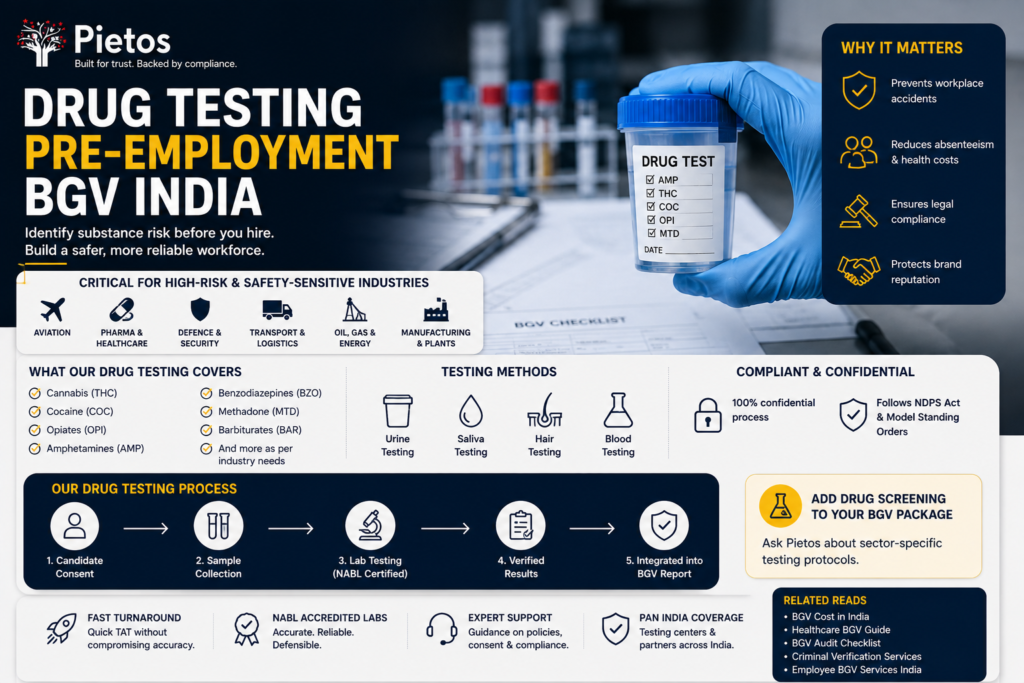
Pre-employment drug testing in India used to sit outside standard hiring checklists. Not anymore. Aviation ground crews, pharma manufacturing floors, defence-linked plants, and heavy logistics fleets now treat substance screening as a hiring gate, not an afterthought. A single impaired worker on a shop floor or a flight line can cost a company far more than the test itself.
This guide breaks down what Indian law actually requires, which sectors face real exposure, how the testing process works end to end, and how to build a policy that survives an audit. If you run HR or compliance for a safety-sensitive employer, this is the reference you keep open during your next hiring cycle.
Thinking about adding drug screening to your background verification stack? Talk to Pietos about sector-specific testing protocols built for Indian compliance requirements.
No single HR handbook template covers this well, mainly because the rules sit scattered across aviation regulation, narcotics law, and data protection law rather than one unified statute. That gap is exactly why this guide exists: to pull the scattered pieces into one working reference you can hand to your legal team, your safety officer, and your BGV vendor without rewriting it from scratch.
What Pre-Employment Drug Testing Actually Means in India
Pre-employment drug testing is a screening step, usually a urine or hair sample, that checks a candidate for recent use of narcotics, psychotropic substances, or alcohol before they join. Employers run it alongside identity, address, and criminal checks as part of a full background verification cycle.
Unlike the US, India has no single federal law that forces every private employer to test every hire. Instead, obligations sit inside sector regulations, safety codes, and internal company policy. That patchwork confuses many HR teams. They assume drug testing is either mandatory everywhere or optional everywhere. Neither is true.
Drug Testing vs Medical Fitness Certification: A Common Mix-Up
Many HR teams already collect a pre-joining medical fitness certificate and assume it covers substance use. It usually doesn’t. A standard fitness check confirms general health, vision, hearing, and fitness for physical duty. It rarely screens for narcotics or psychoactive substances unless the employer explicitly adds a drug panel to the medical protocol.
If your offer letter says “subject to medical fitness,” ask your medical vendor a direct question: does the panel include a substance screen, or only vitals and vision? Many employers discover the gap only after an incident, which is the worst possible time to find out.
Why Indian Employers Are Adding It Now
Three shifts explain the recent surge in demand.
First, safety-sensitive sectors face tighter regulator scrutiny. The Directorate General of Civil Aviation now runs random and pre-employment psychoactive substance checks across airlines, ground handlers, and air traffic services.
Second, insurers and enterprise clients ask for it. A logistics company bidding for a pharma distribution contract will often see substance screening listed as a vendor pre-qualification clause.
Third, litigation risk has grown. Courts increasingly hold employers responsible for on-duty incidents involving impaired staff, especially in manufacturing and transport roles.
Together, these pressures push drug testing from a nice-to-have into a documented, auditable control — exactly the kind of evidence a BGV audit checklist is designed to capture.
The Legal Backbone: NDPS Act, DGCA Rules, and DPDP Consent
Three legal frameworks shape how Indian employers can and should run drug testing. Skip any one of them, and your policy becomes a liability instead of a shield.
The NDPS Act, 1985: What It Actually Covers
The Narcotic Drugs and Psychotropic Substances Act, 1985 is India’s core drug control law. It criminalises the production, sale, purchase, transport, and consumption of narcotic drugs and psychotropic substances, and it created the Narcotics Control Bureau to enforce this.
The Act does not require private employers to test candidates. What it does is set the legal definition of a banned substance, which every employer policy references when writing its own testing panel and disciplinary consequences. Because the Act treats cannabis derivatives like charas and ganja differently from bhang, HR teams sometimes get confused about what a “positive” result actually means legally. A workplace policy should define its own testing threshold rather than relying on the criminal law standard alone.
DGCA’s Sector-Specific Mandate for Aviation
Civil aviation is the clearest example of a hard legal mandate. Under Civil Aviation Requirement Section 5, Series F, the DGCA requires random and pre-employment testing for psychoactive substances among flight crew, cabin crew, air traffic controllers, and select ground personnel. Operators must test at least 10% of covered staff every year, and a confirmed positive triggers suspension and mandatory rehabilitation before the employee can return to safety-sensitive duty.
The DGCA revised this framework again in early 2026, tightening the medical examination procedure for alcohol consumption under CAR Section 5, Series F Part III. That update matters for HR teams: it signals the regulator is actively refining, not relaxing, its stance on substance testing. Airlines, MRO organisations, and ground handling companies that skip this exposure themselves to DGCA penalties and licence risk, and the exposure extends to trainee pilots and aircraft maintenance engineers, not only licensed crew.
Factories Act and Industrial Safety Codes
Outside aviation, the Factories Act, 1948 and state-level industrial safety rules require employers to maintain a safe working environment. While the Act does not name drug testing explicitly, courts and labour inspectors increasingly treat substance screening as a reasonable step toward that obligation in hazardous manufacturing, mining, and chemical-handling roles. This is why pharma and defence-linked plants build drug testing into their safety induction, even without a name-check regulation forcing their hand.
The DPDP Act: Consent Comes Before the Swab
A drug test collects health data, one of the most sensitive categories under the Digital Personal Data Protection Act, 2023. Employers must get explicit, informed consent before collection, state the purpose clearly, and limit how long they retain results.
Skipping written consent does not just create an HR headache. It creates a DPDP compliance gap that shows up the moment a candidate files a grievance or a regulator asks for evidence. Consent should be collected as a standalone document, separate from the general offer letter, so it can be produced independently during an audit.
Key takeaway: No single law forces every Indian employer to run pre-employment drug testing. But sector rules, safety codes, consent law, and negligent-hiring liability together make it close to mandatory for aviation, pharma, defence, mining, and heavy transport.
Which Sectors in India Actually Need Pre-Employment Drug Testing
Not every hire needs a drug panel. Role risk should drive the decision, not blanket policy. Here’s how the exposure breaks down by sector, followed by a quick-reference table.
Aviation: The Only Hard Legal Mandate
Flight crew, cabin crew, air traffic controllers, aircraft maintenance engineers, and ground handling staff at Indian airports fall under direct DGCA testing rules. This is the one sector where skipping the test isn’t a business choice — it’s a licensing risk for the operator, and a career-ending one for the individual if they refuse.
Pharma Manufacturing: Client Audits Drive the Requirement
Pharma companies rarely face a named drug-testing law, but Good Manufacturing Practice audits and client due-diligence reviews frequently ask for evidence of substance-abuse screening for production-floor staff. A worker with impaired judgment near sterile manufacturing lines or controlled substances creates both a safety and a regulatory-compliance risk that auditors specifically look for.
Defence-Linked Manufacturing: Security Clearance Meets Safety Policy
Contractors supplying defence establishments often build drug testing into their broader security-clearance and background-verification process. The driver here is contractual, tied to the Ministry’s vendor empanelment terms, rather than a standalone civilian law.
Mining, Heavy Industry, and Logistics: Safety-Code Pressure
Mines Act provisions and factory safety codes push employers toward substance screening for roles operating heavy machinery, handling hazardous materials, or driving commercial fleets. Logistics companies increasingly add it because enterprise clients write it into their vendor SLAs, especially for cold-chain and pharma distribution contracts.
BFSI and IT Services: Usually Optional
For most desk-based BFSI or IT roles, drug testing adds cost without matching risk reduction. Employers in these sectors typically apply it only to specific high-trust roles, such as vault custodians or data-centre operations staff, rather than the entire workforce.
| Sector | Legal driver | Typical trigger | Testing frequency |
|---|---|---|---|
| Aviation (flight crew, ATC, ground ops) | DGCA CAR Section 5, Series F | Mandatory | Pre-employment + random (10% annually) |
| Pharma manufacturing | Drugs and Cosmetics Act, GMP client audits | Client/auditor requirement | Pre-employment + periodic |
| Defence-linked manufacturing | Ministry contracts, security clearance norms | Contractual clause | Pre-employment |
| Mining and heavy industry | Mines Act, factory safety codes | Internal safety policy | Pre-employment + post-incident |
| Logistics and fleet operations | Motor Vehicles Act, client SLAs | Client requirement | Pre-employment + random |
| BFSI and IT services | Rarely mandatory | Internal risk policy | Optional, role-based |
For most desk-based BFSI or IT roles, drug testing adds cost without matching risk reduction. For safety-sensitive roles, skipping it invites regulatory and liability exposure that no HR budget can absorb after the fact.
Not sure whether your hiring workflow needs sector-specific screening? Pietos’ employee background verification services in India already cover role-based BGV design for aviation, pharma, and industrial clients — ask us where drug testing fits your risk profile.
How the Pre-Employment Drug Screening Process Works
A compliant screening cycle follows a fixed sequence. Miss a step, and the result becomes legally shaky.
- Written consent. The candidate signs a consent form stating the purpose, the substances tested, and the retention period, satisfying DPDP requirements. This step should happen before scheduling the sample collection, never after.
- Sample collection. A trained collector takes a urine or hair sample at an approved facility, following chain-of-custody protocols that prevent tampering claims later. The sample gets sealed, labelled, and logged in front of the candidate.
- Initial screening. A lab runs an immunoassay screen across the panel, usually covering five to ten substance classes. This step is fast but not conclusive on its own.
- Confirmatory testing. Any non-negative result goes to gas chromatography-mass spectrometry (GC-MS) confirmation, the gold standard that rules out false positives from cross-reacting medications.
- Medical Review Officer check. A qualified MRO reviews confirmed positives against declared prescriptions, since codeine-based cough syrup or certain painkillers can trigger a false flag. The MRO’s job is to separate genuine substance use from legitimate medical treatment.
- Reporting and decision. The employer receives a pass/fail report, never raw lab data, protecting candidate privacy while giving HR a clear hiring signal. This report should slot directly into the candidate’s BGV file alongside identity and criminal check results.
This sequence mirrors what DGCA already mandates for aviation personnel, and most enterprise HR teams now apply the same rigour to pharma and defence hires, even without a direct legal mandate.
What Gets Tested: Panels, Methods, and Alcohol vs Drug Protocols
Indian employers typically choose between three collection methods, each with different cost and detection windows.
- Urine testing is the most common. It detects use within the past 2–7 days depending on the substance, costs the least, and suits high-volume pre-employment screening.
- Hair follicle testing detects use over a 90-day window. Employers use it for safety-critical or senior roles where a longer look-back matters more than speed.
- Oral fluid (saliva) testing detects very recent use, within 24–48 hours, and works well for post-incident or random checks rather than pre-employment gates.
Standard panels cover five to ten substance classes: cannabis, opiates, cocaine, amphetamines, benzodiazepines, and, for aviation, the DGCA’s specified psychoactive substance list.
Drug Testing and Alcohol Testing Are Not the Same Protocol
HR teams sometimes bundle drug and alcohol testing into one line item, but the methods differ. Alcohol testing uses a breath analyser and measures blood alcohol content at the point of testing, useful mainly for on-duty or pre-shift checks rather than pre-employment screening, since alcohol clears the system within hours. Drug testing, by contrast, looks for metabolites that stay detectable for days or weeks, which is why it works as a pre-employment gate. A complete policy names both, but treats them as separate tests with separate triggers.
Turnaround for a standard urine panel with negative results usually lands within 24–48 hours. A confirmatory GC-MS test on a non-negative sample adds 3–5 working days.
Pre-Employment vs Random vs Post-Incident Testing: Know the Difference
HR teams often use “drug testing” as a single catch-all term, but the trigger changes the protocol. Treating these three types as interchangeable is a common policy mistake.
Pre-employment testing happens once, before a conditional offer becomes final. It sets a clean baseline and screens out risk before it ever enters the building. This is the type most sectors default to, and the type this guide focuses on.
Random testing happens on an ongoing basis, without advance notice, across a defined percentage of the workforce. DGCA mandates this for aviation at a minimum 10% annual rate. Random testing works because employees cannot time their use around a known test date, which pre-employment testing alone cannot achieve.
Post-incident testing happens after a workplace accident, near-miss, or safety violation. It answers a narrower question: was impairment a contributing factor. Courts and insurers treat post-incident testing as strong evidence during liability reviews, so the chain-of-custody standard here needs to be airtight.
A mature substance-abuse policy names all three, states the trigger for each, and does not rely on pre-employment screening alone to manage ongoing risk. An employee who passes at hiring can still develop a substance issue eighteen months into the job; only random or post-incident testing catches that.
How Long Should Employers Retain Drug Test Records?
Retention is one of the most overlooked parts of a drug testing policy, and it sits directly at the intersection of labour compliance and the DPDP Act.
Employers should retain the consent form, the lab report, and any MRO clearance for as long as the employment relationship continues, plus a defined period afterward to cover potential disputes, typically aligned with the limitation period for labour claims. Beyond that window, the DPDP Act’s data-minimisation principle pushes employers to delete records rather than hold them indefinitely “just in case.”
Two practical rules help here. First, never store raw toxicology data long-term; a pass/fail result with supporting documentation is enough for HR purposes. Second, restrict access to drug test records to a small group, usually HR compliance and the reporting manager only, since these records qualify as sensitive personal data under DPDP and broad internal access increases breach exposure.
Training Supervisors to Spot Impairment Between Tests
No testing cadence, however frequent, catches every case in real time. Pre-employment and even random testing leave gaps between test dates, which is why mature safety programmes pair testing with supervisor training.
Line managers and shift supervisors in aviation, pharma, and industrial settings should know the basic behavioural signs of impairment: slurred speech, unsteady gait, unusual smell, erratic decision-making, or a sudden change in attendance patterns. This training does not turn supervisors into medical experts. It gives them a documented basis to request a for-cause test, which sits alongside pre-employment, random, and post-incident testing as a fourth practical trigger.
Employers that combine testing with supervisor awareness catch problems weeks or months earlier than those relying on testing alone, and that earlier catch is what actually prevents the safety incident, not just the paperwork trail after one occurs.
How India’s Approach Compares Internationally
HR teams that have worked with US or Gulf-based employers sometimes expect India to mirror those frameworks exactly. It doesn’t, and the gap matters when designing policy for a multinational workforce.
The United States runs pre-employment and random drug testing as a near-default expectation across transport, aviation, and federal-contractor roles, backed by long-standing federal regulation. India has no equivalent blanket federal rule; its closest parallel is the DGCA’s aviation-specific mandate, which is narrower in scope but follows a similar random-testing logic, including the confirmatory GC-MS standard used internationally.
Gulf Cooperation Council countries typically combine strict criminal penalties for drug use with employer-driven pre-employment screening, especially for expatriate visa processing. Indian employers hiring for GCC-linked roles sometimes need to run testing that satisfies both Indian consent law and the destination country’s visa medical requirements simultaneously, which is worth flagging early with your BGV partner rather than discovering the conflict during offboarding for an overseas posting.
The practical takeaway: don’t assume a policy template built for a US or Gulf entity transfers cleanly to an Indian workforce. Indian employers need to build from the DGCA, NDPS, and DPDP framework directly, not adapt a foreign template after the fact.
The Cost of Skipping Pre-Employment Drug Testing
Employers often treat drug screening as an optional line item. The numbers say otherwise.
India’s Ministry of Social Justice and Empowerment, through AIIMS’ National Drug Dependence Treatment Centre, found that roughly 2.1% of Indians aged 10–75 currently use opioids, and 2.8% report cannabis use in the past year. In a workforce of 500 safety-sensitive employees, that statistical baseline alone justifies a screening layer.
Consider a common scenario. A mid-sized pharma manufacturer skips substance screening for production-floor hires to save time during a hiring push. Eight months later, a client audit flags a safety incident involving an employee under the influence during a night shift. The client suspends the contract pending a corrective-action review. The company now needs to retrofit a testing programme under audit pressure, at higher cost and with far less negotiating room than if it had built the process in from day one.
Beyond scenarios like this, three business risks compound quickly:
- Vicarious liability. Under the doctrine of Respondeat Superior, courts can hold an employer liable for an impaired employee’s on-duty negligence, especially in healthcare, transport, and manufacturing.
- Insurance and contract exposure. Enterprise clients increasingly write substance-screening clauses into vendor and staffing contracts. Fail to produce evidence, and you risk losing the account, not just a compliance note.
- Regulatory penalty. For DGCA-covered aviation roles, a missed testing cycle can trigger licence action against the operator, not just the individual.
The cost of a screening panel runs a few hundred to a few thousand rupees per candidate. The cost of a workplace incident, a lost contract, or a regulatory finding runs into lakhs or crores. That gap is the entire business case.
Common Employer Objections, Answered
HR leaders raise the same objections every time this topic comes up. Here are direct answers.
“Isn’t this a privacy violation?” Not if you follow DPDP consent requirements. Written, informed consent, a stated purpose, and limited retention keep testing squarely within the law.
“What about false positives from medication?” A proper MRO review step catches this. Cough syrups with codeine or certain prescription painkillers can trigger an initial flag, but confirmatory testing plus MRO clearance resolves it before it affects a hiring decision.
“It adds cost and delay to hiring.” A standard urine panel adds 24–48 hours and a modest per-candidate fee. Compare that to the cost of a bad hire in a safety-sensitive role, and the delay looks small.
“We’re not in aviation, so it doesn’t apply to us.” Legal mandate and business risk are different things. Pharma, defence contractors, mining, and logistics face client and liability pressure even without a DGCA-style law forcing their hand.
“Won’t candidates drop out if we ask for a drug test?” Some will, and that’s often the point. Candidates who withdraw rather than take a routine screen tell you something about risk before you’ve made an offer, not after.
Building a Compliant Drug Testing Policy: A Six-Step Framework
A defensible policy needs structure, not just a lab partner. Use this framework as a starting checklist.
- Map role risk first. Identify which roles are safety-sensitive, client-mandated, or regulator-covered. Don’t test everyone by default.
- Draft a written policy. State the panel, the consent process, the consequence of a confirmed positive, and the appeal process, before you run a single test.
- Secure DPDP-compliant consent. Use a standalone consent form, not a buried clause in the offer letter, and log it with a timestamp.
- Partner with an accredited lab and MRO. Chain-of-custody failures and missing MRO review are the two most common reasons a positive result gets challenged.
- Fold results into your BGV audit trail. Store consent, lab reports, and MRO clearances alongside your other verification evidence so a client review or ISO audit has one clean file to check.
- Review the policy annually. Regulations like the DGCA’s CAR framework get revised periodically; a policy written in 2024 may already be out of step with 2026 requirements.
Key takeaways:
- No blanket Indian law mandates drug testing; sector rules and liability exposure do the real work.
- Aviation carries a hard DGCA mandate; pharma, defence, and logistics carry contractual and liability pressure.
- Consent under the DPDP Act is not optional paperwork — it’s the legal foundation of a defensible test.
- Role-risk mapping, not blanket testing, keeps cost and legal exposure proportionate.
Budgeting for a Drug Testing Programme: What to Expect Per Candidate
Cost is usually the first question a finance team asks, and the honest answer is that it varies by panel depth and method. A standard five-panel urine test typically costs a few hundred to around a thousand rupees per candidate at scale, while a ten-panel test or hair follicle screen runs higher. Confirmatory GC-MS testing on a non-negative sample adds an incremental fee, but only applies to the small percentage of candidates who flag on the initial screen.
Budget in three lines, not one: the base panel cost, an allowance for confirmatory testing on flagged samples, and the MRO review fee. Employers who forget the second and third lines often get surprised when a monthly invoice runs higher than the quoted per-candidate rate, simply because a normal proportion of samples needed confirmatory review that month.
For high-volume hiring, most BGV vendors offer bundled pricing that folds drug screening into the broader verification package rather than billing it as a separate line item, which simplifies both budgeting and vendor management for HR.
Rolling Out Your Policy Without Triggering Unnecessary Attrition
A drug testing policy announced badly can spook good candidates who have nothing to hide. The rollout matters as much as the legal drafting.
State the requirement early, ideally in the job posting or the first recruiter conversation, not buried in the offer letter as a surprise. Candidates who learn about a mandatory test late in the process, after they’ve mentally committed to the role, tend to react more negatively than those who knew from day one.
Explain the “why” briefly. A one-line note that the role is safety-sensitive and the testing follows standard sector practice does more to reassure a candidate than silence ever will. Most candidates in aviation, pharma, and industrial hiring already expect this step; treating it as routine, rather than as an accusation, keeps the process smooth.
Finally, apply the policy consistently across every candidate for the same role tier. Selective testing, even if unintentional, creates both a fairness problem internally and a discrimination risk externally. Consistency is the single easiest way to keep a compliant policy from becoming a recruiting liability.
Choosing a Drug Testing Partner: What to Check Before You Sign
Not every diagnostic lab handles employment-grade drug screening correctly. Before you sign a vendor, confirm four things.
First, ask whether they maintain proper chain-of-custody documentation, since a broken chain is the fastest way to lose a challenged result in a labour dispute. Second, confirm they use GC-MS confirmatory testing rather than relying on immunoassay screens alone. Third, check that a qualified MRO reviews every non-negative result, not just a lab technician. Fourth, ask how they store and eventually delete data, since DPDP retention limits apply to your vendor’s systems as much as your own.
A vendor who can’t answer these four questions clearly isn’t ready for employment-grade testing, regardless of how quickly they promise results.
Special Considerations for Startups and Smaller Employers
Not every reader running this search works at a large enterprise. Startups and SMEs entering aviation ground services, pharma contract manufacturing, or industrial supply chains for the first time often assume drug testing is out of reach on a smaller budget. It isn’t, but the approach should scale down sensibly.
Start with the roles that carry real regulatory or client exposure, rather than testing the entire company from day one. A ten-person logistics startup bidding for its first pharma distribution contract needs to screen its drivers and warehouse staff, not its finance intern. This keeps cost proportionate while still producing the audit evidence a larger client will ask for during vendor due diligence.
Smaller employers also benefit from bundling drug screening into an existing BGV vendor relationship rather than managing a separate lab contract. It removes the administrative overhead of running two vendor relationships for what is, functionally, one hiring gate. As the company scales and takes on more safety-sensitive contracts, the same vendor relationship can expand the testing panel and frequency without a fresh procurement cycle.
How Pietos Runs Sector-Specific Pre-Employment Drug Screening
Pietos builds drug and substance screening into the same digital BGV workflow that already covers identity, address, employment, and criminal checks, so HR teams get one report instead of five disconnected vendor emails.
For aviation, pharma, defence-linked, and industrial clients, Pietos maps the testing panel to sector requirements, manages DPDP-compliant consent capture, and keeps every consent form, lab report, and MRO clearance inside an audit-ready file, the same structure our clients already use for ISO and client BGV audit reviews.
Hiring for a safety-sensitive role this quarter? Add drug screening to your BGV package — reach out to Pietos at contact@pietos.com or +91 11 49074103 to ask about sector-specific testing protocols for aviation, pharma, and defence hiring.
Frequently Asked Questions
Yes. No law bans it, and DPDP-compliant consent makes it fully legal for private employers to run as part of hiring.
No. It’s a hard legal mandate only in DGCA-covered aviation roles. Other sectors adopt it through internal policy, client contracts, or liability management.
Yes, but employers can lawfully treat refusal as grounds to withdraw a conditional offer, provided the policy states this upfront and consent was requested transparently.
A standard urine panel with a negative result returns in 24–48 hours. A confirmatory GC-MS test on a non-negative sample adds 3–5 working days.
Yes. Health data falls under the DPDP Act’s protections, which means employers need explicit consent, a stated purpose, and a limited retention period before testing.
No. Alcohol testing uses a breath analyser and measures present impairment, while drug testing screens for metabolites that indicate use over the past several days or weeks. A complete policy addresses both, with separate protocols.




Pingback: Pre-Employment Medical Checks in India: What Every HR Team Must Know - Best Background Verification Company in India | Pietos