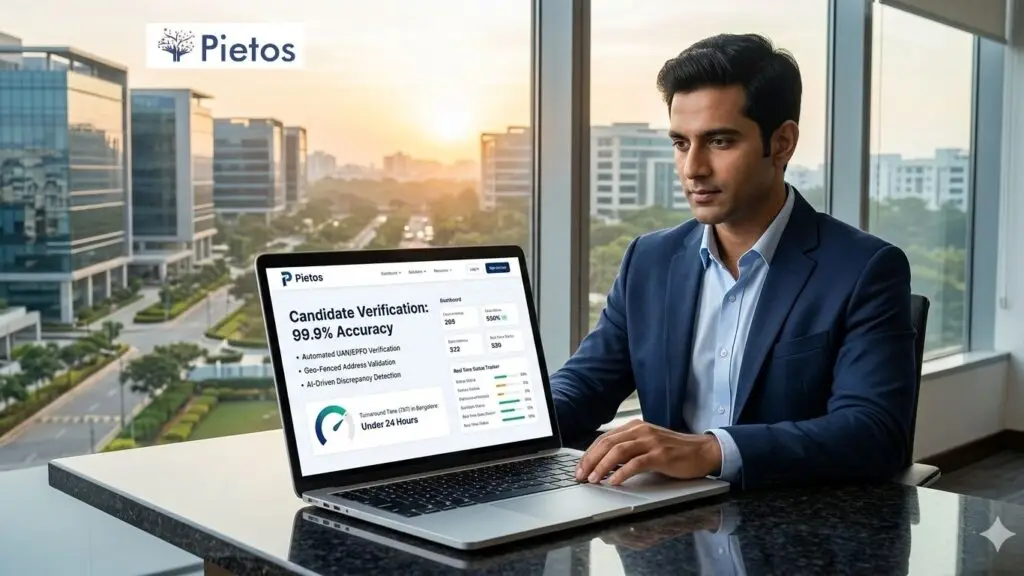
The talent landscape in Karnataka has officially entered a new era. As India’s undisputed Silicon Valley continues to mature into a global deep-tech, fintech, and generative AI powerhouse, evaluating and selecting the right BGV vendors in Bangalore has become a top priority for high-growth enterprises. Hiring cycles are moving faster than ever, yet the pressure on Talent Acquisition (TA) teams and HR leaders has intensified exponentially as the risks associated with resume inflation, moonlighting, and fraudulent documentation peak.
When scaling a high-performance team in hubs like Electronic City, Koramangala, Whitefield, or Outer Ring Road (ORR), vendor selection for background verification (BGV) isn’t just an administrative checkbox. It is a critical risk mitigation and candidate experience engine.
However, mapping the local BGV landscape can be daunting. Industry-wide directories and roundups, such as AuthBridge’s definitive breakdown of the best background verification companies in Bangalore, clearly illustrate that the market is highly competitive. In fact, we are proud to note that Pietos was recently highlighted by AuthBridge in that very report as a leading player driving innovation in the region.
But once you have short-listed the top names from industry-trusted lists, how do you actually run an objective evaluation? How do you separate marketing promises from operational reality?
To protect your organization from bad hires while ensuring a friction-free onboarding experience, you must hold your prospective screening partner to strict, measurable Service Level Agreements (SLAs). Here is the ultimate 2026 evaluation framework, built specifically for Bangalore’s high-velocity hiring market.
The Evolution of Background Verification in Bangalore’s Tech Ecosystem
In 2026, that legacy model is a liabilities nightmare. Evaluating BGV vendors in Bangalore requires looking for platforms equipped to handle unique local corporate ecosystem challenges. India’s tech hub presents three distinct risks that demand a real-time, technology-first approach to screening:
Historically, BGV was a slow, retrospective process. Companies would onboard a candidate, initiate verification on day one of employment, and wait three to four weeks for a physical report to land on an HR manager’s desk. If an anomaly was discovered, the company faced the awkward, legally sensitive, and expensive task of terminating an employee who had already been introduced to clients and internal systems.
In 2026, that legacy model is a liabilities nightmare. Bangalore’s unique corporate ecosystem presents three distinct challenges that demand a real-time, technology-first approach to screening:
1. The Proliferation of “Ghost” Companies and Digital Resume Inflation
With thousands of tech startups launching and shutting down across India over the last decade, verifying past employment has become incredibly complex. Malicious actors have weaponized this reality, creating sophisticated “ghost” companies—complete with fake websites, active corporate registration numbers, and operational phone lines—solely to provide fraudulent experience certificates for candidates.
Standard physical address verification or basic telephonic checks can no longer catch these discrepancies. BGV vendors must now deploy advanced digital forensics, automated cross-referencing against EPFO (Employees’ Provident Fund Organisation) databases, and MCA (Ministry of Corporate Affairs) records to validate the legitimacy of past employers instantly.
2. Dual Employment and the Unchecked “Moonlighting” Wave
While remote and hybrid work models have stabilized, dual employment remains a persistent risk for IT services, SaaS providers, and global captive centers (GCCs) in Bangalore. Unchecked moonlighting not only drains productivity but also exposes enterprises to catastrophic data leaks and intellectual property violations.
Modern screening requires continuous, automated tracking of concurrent tax submissions, dual PF contributions, and digital footprints to flag overlapping employment timelines before a candidate signs an offer letter.
3. The Onboarding Drop-Off Crisis
Bangalore’s tech talent is notoriously fluid. Top-tier software engineers, product managers, and data scientists frequently hold three to four competing offers simultaneously. If your BGV onboarding process is clunky, manual, or requires candidates to upload dozens of documents into an unoptimized portal, they will drop out of your pipeline and accept a competitor’s offer. Your screening process must feel like a premium extension of your employer brand.
With these regional realities in mind, let’s explore the five non-negotiable SLAs you must demand when evaluating your next BGV partner.
SLA #1: Automated Turnaround Time (TAT) for Core Identity & Employment Rails
In background screening, time is literally money. Every day a critical position remains open, or every day a candidate sits in limbo waiting for BGV clearance, represents lost operational momentum.
When reviewing vendor capabilities, you must demand a clear distinction between Digital Rails (instant checks) and Deep Verification Components (manual/field checks).
When shortlisting prospective BGV vendors in Bangalore, you must demand a clear distinction between digital rails (instant checks) and deep verification components (manual/field checks).
| Verification Component | Legacy Vendor TAT (Manual) | Modern Tech-First TAT (Pietos Standard) |
|---|---|---|
| National Identity (PAN, Aadhaar, Voter ID) | 24 – 48 Hours | Instant (Real-Time API) |
| EPFO / Universal Account Number (UAN) History | 3 – 5 Business Days | Instant to 2 Hours |
| Criminal Database & E-Courts Mapping | 5 – 7 Business Days | Under 24 Hours |
| Executive Employment Verification | 10 – 14 Business Days | 3 – 5 Business Days |
The Danger of Average TAT Metrics
Many legacy BGV vendors will pitch an “Average TAT of 5 Days.” This is a misleading metric designed to obscure operational bottlenecks. If a vendor completes ten identity checks instantly but takes 25 days to complete one critical employment check, the average look deceptively clean, but your onboarding pipeline is still completely stalled.
The SLA to Demand: Insist on a Component-Level Component-Specific SLA backed by financial credits or penalties. For example:
- 95% of Identity and Database checks must be delivered within 4 hours of candidate submission.
- 85% of standard dual-employment/EPFO verifications must be completed within 24 hours.
By holding vendors to component-level metrics, you ensure that your talent acquisition team can issue conditional or final clearances in stages, keeping the hiring pipeline moving safely without waiting for every single line item to close.
SLA #2: Dual-Layered Digital Address Verification with Geo-Fencing
Physical address verification has traditionally been the biggest bottleneck for background screening providers. When interviewing different BGV vendors in Bangalore, you’ll find that legacy firms still rely entirely on a distributed network of local field agents who physically travel to a candidate’s permanent or temporary residence.
In a city like Bangalore where a significant portion of the tech workforce consists of migrating professionals living in temporary co-living spaces, PGs, or rented apartments in tech corridors, this manual approach is highly inefficient and prone to human error. Field agents get stuck in traffic, input wrong data, or file delayed reports.
The 2026 Standard: Hybrid Geo-Fencing
To balance speed with bulletproof compliance, your BGV vendor must offer a dual-layered approach to address verification:
- Digital Address Verification (Instant Baseline): The candidate receives a secure, encrypted link on their mobile device. Utilizing GPS coordinates, IP tracking, and real-time camera access, the system captures the exact latitude and longitude of the candidate’s current location while they upload supporting documents (like rent agreements or utility bills). This creates an un-alterable, digitally timestamped record instantly.
- Targeted Physical Escalation: Physical verification should be reserved for high-risk profiles, executive leadership roles, or cases where digital markers indicate a high probability of discrepancy.
The SLA to Demand: Your partner must guarantee that Digital Address Verification is completed within 12 hours of candidate initialization, with a fallback physical verification loop that triggers automatically and concludes within 48 to 72 hours if anomalies are flagged.
SLA #3: Executive-Level Digital Discrepancy Rate (The Accuracy Metric)
Speed means absolutely nothing if a vendor misses a critical red flag. A single bad hire who falsified an engineering degree or hid a history of financial fraud can cost an enterprise millions in regulatory fines, litigation, and reputational damage.
However, many HR leaders don’t realize that legacy BGV firms often suffer from a high rate of False Positives (flagging benign clerical errors as major discrepancies) or False Negatives (missing actual fraud due to superficial checks).
[Candidate Submits Data]
       │
       ▼
[Automated Engine: Database Cross-Referencing & AI Anomaly Detection]
       │
       ├─► Clean Record? ──► Instant Clearance Issued
       │
       └─► Anomaly Detected?
                 │
                 ▼
[Secondary Expert Human Review & Executive Verification Audit]
                 │
                 ├─► True Discrepancy ──► High-Priority HR Alert
                 └─► False Positive   ──► Corrected & Logged Clean
The Human-in-the-Loop AI Paradigm
To achieve maximum accuracy without dragging down turnaround times, the best BGV vendors in Bangalore utilize automated engines to instantly sweep structured public records, global sanctions lists, and regulatory databases.
However, when an anomaly is identified, a strict Human-in-the-Loop verification workflow must take over. Experienced background screening specialists must manually audit the discrepancy to verify its validity before escalating it to your HR team. This prevents your recruitment team from wasting hours chasing down false alarms, while ensuring that real threats are caught immediately.
The SLA to Demand: A guaranteed Platform Discrepancy Accuracy Rate of 99.9%. Furthermore, demand an SLA stating that any “Major/Red-Category Discrepancy” (such as a forged degree or active criminal record) must be verified by a secondary internal auditor at the BGV firm and escalated to your HR director within 2 hours of confirmation.
SLA #4: Seamless ATS Integration and Candidate Experience UX
Your background verification process is one of the very first interactions a new hire has with your organization after deciding to join. If you select BGV vendors in Bangalore whose processes feel antiquated, confusing, or punitive, it severely damages candidate trust and increases your post-offer drop-off rate.
If your HR team has to manually extract candidate details from an Applicant Tracking System (like Darwinbox, Greenhouse, Lever, or Workday), log into a separate BGV vendor portal, type in the candidate’s information all over again, and manually upload resumes, your internal workflows are broken. This manual data entry introduces severe friction, slows down initialization, and creates massive room for clerical errors.
The Frictionless Candidate Journey
A modern, tech-driven BGV platform operates completely behind the scenes via robust APIs.
- The Trigger: Your TA team moves a candidate to “Offer Accepted” or “Initiate BGV” inside your existing ATS.
- The Automation: The BGV platform instantly pulls the relevant data fields via webhook and triggers a personalized, mobile-optimized link directly to the candidate via WhatsApp, SMS, and Email.
- The Interface: The candidate interacts with a beautiful, intuitive interface optimized for smartphones. They can snap photos of their documents, authorize EPFO access via a secure OTP link, and complete their submission in under 5 minutes without printing a single piece of paper.
The SLA to Demand: Full operational integration with your primary ATS platform within 14 business days of onboarding, alongside a Candidate Net Promoter Score (NPS) SLA of 85+ for the onboarding portal experience. If candidates struggle to use the platform, your vendor is failing an essential part of their mandate.
SLA #5: Bulletproof Data Security, GDPR, and Digital Personal Data Protection (DPDP) Compliance
In background verification, you are handling the most sensitive personal data imaginable: national identity numbers, financial history, educational transcripts, residential addresses, and criminal records.
With India’s Digital Personal Data Protection (DPDP) Act fully active, corporate liability regarding candidate data privacy has reached an all-time high. Mismanaging candidate data, failing to secure explicit consent, or utilizing vendors with weak data storage frameworks can result in staggering corporate penalties and devastating public relations crises.
You cannot afford to treat data security as an afterthought. When vetting a screening partner, a simple “we secure our servers” verbal promise is entirely insufficient.
The Security Compliance Audit Checklist
Before signing a master services agreement (MSA) with any vendor, ensure they provide formal documentation for the following security standards:
- ISO/IEC 27001:2022 Certification: Proving rigorous, standardized international frameworks for information security management systems.
- SOC 2 Type II Compliance: Verifying that the vendor’s internal controls securely manage data to protect the privacy and confidentiality of your candidates over extended operational periods.
- Data Encryption Standards: Absolute enforcement of AES-256 encryption for data at rest and TLS 1.3 encryption for data in transit.
- Consent Architecture: A completely transparent, auditable digital consent trail built directly into the candidate interface, allowing candidates to revoke or manage data access permissions in strict alignment with current DPDP mandates.
The SLA to Demand: A contractual guarantee of Zero Data Breaches, coupled with explicit legal indemnification clauses protecting your enterprise from any regulatory liabilities or fines resulting from data mismanagement or compliance failures on the vendor’s platform.
Beyond the List: Why Strategic Fit Trumps Generic Directories
When premier corporate blogs and market analysts publish guides evaluating the industry such as AuthBridge’s highly regarded 2026 industry report, they provide a vital service by filtering out low-tier operations. Seeing Pietos featured prominently alongside top BGV vendors in Bangalore validates our core mission: combining relentless technological innovation with deep local compliance expertise.
However, finding the best background verification company for your specific organization requires looking beyond a generic checklist or directory. It requires selecting a strategic partner whose technological capabilities perfectly map to your specific corporate profile, industry sector, and operational hiring velocity:
For Rapidly Scaling Tech Startups & High-Growth Scale-Ups
If you are adding dozens of engineers and product builders every single month, your primary operational bottlenecks are speed, onboarding conversion, and automated compliance rails. You need a frictionless platform that eliminates manual data entry, integrates flawlessly with your ATS via plug-and-play webhooks, and leverages instant EPFO and digital address verification to clear candidates quickly before they accept competing offers.
For Global Captive Centers (GCCs) & Large-Scale Enterprises
For massive global organizations managing thousands of active employees across multi-city campuses, the top priorities shift toward ironclad security, continuous monitoring, and complex global compliance. You require a vendor backed by rigorous SOC 2 Type II auditing, comprehensive multi-layered background screening capabilities, and custom analytical dashboards capable of giving enterprise HR directors absolute, centralized visibility across multiple business units.
Conclusion: Take Control of Your Employee Risk Mitigation Strategy in 2026
Background verification is no longer a standard commodity purchase or a minor administrative chore managed by low-cost vendors. It is a fundamental pillar of corporate risk management, workplace safety, operational efficiency, and employer brand reputation.
As you audit your current screening processes or evaluate new prospective partners from the market’s leading lists, remember to look past flashy marketing presentations. Hold every single vendor strictly accountable to measurable, component-level SLAs covering speed, automated data accuracy, integration capabilities, and legal compliance frameworks.
Ready to Benchmark Your Current BGV Turnaround Times?
As you audit your current screening processes or evaluate new prospective BGV vendors in Bangalore from the market’s leading lists, remember to look past flashy marketing presentations. Hold every single vendor strictly accountable to measurable, component-level SLAs covering speed, automated data accuracy, integration capabilities, and legal compliance frameworks.
Stop settling for opaque “average turnaround time” metrics and delayed manual reporting loops from legacy vendors.
Click here to request a complimentary 10-Check BGV Audit with Pietos today. Let our background screening experts analyze your existing workflows, run a real-world speed benchmark, and demonstrate exactly how our automated infrastructure can optimize your candidate onboarding experience while keeping your organization completely secure.