
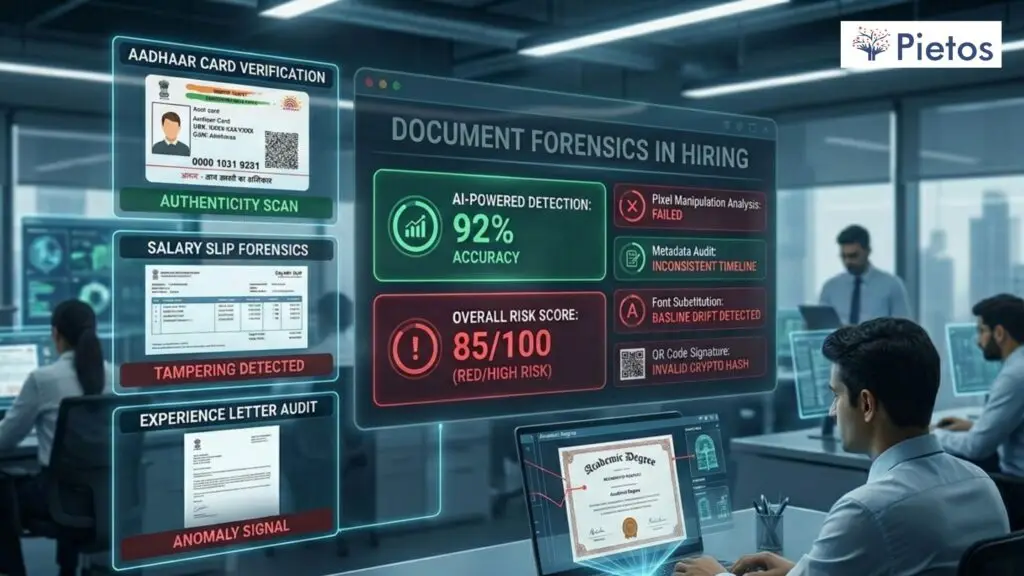
Executive Summary
AI-powered document forensics has officially become essential as credential fraud completely outpaces traditional background verification infrastructure. To secure India’s hiring ecosystem which spans over 50 million annual hires across gig, BFSI, logistics, and white-collar sectors enterprises must adapt to an era where fraudsters rapidly produce convincing fake Aadhaar cards, fabricated employment histories, tampered UAN records, and AI-generated offer letters that easily bypass traditional HR screening filters.
While manual document review catches fewer than 30% of high-quality fakes, modern digital forgery scanners now intercept over 92% of manipulated identity documents before an enterprise extends a single offer. This operational guide provides a deep technical breakdown of how modern forgery detection works, highlights where your enterprise is most exposed, and outlines what an audit-ready compliance framework looks like today.
Key Statistics Proving the Verification Gap
- 92% — Detection rate of AI-powered document forensics vs. a mere 27% for manual visual review.
- ₹8,400 Crore — The staggering estimated annual cost of hiring fraud to Indian enterprises.
- 1 in 14 — Job applications in India containing at least one materially manipulated onboarding document.
- 340% — The exponential rise in synthetic identity submissions during high-volume hiring cycles.
- 67% — BFSI hiring managers who admit they cannot distinguish a high-quality Aadhaar forgery from an authentic card.
Section 1: The Scale of India’s Document Fraud Economy
Hiring fraud in India is no longer a fringe operational issue; it has transformed into an organized, highly scalable, and commoditized digital market. Public Telegram channels openly sell “verified” fake salary slips for ₹500, counterfeit Aadhaar PDFs with embedded QR codes for ₹1,200, and fully constructed employment histories. For under ₹8,000 per candidate profile, applicants receive matching LinkedIn profiles, backdated relieving letters, and callable reference numbers.
The sophistication of these illicit services makes them completely invisible to standard corporate filters. Most enterprises rely entirely on a recruiter or HR executive reviewing a PDF on a laptop screen. However, the cognitive load of identifying a high-fidelity fake has completely surpassed human visual acuity. Pixel manipulation, metadata injection, font-layer reconstruction, and QR code spoofing have all evolved to defeat the unaided eye. The verification gap is structural, not operational.
Compliance Risk Alert: Under the Information Technology Act andRBI Master Directions for Regulated Entities(External Link), knowingly employing individuals with fraudulent credentials constitutes a major compliance failure. “We didn’t know” is no longer a legally sufficient defense if your organization lacks a systematic verification layer.
Where Forgery Enters the Hiring Funnel
Document fraud concentrates heavily at specific pinch points where applicant volume is high and initial scrutiny is low:
- Initial Application Stage: Fake educational degrees and certification documents are submitted alongside resumes to pass standard ATS filters and recruiter pre-screens. Protecting your workplace from credential fraud requires robust academic background checks to validate real qualifications.
- Pre-Offer Verification: Applicants submit tampered salary slips and experience letters to inflate baseline CTC benchmarks and secure unearned offers.
- Onboarding Document Collection: Candidates provide manipulated Aadhaar, PAN, and bank passbooks to slip through basic internal identity checks.
- EPFO / UAN Stage: Fraudsters submit fabricated Universal Account Numbers (UAN) with inflated service histories to completely bypass automated employment continuity checks.
- Relieving Letter Submission: Candidates use real corporate letterheads obtained from the internet to forge backdated or entirely fabricated letters from previous employers.
Section 2: Anatomy of a Forged Document & The Need for AI-Powered Document Forensics
Understanding how documents are forged is the prerequisite to understanding how they are intercepted. Modern document fraud has moved well beyond simple photocopies. Today, forgery methods exploit the exact same advanced digital tools that enterprises use to produce legitimate documentation.
The Seven Primary Manipulation Techniques
- Layer-Based Pixel Editing (Photoshop/GIMP): Text fields including names, dates, CTC figures, and UAN numbers are isolated on separate layers, altered, and flattened into a final PDF. High-quality fakes apply selective blur and dithering to mask compression artifacts at edit boundaries.
- Font Substitution and Reflow: Forgers extract a document’s original font metadata, match it with open-source equivalents, and reconstruct complete text blocks. Kerning inconsistencies and baseline drift remain highly detectable through typographic fingerprinting algorithms.
- QR Code Spoofing: Authentic Aadhaar QR codes encode an encrypted cryptographic hash of the cardholder’s data. Sophisticated forgeries replace the real QR with a custom-generated code linked to a lookalike clone site that mirrors the official UIDAI verification interface. Utilizing an instant Aadhaar Verification API allows organizations to verify identity details with total cryptographic accuracy.
- Metadata Injection and EXIF Manipulation: PDF metadata covering creation dates, authors, software, and modification history is altered to match the purported document origin. Human reviewers never check deep EXIF layers, allowing severe timeline anomalies to pass unnoticed.
- Template-Based Reconstruction: Actual offer letters and experience letters from real companies circulate widely online. Forgers use these as master templates, replacing only the candidate-specific fields while keeping authentic letterheads, layout structures, and signatory details intact.
- AI-Generated Documents (GenAI Fraud): Large language models are now actively used to generate highly plausible salary slips, experience letters, and academic transcripts from scratch. Because these documents have no original counterpart to compare against, detection relies entirely on semantic and structural anomaly analysis.
- Physical-to-Digital Re-Scanning: A digitally forged document is printed and purposefully re-scanned to introduce natural paper texture, scan noise, and lighting variations. This scanning process introduces lossy compression designed to wipe away pixel-level digital editing evidence.
Section 3: How AI-Powered Document Forensics Actually Works to Intercept Forgeries
The outstanding 92% detection rate achieved by enterprise-grade background verification software is not the product of a single, simple scan. Instead, it relies on a multi-layer detection stack where each layer targets a distinct class of manipulation running simultaneously.
The AI Forensics Detection Stack Architecture
| Layer | Technical Function | Primary Operational Target |
| L1 | Document Classification & Routing | Automatically identifies document type to assign targeted forensic rules. |
| L2 | Structural Authenticity Mapping | Catches geometric, spacing, and alignment anomalies against master files. |
| L3 | Pixel-Level ELA & Splicing Detection | Exposes distinct compression histories via Error Level Analysis. |
| L4 | Typographic Fingerprinting | Spots font substitutions via sub-pixel character kerning checks. |
| L5 | Metadata & Cryptographic Validation | Validates underlying EXIF data and public-key digital signatures via real-time PAN Verification API infrastructure. |
| L6 | Semantic Plausibility Scoring | Intercepts GenAI fakes by cross-checking data logic against industry benchmarks. |
| L7 | Cross-Document Consistency Audit | Compares data strings across all submitted documents to find network contradictions. |
| L8 | Risk Score & Audit Trail Generation | Compiles all deep anomalies into a legally defensible compliance report. |
Section 4: Industry Vulnerability Map — Deploying AI-Powered Document Forensics Across Sectors
Different industries face unique risks across the onboarding funnel. Evaluating your vertical helps determine the necessary depth of your verification tech stack:
- BFSI and NBFCs [CRITICAL RISK]: High exposure to manipulated financial documents, fabricated experience, and fake credentials. Driven by high performance-linked compensation and direct access to sensitive financial networks. Managing risk here requires thorough financial background checks to evaluate credit histories and financial red flags.
- Fintech and Digital Payments [CRITICAL RISK]: Extremely vulnerable to synthetic identities and GenAI offer letters seeking to exploit automated payment rails. These operations require advanced fraud mitigation tailored strictly for BFSI & Fintech screening frameworks.
- Healthcare Services [CRITICAL RISK]: Dangerous exposure to fake medical degrees or fraudulent professional registration numbers. This creates severe patient safety issues and immediate negligence liabilities under the National Medical Commission (NMC) Act.
- Gig, Logistics, and Staffing [HIGH RISK]: Driven by extreme hiring volumes. Highly vulnerable to fake driving licenses, duplicate Aadhaar profiles, and template-based CTC inflation designed to game client SLA benchmarks.
Section 5: Building an Audit-Ready Document Forensics Framework
To transition your company from basic visual box-checking to an undeniable, legally defensible evidential standard, your automated workflow should execute five key phases:
[Candidate Portal Submission] ──► [Parallel 8-Layer AI Processing] ──► [Automated Triage Scoring]
                                                                        ├── Green (0-25): Auto-Pass
                                                                        ├── Amber (26-60): Human/API Check
                                                                        └── Red (61-100): Hold & Escalate
- Candidate-Facing Collection: Avoid accepting raw email attachments, which naturally strip and compromise metadata in transit. Use secure, direct-upload portals with format-locking parameters.
- Automated Forensic Processing: Ensure your platform executes all eight forensic detection layers concurrently in parallel. This keeps turnaround times low—processing a standard 6-document pack in under 5 minutes.
- Risk Scoring and Triage: Utilize a weighted scoring framework. Green (0-25) marks clear documents; Amber (26-60) routes files to targeted API or human re-examination; Red (61-100) issues an immediate hiring hold and alerts compliance officers.
- Secondary Source Verification: For Amber-flagged items, trigger real-time, automated database checks—such as direct EPFO UAN API data verification (Internal/External Link Placeholder) to validate background timelines directly against government records.
- Chain of Custody Logging: Automatically generate an immutable process log for every single candidate. To pass regulatory audits under SEBI, RBI, or IRDAI frameworks, you must be able to prove exactly how, when, and by what parameters every document assertion was tested.
Frequently Asked Questions
AI-powered document forensics refers to the automated, multi-layered digital analysis of identity and employment documents to detect manipulation or fabrication. Unlike human review, it concurrently evaluates pixel compression, typographic fingerprints, hidden metadata, structural geometry, and semantic plausibility.
Salary slips are frequently targeted because they lack a uniform central issuing authority or a standardized layout. Because they are often free-form text documents, candidates modify them easily using basic PDF editors. Intercepting this requires deep cross-referencing against secure government endpoints like the EPFO database.
When a digital document is saved, the entire file reaches a uniform compression error level. If a text field or image is digitally edited and re-saved, the modified section retains a distinct compression history. AI-powered ELA highlights these hidden pixel variations instantly.
Yes. While GenAI documents look visually perfect and lack standard pixel editing flaws, they fail semantic plausibility checks. AI platforms catch them by flagging contextual logical errors, such as salary metrics that mismatch industry benchmarks or employment dates that contradict underlying UAN records.
A cross-document consistency audit maps every shared piece of information across all documents submitted by a candidate. It cross-checks name spellings, date formats, address structures, and employment timelines. Fraudulent applicants who alter individual files almost always fail to maintain a cohesive data network across all 6 to 10 submissions.
Conclusion: Shifting to Verification Intelligence
Relying on traditional manual verification bureaus leaves your enterprise wide open to compliance liabilities and security threats. In an era where high-quality digital forgery costs a few hundred rupees on public messaging apps, organizations must treat background screening as Signal Intelligence.
By embedding parallel AI forensics, direct DigiLocker integration, real-time EPFO data hooks, and automated audit logging directly into your application workflow, you can successfully protect your organization from systemic risk while scaling your hiring funnel effortlessly.




Pingback: EY Employment Fraud Report: Lessons From 1 Million Background Checks - Best Background Verification Company in India | Pietos