
By the Pietos Research Desk | Updated June 2026 | 13-minute read
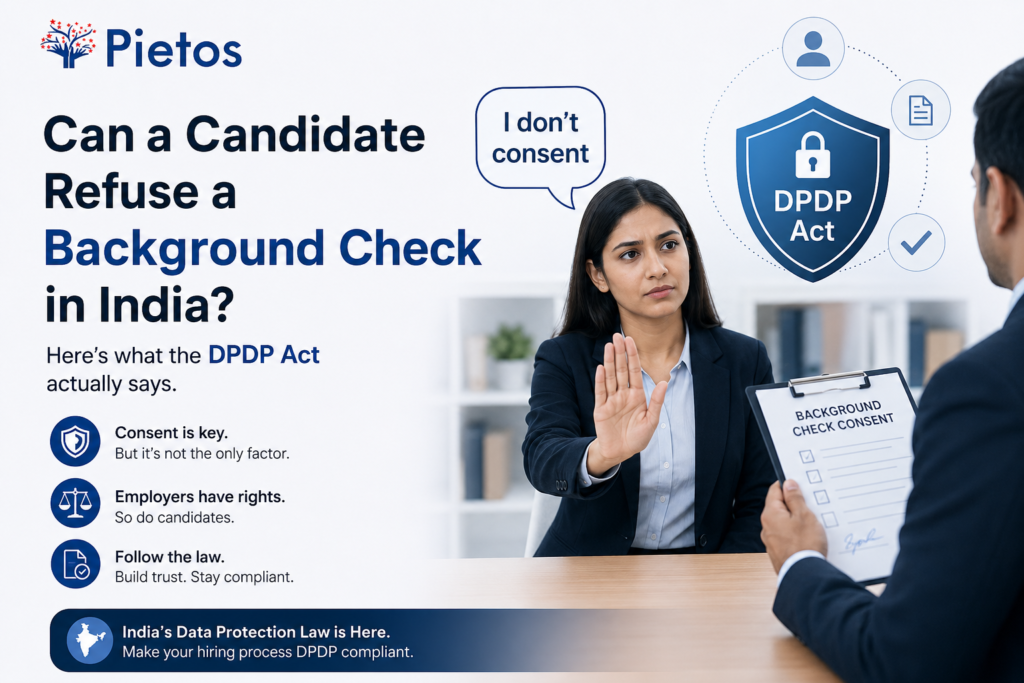
A candidate emails your recruiter: “I’m not comfortable signing this background check consent form until you tell me exactly what data you’re collecting and why.” Your recruiter forwards it to you. Now what?
This question comes up more often than most HR teams admit, and it’s becoming more frequent as candidates — particularly in tech, BFSI, and senior hiring — grow more aware of their data rights under India’s Digital Personal Data Protection Act, 2023 (“DPDP Act”). The honest answer isn’t a simple yes or no. It’s “yes, they can refuse — but here’s what that actually means for your hiring process, and here’s what the law requires of you either way.”
This article breaks down what the DPDP Act says about candidate consent for background verification, where a genuine legal grey zone exists, and how to build a process that’s defensible if a candidate — or the Data Protection Board — ever asks you to prove it.
Note: This article is for informational purposes and reflects the legal and regulatory position as of June 2026. It is not a substitute for legal advice. Given how recently the DPDP Rules were notified and the phased timeline still unfolding, we’d recommend validating your specific consent workflow with legal counsel before finalising policy.
Building or revising your candidate consent process? See how Pietos structures DPDP-aligned consent collection for background verification — from notice to withdrawal to audit trail. See how Pietos handles candidate consent →
The Short Answer: Yes — But It Comes With a Trade-Off
A candidate in India can legally decline to give consent for a background check. Consent, under the DPDP Act, must be free, specific, and given through clear affirmative action — which by definition means it can be withheld.
A candidate emails your recruiter: “I’m not comfortable signing this background check consent form until you tell me exactly what data you’re collecting and why.” Your recruiter forwards it to you. Now what?
So — can a candidate refuse a background check in India? This question comes up more often than most HR teams admit, and it’s becoming more frequent as candidates — particularly in tech, BFSI, and senior hiring — grow more aware of their data rights under India’s Digital Personal Data Protection Act, 2023 (“DPDP Act”). The honest answer isn’t a simple yes or no…
What a candidate cannot do is compel an employer to continue the hiring process without it. If background verification is a genuine, disclosed condition of an offer — which it almost always is for roles involving financial access, customer data, or regulated functions — declining consent typically means the employer is within its rights to withdraw the offer or discontinue the candidacy. Refusal is not a violation of the candidate’s rights; it’s the candidate exercising one right (control over their data) while the employer exercises another (the freedom to set hiring conditions).
The real compliance risk isn’t that a candidate might refuse. It’s that most companies can’t clearly show what the candidate was told, what they consented to, and what happens next if they say no. That gap — not the refusal itself — is what creates exposure.
Why This Question Is Coming Up More Often Right Now
A few years ago, a candidate pushing back on a background check consent form was rare enough that most recruiters had never encountered it. That’s changing, and it’s worth understanding why before getting into the legal mechanics.
Three forces are converging:
- Rising privacy literacy. The DPDP Act passed in 2023. The Rules followed in November 2025, along with ongoing enforcement coverage. Together, these have pushed data rights into mainstream conversation — a shift that simply didn’t exist for Indian job-seekers a few hiring cycles ago. Candidates in IT, fintech, and consulting feel this most. Data privacy is part of their day job, so they’re disproportionately likely to ask pointed questions about consent.
- A genuinely operational Data Protection Board. Until recently, “you can escalate to a regulator” was a theoretical statement. It no longer is. A live grievance and escalation path changes how seriously both candidates and HR teams treat the consent step.
- Higher-stakes data categories in modern BGV. Background checks increasingly pull in credit history, social media screening, and even biometric verification in some cases. Candidates are more protective of these categories than a basic education check. The more sensitive the data category, the more likely a candidate is to ask why it’s needed.
None of this means background verification has become harder to justify. But the burden has gone up — companies now need to explain it clearly, upfront. Companies that haven’t adjusted their consent language are the ones most likely to get a pushback email like the one above.
What the DPDP Act Actually Says About Candidate Consent
Two Lawful Grounds for Processing — Consent or “Legitimate Use”
The DPDP Act gives a data fiduciary (your company, in this context) exactly two lawful grounds to process a person’s personal data: consent under Section 6, or one of nine specified “legitimate uses” under Section 7. There’s no third option, and no general “legitimate interest” catch-all the way GDPR allows in Europe.
This closed-list structure matters because it means an HR team can’t simply assume background verification is justified by “business necessity.” It has to fit one of these two defined boxes — and which box it fits changes what’s required of you.
For context, the nine legitimate uses under Section 7 cover a fairly narrow, specific set of situations: data voluntarily provided for a specified purpose, processing by the State for permits/licences/benefits, compliance with law or court orders/judgments, responding to medical emergencies, providing medical treatment during epidemics or public health threats, ensuring safety during a disaster or breakdown of public order, and — the one most relevant here — employment-related processing under Section 7(i). Notice how specific and situational each of these is; the legislature deliberately avoided a broad, flexible “legitimate interest” standard precisely so organisations couldn’t use it as a general workaround to consent.
Where Background Checks Sit Under Section 6 (Consent)
For most pre-employment background verification, consent is the operative basis. Under Section 6, valid consent must be:
- Free — not bundled with unrelated permissions or made artificially difficult to refuse
- Specific — tied to a clearly stated purpose (e.g., “criminal record check for the Loan Officer role”), not a vague catch-all
- Informed — preceded by a notice that explains what’s being collected and why
- Unconditional — not made a precondition for something unrelated to the stated purpose
- Consent must come through clear affirmative action — a signed form, a checked box, or an explicit click. Silence does not count, and neither does a pre-ticked box.
Critically, Section 6(4) also gives the candidate the right to withdraw consent at any time. Withdrawal must be “as easy” as giving consent was. This creates a practical question for BGV specifically. Every HR team should have an answer ready: what happens if a candidate withdraws consent mid-verification? (We cover this in the practical framework below.)
The Section 7(i) Employment Exception — and Its Grey Zone for Candidates
This is the part most articles on this topic get wrong or skip entirely.
Section 7 of the DPDP Act allows processing without consent for nine specific “legitimate uses.” Section 7(i) covers employment-related processing. It applies to processing “for the purposes of employment or those related to safeguarding the employer from loss or liability.” This includes things like preventing corporate espionage, protecting trade secrets, and providing services or benefits to an employee
Here’s the grey zone: Section 7(i)’s language refers to a “Data Principal who is an employee.” A candidate undergoing pre-employment background verification is not yet an employeeLegal commentary on this provision has generally read it narrowly. It covers ongoing employment processing — payroll, performance data, internal investigations — rather than pre-hire screening of a prospective hire. The Data Protection Board hasn’t issued guidance or a ruling on this specific question yet. Until then, the more defensible reading for most companies is to treat pre-employment BGV as a consent-based activity under Section 6, not a Section 7(i) legitimate use.
Practical takeaway: Don’t build your BGV consent process assuming the employment exception covers candidates. Build it on consent — properly notified, specific, and documented. Treat any legitimate-use argument as a fallback you’d need to defend, not a default you rely on.
Where India Stands Today: The Phased Rollout You Need to Know
This is the detail most compliance teams researching this topic in 2026 actually need, and it changes the practical answer to “what do we need to do right now.”
The Government notified the DPDP Rules, 2025 on 13 November 2025. But the Rules — and the Act’s substantive provisions — are rolling out in phases, not all at once. This includes the consent requirements under Section 6, the notice requirements, the legitimate-use provisions under Section 7, and the data principal rights under Sections 11–14.
- Phase 1 (immediate, from 13 November 2025): Establishment of the Data Protection Board of India and foundational provisions.
- Phase 2 (from 13 November 2026): Consent Manager registration framework opens.
- Phase 3 (from 13 May 2027): The remaining substantive provisions — consent mechanics, notice requirements, legitimate uses, and data principal rights — come into full force.
Until Phase 3 takes effect, the operative legal framework for sensitive personal data collected during background checks — financial details, identity documents, in some cases criminal records — remains the Information Technology (Reasonable Security Practices and Procedures and Sensitive Personal Data or Information) Rules, 2011 (“SPDI Rules”) under the IT Act, which already require written consent before collecting or transferring sensitive personal data.
What this means for your hiring process today: You’re not in a regulatory vacuum, and you’re not yet bound by the full DPDP consent regime either. The smart move — and the one we recommend to every client — is to build your candidate consent process now to the DPDP Act’s higher standard, rather than the lighter SPDI baseline, so you’re not retrofitting your hiring workflow under deadline pressure in 2027.
What Rights Does a Candidate Actually Have
The Right to Notice Before Giving Consent
A candidate has the right to know what personal data you’re collecting, why you need it, and how to exercise their rights — before you ask for consent. Explain this in clear language, ideally in the language the candidate is comfortable with. Don’t bury it in a paragraph after the consent checkbox.
The Right to Withdraw Consent
A candidate can withdraw consent at any point. For an active background check, this typically means the employer must stop processing that candidate’s data from that point forward. You generally don’t need to unwind data you already processed lawfully before the withdrawal. But you should treat the withdrawal the same way you’d treat an initial refusal — as grounds to pause or discontinue the hiring process, if you stated BGV as a condition of the offer.
The Right to Access, Correct, and Erase
Candidates have the right to know what data an organisation holds about them, request correction of inaccurate information (a real issue in BGV, where a mismatched address or an outdated employment record can wrongly flag someone), and request erasure once the data has served its purpose — i.e., once the organisation makes its hiring decision and no longer needs the data, subject to legal retention requirements.
The Right to Grievance Redress
Every data fiduciary must provide an accessible grievance redress mechanism. If a candidate isn’t satisfied with how the organisation handled their grievance, they can escalate to the Data Protection Board. The government has established the Board but is still staffing it up. So it’s not yet hearing cases at full strength.
Most consent forms fail on exactly one of these four points — usually notice clarity or withdrawal mechanics. Pietos builds consent workflows that are independently reviewable against all four. Get a free review of your current consent form →
What Happens When a Candidate Refuses — A Practical Framework
Refusal vs. Discrimination — Where HR Teams Need to Be Careful
There’s an important distinction between a candidate refusing consent and a candidate raising a legitimate question about why certain data is being collected. If a candidate refuses outright because of a fundamental discomfort with the BGV process, that’s their right to exercise — and your right to treat as a condition not met. But if a candidate is selectively refusing based on a protected characteristic-adjacent concern (for example, objecting specifically to a credit check tied to financial inclusion concerns), document the conversation carefully and route it to legal/compliance before making a final call. The risk isn’t the refusal — it’s an inconsistent or undocumented response to it.
A Worked Example: How This Plays Out in Practice
Consider a mid-size NBFC hiring a regional collections manager. The offer letter states verification is a condition of joining. The consent form, however, bundles identity, address, employment history, criminal record, and credit check into a single checkbox labelled “I consent to background verification.”
The candidate accepts the offer but emails HR before signing: “I’m fine with the employment and identity checks, but I don’t understand why you need my personal credit history for this role.” This is a textbook scenario — and notice that the candidate isn’t refusing BGV outright. They’re refusing one component of a bundled, non-granular consent request.
A company without granular consent has two bad options here: push the candidate to accept the whole bundle (creating friction and a weaker consent record, since “agreeing under pressure” undermines the “free” element of valid consent), or quietly drop the credit check without documenting why (creating an inconsistent process across candidates for the same role, which is its own audit risk).
A company with granular, purpose-specific consent has a third option: explain that the credit check exists because the role involves direct handling of loan disbursement and repayment data, let the candidate decide on that specific component with full information, and document the outcome either way. That’s the difference a properly designed consent architecture makes in a real scenario — not in the abstract.
Making BGV a Documented Condition of Offer
The cleanest practice — and the one most large employers in India already follow — is to make background verification an explicit, written condition of the offer letter, not an assumption baked into the process. This does three things:
- It gives the candidate clear notice before they accept, satisfying the “informed” element of valid consent
- It gives the employer a documented, contractual basis for withdrawing an offer if consent is refused or verification surfaces a disqualifying finding
- It removes ambiguity for your recruiters, who otherwise have to make judgment calls in real time when a candidate pushes back
How to Document a Refusal Defensibly
If a candidate refuses, your file should show:
- The notice they were given, with timestamp
- The specific consent request they declined, and how (form, email, verbal — captured in writing)
- The offer condition language that made BGV a requirement
- The action taken (offer withdrawn / candidacy discontinued) and the date
This isn’t bureaucratic overhead for its own sake. It’s the exact evidence trail a Data Protection Board inquiry — or an aggrieved candidate’s escalation — would ask for first.
Consent vs. Legitimate Use for Background Verification — A Comparison
| Dimension | Consent (Section 6) | Legitimate Use — Employment (Section 7(i)) |
| Applies to candidates pre-hire | Yes — the standard, defensible basis | Grey zone; provision references “employee,” not candidate |
| Requires prior notice | Yes, mandatory | Reduced notice burden, but still expected |
| Can be withdrawn | Yes, at any time | Not applicable — no consent to withdraw |
| Documentation burden | High — must capture affirmative, specific consent | Lower, but requires documenting why the use qualifies as “legitimate” |
| Risk if challenged | Low, if properly notified and documented | Higher — relies on an interpretation that hasn’t been tested by the Board |
| Recommended for pre-employment BGV | Yes | Not recommended as primary basis |
How This Plays Out Differently Across Sectors
The legal framework is the same for every employer, but how consent refusal actually shows up — and how much it matters operationally — varies a lot by sector.
BFSI and NBFC Hiring
Financial services roles carry the deepest verification requirements (credit history, criminal record, sometimes director/litigation database checks for senior roles), which means BFSI and NBFC employers see the highest rate of candidates questioning why they need a specific check — credit checks in particular. The fix isn’t to verify less; regulatory obligations (including RBI’s expectations for NBFCs) often require the depth. The fix is tying each verification category explicitly to a regulatory or role-specific reason in the consent notice itself, so the consent notice answers the “why” before the candidate has to ask.
IT/ITES and Technology Roles
Tech candidates are, on average, the most data-literate applicant pool you’ll hire from — and the most likely to actually read a consent form before signing it. They’re also disproportionately likely to have worked at companies with mature privacy programmes themselves, which raises their baseline expectation of what a “good” consent process looks like. A vague or dated consent form is a small but real signal mismatch for this audience, and it’s one of the lower-effort fixes available to a TA team.
Gig Economy and Staffing Placements
This is the sector with the most structural risk, for a different reason than expected: it’s not the consent quality that’s the gap, it’s the clarity of who the data fiduciary actually is. When a staffing firm places a candidate with a client company, both organisations may handle aspects of the candidate’s data, and candidates are often unclear which entity to direct a consent question — or a withdrawal request — to. Staffing and gig platforms should resolve this explicitly in the consent notice itself, naming both the placement agency and the end client where applicable.
Startups Scaling Hiring Quickly
Fast-growing companies frequently inherit a consent process built when the company was 20 people and never revisited it as hiring volume and role complexity grew. The risk here isn’t malicious shortcutting — it’s simply that nobody has gone back to check whether the original consent template still matches what the company actually verifies today, especially after expanding into new functions (finance, compliance, customer data roles) that carry different verification needs than the engineering-heavy hiring that originally shaped the template
Designing a DPDP-Ready Candidate Consent Process
Notice Requirements That Will Hold Up
Your consent notice should specify several things. List the categories of data you collect — identity, address, employment history, education, criminal record, and credit history if applicable. State the specific purpose for each category. Note how long you retain the data. Name who you may share it with, including your BGV vendor. Explain how the candidate can exercise their rights. Generic language like “for verification purposes” will not hold up to scrutiny.
Granular, Purpose-Specific Consent — Not a Blanket Checkbox
A single checkbox covering “all background verification activities” is the single most common compliance gap we see. Best practice is to separate consent by data category, particularly where one category (e.g., credit history for a finance role) is materially more sensitive than another (e.g., education verification). This also makes partial refusals easier to handle — a candidate might be entirely comfortable with employment verification but hesitant about credit checks, and a granular process lets you address that specifically rather than treating it as an all-or-nothing refusal.
Data Minimisation — Only Verify What the Role Justifies
A junior support role does not need the same verification depth as a CFO candidate. Beyond being good practice, this is a direct DPDP principle — data collection must be limited to what’s necessary for the stated purpose. Over-collecting “just in case” is itself a compliance liability, not a safety margin.
A 5-Step Framework for Building This Properly
If you’re starting from an existing consent process rather than a blank page, here’s the sequence we walk clients through:
- Map data categories to roles. List every role category you hire for and the specific verification types each one actually requires. Resist the urge to apply your most thorough check to every role “to be safe” — that’s the data minimisation gap most companies don’t realise they have.
- Rewrite notice language per category. For each data category, write one or two plain-language sentences explaining what’s collected and why it’s tied to the role. This becomes the backbone of your consent form and your defence if a candidate or the Board ever asks.
- Separate consent capture by category. Move from one blanket checkbox to category-level consent toggles, so a candidate can accept some checks and question others without the whole process stalling.
- Build a withdrawal and refusal workflow. Decide in advance — not in the moment — what your recruiters do when a candidate withdraws consent or refuses a specific category, and put it in writing so it’s applied consistently.
- Set a review cadence. Revisit the whole process at least annually, and immediately after any change to the roles you hire for or the verification categories you use. A consent process is a living document, not a one-time form.
The Cost of Getting Candidate Consent Wrong
Regulatory Penalty Exposure Under the DPDP Schedule
The DPDP Act’s penalty schedule, once fully in force, sets out some of the steepest data protection fines globally relative to the violations they attach to:
- Up to ₹250 crore for failure to implement reasonable security safeguards around personal data (Section 8(5))
- Up to ₹200 crore for failure to notify the Data Protection Board or affected individuals of a data breach (Section 8(6))
- Up to ₹200 crore for non-compliance with special provisions protecting children’s data (Section 9)
- Up to ₹150 crore for Significant Data Fiduciaries that fail to meet additional obligations like DPO appointment or impact assessments (Section 10)
These figures are per violation category, not capped per incident — meaning a single inquiry that surfaces multiple distinct failures (say, inadequate security around stored BGV data and a failure to notify affected candidates of a breach) can attract cumulative exposure well beyond any single ceiling.
Candidate Experience and Employer Brand Risk
Beyond regulatory exposure, a clumsy consent process has a direct talent acquisition cost. Candidates increasingly compare notes on hiring experience, including how a company handled their data. This is especially true in competitive tech and BFSI hiring markets. A consent process that feels invasive, unclear, or inconsistently applied is a quiet but real drag on offer acceptance rates. This hits senior and in-demand candidates hardest, since they usually have other offers on the table.
Grievance and Board Complaint Exposure
With the Data Protection Board now operational, candidates have a real, accessible escalation path. This didn’t exist a few years ago. A pattern of unresolved or poorly handled consent grievances can itself trigger Board scrutiny — even without a major data breach. This scrutiny can extend to an organisation’s broader data governance practices.
Key Takeaways
The 5 things to act on after reading this:
- Candidates can legally refuse consent — but a documented offer condition gives you a clean basis to discontinue candidacy when they do.
- Build on consent (Section 6), not the employment exception — Section 7(i)’s “legitimate use” carve-out is a grey zone for pre-hire candidates, not a safe default.
- The DPDP Act’s substantive consent provisions aren’t fully in force until May 2027 — but building to that standard now avoids a compliance scramble later.
- Granular, purpose-specific consent beats a blanket checkbox — both legally and operationally.
- Documentation is your defence — notice given, consent requested, response received, action taken. If you can’t produce that trail, the refusal itself is the smaller problem.
Frequently Asked Questions
Generally, yes — if background verification was clearly disclosed as a condition of the offer or hiring process before the candidate accepted. The candidate’s right to refuse consent doesn’t obligate the employer to continue the hiring process without it. The condition must meet two requirements: disclosure in advance, and consistent application across candidates for the same role.
The DPDP Act requires consent to be given through “clear affirmative action.” In practice, this means a signed form, a checked box, or another explicit, recorded action — not a verbal agreement or implied consent. The Act’s consent provisions aren’t fully in force yet; that happens in May 2027. Until then, the SPDI Rules under the IT Act already require written consent for collecting sensitive personal data. So written consent is the safer and currently more defensible practice either way.
This is genuinely unsettled. Section 7(i) covers employment-related processing for a “Data Principal who is an employee,” and a candidate isn’t yet an employee at the point of pre-hire screening. Most legal commentary reads this exception narrowly. The more defensible position for employers is to treat pre-employment BGV as consent-based rather than relying on the employment exception.
The employer should stop further processing related to that consent from the point of withdrawal. Data already lawfully collected up to that point generally doesn’t need to be deleted retroactively, but continuing to actively verify new information after withdrawal would not be compliant. Practically, this usually means treating the candidacy the same way you would treat an initial refusal — pausing the process and revisiting the offer condition.
Yes, these fall within “personal data” under the DPDP Act’s current framework. Verification typically involves contacting third parties — universities, prior employers — on the candidate’s behalf. This should be disclosed and consented to as part of the BGV notice. That said, education and employment data is generally lower-sensitivity than financial or criminal records.
Yes, these fall within “personal data” under the DPDP Act’s current framework. Verification typically involves contacting third parties — universities, prior employers — on the candidate’s behalf. This should be disclosed and consented to as part of the BGV notice. That said, education and employment data is generally lower-sensitivity than financial or criminal records.
Pietos structures candidate consent collection around purpose-specific, granular consent capture — not a single blanket checkbox. Notice language is clear. The consent trail is auditable, timestamped, and versioned. A built-in withdrawal mechanism flags affected verification steps in real time. Our consent workflows are already designed to the DPDP Act’s higher standard. So clients aren’t rebuilding their process under deadline pressure as the Act’s remaining provisions come into force.
Related Resources
| # | Anchor Text | Recommended Destination | Why |
| 1 | DPDP-compliant candidate consent workflow | /platform/consent-management | Direct product page; highest-intent reader action after this article |
| 2 | how RBI compliance affects NBFC background checks | /blog/background-verification-nbfc-india-rbi-compliance | Cross-sells regulatory-compliance topical authority to BFSI/NBFC readers |
| 3 | education certificate verification process | /blog/education-certificate-verification-india | Relevant to the “what gets verified” context candidates ask about |
| 4 | BGV compliance checklist for HR teams | /resources/bgv-compliance-checklist | Bottom-of-funnel downloadable asset; natural next step for a TOFU reader moving toward MOFU |
| 5 | employment verification for financial institutions | /blog/employment-verification-financial-sector-india | Deepens topical cluster around verification types referenced in this article |
Worried your current consent process wouldn’t hold up to a candidate challenge — or a Board inquiry? Pietos can review your existing BGV consent workflow against the DPDP Act’s notice, consent, and withdrawal requirements, and show you exactly where the gaps are. Request a Free Consent Process Review →




Pingback: DigiLocker Background Verification: 2026 HR Guide - Best Background Verification Company in India | Pietos