
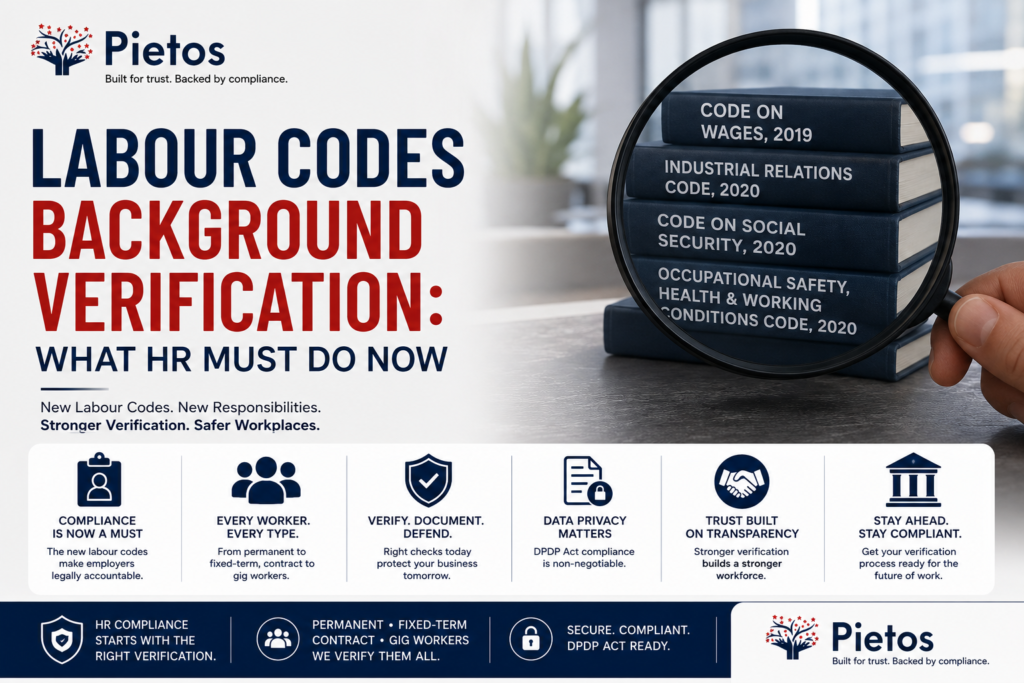
India’s labour law framework changed more in one November afternoon than it had in the previous seven decades. On November 21, 2025, the Government of India brought all four labour codes into force, replacing 29 separate central laws with a single, consolidated framework covering wages, industrial relations, social security, and workplace safety. For HR teams, the headline news was appointment letters, night shifts, and health checkups. The quieter story — the one almost nobody has written about yet — is what this means for labour codes background verification: how you screen, document, and prove compliance for every category of worker on your payroll.
This gap matters because the codes didn’t just change entitlements. They changed who counts as a worker, what documentation you owe them, and what a labour inspector or a court will expect you to produce if something goes wrong. A verification process built for the old Contract Labour Act and the old Industrial Disputes Act no longer covers what the law now requires. This guide breaks down exactly what changed and what your labour codes background verification process needs to include starting now.
Not sure if your current BGV process already covers the new requirements? Book a free compliance review with Pietos and find out in 20 minutes.
What Changed on November 21, 2025
The four labour codes are the Code on Wages (2019), the Industrial Relations Code (2020), the Code on Social Security (2020), and the Occupational Safety, Health and Working Conditions Code (2020). All four received presidential assent years ago but sat unimplemented while the government finalised rules. That changed on November 21, 2025, when the Ministry of Labour and Employment notified their commencement through an official gazette notification.
A few structural facts matter for HR before the sector-specific detail:
- The codes rationalise 29 existing labour laws into four consolidated statutes.
- Central rules under all four codes were still in draft form as of late December 2025, open for stakeholder objections.
- Existing rules, notifications, and schemes under the old laws continue to apply during this transition window.
- State-specific rules are being notified separately and at different speeds across states.
This transition period is exactly when documentation gaps are most dangerous. Two regimes overlap, HR teams are updating policy language on the fly, and background verification vendors who haven’t updated their checklists will quietly leave gaps that surface only during an audit or a dispute.
The Four Codes, in HR Terms
Each code touches a different part of your workforce risk profile. Understanding what each one actually requires is the first step toward a labour codes background verification process that holds up.
Code on Wages, 2019 sets a national floor wage and extends minimum wage protection to every employee, regardless of sector or salary ceiling — a departure from the old law, which only covered scheduled employments. For HR, this means wage records now need to withstand scrutiny across a much larger share of the workforce, including roles that were previously exempt.
Industrial Relations Code, 2020 formalises Fixed Term Employment (FTE) as a distinct legal category under Section 2(o), with parity provisions under Section 30. This is the section every staffing-heavy business needs to read twice — more on it below.
Code on Social Security, 2020 is the one that finally puts gig and platform workers inside a statutory framework. Section 2(35) defines a gig worker as someone earning outside a traditional employer-employee relationship. Section 2(61) defines a platform worker as someone accessing work through an online platform or app. This single change reshapes how gig-economy companies need to think about identity and eligibility verification.
Occupational Safety, Health and Working Conditions Code, 2020 consolidates safety and working-conditions law, including the appointment letter mandate and the annual health checkup requirement for workers above 40.
Old Law vs New Code: What Verification Teams Need to Track
| Area | Pre-November 2025 | Under the New Codes | BGV Impact |
|---|---|---|---|
| Minimum wage | Applied only to “scheduled employments” | Applies to every employee, sector-agnostic | Wage records now need verification across a far larger worker population |
| Fixed-term hiring | Sector-restricted, inconsistently defined | Formal category under IR Code, Section 2(o) | Identity, tenure, and renewal history need documented proof |
| Gig/platform workers | No statutory recognition | Defined under Sections 2(35) and 2(61) of the SS Code | Registration and cross-platform activity checks become necessary |
| Appointment letters | Best practice, not universally mandatory | Mandatory for all workers | Verification must confirm letter-to-identity match |
| Contract worker liability | Principal employer secondary liability under Contract Labour Act | Reinforced and clarified across codes | Documented verification trail becomes a legal defense, not a formality |
This table is the fastest way to brief a compliance committee on what actually shifted. Every row on the right maps to a concrete labour codes background verification task, not just a policy update.
Why Labour Codes Background Verification Is Now a Distinct Discipline
Before November 2025, background verification and labour law compliance ran on separate tracks. BGV confirmed identity, education, employment history, and criminal record. Labour compliance was a payroll and legal function. The new codes collapse that separation, for three reasons.
First, fixed-term parity creates a documentation obligation that verification teams now own. Under Section 30 of the IR Code, a fixed-term employee must receive wages, hours, allowances, and benefits at par with a permanent worker doing similar work. They’re also entitled to pro-rata gratuity after one year of service. Proving parity, and proving the worker’s identity and role classification align with what’s on record, is a verification problem as much as a payroll one.
Second, gig and platform worker recognition means identity verification now carries legal weight it didn’t before. Aggregators must contribute between 1% and 2% of annual turnover, capped at 5% of amounts paid to workers, into a Social Security Fund under Section 109. Workers register through e-SHRAM or state-notified portals to claim these benefits. If your platform can’t reliably verify who a worker is, you cannot administer this correctly. Misreporting exposes the aggregator, not just the worker.
Third, appointment letters are now mandatory for every worker, not a best-practice recommendation. A verification process that doesn’t confirm the letter matches the worker’s identity, role, and start date leaves a documentation hole. An inspector will find it immediately.
See how this plays out for high-volume gig and blue-collar hiring specifically: Read Pietos’ guide to gig economy background verification.
Four New Verification Checkpoints HR Must Build
A compliant labour codes background verification process now needs four checkpoints that most existing BGV workflows don’t cover in depth.
1. Fixed-Term Employee Identity and Tenure Verification
Because FTE workers are entitled to full parity with permanent employees, HR needs airtight proof of who was hired, when, and under what terms. Verification should confirm the candidate’s identity against the appointment letter. It should also cross-check the contract’s stated duration against actual engagement records. And it should flag any contract renewed repeatedly without a documented business reason. Regulators watch this pattern closely. The codes permit renewal, but they expect it to reflect genuine fixed-duration need, not disguised permanent employment.
One detail HR teams miss: the IR Code does not require automatic conversion to permanent status, however many times an FTE contract renews. That absence of a conversion trigger is exactly why documentation matters more, not less. Without a clear paper trail showing each renewal was a distinct, justified decision, a long-tenured FTE worker has a much stronger case in a dispute.
2. Gig and Platform Worker Registration Checks
For aggregators, verification now extends past the old identity-and-address checklist into confirming a worker’s registration status and engagement history across the platform. Draft rules link social security eligibility to minimum working-day thresholds, which differ for a single aggregator versus multiple platforms. HR and compliance teams handling multi-platform workers need verification workflows that reconcile a worker’s activity across their full gig footprint, not just one platform in isolation.
This is where address verification for a geographically dispersed, high-churn gig workforce becomes a compliance requirement, not a convenience feature.
Gig hiring concentrated outside metro cities? Pietos’ Tier 2/3 address verification framework is built for exactly this population.
3. Contract Worker Parity Documentation
Principal employers have long carried secondary liability for contractors’ compliance failures. If a contractor skips wage payments or welfare amenities, the principal employer must step in and recover the cost later. The new codes sharpen this obligation rather than soften it. A principal employer with a documented verification trail holds a stronger legal position. Proof it checked contractor licensing, verified worker identities and PF status, and monitored compliance ongoing — that trail beats a vendor’s unverified word every time.
This is worth reading in full if you rely on staffing agencies for any part of your workforce: Pietos’ guide to contract worker verification liability.
4. DPDP Act Consent Layered on Labour Code Compliance
The Digital Personal Data Protection Act, 2025 now intersects directly with labour code documentation. Every appointment letter, PF record, and identity check collects personal data that DPDP governs independently of labour law. Verification processes need explicit, itemised consent for each data point collected — not a blanket clause buried in a joining form — and a clear audit log if a worker later withdraws consent. Skipping this step doesn’t just create a labour compliance gap; it creates a second, unrelated legal exposure.
Sector-by-Sector: What Changes for Different Workforces
The four codes don’t land the same way across industries. A labour codes background verification process built for one sector often misses the risk profile of another. Here’s how the impact plays out across the workforces Pietos verifies most often.
IT and SaaS: Fixed-Term Contractors and Moonlighting Overlap
IT firms lean heavily on fixed-term and project-based contracts for specialised roles. Under Section 30 parity rules, every one of those contracts now needs wage, benefit, and gratuity terms that match permanent employees doing similar work. Layer this against the moonlighting risk IT companies already face — engineers holding two full-time roles simultaneously — and verification teams need to confirm both employment authenticity and parity compliance in the same pass. A UAN-based check that flags dual PF contributions does double duty here: it catches moonlighting and validates whether the fixed-term worker’s employment history matches what’s on file.
BFSI: Contract Staff and Data-Sensitive Roles
Banking, financial services, and insurance companies route a large share of frontline and back-office roles through staffing agencies. Principal employer liability for contract worker compliance now sits more clearly with the hiring company. That means BFSI compliance teams need documented proof that every contract worker’s identity, PF status, and licensing chain were checked, not just the staffing vendor’s word. RBI and SEBI KYC norms already push BFSI toward rigorous identity checks. The labour codes now add an employment-law reason to keep that same rigor for contract staff, not just customer-facing verification.
Manufacturing and Logistics: Subcontractor Layers
Manufacturing hiring often runs through layered subcontractors spread across industrial belts. Warehouse and logistics operations add a second layer of contract labour on top. Deloitte’s 2025 workforce data shows close to 69% of blue-collar hires nationally are temporary, with vendor reliance growing to manage costs and turnover. That means the new codes’ parity and liability provisions touch a majority of this workforce, not an edge case. Verification here needs to extend down through subcontractor layers, confirming that each worker’s identity and address checks actually happened, not just the vendor’s aggregate headcount.
Gig and Quick Commerce: Registration and Multi-Platform Activity
Quick commerce and delivery platforms carry the sharpest exposure under the Code on Social Security. Draft rules link benefit eligibility to minimum working-day thresholds: reportedly 90 days with a single aggregator, or 120 days across multiple platforms. That means verification needs to reconstruct a worker’s activity history accurately, not just confirm identity at onboarding. Quick commerce and e-commerce platforms are expected to add close to a million jobs as they expand into Tier 2 and Tier 3 cities, with logistics and warehousing adding roughly 500,000 more roles. That scale makes manual, field-only verification unworkable — this is exactly where digital-first, API-driven checks earn their keep.
What Non-Compliance Actually Costs
The cost of getting labour codes background verification wrong isn’t hypothetical. And it isn’t limited to fines. Four categories of risk compound quickly:
Regulatory exposure. Labour inspectors under the new codes have wider audit powers across a larger population of covered workers, since the wage floor and social security net now extend to categories that were previously exempt. Gaps in documentation — a missing appointment letter, an unverified fixed-term renewal, an unregistered gig worker — surface fastest during exactly this kind of audit.
Litigation exposure. Fixed-term workers denied parity, or contract workers left unpaid by a defaulting vendor, now have clearer statutory grounds to pursue the principal employer directly. A documented verification trail is often the difference between a defensible position and an expensive settlement.
Operational and Reputational Risk Add Up Fast
Operational drag. None of this happens in isolation from hiring speed. Every additional verification checkpoint that’s bolted on reactively, after a compliance scare, slows onboarding for the workers who need it least. That’s the opposite of what a fast-moving gig or blue-collar hiring pipeline needs.
Reputational exposure. Document fraud is already a live concern, independent of the new codes. A December 2025 industry survey of over 1,300 hiring professionals found 74% rank fake degrees and forged documents as their single biggest hiring risk. Roughly 17% of resumes in India carry at least one significant discrepancy. Layer weak labour code documentation on top of that baseline fraud risk, and a single inspection or worker dispute can expose both problems at once, in front of the same regulator.
Key takeaway: The real cost of a gap in labour codes background verification rarely shows up as a single fine. It shows up as compounding exposure — one weak documentation trail feeding a wage dispute, an audit finding, and a reputational story, all from the same root cause.
A Practical Labour Codes Background Verification Framework
Building this correctly doesn’t require rebuilding your entire BGV stack. It requires four deliberate additions to what most companies already run.
Step 1: Classify before you verify. Every worker needs a clear classification — permanent, fixed-term, contract, gig, or platform — before verification begins, because each category now carries a different documentation obligation under the codes.
Step 2: Match verification depth to the new liability profile. Fixed-term and contract workers need parity documentation. Gig and platform workers need registration and cross-platform activity checks. Don’t apply a uniform, lightweight check across categories that now carry materially different legal exposure.
Step 3: Build the appointment letter into the verification workflow, not just the offer workflow. Appointment letters are mandatory for every worker category. Verification should confirm the letter exists, matches the verified identity, and is retrievable on demand, rather than assuming HR generated it correctly upstream.
Step 4: Treat DPDP consent as a parallel checklist, not a footnote. Run consent capture and audit logging alongside labour code documentation for every check. That way, a single verification event satisfies both regimes at once, instead of creating two separate compliance trails.
Want this framework mapped against your actual hiring mix? Talk to a Pietos verification specialist — most reviews take under half a day to scope.
Aadhaar-Based Identity Checks Under the New Compliance Load
Nearly every checkpoint above depends on one foundation: confirming a worker is who their paperwork says they are. Aadhaar-based identity verification has been standard practice in Indian BGV for years. The new codes raise the stakes on getting it right, because identity now underpins wage floor eligibility, fixed-term parity calculations, and gig worker registration all at once.
For fixed-term and contract workers, an identity mismatch doesn’t just create a verification headache. It undermines the parity documentation itself, since wage and benefit comparisons only hold up if identity and role history are confirmed accurately. For gig and platform workers, identity verification is what makes cross-platform activity tracking possible. Without a reliable Aadhaar-linked identity anchor, reconciling a worker’s working days across multiple aggregators becomes guesswork.
This is also where DPDP Act obligations bite hardest. Aadhaar data is sensitive personal data under Indian law, and every verification event that touches it needs purpose-specific consent, not a blanket authorisation buried in an onboarding form. A verification partner that treats Aadhaar checks as a simple API call, without building consent capture and retention limits around it, is solving the labour code problem while quietly creating a data protection one.
Companies that get this right treat identity verification as the connective layer between labour code compliance and data protection compliance. One verified identity gets referenced consistently across appointment letters, wage records, registration checks, and consent logs, rather than sitting as a separate, disconnected step at the start of onboarding.
What Good Labour Codes Documentation Actually Looks Like
Frameworks are only useful if they translate into artefacts an auditor or a court can actually inspect. For each worker category, here’s the minimum documentation a defensible labour codes background verification file should contain.
Fixed-term employees need a file holding a signed appointment letter that states the fixed duration and the business reason for it. Add wage and benefit records showing parity with comparable permanent staff, a renewal log if the contract has been extended more than once, and gratuity calculations once the worker crosses one year. Missing any one of these turns a routine audit into a dispute.
Gig and platform workers need identity verification records tied to their registration on e-SHRAM or the relevant state portal. Add an activity log showing working days per aggregator — critical if the worker operates across multiple platforms — plus proof of the aggregator’s Social Security Fund contribution tied to that worker’s earnings.
Contract workers need the contractor’s licence verification and individual identity and PF status checks, not just a headcount reconciliation from the vendor. A monitoring log should also show the principal employer actively reviewed compliance, rather than passively trusting the vendor’s assurances.
Every category, regardless of type, needs DPDP-compliant consent records specific to each data point collected. A timestamp trail should also show when each check ran and who reviewed the result.
A verification partner that hands over a single PDF report per worker, without this level of structured, retrievable detail, leaves HR exposed exactly at the moment documentation matters most — during an inspection, not during onboarding.
Objections HR Teams Raise — and the Honest Answers
“Our BGV vendor already handles compliance.” Most vendors handle identity, education, and employment history — not labour code classification logic or DPDP consent layering. Ask specifically whether your current process distinguishes verification depth by worker category under the new codes. Many don’t yet.
“The rules aren’t final yet, so why act now? Central rules remain in draft, but the codes themselves are already in force, and existing laws continue to apply during the transition. Waiting for final rules to start verifying correctly means months of exposure under a framework that’s already live.
“This only applies to large enterprises.” The wage floor and several other provisions apply regardless of company size. Smaller companies relying on contract and gig labour are often more exposed, not less, because they typically have thinner documentation practices to begin with.
“We don’t hire gig workers directly, so social security provisions don’t touch us.” If you engage workers through staffing agencies or aggregators, the principal employer liability chain still runs through your organisation. Distance from direct employment doesn’t remove the documentation obligation.
“Updating our verification process will slow down hiring.” The opposite tends to happen once the initial setup is done. Digital-first checks that pull directly from UAN, Aadhaar, and DigiLocker sources typically run faster than manual verification. Building compliance into the check itself also removes the need for a separate, slower legal review later in the hiring cycle.
“Our legal team handles this, not HR or verification.” Legal teams set policy; verification teams generate the evidence that proves policy was followed. Without a documented labour codes background verification trail feeding back to legal, even well-written policy has nothing to point to during an actual audit or dispute.
A 90-Day Roadmap for Closing the Gap
Most HR and compliance teams don’t need a full BGV overhaul. They need a structured way to close the specific gaps the new codes created, without disrupting active hiring. Here’s a realistic sequence.
Days 1–15: Audit and classify. Pull every active worker record — permanent, fixed-term, contract, and gig — and confirm each one is correctly classified under the new codes. This single step usually surfaces the biggest surprises, since many companies discover workers classified informally as “contractors” who legally sit closer to fixed-term employees under Section 2(o).
Days 16–30: Close the appointment letter gap. Cross-check every worker file for a signed, compliant appointment letter. For gig and platform workers, confirm registration status on e-SHRAM or the applicable state portal. This is usually the fastest gap to close and the one inspectors check first.
Days 31–60: Rebuild the verification workflow by category. Implement the four checkpoints covered earlier: fixed-term tenure verification, gig registration checks, contract worker parity documentation, and DPDP-layered consent. Make these standing parts of onboarding, not one-time fixes applied only to the current backlog.
Days 61–90: Test the file against an audit standard. Pick a sample of workers across each category. Ask: could this file survive a labour inspection today, with every document retrievable and every consent traceable? Where the answer is no, that’s the gap to prioritise next.
This sequence works because it separates the urgent fix (documentation that already exists but isn’t organised) from the structural fix (a verification workflow that keeps pace with the codes going forward). Companies that skip straight to the second step often rebuild processes around a backlog they haven’t actually cleared yet.
How Pietos Solutions Private Limited Helps
Pietos Solutions Private Limited built its verification infrastructure around exactly the workforce categories the new codes now regulate most closely. That means contract labour, gig and platform workers, and high-volume blue-collar hiring across Tier 1, 2, and 3 India. Real-time UAN and EPFO checks catch fixed-term and contract worker misclassification before it becomes a liability. Digital-first address verification keeps pace with gig workforces spread across geographies that traditional field-only BGV can’t cover fast enough. And every check runs through a DPDP-compliant consent and audit trail, so labour code documentation and data protection compliance happen in the same workflow instead of two disconnected ones.
If your current background verification process was built before November 2025, it almost certainly has gaps the new codes have exposed — not because anyone did anything wrong, but because the law changed underneath the process.
Get a free labour codes compliance review of your current BGV process. Book a consultation with Pietos or call 9821011624
8. FAQ SECTION
It’s the process of verifying worker identity, tenure, and documentation in a way that satisfies the obligations created by India’s four labour codes — covering fixed-term parity, gig and platform worker registration, and contract worker liability documentation.
All four labour codes became effective on November 21, 2025, though central and state rules remain in draft form and continue rolling out
Yes. The Code on Social Security, 2020 formally defines gig workers and platform workers and brings them into a statutory social security framework for the first time.
The principal employer carries secondary — and in several situations primary — liability, even when a staffing agency directly employs the worker.
No. The Industrial Relations Code does not include an automatic conversion trigger, but each renewal should be documented with a clear, genuine business reason.
Separately, but simultaneously. Every verification event that supports labour code compliance also collects personal data, which means it needs explicit, itemised consent and an audit trail under the DPDP Act, 2025 — one process, two regulatory obligations.
Not yet. They currently sit in draft central rules and may shift before final notification, so verification workflows should be built to track activity data accurately regardless of where the final threshold lands.
Some provisions carry size-based thresholds, but the wage floor and several worker-classification rules apply regardless of company size, which means smaller companies with contract or gig labour often carry more exposure per worker, not less.




Pingback: Festive Season Background Verification: Eid to Pongal - Best Background Verification Company in India | Pietos