
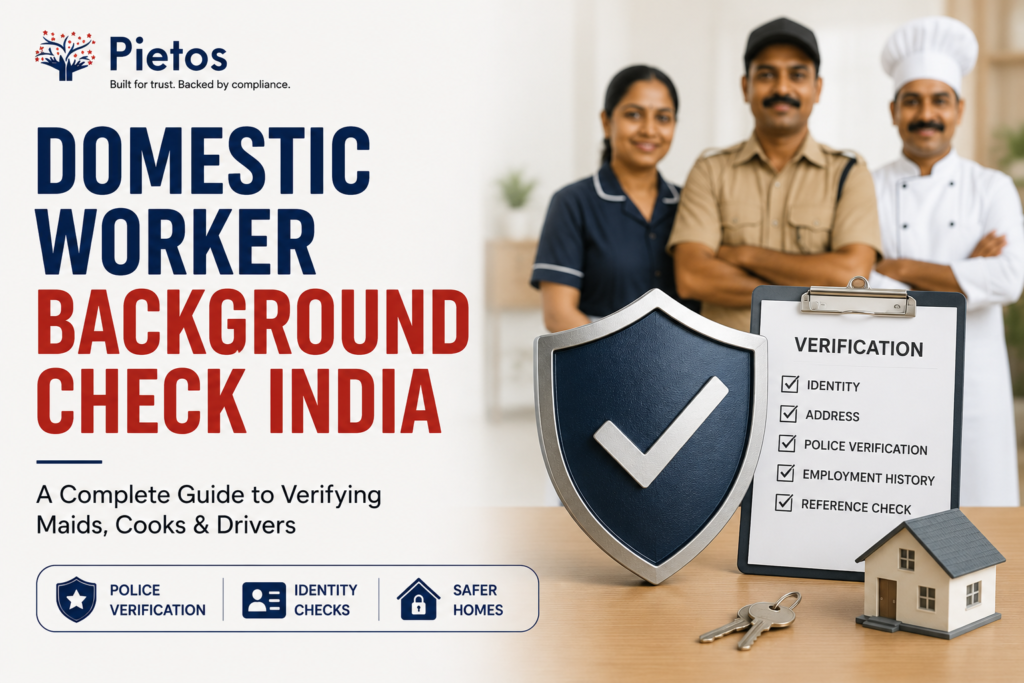
A domestic worker background check India families run before hiring a cook, driver, maid, or guard is quietly becoming standard practice. It used to feel excessive. Now it feels overdue.
Every day, lakhs of Indian households hand over house keys, gate codes, and daily access to a person they met through a neighbour’s reference or a placement agency. Most of that trust is well placed. Some of it isn’t. A background check doesn’t assume the worst about people. It simply removes the guesswork.
This guide explains what a domestic worker background check India process actually covers, how police verification works, what it costs, and what most households get wrong.
Already convinced you need one and just want it done? Book a verification consult with Pietos →
Why Domestic Worker Background Check India Searches Are Rising
Search interest in this topic has grown for a reason. Urban households now hire staff through apps, agencies, and WhatsApp referrals, not just word of mouth from a trusted family friend. That convenience comes with a trade-off: less built-in vetting.
At the same time, RWAs across metro cities have started making verification a condition of building access. A guard who once waved staff through on a resident’s say-so now checks for a gate pass, and that gate pass increasingly depends on a completed police verification. Families that never thought about a domestic worker background check India process a few years ago now encounter it as a building rule, not a personal choice.
Media coverage of isolated but serious incidents involving unverified household staff has also pushed the topic into everyday conversation. None of this means most domestic workers pose a risk. It means households now have far more visible reasons to close the gap between “someone I trust” and “someone I’ve verified.”
What Is a Domestic Worker Background Check in India?
A domestic worker background check in India confirms that the person you’re hiring is who they claim to be. It typically verifies identity documents, current and permanent address, past employer or agency references, and criminal record status through local police.
It is different from a casual reference call. A reference call relies on someone else’s opinion. A background check relies on government records, police databases, and document verification. That distinction matters when the person you’re checking will be inside your home unsupervised.
Most urban households encounter this process through one of three routes: a Resident Welfare Association (RWA) that requires it before issuing a gate pass, a placement agency that offers it as an add-on, or a direct application through a state police portal.
Why Household Staff Verification Isn’t Optional Anymore
The Access Problem: Keys, Cash, and Children
Domestic workers occupy a unique position of trust. Cooks handle kitchens and often cash for groceries. Drivers carry car keys and know family routines. Guards control building entry for hundreds of residents. Nannies spend unsupervised hours with children.
This level of access is not comparable to most other service interactions. A delivery rider spends two minutes at your door. A domestic worker spends hours, sometimes years, inside your daily life. The risk isn’t that most workers are dishonest. The risk is that a household has no reliable way to tell the exceptions apart from everyone else, without verification.
What Happens When Verification Is Skipped
Skipping verification doesn’t usually cause a problem. That’s exactly why it’s easy to skip. But when something does go wrong — a theft, an identity mismatch, a worker who vanishes with dues owed to them or by them — the household discovers it has almost no paper trail to fall back on.
A verified hire changes that. Verification means a household knows the worker’s real identity, real address, and whether local police have any record against that person. If a dispute or incident ever occurs, that documentation is the difference between a quick resolution and a drawn-out mess.
Not sure where to even start? Talk to Pietos about setting up household staff verification →
How the Domestic Worker Background Check India Process Actually Works
Step 1: Identity and Address Verification
The process starts with basic documents — Aadhaar, PAN, voter ID, or a driving licence for drivers. Verification confirms the document is genuine and matches the person presenting it. Address verification confirms the worker actually lives where they claim, either at a permanent address or current rented accommodation.
Step 2: Police Verification Certificate (PVC)
This is the core of a formal domestic worker background check India process. Most Indian states allow residents to apply for a Police Verification Certificate for domestic help, either online or at the local police station.
The National Government Services Portal lists this as a standard citizen service, and city police departments including Mumbai Police and Delhi Police run their own domestic servant verification forms. Some states, such as Assam, offer this entirely online through a dedicated citizen portal. Processing usually takes a few days to a few weeks, depending on the state and how busy the local station is.
Step 3: Employer and Reference History
Beyond police records, a thorough check calls previous employers directly rather than relying on the worker’s own summary. This step catches issues a police record alone won’t show — unreliability, unexplained gaps, or conflicting accounts of past employment.
Step 4: Specialised Checks by Role
Not every household staff role needs the same checks. The right domestic worker background check India process adjusts depth based on access level and vulnerability of the people involved.
Verification for Different Household Roles
Cooks and Kitchen Staff
Cooks handle daily household cash for groceries and often work unsupervised for hours. Identity verification, address confirmation, and a police verification certificate cover most of the risk here. If a cook is sourced through an agency, ask the agency directly what checks they already ran, and don’t assume “agency-sourced” means “verified.”
Drivers
Drivers carry vehicle keys, know a family’s daily schedule, and are often alone with children during school runs. Beyond standard identity and police checks, confirm the driving licence is genuine and currently valid through the RTO, and check for any traffic violation history where records are available. A verified licence protects against both safety risk and legal liability if an accident occurs.
Nannies and Caregivers
This is the highest-trust role in most households. Beyond identity and police verification, a behavioural or psychological reference from a previous family carries real weight. Ask past employers direct questions about patience, temperament, and how the caregiver handled stressful moments, not just whether they showed up on time.
Guards and Security Staff
A single guard controls access for an entire building or RWA, not one flat. That scale changes the stakes. Police verification is the baseline, but RWAs should also confirm employment history with the security agency supplying the guard, and re-verify on a fixed schedule rather than once at onboarding. A lapsed or unverified guard rotation is one of the most common security gaps in Indian residential societies.
Police Verification vs. Private Background Verification: What’s the Difference?
Police verification through a state portal is free or low-cost and checks criminal records against the worker’s declared address. It’s necessary, but it isn’t exhaustive. It depends on the worker’s own information being accurate and doesn’t always cover past employment history or cross-state record gaps.
Private background verification, run through a professional BGV provider, layers document authentication, employment reference calls, and multi-database checks on top of police verification. Households that want a single verified report — rather than piecing together a police certificate, a phone call to an old employer, and a guess about the rest — increasingly choose this route, especially RWAs verifying staff across dozens of flats at once.
Want a single consolidated report instead of chasing three separate processes? See how Pietos handles household and RWA verification →
| Factor | Police Verification (Government) | Private Background Verification |
|---|---|---|
| Cost | Free to nominal fee | Few hundred to few thousand rupees per worker |
| Coverage | Criminal record at declared address | Identity, address, employment history, criminal record, role-specific checks |
| Turnaround | Days to a few weeks | Often faster, since a single provider runs all checks in parallel |
| Best for | One household, one worker | RWAs, multiple workers, ongoing staff turnover |
What a Domestic Worker Background Check Costs in India
Government police verification typically costs very little — often a nominal application fee, sometimes nothing beyond the paperwork. Private, consolidated background checks cost more, usually a few hundred to a few thousand rupees per worker, depending on how many checks are bundled in.
For a single household hiring one cook or driver, the free police-verification route is often enough. For an RWA verifying staff across an entire building or society, a private BGV partner is usually faster and far less administratively painful than pushing every resident through the same government process individually.
Consider a mid-sized RWA with 150 flats, each with an average of one domestic worker requiring verification. Routing every resident through individual police-station visits creates 150 separate touchpoints, inconsistent documentation, and no single owner tracking completion. A consolidated verification partner turns that into one process, one dashboard, and one point of accountability for the managing committee.
What to Do If Verification Reveals a Problem
Occasionally, verification surfaces something — a mismatched address, an unreported past employment gap, or a flagged police record. This isn’t a reason to panic, but it is a reason to pause hiring until the discrepancy is resolved.
Start by asking the worker or agency directly about the specific mismatch, rather than assuming the worst. Some issues are administrative, such as an outdated address on an old ID. Others are more serious and warrant declining the hire. Either way, having the documentation in hand — rather than relying on a gut feeling — makes that conversation far easier to have fairly.
Common Mistakes Households Make When Hiring Cooks, Drivers, and Guards
- Trusting the agency’s word alone. Agencies vary widely in how carefully they screen candidates before sending them out.
- Verifying only once. A worker’s circumstances can change. Long-term staff deserve periodic re-verification, not a one-time check at hiring.
- Skipping address verification for “known” workers. Familiarity through a neighbour’s referral isn’t the same as documented verification.
- Assuming police verification covers everything. It checks criminal records against a declared address — it doesn’t verify employment history or professional conduct.
- Not verifying guards at all. Building guards are checked far less often than they should be, despite controlling access for an entire community.
A Simple Household Verification Checklist
- Collect and photograph original ID documents — Aadhaar, PAN, driving licence where relevant.
- Confirm current address matches ID or a recent utility bill.
- Apply for police verification through your state’s portal or local station.
- Call at least one previous employer directly.
- For drivers, confirm licence validity and category.
- For nannies or caregivers, request a behavioural reference from a past family.
- Store all verification records together, in case they’re ever needed later.
Common Objections, Answered
“My neighbour already vouched for this person.” A personal reference is useful context, not a substitute for documented verification. Neighbours rarely have access to police records or full employment history.
“This feels excessive for one cook.” Verification for a single hire usually takes a few days and costs little to nothing through the government route. The time cost is small next to the risk it removes.
“Won’t this offend the worker?” Most established domestic workers and agencies are used to verification requests, especially in cities where RWAs already require it. Framing it as standard building or household policy, rather than personal suspicion, avoids awkwardness.
Related Resources
- Digital Background Verification vs Physical Checks — useful if you’re deciding between an online process and an in-person police station visit.
- Digital Background Verification: The Future of Hiring in India — for households and RWAs curious how digital verification systems work end-to-end.
- Background Verification Services in India: A Complete Guide — a broader look at how professional verification is structured.
- Best Background Verification Companies in India — for RWAs or households comparing verification providers.
- AI Background Verification in India: 2026 Guide — for a look at how technology is speeding up verification turnaround.
Frequently Asked Questions
There’s no single national law making it compulsory for every household, though several states and city police departments actively encourage or require it, and many RWAs mandate it as a condition of building access
It varies by state and station workload, typically ranging from a few days to a few weeks after the application is submitted.
Yes. You can apply directly through your state police portal or local station, and separately confirm the driver’s licence validity through the RTO.
Usually a government photo ID such as Aadhaar or voter ID, proof of current address, and — for drivers — a valid driving licence.
No. It checks criminal records against a declared address. Employment history needs a separate reference check with previous employers.
Yes. RWAs manage building-wide access, and a building-level record ensures consistency even when individual flats change hands or forget to re-verify staff over time.
Annually is a reasonable baseline for most households, and RWAs managing guards or shared staff should consider it non-negotiable given the scale of access involved.
No. Most private providers still route the criminal-record component through official police or government channels. A private provider adds speed, consolidation, and additional checks on top of that record, rather than bypassing it.




Pingback: Entertainment Industry Background Verification in India: Closing Bollywood, OTT and IPL's Biggest Hiring Gap - Best Background Verification Company in India | Pietos