
Address verification tier 2 cities checks look simple on paper. A field agent visits, confirms the person lives there, and files a report. In practice, this step derails more hiring timelines than any other part of background verification once a company expands beyond Delhi, Mumbai, or Bengaluru.
HR and compliance teams scaling into smaller cities keep hitting the same wall. A check that takes two days in Gurugram takes eight in a Tier 3 district. Reports come back inconsistent. Vendors quote one TAT and deliver another. This guide breaks down why address verification in tier 2 cities behaves so differently from metro BGV, what actually slows it down, and the framework that keeps it fast and accurate.
Talk to a Pietos verification specialist about your Tier 2/3 hiring rollout. Explore Pietos’ address verification services →
Why Address Verification in Tier 2 Cities Breaks the Metro Playbook
Metro BGV workflows assume three things: structured addressing, dense field-agent coverage, and reliable digital records. None of these hold consistently once you move outside major urban centres.
The Reserve Bank of India classifies urban centres into population tiers, and Tier 2 centres cover populations between 50,000 and 99,999, while Tier 3 centres fall between 20,000 . That population gap matters operationally. Fewer people means fewer verification agents, fewer digital records tied to the address, and far more reliance on local knowledge instead of systems.
Hiring demand in these cities has grown faster than verification infrastructure. Logistics, e-commerce, and quick commerce are driving much of it — <cite index=”25-1″>e-commerce, logistics, retail, automotive, FMCG, and EV sectors are leading a hiring surge that is spreading into Tier 2 regions of India</cite>. Frontline, field, and delivery roles in these sectors depend heavily on accurate address verification, since many require cash handling, last-mile access, or fleet custody.
Address verification tier 2 cities work differs at every stage
The candidate sourcing document might list a landmark, not a PIN-mapped address. The field agent might travel 40 km to reach a single location. And the reference network the agent relies on to confirm residency might not exist at metro density. Each of these adds days, not hours.
The Real TAT Problem With Address Verification in Tier 3 Cities
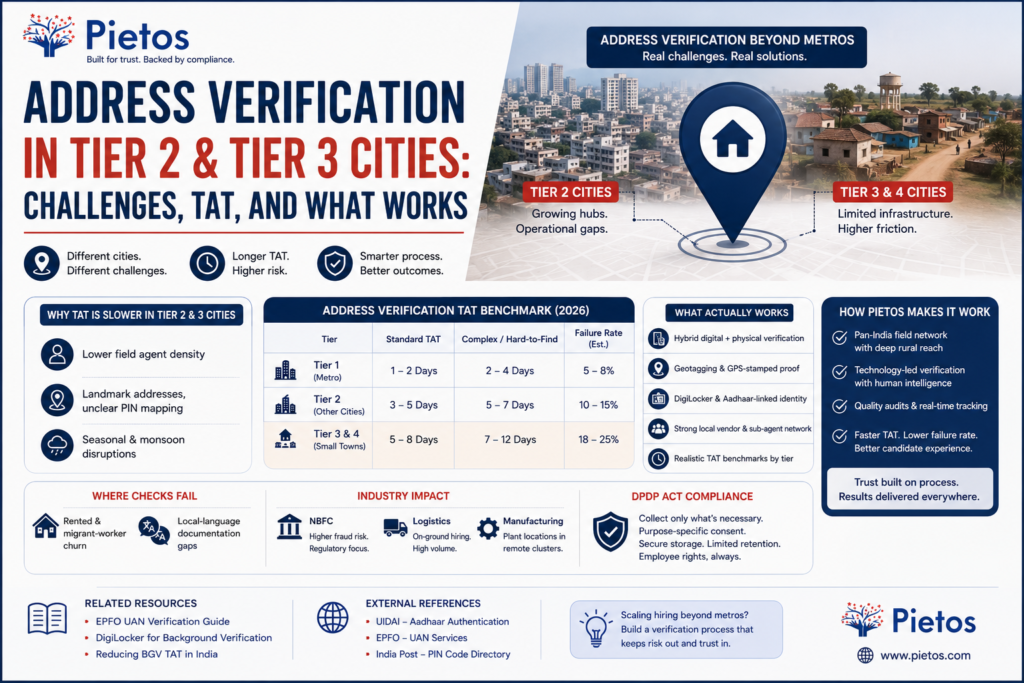
Turnaround time is the metric HR teams care about most, and it’s the one that suffers first outside metro India. A generic BGV vendor page rarely explains why. Three structural factors drive it.
Field agent density outside metro clusters
Verification networks cluster around metros because that’s where volume justifies a full-time local agent. In Tier 3 and Tier 4 towns, agents often cover multiple districts. A single address check can mean a half-day trip, which turns a same-day metro TAT into a multi-day wait.
Landmark-based addresses without clean PIN mapping
Many candidates in smaller towns write addresses using local landmarks — “near the old grain market” or “behind the bus stand” — instead of a structured house number and street. Agents lose time simply locating the residence before verification can even start.
Seasonal and monsoon disruption
Field visits in semi-urban and rural-adjacent areas depend on road access. Monsoon flooding, unpaved approach roads, and festival-season staffing gaps push out TAT in ways that rarely affect city-centre checks. A serious vendor builds this variability into its SLA instead of hiding it.
Where Address Checks Actually Fail Beyond Tier 1 India
TAT delay is visible. Verification failure is the costlier, less visible risk. These are the failure points that show up repeatedly once hiring volume moves into Tier 2 and Tier 3 India.
Rented and migrant-worker accommodation churn
Frontline and gig roles pull heavily from migrant workers who move between rented rooms every few months. By the time a field agent visits, the candidate may have already relocated. Landlords in these markets rarely maintain formal tenancy records, which weakens the paper trail an agent can lean on.
Local-language documentation gaps
Utility bills, ration cards, and rent agreements in smaller towns are frequently issued in the regional language only. An agent or reviewer unfamiliar with that language can misread or mis-transliterate the address, creating false mismatches against the candidate’s application.
Thin sub-agent coverage in Tier 3 and Tier 4 towns
Large BGV vendors often subcontract Tier 3 and Tier 4 checks to a patchwork of local sub-agents with inconsistent training. Report quality varies sharply from one sub-agent to the next, and there’s rarely a standard photo, geotag, or reference-check format enforced across the network.
Struggling with inconsistent field reports from your current vendor? See how Pietos standardises field verification nationally →
What Actually Works: A Framework for Address Verification in Tier 2 Cities
Fixing address verification tier 2 cities workflows isn’t about picking digital over physical. It’s about sequencing both correctly and setting TAT expectations by tier instead of applying one national SLA.
Hybrid digital-plus-physical verification
Run a digital layer first — document checks, database matches, and geotagged self-submission — before dispatching a field agent. This narrows down which cases genuinely need a physical visit, cutting agent workload and speeding up low-risk cases. Pietos’ employee address verification approach uses exactly this sequencing to reduce dependence on field-only workflows.
Geotagging and GPS-stamped proof
GPS-stamped photographs solve the landmark problem directly. Instead of relying on a written description, the agent captures coordinates at the point of verification, creating a defensible, timestamped record that holds up in audits and disputes alike.
DigiLocker and Aadhaar-linked identity layers
For the identity and document layer, DigiLocker-based checks pull government-issued proof directly from source, reducing forgery risk before a field visit is even needed. Pietos’ DigiLocker background verification guide covers how this integrates into a Tier 2/3-ready screening stack.
Local vendor and sub-agent networks
A verification partner needs genuine district-level coverage, not a thin sub-agent layer stretched across states. Ask any vendor for their actual field-agent map before signing — coverage claims and coverage reality diverge often in Tier 3 and Tier 4 India.
Realistic TAT benchmarks by tier
| City Tier | Typical Address Verification TAT | Primary Bottleneck |
|---|---|---|
| Tier 1 (metro) | 1–2 business days | Volume, not access |
| Tier 2 | 3–5 business days | Agent travel distance |
| Tier 3 | 5–8 business days | Landmark addresses, thin agent coverage |
| Tier 4 / rural-adjacent | 7–10+ business days | Road access, seasonal disruption |
Key takeaway: a vendor quoting identical TAT for Tier 1 and Tier 3 addresses is either padding metro numbers or under-delivering on smaller cities. Ask for tier-wise SLAs, not a single blended average.
Address Verification by Industry: NBFC, Logistics, and Manufacturing
Tier 2/3 hiring growth is concentrated in a few sectors, and each has a different reason address accuracy matters.
NBFC and BFSI field staff. Loan officers and collection agents operate directly in the communities they lend to, often handling cash. Weak address verification here is a direct fraud and compliance exposure. Pietos’ NBFC background verification guide and banks and NBFC screening guide cover the sector-specific checks that pair with address validation for this workforce.
Logistics and last-mile hiring. Gig and delivery hiring is scaling fastest into non-metro India — <cite index=”23-1″>quick commerce and e-commerce platforms are expected to add close to a million jobs as they expand into Tier 2 and Tier 3 cities, with logistics and warehousing adding roughly 500,000 more roles</cite>. Delivery partners handle customer-facing cash and access residential addresses directly, making verified home addresses a basic trust requirement, not a formality.
Manufacturing and distributed vendor workforces. Manufacturing hiring often runs through layered subcontractors spread across industrial belts near Tier 2 cities. Pietos’ vendor due diligence guide explains how address and identity checks extend down through subcontractor layers, not just direct hires.
DPDP Act Compliance for Address Checks Outside Metro India
Every address verification touchpoint collects personal data, and the Digital Personal Data Protection Act applies regardless of city tier. Field agents capturing GPS coordinates, photographs, and documents in Tier 2/3 India need the same consent trail and data-minimisation discipline as a metro digital check.
Organisations processing candidate data at scale — including NBFCs and large staffing firms hiring across many smaller cities — risk classification as Significant Data Fiduciaries, which brings added audit and reporting obligations. Pietos’ guide to DPDP-aligned digital verification walks through what that means for a distributed, field-heavy screening process.
How Pietos Handles Address Verification in Tier 2 and Tier 3 Cities
Pietos runs address verification in tier 2 cities and tier 3 towns through the hybrid model above: a digital-first pass to filter and validate, followed by GPS-stamped field visits only where they’re genuinely needed. District-level agent coverage replaces thin sub-agent chains, and every report follows the same photo, geotag, and reference-check format regardless of which state or town it comes from.
This same infrastructure supports UAN and employment history verification and city-specific screening, including for hiring hubs like Noida and the broader NCR belt, so address checks don’t sit in isolation from the rest of a candidate’s BGV file.
Scaling hiring into Tier 2 or Tier 3 India and tired of TAT surprises? Request a tier-wise TAT benchmark from Pietos →
FAQs
Fewer field agents cover a wider area, addresses often rely on local landmarks instead of structured PIN mapping, and seasonal road access can delay physical visits. Realistic TAT runs 3–8 business days outside metros, against 1–2 days in Tier 1 cities.
Not entirely. Digital checks — Digi Locker, Aadhaar-linked records, geotagged self-submission — can validate identity and documents quickly, but physical confirmation still matters for high-trust roles like field sales, cash handling, or delivery, where a genuine on-ground presence needs verification.
Migrant and rented accommodation churn. Candidates in gig and frontline roles often relocate between short-term rentals, so by the time a field agent visits, the address on file may already be outdated.
Through a hybrid model: a digital-first document and identity pass, followed by GPS-stamped physical verification through district-level field agents, with a standardised report format across every location.
The legal obligations are the same nationwide, but the operational risk is higher, since more data touchpoints — photos, GPS coordinates, physical documents — pass through field agents rather than digital systems, making consent and retention discipline more important to enforce consistently.




Pingback: Labour Codes Background Verification: What HR Must Do Now - Best Background Verification Company in India | Pietos
Pingback: Tenant Background Verification India: What Every Landlord Must Check Before Handing Over Keys - Best Background Verification Company in India | Pietos