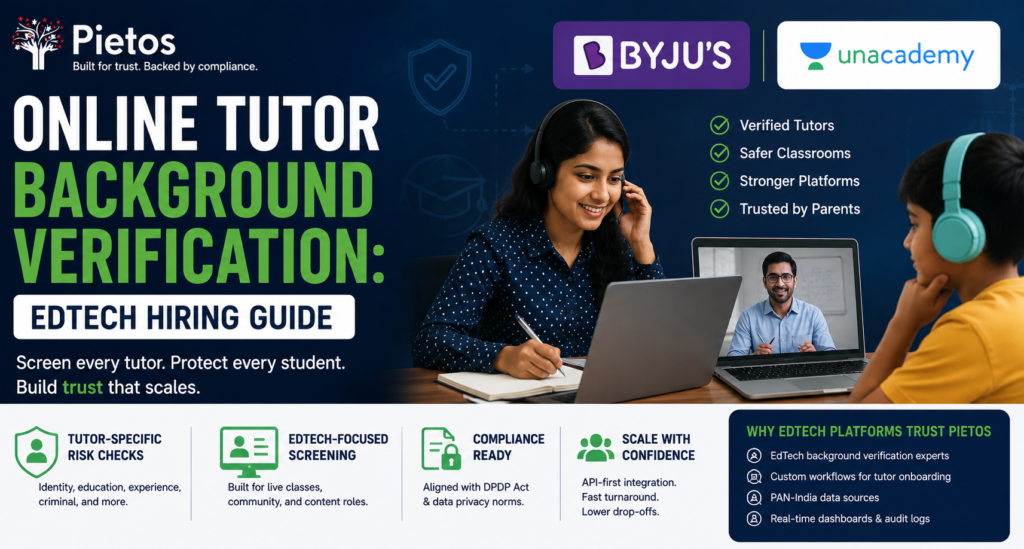
Every online tutor background verification decision an EdTech platform delays is a decision made on the parent’s behalf, without their knowledge. That is the uncomfortable truth behind India’s tutoring boom. Millions of students now log in for one-on-one sessions with adults they have never met in person, verified only by a resume and a video call. Most platforms still treat this step as optional paperwork rather than a safety function.
This guide breaks down why online tutor background verification is different from standard corporate hiring, what a compliant process actually covers, and how EdTech platforms can build tutor screening into onboarding without slowing growth. It also maps the regulatory pressure building around child data and platform safety, so founders and trust-and-safety teams can get ahead of it rather than react to it.
📩 Curious what a tutor verification workflow looks like for your platform? Talk to Pietos about education credential checks starting at ₹499.
Why Online Tutor Background Verification Matters in India’s EdTech Boom
India’s online education market crossed roughly USD 3.6 billion in 2025, and analysts project it will grow past USD 23 billion by 2034, driven by smartphone penetration and NEP 2020’s digital push. <cite index=”58-1″>Surging smartphone penetration, affordable internet access, government-backed digital learning programs, and rapidly evolving EdTech platforms are driving this growth</cite>. Online tutoring specifically is expanding even faster. India’s tutoring services market alone is expected to add over USD 23 billion between 2026 and 2030, at a compound annual growth rate above 21%. <cite index=”59-1″>Addressing data privacy and ensuring quality control for online tutors are becoming critical for the long-term sustainability of this market</cite>.
Growth is not staying confined to metro cities either. Vernacular-language tutoring and low-bandwidth platforms are pulling students from Tier 2 and Tier 3 towns into the same digital marketplaces used by students in Delhi, Bangalore, and Mumbai. Every new city added to a platform’s tutor supply is a new region where local verification standards, university recognition, and criminal-record databases differ — and where a single national screening standard becomes even more necessary, not less.
That growth changes the risk equation. A decade ago, tutoring meant a known neighbourhood teacher or a coaching centre with a physical address parents could visit. Today it means a marketplace matching a student to a stranger within minutes, often for a trial session before any real vetting happens. Scale brings anonymity, and anonymity is exactly where credential fraud and unsafe access hide.
Platforms racing to add tutor supply often skip the one step that catches both problems early. Online tutor background verification is not a compliance afterthought here — it is the trust layer that makes the entire marketplace model work. Parents pay for access to a stranger’s judgment and patience with their child. Verification is the only proof that trust is warranted, and it is increasingly the only proof investors, school partners, and enterprise B2B2C clients will accept before signing a contract.
This is also where verification becomes a genuine differentiator rather than a defensive measure. In a market this crowded, most tutoring platforms compete on price, subject coverage, and tutor availability — all easy for a competitor to match within a quarter. A documented, source-verified tutor screening standard is much harder to copy quickly, and it speaks directly to the one thing every parent cares about regardless of price point: whether their child is safe with the person on the other side of the screen.
The Hidden Risks When EdTech Platforms Skip Tutor Screening
Skipping or rushing tutor screening does not remove risk. It just moves the discovery point later, usually to a moment that is far more expensive than a pre-onboarding check would have been.
Fake Degrees and Inflated Teaching Credentials
Tutoring platforms hire fast, often onboarding hundreds of tutors a month through self-uploaded documents and automated approval. That speed is exactly what credential fraud exploits. India’s higher education regulator has flagged this pattern directly: the government recently confirmed that some <cite index=”49-1″>EdTech companies have been advertising degree and diploma programmes in partnership with institutions that are not properly recognised by the UGC</cite>, and the regulator has begun cautioning students and platforms about misleading claims tied to online and distance-mode degrees.
The University Grants Commission maintains a running list of universities with no legal authority to confer degrees. As of early 2026, that list had grown to 32 institutions nationwide, most concentrated in Delhi and Uttar Pradesh — exactly the cities where many EdTech hiring pipelines are strongest. A tutor holding a certificate from one of these institutions is not simply under-qualified. Their credential carries no legal standing at all.
Unsupervised Access to Minors
This is the risk that separates EdTech BGV from almost every other hiring vertical. A tutor is not just an employee; they get direct, often one-on-one, digital access to a child, sometimes with a camera on in a bedroom or study space. India’s child rights regulator has been explicit about this exposure. NCPCR has repeatedly flagged age verification gaps, weak reporting tools, and inconsistent safety-by-design features across digital platforms that interact with minors, and has pushed for stronger accountability from any service handling children’s data or access. Skipping identity and criminal-record verification on tutors is not an HR shortcut — it is a direct safety gap in exactly the area regulators are watching most closely.
Data Privacy and DPDP Exposure
Every tutoring session generates data: a child’s name, school, learning gaps, sometimes their location and payment details tied to a parent’s account. The Digital Personal Data Protection Rules, 2025, notified by MeitY, place specific, heightened obligations on any platform processing a child’s data, including verifiable parental consent and restrictions on tracking or targeted advertising directed at minors. A platform that has not verified who its tutors are has effectively handed a compliance-sensitive data flow to an unverified party — a gap that becomes very difficult to explain to a regulator or an investor after an incident.
Session recordings add another layer. Many platforms record classes for quality control or dispute resolution, which means a tutor’s device, storage habits, and data-handling discipline all become part of the platform’s compliance surface. An unverified tutor is also an unverified custodian of that recorded data, whether the platform has thought about it that way or not.
Platform Liability and Brand Risk
Beyond the direct safety and privacy exposure, there is a slower-moving but equally serious risk: liability. If a tutor with a concealed criminal history or falsified credentials causes harm, the platform’s onboarding process becomes the first thing examined — by parents, by media, and potentially by regulators. “We relied on self-declared documents” is not a defence that holds up well in any of those conversations.
Brand damage compounds the financial one. EdTech platforms compete heavily on trust signals — testimonials, safety badges, parent reviews. A single credible safety story can undo years of that positioning within days, and rebuilding it costs far more than the verification budget it would have taken to prevent.
What Unverified Tutor Access Actually Looks Like
Consider a common growth-stage scenario. A tutoring platform onboards 300 new tutors in a month to meet demand ahead of exam season. Applications arrive through a self-serve form: upload a degree certificate, upload an ID, record a short introduction video. An algorithm scores the video, a reviewer skims the documents, and approval happens within 48 hours. None of this confirms the certificate is genuine or checks whether the applicant has a disqualifying criminal record.
Within weeks, some of those 300 tutors are teaching one-on-one sessions with 9- and 10-year-olds, video camera on, parent in another room. If even a small fraction of that batch carries a fabricated credential or an undisclosed criminal history, the platform has no early-warning system. The first signal often arrives as a support ticket, a parent complaint, or a screenshot circulating on social media, not as a flag inside the hiring pipeline.
This is not a hypothetical edge case. It is the default outcome of any onboarding process built purely for speed, in a market growing more than 20% a year. Verification does not need to slow onboarding to this degree — but it does need to exist before, not after, a tutor gets live access to a student.
What a Proper Online Tutor Background Verification Process Covers
A defensible online tutor background verification process is not one check. It is a small, sequenced set of checks calibrated to what tutoring actually involves: teaching credentials, unsupervised digital access, and recurring contact with the same student over weeks or months. Getting the sequence and depth right matters as much as running the checks at all, since a shallow process creates a false sense of security that can be worse than having no process to point to.
Education and Credential Verification
This is the anchor check for any tutoring platform. Verification means confirming the degree, diploma, or teaching certificate directly with the issuing university or board — not simply reviewing the uploaded PDF. It should also cross-check the institution against the UGC’s list of recognised universities and flag any name appearing on the fake-university register. This single step catches a meaningful share of credential fraud on its own, because fabricated certificates are usually built to pass a visual review, not a source-level confirmation call. Pietos already runs this exact workflow for corporate hiring; see our detailed breakdown on detecting fake degrees before they cost you a hire.
Criminal Record Checks
Given direct minor access, criminal verification for tutors should go beyond a single-city police check. A proper process screens court records, national and state criminal databases, and any history that would disqualify someone from working with children — the same depth Pietos applies through its criminal verification services, extended here with a child-safety-specific disqualification list rather than a generic corporate one. The disqualification list matters as much as the database coverage; a check that runs deep but applies loose approval criteria still leaves the core risk unaddressed.
Identity and Address Verification
Confirming a tutor is who their profile says they are matters more on a tutoring platform than almost anywhere else, because the relationship is entirely digital. PAN, Aadhaar, and address checks close the gap between a profile photo and a verified, traceable individual, reducing the chance of impersonation or a tutor operating multiple unverifiable accounts. This check also matters for dispute resolution: if a parent raises a concern later, a platform needs a confirmed, traceable identity behind the account, not just a name typed into a signup form.
Digital Verification Through DigiLocker and UGC Databases
Manual education checks that involve calling universities can take 5–10 working days, which slows tutor onboarding and hurts platform growth. Digital-first verification pulls documents directly from DigiLocker or cross-references UGC’s live recognised-institution database, cutting turnaround to a fraction of that while keeping the source authoritative rather than self-submitted.
Reference and Teaching-History Checks
Degrees confirm what a tutor studied, not how they behave with students. Reference checks with a previous coaching centre, school, or platform add a behavioural layer that credential and criminal checks cannot cover on their own. For tutors with prior EdTech platform experience, a quick check with the previous employer can also surface informal red flags, such as unexplained account suspensions, that never appear in a formal record.
Ongoing Monitoring, Not Just a One-Time Approval
Verification at onboarding answers “was this tutor safe to onboard.” It does not answer “is this tutor still safe six months later.” Criminal records change, and a tutor’s employment status elsewhere can shift too. Platforms with high-risk exposure — anyone teaching young children, in particular — should build periodic re-verification into their tutor lifecycle, not treat the first check as a permanent clearance.
📩 Building tutor onboarding at scale? See how Pietos structures digital background verification for EdTech platforms.
EdTech BGV vs Traditional Corporate BGV: What Changes
| Factor | Corporate BGV | EdTech Tutor BGV |
|---|---|---|
| Primary risk | Fraud, financial loss, workplace conduct | Child safety, credential fraud, parent trust |
| Access granted | Company systems, colleagues | Direct, often unsupervised, contact with minors |
| Regulatory lens | Labour law, DPDP for general employees | DPDP child-data provisions, NCPCR expectations |
| Verification depth needed | Standard employment + education | Deeper criminal screening + child-safety disqualifiers |
| Speed pressure | Moderate | High — supply-side growth depends on fast onboarding |
| Consequence of a miss | Reputational, financial | Reputational, financial, and child-safety incident |
The checks overlap, but the stakes and the disqualification criteria do not. A candidate with a minor financial dispute might be acceptable for a back-office corporate role and unacceptable for direct student access. Similarly, a corporate BGV process rarely asks “should this person be alone, digitally, with a child,” because it was never designed to. EdTech platforms need a screening framework built around that distinction, not a copy-pasted corporate checklist repurposed for a different risk category.
Common Mistakes EdTech Platforms Make With Tutor Screening
Even platforms that take verification seriously tend to repeat a small set of avoidable mistakes.
- Treating document upload as verification. Collecting a scanned certificate is data collection, not confirmation. Without a source check, a well-made fake looks identical to a genuine document in the review queue.
- Applying one generic check to every role. A K-12 live tutor and a college-level doubt-solving assistant do not carry the same access risk, yet many platforms screen both identically — or worse, screen neither with real depth.
- Verifying once and never again. Onboarding-stage checks go stale. A clean record at signup says nothing about the following year.
- Outsourcing tutor sourcing without extending verification standards. When tutors come through a third-party agency or freelance marketplace, platforms often assume the agency has already screened them. That assumption is rarely confirmed in writing, let alone audited.
- Prioritising speed over source accuracy. Fast approval matters for growth, but speed achieved by skipping source verification simply moves risk downstream instead of removing it.
How to Evaluate a Tutor Verification Vendor
Not every background verification company understands EdTech’s specific risk profile. Most BGV vendors in India built their processes around corporate hiring, where the biggest concerns are inflated resumes and employment fraud, not child-safety-specific disqualification. Founders evaluating a partner should look past turnaround-time marketing and ask sharper questions before signing on.
- Does the vendor verify at the source, or just review documents? Source verification with the issuing university or a UGC database check is fundamentally different from a visual document review.
- Can they apply child-safety-specific disqualification criteria, not just a generic corporate criminal-check template?
- Do they support digital-first workflows like DigiLocker integration, so onboarding speed does not force a trade-off against depth?
- Can pricing scale with a tutor pool that might double in a quarter, without renegotiating every few months?
- Do they understand DPDP’s child-data provisions well enough to advise on consent and data-handling questions that come up during onboarding design?
A vendor that cannot answer these clearly is likely applying a corporate hiring template to a use case it was never built for.
The Regulatory Landscape: DPDP, NCPCR, and POCSO Context
Three regulatory threads converge on EdTech platforms right now, and each one strengthens the case for structured tutor verification.
First, the DPDP Rules, 2025 require verifiable parental consent before processing a child’s personal data and restrict behavioural tracking of minors. Significant data fiduciaries also face added obligations, including data protection impact assessments. A platform cannot demonstrate “reasonable security safeguards” around a child’s data if it cannot demonstrate who is accessing that child in the first place. Verification and consent are two sides of the same compliance requirement, not separate workstreams.
Second, NCPCR’s ongoing guidance to digital platforms pushes for safety-by-design features, age-verification standards, and accountability mechanisms. The commission has specifically flagged EdTech platforms in its advisories on children’s data protection and commercial exploitation, and it continues to push for stronger reporting tools and default privacy settings across any service where an adult interacts one-on-one with a minor. Tutoring fits that description directly, even when a platform frames itself primarily as an education product rather than a child-safety-sensitive one.
Third, the broader POCSO framework underlines why identity and criminal-history verification for anyone with regular child access is not optional in India’s legal environment, even where a specific EdTech-tutor mandate has not yet been codified into a single statute. Schools already apply POCSO-linked child-protection policies to staff with student contact; EdTech platforms offering the digital equivalent of that access are a natural extension of the same logic, whether or not a regulator has said so explicitly yet.
UNICEF’s 2026 guidance on children’s online safety in education notes that <cite index=”68-1″>the proliferation of EdTech applications without standardised regulations has increased children’s exposure to safety, privacy, and security risks</cite> — a gap platforms can close voluntarily, well ahead of any future mandate. Treating tutor verification as a proactive standard, rather than waiting for a sector-specific law, is the difference between leading the category and reacting to a headline once one of these threads tightens into an explicit legal requirement.
A 5-Step Playbook to Build Tutor Verification Into Your Platform
- Map your risk tiers. Not every role needs identical depth. A doubt-solving chat moderator carries different risk than a live one-on-one video tutor teaching primary-school children. Segment roles first, then design checks that match each tier’s actual access level, instead of applying one blanket process everywhere.
- Set non-negotiable disqualifiers. Define upfront which criminal-record categories and credential red flags automatically block onboarding. Put this in writing and share it across hiring, trust-and-safety, and legal teams, so approvals stay consistent and defensible if a decision is ever questioned later.
- Move verification before platform access, not after. Many platforms onboard first and verify later, allowing weeks of live tutor-student contact before a check completes. Reverse that sequence, even if it means a short “pending verification” holding state instead of instant activation.
- Automate the paper trail. Use digital-source verification — DigiLocker pulls, UGC database checks, direct institution confirmation — so approvals are fast and fully auditable, not dependent on someone remembering to follow up on a phone call.
- Re-verify on a cycle, not once. Criminal records and employment status change over time. A tutor cleared 18 months ago should be re-screened periodically, especially before a contract renewal or a move into a higher-access role.
Fast-scaling platforms — including many funded through their early hiring rounds — often build exactly this kind of structured, MSME-friendly verification stack. Pietos supports that model directly through background verification for startups and MSMEs.
The Cost of Inaction: What Skipping Verification Actually Risks
The direct cost of a tutor background check is small — often a few hundred rupees per candidate. The cost of skipping it shows up later, and it is rarely small.
- Parent trust collapses fast. A single safety incident, publicised on social media, can undo years of brand-building in days. Refund requests, churn, and negative reviews typically follow within the same news cycle.
- Investor due diligence catches the gap. Series B and C investors increasingly ask trust-and-safety questions before writing a check. An absent verification process is now a visible red flag in data rooms, and it can slow or stall a funding round entirely.
- Regulatory exposure grows with scale. The bigger a platform’s user base, the more DPDP and child-safety scrutiny it attracts, and the harder an unverified tutor pool becomes to defend if a complaint reaches a regulator.
- Re-verification after an incident costs more than prevention. Retroactively screening an entire existing tutor base, under pressure, after a problem surfaces is slower and far more expensive than screening at onboarding. It also has to happen in public view, which prevention never does.
- Enterprise and school partnerships stall. B2B2C deals with schools or corporate learning-benefit programmes increasingly require proof of tutor screening as a contractual condition, not a nice-to-have.
None of these costs appear on a monthly P&L until the year they do. By then, the bill usually includes reputation, not just rupees — and reputation, unlike a line-item expense, does not come back on a fixed schedule once it is spent.
Rolling Out Verification Without Slowing Growth: A Phased Approach
Platforms that already have a large, unverified tutor base often worry that adding screening means pausing growth to fix the backlog first. A phased rollout avoids that trade-off.
Phase 1 — New tutors only. Apply full online tutor background verification to every new applicant starting immediately. This closes the biggest ongoing risk without requiring a disruptive, all-at-once audit of existing tutors.
Phase 2 — Highest-risk existing cohort. Prioritise re-verification for tutors teaching the youngest students or handling the highest session volumes, since that group represents the largest concentration of exposure per tutor.
Phase 3 — Full existing base, on a rolling schedule. Work through the remaining tutor pool over a defined period, rather than an indefinite “eventually” timeline that tends to quietly stall once the initial urgency fades.
Phase 4 — Recurring re-verification cycle. Once the full base is verified once, move to a standing cadence — annually for most roles, more frequently for the highest-access tier — so verification becomes a maintained standard rather than a one-time project.
This sequencing lets a platform show measurable safety progress within weeks, rather than waiting months for a single, all-encompassing rollout to finish before any of it counts.
Objections Founders Raise — and Straight Answers
“Verification will slow our tutor onboarding.” Digital-first checks pulling from DigiLocker and UGC databases run in hours to a few days, not weeks. The bottleneck is usually manual, paper-based verification — not verification itself.
“Our tutors are mostly college students moonlighting; deep checks feel excessive.” Age or employment status does not remove child-access risk. If anything, a thinner professional history makes credential and identity verification more important, not less.
“We already collect ID proof at signup.” Collecting a document is not the same as verifying it against the issuing source. Self-submitted ID is exactly what credential fraud is built to pass.
“This is a cost centre with no clear ROI.” Trust is the product on a tutoring platform. One prevented incident, one investor question answered confidently, or one parent complaint avoided routinely offsets a full year of screening costs for a mid-sized tutor pool.
“Our tutors work through a third-party agency, so it’s their responsibility.” Parents and regulators hold the platform accountable, not the staffing layer behind it. A contractual pass-through does not remove reputational or compliance exposure if something goes wrong on your app.
What Parents and School Partners Now Expect
Parent expectations have shifted alongside the market’s growth. Early online tutoring adopters were often comfortable with minimal vetting because the category itself felt new and experimental. Today’s parents compare tutoring platforms the way they compare schools — asking about staff screening, safety policies, and what happens if something goes wrong. A platform that cannot answer those questions clearly loses the comparison before pricing even enters the conversation.
School and corporate partnerships raise the bar further. When a tutoring platform sells into schools, corporate learning-and-development budgets, or education-benefit programmes for employees’ children, procurement teams increasingly request documentation of tutor screening as part of vendor onboarding. This is no longer limited to enterprise deals; even mid-market B2B2C partnerships are starting to ask the same question during contract review. Platforms that already have a documented, source-verified process move through these conversations faster, while platforms without one face delays, or lose the deal outright to a competitor that can produce the paperwork on request.
That shift is exactly why online tutor background verification belongs in a platform’s core operating model, not its legal team’s someday list. It has become a sales enabler as much as a safety measure.
Why EdTech Platforms Choose Pietos for Tutor Verification
Pietos built its verification infrastructure on the same principle EdTech platforms need: speed without cutting corners on the source. Education checks confirm directly with universities and cross-reference UGC’s recognised-institution data, so a certificate from an institution on the fake-university list gets caught before a tutor ever goes live. Criminal screening covers court and national databases, not a single-city lookup, which matters given how often tutoring platforms hire across states rather than from one metro. Digital-first workflows, including DigiLocker-based document pulls, keep turnaround fast enough to match tutor-onboarding volumes rather than slow them down.
Pricing is structured to work at the volume EdTech platforms actually operate at — dozens to hundreds of tutors a month, not the occasional corporate hire. That means predictable per-candidate costs that scale cleanly as a tutor pool grows, instead of custom enterprise pricing negotiated from scratch every time volume changes.
No Indian BGV company has published dedicated guidance for this EdTech-tutor use case yet — the field so far is general news coverage about EdTech growth, not verification practice built specifically around tutor-student access risk. That gap is exactly where Pietos is positioning its education credential checks, starting at ₹499 per candidate, with criminal, identity, and address checks layered on based on the access level each tutor role actually carries.
Whichever partner a platform ultimately chooses, the underlying decision does not change: online tutor background verification is now a core trust function, not a paperwork step somewhere behind onboarding. Platforms that treat it that way early tend to spend far less time managing the fallout of skipping it later.
Verify every tutor on your platform before they enter a student’s home — Pietos’ education credential checks start at ₹499. Book a consultation with Pietos today.
Related Resources
- Education Verification & Fake Degree Detection Guide — how Pietos identifies fraudulent academic credentials before they reach onboarding.
- Criminal Verification Services in India — court, national, and state-level criminal screening depth for child-facing roles.
- Background Verification for Startups & MSMEs — right-sized verification frameworks for fast-scaling platforms.
- Digital Background Verification in India — how DigiLocker and API-based checks cut turnaround time.
- Best Background Verification Companies in India (2026 Guide) — how to evaluate a BGV partner beyond price.
FAQ
Online tutor background verification is the process of confirming a tutor’s education credentials, identity, address, and criminal record before they get platform access to students, using source-verified checks rather than self-submitted documents. The goal is to confirm these facts before a tutor ever interacts with a child, not after a concern is raised.
Because tutors get direct, often unsupervised, digital access to minors. That access changes both the depth of criminal screening required and the disqualification criteria, compared to a standard back-office hire, where the main concerns are usually fraud or workplace conduct rather than child safety.
Digital-first checks using DigiLocker or UGC database cross-referencing typically complete within a few days. Manual, university-by-university verification can take 5–10 working days or longer.
There is no single codified law naming EdTech tutor checks specifically, but DPDP child-data provisions, NCPCR guidance, and the broader POCSO framework all create strong compliance and safety pressure for platforms with minor users.
Pricing depends on check depth, but education credential verification through Pietos starts at ₹499 per candidate, with criminal and identity checks layered on based on role risk.
Yes. Age or employment status does not reduce child-access risk, so identity and criminal screening should apply to part-time and student tutors on the same basis as full-time staff.
Periodic re-verification is safer. Criminal records and employment status can change after onboarding, so platforms with significant minor-user exposure should build re-screening into the tutor lifecycle rather than treating the first check as permanent.
Look for source-level checks rather than document review, child-safety-specific disqualification criteria, digital-first workflows like DigiLocker integration, and pricing that scales with a growing tutor pool.
KEY TAKEAWAYS
- India’s online tutoring market is growing over 20% a year, and scale is outpacing platform-level safety infrastructure.
- Fake or unrecognised degrees are a documented, government-flagged problem specifically tied to EdTech hiring pipelines.
- Tutor access to minors makes criminal and identity verification a child-safety issue, not just an HR formality.
- DPDP child-data rules and NCPCR guidance both raise the compliance stakes for unverified tutor pools.
- Digital-first verification (DigiLocker, UGC database checks) delivers speed without trading away source-level accuracy.
- No Indian BGV company has published dedicated EdTech-tutor guidance yet — an open positioning opportunity.