
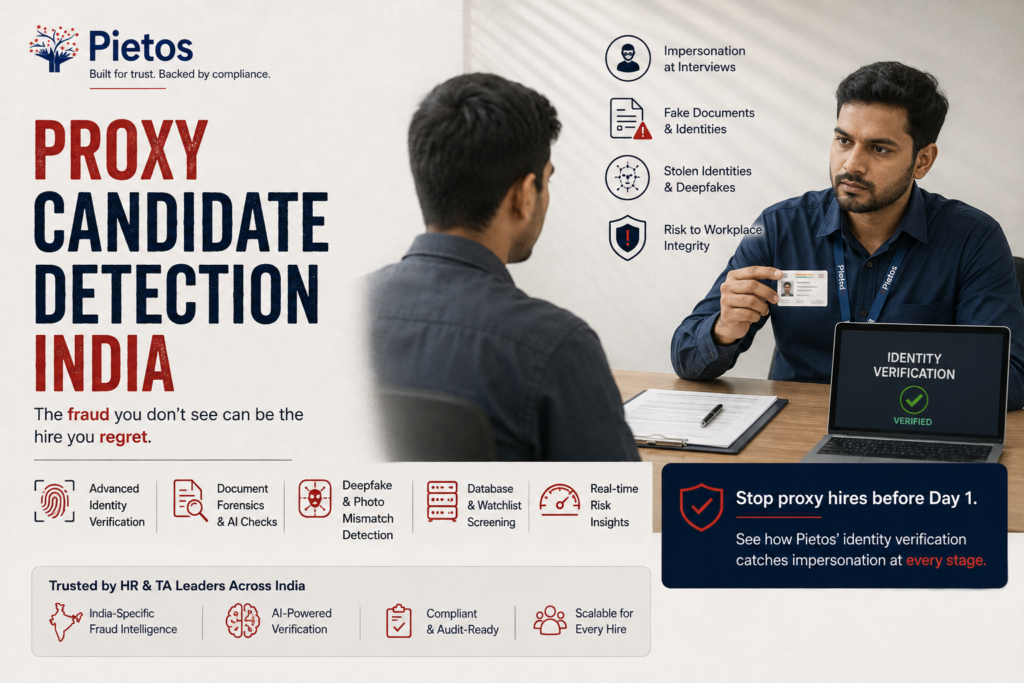
Proxy candidate detection has quietly become one of the most urgent gaps in Indian hiring. A candidate interviews well and joins the team. Then, within two weeks, something feels off — the person on video calls doesn’t match the person who now shows up to work. This is not a hypothetical. Indeed, it has already happened at Infosys, at government recruitment exams, and inside dozens of companies that simply absorbed the fraud as a bad hire instead of filing a complaint.
Remote and hybrid hiring made this possible at scale. A candidate who lacks the skills to clear an interview can simply pay someone else to sit in for them. Sometimes it’s just for the interview. Sometimes it stretches into the first weeks on the job. What used to require an elaborate, high-risk con now runs as an organized, priced service. In fact, entire referral networks operate across Telegram channels in India’s biggest hiring hubs.
So what does this guide cover? It breaks down how proxy candidate fraud actually works in Indian hiring. It walks through what real cases reveal about the gaps companies keep missing. And finally, it lays out a working proxy candidate detection framework for 2026.
Talk to Pietos about auditing your current interview-to-onboarding gap — a 20-minute call is enough to show where a proxy candidate could slip through today.
What Is a Proxy Candidate?
A proxy candidate is a person who impersonates a job applicant during the hiring process, most often the interview. This lets the real applicant secure a role they wouldn’t otherwise earn on their own merit. Typically, the impersonator — sometimes called a “solver” — answers the technical questions and clears the interview. Afterward, they hand the job back to the actual candidate at onboarding, or they simply continue working in that person’s place.
Proxy candidate detection, therefore, is the set of identity and behavioural checks a company runs. Specifically, it confirms that the person who interviewed is the same person who shows up, signs the offer letter, and does the job every day after.
HR teams in India generally report three common patterns:
- Full substitution: A stand-in attends every round and never hands the role back. Instead, they work under the real candidate’s name and credentials.
- Interview-only substitution: A proxy clears the interview. Afterward, the actual, less-qualified candidate joins and performs the job, often poorly.
- Real-time coaching: The registered candidate appears on camera, but a proxy feeds them answers through an earpiece or a second screen off-camera. This variant is harder to catch, because the face matches even though the person answering doesn’t.
Why Proxy Candidate Fraud Is Rising in India in 2026
Three forces have converged here. Together, they’ve turned proxy candidate fraud from a rare oddity into a scalable, marketed service.
Remote Hiring Removed the One Check That Used to Work
Before remote interviews became standard, a proxy had to physically walk into an office and sit across from a panel. Then, they had to disappear again before onboarding — a logistically hard scam to pull off twice. Video interviews removed that friction entirely. As a result, almost no company compares the face on the interview call with the face on the offer letter or the identity document, simply because nobody built that comparison into the process.
Proxy Hiring Is Now a Priced, Marketed Service
What started as a favour between friends has since become an organized business. Services operating out of India’s major tech hubs now charge candidates a flat fee for a “professional interviewer.” Some vendors even offer money-back guarantees if the candidate doesn’t clear the round. As early as 2022, industry bodies flagged this as a growing concern in Indian IT hiring. By 2026, it has matured into a structured underground referral economy.
Generative AI Has Added a Harder-to-Catch Layer
The newest and most concerning variant layers AI on top of human impersonation. Deepfake filters can overlay a candidate’s real face onto a proxy’s live video feed. As a result, the face on screen appears to match, even though a different person answers every question. This tactic is still uncommon compared to plain human stand-ins. However, it’s already technically achievable with consumer-grade tools — and it’s exactly the kind of fraud a resume review or a gut-feeling interview panel simply cannot catch.
Key takeaway: Proxy candidate detection isn’t a one-time interview check anymore. Instead, it has to cover the interview, the onboarding face-match, and — for high-risk or remote-first roles — ongoing verification after Day 1.
Real Proxy Candidate Cases From India
Numbers make the case abstractly. These cases make it concrete.
The Infosys “Dragon” Case (2025)
A software engineer from Telangana applied for a role at Infosys through a staffing partner. He then arranged for a friend to attend his virtual interview in his place, in a plot reportedly inspired by a Tamil film. The impersonator cleared the interview, and the candidate joined soon after. Within roughly fifteen days, however, HR noticed a sharp mismatch between the interview performance and his actual communication skills on the job. An internal investigation followed, and the team compared interview recordings against his real appearance. Infosys terminated him and filed a police complaint. Consequently, authorities booked him under India’s IT Act and under Sections 318 and 319 of the Bharatiya Nyaya Sanhita, for cheating and cheating by personation. Remarkably, he later demanded payment for the days he had worked.
The CBSE Recruitment Exam Racket (2025)
Delhi Police broke up a proxy racket built around a CBSE recruitment exam for superintendent and junior assistant posts. One candidate paid roughly ₹15 lakh to a network of middlemen. They, in turn, arranged an impersonator equipped with a Bluetooth device to sit the exam in his place, for a further ₹12 lakh. During a routine check, however, an invigilator flagged a biometric mismatch. This single flag unraveled the entire network and led to four arrests, including both the real candidate and his proxy.
The NEET-UG Biometric Breach (2026)
A more serious case out of Bihar involved a “solver gang.” Allegedly, this gang compromised the biometric verification process at the level of the staff running it, which let proxy candidates sit one of India’s most competitive medical entrance exams. Police arrested thirty people, including a medical student accused of working as biometric staff under someone else’s identity. Ultimately, this case shows that biometric checks only hold if the process around them — who operates the scanner, who validates the match — is itself verified and audited.
Notably, each of these cases shares the same root failure. No one compared the person present at the critical moment against a verified identity record, until a human noticed something felt wrong — sometimes weeks too late.
See how Pietos closes this exact gap between interview and onboarding — book a walkthrough of our identity verification services.
The Business Risk of an Undetected Proxy Hire
A proxy hire that goes undetected doesn’t just cost a bad performance review. Rather, it compounds across four risk categories.
| Risk category | What it looks like | Cost of inaction |
|---|---|---|
| Financial | Salary paid to an underqualified or unauthorized worker; cost of re-hiring and retraining | Weeks to months of wasted payroll, recruiter fees, and onboarding spend |
| Security | An unverified person gets systems access, client data, or physical premises entry | Data breach, IP leakage, insider threat with no verified accountability trail |
| Legal | Company becomes party to a fraud it didn’t detect; exposure under IT Act and BNS Sections 318–319 | Regulatory scrutiny, potential liability if the proxy causes downstream harm |
| Reputational | Case becomes public — on LinkedIn, in the press, or via a client audit | Client trust erosion, especially in BFSI, healthcare, or government-adjacent contracts |
Most HR teams underweight the security risk specifically. Consider a proxy candidate who clears a technical interview for a role with system access or client data — that person has bypassed every trust signal the company thought it was checking. If someone later misuses that access, the company faces the same downstream fallout as an insider threat. Except, in this case, no one ever actually vetted the “insider” in the first place.
What the Law Says: Cheating by Personation Under BNS
India’s criminal law already treats this conduct as a specific, named offence, not a vague grey area. Under Section 319 of the Bharatiya Nyaya Sanhita, 2023 — which replaced Section 416 of the erstwhile Indian Penal Code — a person commits “cheating by personation” if they pretend to be someone else or knowingly substitute one person for another. Authorities typically charge this offence alongside Section 318 (cheating) and relevant IT Act provisions, particularly when the impersonation happens over a digital channel like a video interview. The offence carries imprisonment of up to five years, a fine, or both.
This matters for two reasons. First, companies that detect and report a proxy candidate case have a clear legal basis to act; this isn’t a policy grey zone. Second, and more relevant for HR teams building a defense: a five-year custodial penalty has done little to slow the practice down, because detection — not deterrence — is the real bottleneck. Candidates evidently believe the odds of being caught are low enough to take the risk. Proxy candidate detection, built directly into the hiring process, changes that calculation at the exact point where it matters most.
How Proxy Candidates Slip Past Traditional Hiring Checks
Most Indian hiring pipelines were never designed to catch this. After all, the checks already in place solve a different problem entirely.
- Resume screening validates claimed skills and history on paper. However, it says nothing about who actually shows up to the interview.
- Phone screens are voice-only. As a result, a candidate can hand them off entirely to a proxy, with no visual trace at all.
- Unrecorded video interviews leave no artifact to compare against later. So even a suspicious HR manager has nothing left to check retroactively.
- Reference checks verify the résumé’s claims through a third party. They don’t verify the physical identity of the person sitting in front of the panel.
- A single onboarding ID check, like a PAN card or degree certificate, confirms the document is real. It doesn’t confirm the document holder is the same person who was interviewed weeks earlier.
Every one of these checks does something useful on its own. Yet none of them, even stacked together, closes the one gap a proxy candidate is specifically designed to exploit: the identity of the person, not the paperwork.
A Working Framework for Proxy Candidate Detection
Closing this gap doesn’t require rebuilding the entire hiring process. Instead, it simply requires inserting identity verification at specific checkpoints most companies currently skip.
- Record the interview, with consent. A recorded video interview creates the reference artifact everything else gets checked against. Mention this upfront in the scheduling email, so consent never becomes friction later.
- Run liveness detection at the interview stage. A liveness check — asking the candidate to blink, turn, or perform a random action — filters out pre-recorded video and basic deepfake overlays before the interview even starts.
- Match the onboarding face against the interview recording. At the point of joining, compare a fresh biometric capture against that earlier recording. This one step alone catches the most common proxy pattern: interview-only substitution.
- Anchor identity to a government-verified source. A masked, token-based Aadhaar e-KYC check ties the verified face to a government identity record. Importantly, the employer never stores the raw Aadhaar number, which closes the loop both legally and technically.
- Re-verify periodically for high-risk or fully remote roles. A single Day 1 check won’t catch a proxy who takes over after the real candidate’s first week. Periodic re-verification closes that later-stage gap, especially for system-access or client-facing roles.
Key takeaway box: Proxy candidate detection works best as several checkpoints, not one — at interview, at onboarding, and on an ongoing basis for high-risk roles. A single ID check at joining catches almost none of the fraud patterns seen in real Indian cases.
Common Objections HR Teams Raise — and the Honest Answers
“This adds friction to our hiring process.” Actually, a liveness check and a face-match together take under two minutes. Compared to the weeks lost to a bad proxy hire, that added time is a rounding error.
“We already do reference checks and degree verification.” Both matter, but neither confirms the identity of the person who attended the interview. They solve a different, real problem — proxy candidate detection solves this one instead.
“Our volume is too high to verify every hire manually.” This is exactly why API-based, automated identity verification exists. At high volume, manual checks fail first; automation is the only approach that scales without becoming a bottleneck itself.
“This feels like it assumes candidates are guilty until proven innocent.” Not quite — the check is neutral and near-instant for a genuine candidate, since it simply confirms what they’ve already claimed. It only creates friction for the small minority attempting fraud, which is the entire point.
How Pietos Builds Proxy Candidate Detection Into Onboarding
Pietos Solutions Private Limited treats proxy candidate detection as a layered identity check, not a single gate. Liveness detection and biometric face-matching run at the exact point candidates would least expect a swap to get caught — automatically comparing the interview face against the onboarding face, rather than waiting on an HR manager to notice a mismatch weeks later. Alongside this, Aadhaar-linked e-KYC runs through a licensed authentication pathway. So identity stays anchored to a government-verified source, and the employer never handles raw Aadhaar data directly.
For high-volume hiring — think IT services, BPO, BFSI, or gig and field roles — this check plugs straight into the existing applicant tracking or HRMS workflow via API. Consequently, it adds verification without adding a manual step for recruiters already managing hundreds of applications a week.
Stop proxy hires before Day 1. See how Pietos’ identity verification catches impersonation at every stage of the hiring pipeline — from interview to onboarding to ongoing monitoring. [Talk to a Pietos verification specialist →]
Frequently Asked Questions
Proxy candidate detection is the process of verifying that the person who attends a job interview is the same person who joins and performs the role, using tools like liveness detection, biometric face-matching, and government-anchored identity checks.
There is no single official national figure, but real, documented cases — including at major IT firms and in government recruitment exams — surfaced through 2025 and 2026, and industry bodies flagged rising proxy interview activity in Indian IT hiring as early as 2022.
Yes. It falls under Section 319 of the Bharatiya Nyaya Sanhita (cheating by personation), often charged alongside Section 318 (cheating) and India’s IT Act when the impersonation happens through a digital interview, carrying imprisonment of up to five years, a fine, or both.
Yes, if the company has no liveness check or later face-match in place. A proxy can clear a standard, unrecorded video interview without detection unless the identity is verified again at onboarding.
Background verification confirms a candidate’s claimed history — education, employment, criminal record. Proxy candidate detection confirms the physical identity of the person going through the process is consistent from interview to onboarding. Most companies need both.
API-based identity verification, like Pietos’, typically integrates into an existing ATS or HRMS workflow within days, without requiring a separate portal for recruiters to manage.




Pingback: AI Cheating Hiring Assessments: What BGV Still Catches in the Astra Era - Best Background Verification Company in India | Pietos
Pingback: AI Engineer Background Verification in India - Best Background Verification Company in India | Pietos