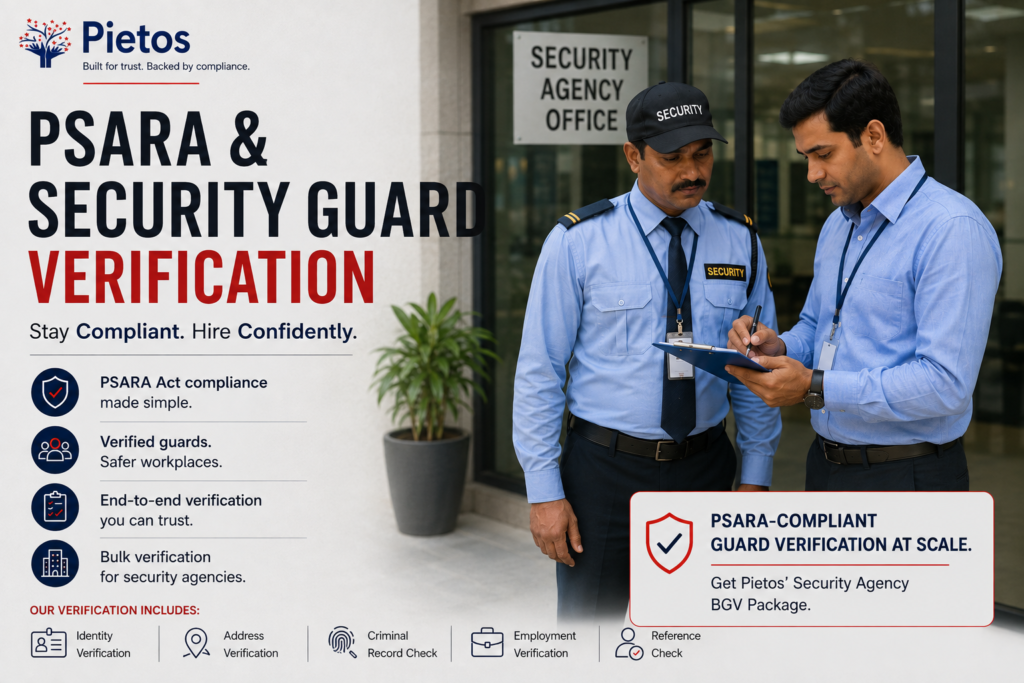
PSARA security guard verification is the process of confirming that every individual guard deployed by a security agency has passed police antecedent checks, identity verification, and address confirmation — not just that the agency itself holds a valid PSARA licence. This distinction matters more than most facility managers realise. A licensed agency can still deploy an unverified guard if internal screening is weak or paperwork is backdated. For any organisation that outsources physical security, understanding this gap is the first step toward real protection, not paper compliance.
Most guidance available online explains how a security agency applies for its PSARA licence. Very little explains what the client — the mall, the residential society, the corporate campus, the logistics park — should independently verify before signing a guarding contract. This guide covers both sides.
Get in touch with Pietos for a PSARA-compliant security agency verification package built for bulk guard onboarding.
What the Private Security Agencies (Regulation) Act Actually Requires
The Private Security Agencies (Regulation) Act, 2005, commonly called PSARA, governs how private security agencies operate across India. It sets out licensing rules for the agency and mandates police verification for every guard and supervisor the agency deploys. The law is enforced through state-level Controlling Authorities and tracked centrally through the PSARA licensing portal, an initiative of the Ministry of Home Affairs.
Under the Act, an agency must prove three things before deploying personnel:
- The agency itself holds a valid, current PSARA licence for the state of operation.
- Every guard has undergone police antecedent verification confirming no pending criminal cases or disqualifying convictions.
- Every guard has completed mandatory training covering security duties, physical fitness, and legal awareness.
Guards must also fall within the age band the Act prescribes, generally 18 to 65 years, and hold a clean record free of prior termination from government service. These conditions exist for a reason. A guard has access to premises, cash points, visitor logs, and sometimes weapons. Skipping verification at this level is a direct liability exposure, not a paperwork shortcut.
Why PSARA Security Guard Verification Is Not the Same as an Agency Licence Check
Here’s where most procurement teams get it wrong. They check whether the vendor holds a PSARA licence, confirm the licence number on the government portal, and consider the due diligence complete. That check confirms the agency is legally allowed to operate. It says nothing about whether the specific guards standing at your gate today were individually verified.
A valid agency licence and an individually verified guard are two separate facts. Renewal cycles run every five years, while guard rosters turn over constantly — contract security staff churn is high, and agencies under pressure to fill a shift sometimes deploy a substitute guard whose paperwork hasn’t caught up. This is where PSARA security guard verification, done at the individual level and refreshed periodically, closes a gap that a one-time licence check cannot.
Talk to Pietos about verifying your security vendor’s guard roster, not just their licence.
What Happens When Agencies Skip Guard-Level Verification
The cost of skipping individual verification rarely shows up until something goes wrong. Then it shows up fast, and it shows up expensive.
The Business Risk of Unverified Guards
An unverified guard with a concealed criminal history who commits theft, assault, or worse on your premises creates exposure that goes beyond the individual incident. Courts and regulators increasingly hold the hiring organisation, not just the security agency, accountable for inadequate vendor due diligence. If your organisation cannot produce verification records when asked, that absence itself becomes evidence of negligence.
Beyond legal exposure, there’s a quieter cost: reputational damage. A single publicised incident involving an unverified guard at a residential society, a mall, or a corporate campus erodes trust that took years to build. Tenants leave. Clients ask harder questions during renewal. Insurance premiums climb.
Why This Gap Exists in the Market
Search engines and vendor directories are full of PSARA licence application guides written for agency owners. Very few resources explain, from the client’s side, how to verify that a vendor’s guards are individually compliant. Listings on platforms like IndiaMART connect buyers to security agencies but carry no editorial guidance on verification depth. Government PSARA pages confirm licence status but don’t offer HR-side procurement guidance either. That leaves a real gap between “the agency is licensed” and “I have confidence in the specific guards on my property,” and most organisations don’t realise the gap exists until an incident forces the question.
The PSARA Security Guard Verification Checklist
Use this checklist whether you’re an agency preparing for an audit or a client vetting a vendor before signing a contract.
- Agency licence validity — Confirm the PSARA licence number, issuing state, and expiry date against the official portal.
- Police antecedent verification per guard — Each guard must have documented antecedent verification, not a blanket agency-level clearance.
- Identity verification — Confirm Aadhaar, PAN, or another government ID matches the person deployed, not just the person on file.
- Address verification — Confirm current and permanent address for post-incident traceability and legal notice purposes.
- Criminal and court record check — Screen against district court and police records for pending cases, not only past convictions.
- Training certificate — Confirm completion of the mandatory PSARA training curriculum through a recognised institute.
- Age and eligibility compliance — Confirm the guard falls within the 18–65 age band and meets state-specific criteria.
- Re-verification cadence — Set a periodic refresh cycle, since guard rosters and shift substitutions change more often than licences do.
Skipping any one of these leaves a gap that an incident, an audit, or a regulator can expose.
See how Pietos runs this checklist at scale — get a PSARA guard verification quote for your agency or facility.
How Pietos Verifies Security Guards for PSARA Compliance
Pietos Solutions Private Limited runs PSARA-aligned guard verification for security agencies that need to onboard staff at volume, and for corporate, residential, and retail clients that want independent confirmation of a vendor’s guard roster.
Police Antecedent and Criminal Record Screening
Every guard’s antecedent history is checked against district court records and available police data, following the same principle used in Pietos’ criminal verification services. This step confirms there’s no pending case or disqualifying conviction that PSARA’s eligibility criteria would flag.
Identity and Document Verification
Guards’ identity documents are checked against government databases rather than accepted at face value. This mirrors the approach used across Pietos’ broader identity verification work, where document authenticity and biometric matching prevent impersonation and forged credentials from slipping through onboarding.
Address Confirmation for Traceability
Physical or digital address verification confirms a guard’s current and permanent residence, an essential step for legal notice delivery and post-incident tracing. Pietos’ address verification services cover metro, semi-urban, and rural addresses through a pan-India field network, which matters because guarding contracts often extend into Tier 2 and Tier 3 locations where digital-only checks fall short.
Bulk, High-Volume Onboarding Without Slowing Deployment
Security agencies frequently onboard large guard batches ahead of a new contract or a festive-season surge in demand for facility staffing. Pietos’ experience running high-volume, time-boxed verification for blue-collar and gig workforces transfers directly to guard onboarding: parallel-track checks that don’t force an agency to choose between speed and compliance.
Right-Sized Verification for Smaller Agencies
Not every security agency operates at enterprise scale. Many are regional operators with lean back-office teams. Pietos’ background verification for startups and MSMEs framework applies the same logic to smaller security agencies — enterprise-grade checks priced and packaged for teams that can’t run an in-house compliance function.
Comparing Verification Approaches
| Approach | What It Confirms | What It Misses | Best For |
|---|---|---|---|
| Government portal licence check | Agency holds a valid PSARA licence | Individual guard status, roster changes, substitutions | Baseline vendor screening |
| In-house HR verification | Some document collection, informal checks | Depth, consistency, audit-ready evidence | Small, single-site deployments |
| Marketplace listings (e.g. IndiaMART) | Vendor contact and service listing | Any verification depth at all | Vendor discovery, not due diligence |
| Managed verification (Pietos) | Individual guard antecedent, identity, address, training | Nothing structural — built for audit readiness | Multi-site, bulk, or recurring guard deployment |
Who Needs Bulk Security Guard Verification
Several buyer types repeatedly need PSARA-aligned, guard-level verification rather than a one-time licence check.
Security agencies preparing for renewal or audit. State Controlling Authorities can inspect records at any time. Agencies that maintain individual, audit-ready verification files for every guard clear these reviews faster and avoid penalties.
Residential societies and facility management companies. Managing committees hire security vendors but rarely have the tools to verify guards independently. A verified roster, refreshed periodically, protects both residents and the managing committee from liability.
Corporate campuses and logistics parks. High-footfall sites with valuable assets need documented proof of guard verification for insurance, client audits, and internal risk reviews — not just a vendor’s word.
Retail chains and malls. Multiple locations mean multiple guard rosters, often supplied by different regional vendors. Centralised verification gives a consistent compliance standard across every site.
Objections HR and Facility Teams Raise — Answered
“Our vendor already told us they’re PSARA-licensed. Isn’t that enough?” A licence confirms the agency can legally operate. It does not confirm that every guard on your premises today was individually verified or that substitutions haven’t introduced unverified staff.
“Verification will slow down guard deployment when we need coverage fast.” Bulk, parallel-track verification is built precisely for this problem. Structured processes confirm identity and antecedent status within days, not weeks, without leaving a coverage gap.
“We’re a small facility. Enterprise BGV feels like overkill.” Right-sized packages exist for exactly this reason. A residential society or single-site retailer doesn’t need the same scope as a national logistics operator, but it does need the same core checks.
“What if a guard passes verification and later commits an offence?” No verification process eliminates future risk entirely, but periodic re-verification catches new criminal cases, address changes, or training lapses that a one-time check would miss.
Key Takeaways
- A PSARA licence confirms the agency, not the individual guard — verify both separately.
- Guard-level checks should cover antecedent history, identity, address, and training, refreshed periodically.
- The market has almost no client-side guidance on this topic; most content targets agencies, not buyers.
- Bulk, parallel-track verification lets agencies and facility teams meet deployment deadlines without cutting corners.
- Right-sized packages make guard-level verification accessible to regional agencies and single-site facilities, not only enterprise buyers.
Frequently Asked Questions
It is the process of confirming an individual guard’s police antecedent history, identity, address, and training compliance, in addition to the security agency’s own PSARA licence.
No. A PSARA licence confirms the agency’s legal registration. Individual guards still need separate, documented antecedent and identity checks, since staff rosters change more often than licences renew.
Any person or business providing private security guards, supervisors, or related services in India must hold a valid PSARA licence issued by the relevant state’s Controlling Authority.
Given typical churn in contract security staffing, periodic re-verification — rather than a one-time check at onboarding — better reflects who is actually deployed on-site at any given time.
Yes. Licence status can be checked against the PSARA licensing portal, which the Ministry of Home Affairs maintains as the central registry for licensed agencies across states.
Pietos verifies individual guards — antecedent history, identity, address, and training records — giving agencies and their clients audit-ready evidence at the guard level, not just confirmation of the agency’s licence.
Related Resources
| Anchor Text | Destination | Why It’s Linked |
|---|---|---|
| criminal verification services | pietos.com/criminal-verification-services-india | Backs the antecedent-check methodology described in the guard verification checklist |
| identity verification approach | pietos.com/beyond-documents…id-verification | Supports the document and biometric verification step for guard onboarding |
| address verification services | pietos.com/address-verification-services-india | Directly relevant to the traceability and Tier 2/3 site coverage discussed |
| blue-collar and gig workforce verification | pietos.com/gig-economy-onboarding | Explains the bulk, time-boxed onboarding model referenced for guard batches |
| background verification for startups and MSMEs | pietos.com/background-verification-for-startups-msmes | Supports the right-sized verification packages section for smaller agencies |
Ready to Verify Your Security Guard Roster?
An unverified guard is a liability your organisation carries silently until the day it isn’t silent anymore. Whether you’re a security agency preparing for a PSARA audit or a facility team vetting a vendor, Pietos runs guard-level verification — police antecedent checks, identity, address, and training records — built for PSARA compliance and audit readiness.
Get Pietos’ PSARA-compliant security agency BGV package and verify your guard roster at scale.