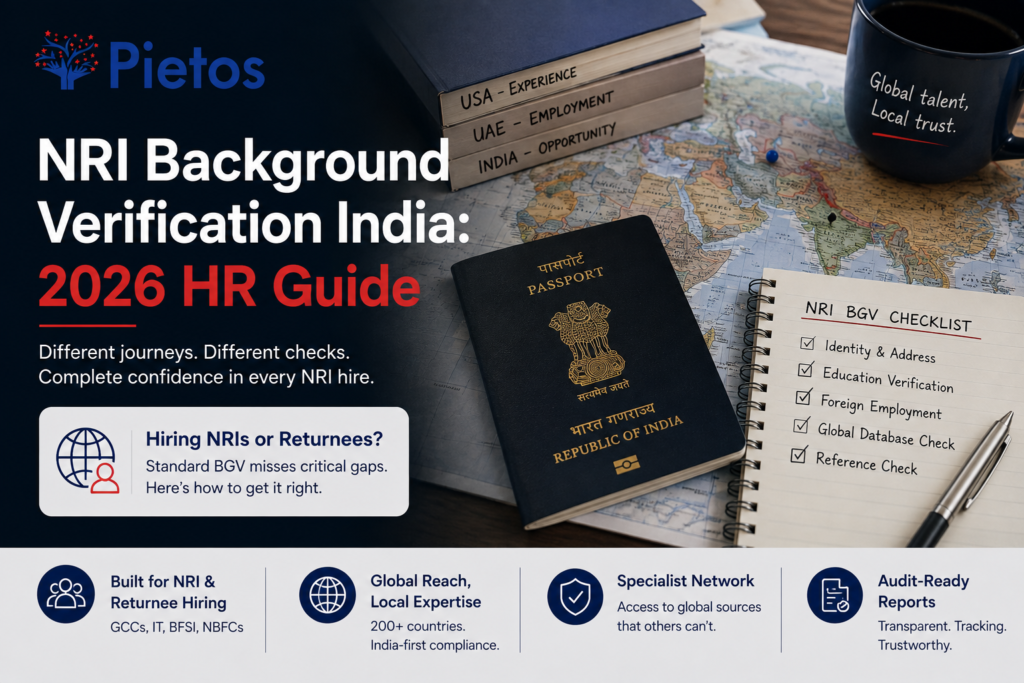
NRI background verification India requires a different playbook than domestic hiring. A returnee’s degree sits with a foreign university. Their last three employers sit outside India’s EPFO and UAN systems. Their identity documents split across an Indian PAN, an Aadhaar that may be dormant, and an OCI or PIO card your verification vendor has never processed. Standard BGV checklists were not built for this candidate, and HR teams who run them anyway end up with a report that says “verified” without confirming the parts that actually carry risk.
This guide breaks down where the gap sits, what a correct NRI background verification India process checks, and how to build one into your hiring pipeline without adding weeks to your timeline.
Why NRI Returnee Hiring Is Rising in Indian Companies Right Now
Two forces are pulling NRIs back to Indian payrolls at the same time. Global capability centres are hiring senior India-based leadership at a pace the domestic talent pool alone cannot fill, and many of those leadership seats go to professionals returning from the US, UK, and Gulf with exactly the global-standards experience GCCs want. Separately, Gulf-based professionals are returning in larger numbers as visa costs rise and Indian salaries close the gap with GCC pay for mid-senior roles.
Both trends land the same resume on an HR desk: strong domestic pedigree, several years of foreign employment, and documentation that sits partly or fully outside India’s usual verification rails. If your BGV vendor cannot chase down that foreign trail, you are hiring on trust alone for the years that matter most.
Why Standard BGV Breaks Down for NRI Candidates
A domestic BGV check leans on four Indian systems: UAN/EPFO for employment history, university registrars and UGC databases for education, UIDAI and NSDL for identity, and state police and court databases for criminal records. Every one of those systems assumes the candidate worked, studied, and lived in India the whole time. An NRI candidate breaks that assumption in at least three places.
Identity documents don’t match the standard flow. A returnee’s primary identity document is often an OCI or PIO card, a foreign passport, or an Aadhaar that has sat unused for years and may show address mismatches. A verifier who only knows how to run Aadhaar demographic matching will either skip this step or return a false flag.
Foreign employment has no UAN trail. If a candidate spent six years at a Dubai logistics firm or a London bank, there is no EPFO record to confirm it. Verification has to go direct to the foreign employer, or through a GCC-linked HR desk, which most domestic-only BGV vendors are not equipped to do.
Foreign education needs a different verification path. A degree from a foreign university does not sit in India’s UGC or AISHE databases. It has to be confirmed with the issuing university’s registrar, sometimes through an apostille or attestation trail, which is a slower and more specialised process than a domestic degree check.
Miss any one of these, and your BGV report looks complete while the highest-risk years of the candidate’s history stay unverified.
[Soft CTA] If a returnee’s resume is sitting in your pipeline right now, it’s worth checking whether your current BGV vendor actually runs OCI/PIO and foreign-employer checks — most domestic-first providers don’t. See how Pietos structures NRI background verification India.
The Business Risk of Skipping NRI-Specific Checks
The cost of an incomplete NRI background verification India process is not abstract. It shows up in three specific ways.
Fabricated GCC or Gulf experience is a documented pattern. Unregistered recruitment agents, cloned job postings, and forged offer letters circulate specifically around Gulf-linked hiring. A candidate can present a polished but entirely fictional employment history, and a domestic-only check will never touch it because there is nothing in an Indian database to contradict it.
Financial history goes unchecked at the exact point it matters most. NRI candidates moving into finance, banking, or fund-handling roles carry cross-border financial history that domestic credit checks do not capture. Skipping this step means hiring for a trust-sensitive role without the trust check that matters.
Regulatory exposure grows quietly. Under the DPDP Act, any company collecting a candidate’s personal data — Indian or foreign — is a data fiduciary with consent, purpose-limitation, and retention obligations. NRI verification often involves cross-border data transfer, which raises the compliance bar rather than lowering it. Treating an NRI file like a domestic one leaves a documented gap for an auditor to find.
Put together, these risks compound. A bad hire in a senior GCC or fintech role costs more in reputational and financial damage than the extra week a proper NRI background verification India process takes.
A Five-Part Framework for NRI Background Verification India
A verification process built for returnees needs to cover five areas that domestic BGV checklists usually skip or shortcut.
1. Identity verification across dual documentation. Confirm the OCI/PIO card against Ministry of External Affairs records, cross-check the foreign passport, and reconcile it against any Indian PAN or Aadhaar on file. Treat mismatched names, spellings, or dates of birth across documents as a flag to resolve, not ignore.
2. Foreign employment verification through direct employer contact. Route every claimed foreign employer through direct confirmation — a phone call or written confirmation to the company’s HR desk — rather than accepting a relieving letter or reference contact supplied by the candidate. Cloned job postings and fake HR contacts are common enough that self-supplied references cannot be the only check.
3. Foreign education verification through the issuing institution. Confirm the degree, certification, or professional qualification directly with the registrar of the issuing university, not from the scanned certificate alone. Where the country uses an apostille or attestation system, verify that chain too.
4. Financial and compliance trail review. For roles touching finance, compliance, or fund management, review the candidate’s cross-border financial history within FEMA-compliant boundaries, and confirm there are no unresolved regulatory or sanctions flags tied to their overseas activity.
5. Criminal and reputational record check, both jurisdictions. Run a domestic criminal record check in India and, where legally accessible, a police clearance or equivalent from the country the candidate is returning from. A clean Indian record says nothing about conduct in another country.
Key takeaway: a correct NRI background verification India process does not add five random checks — it replaces the four assumptions a domestic checklist makes about where a candidate’s history lives.
Standard BGV vs. NRI-Specific BGV
| Check | Standard domestic BGV | NRI-specific BGV |
|---|---|---|
| Identity | Aadhaar/PAN demographic match | OCI/PIO + passport + Aadhaar reconciliation |
| Employment history | UAN/EPFO trail | Direct foreign-employer confirmation |
| Education | UGC/AISHE database match | Issuing-university registrar confirmation |
| Financial history | Domestic credit bureau check | Cross-border financial and compliance review |
| Criminal record | Indian court/police databases | Indian + country-of-origin police clearance |
| Typical turnaround | 3–7 business days | 7–10 business days, verification-dependent |
A Realistic Hiring Scenario
Consider a mid-market NBFC hiring a returning finance professional who spent five years at a Dubai-based investment firm. The candidate’s Indian degree checks out instantly. Their PAN and Aadhaar are valid. On paper, the file looks closed in two days.
But the Dubai employment — the five years that justify the seniority and salary being offered — sits entirely outside domestic databases. Without direct employer confirmation, the NBFC would be onboarding a finance leader on the strength of a relieving letter alone. This is exactly the scenario where GCC and Gulf-linked resumes most often carry inflated titles, invented tenure, or entirely fabricated employers. A five-part NRI background verification India process catches this before the offer is finalised, not after.
Objections HR Teams Raise, and the Honest Answers
“This will slow down our offer timeline.” It adds roughly three to five business days over a domestic-only check, concentrated in foreign-employer and education confirmation. A digital-first verification partner narrows that gap by running domestic and foreign checks in parallel rather than sequentially.
“Our current vendor already checks everything.” Ask them directly whether they run OCI/PIO verification and direct foreign-employer contact, not just whether they “cover international candidates.” Many vendors accept a foreign relieving letter as sufficient, which is the exact gap fraud exploits.
“The candidate will feel over-scrutinised.” A well-run process is not more invasive, just more targeted — it replaces guesswork with confirmation. Framed as standard practice for all returnee hires, not a signal of suspicion, candidates generally accept it the same way they accept any pre-employment check.
Key Takeaways
- NRI background verification India fails when it runs on a domestic checklist, because four of India’s core verification databases don’t cover foreign employment, education, or dual identity documents.
- The highest-risk gap is foreign employment history — GCC and Gulf-linked resumes are a documented target for fabricated experience.
- A correct process adds five specific checks: dual identity reconciliation, direct foreign-employer confirmation, issuing-university education verification, cross-border financial review, and dual-jurisdiction criminal checks.
- Expect seven to ten business days for a properly verified NRI file, not three.
- DPDP Act obligations apply in full to NRI candidate data, including cross-border transfer — this is a compliance requirement, not a nice-to-have.
How Pietos Verifies NRI Returnees
Pietos runs NRI background verification India as a distinct workflow, not a domestic checklist with extra paperwork attached. Identity checks reconcile OCI/PIO documentation against Ministry of External Affairs records alongside Indian PAN and Aadhaar. Foreign employment is confirmed through direct employer contact rather than candidate-supplied references. Education verification routes through the issuing university’s registrar. All of it runs on a DPDP-aligned consent and data-handling process built for cross-border candidate data, closing the exact compliance gap that trips up companies using a domestic-only vendor.
[Strong CTA] Hiring NRIs returning from the Gulf or the West? Pietos’ international verification desk handles the foreign employment, education, and identity trail your current process can’t reach. Book a free NRI BGV consultation with Pietos.
FAQ
Standard BGV relies on Indian databases — UAN/EPFO, UGC, UIDAI, and domestic police records. NRI verification has to confirm foreign employment directly with overseas employers, foreign education directly with issuing universities, and identity across OCI/PIO documentation alongside Indian ID proofs, none of which a purely domestic check reaches.
Most NRI-specific checks take seven to ten business days, longer than a typical three-to-seven-day domestic check, because foreign-employer and university confirmations depend on external response times.
Not on its own. It should be reconciled against the candidate’s foreign passport and any Indian PAN or Aadhaar on record, with name, date-of-birth, and address consistency checked across all documents.
Yes. Any company collecting a candidate’s personal data for verification, including cross-border data from foreign employers or universities, is a data fiduciary under the DPDP Act and carries the same consent, purpose-limitation, and retention obligations as domestic verification.
Technically yes, by contacting foreign employers directly, but most in-house HR teams lack the language, time-zone coverage, and regional contacts to confirm this reliably at scale, which is why companies route NRI background verification India through a specialist partner.
Fabricated GCC or Gulf employment history, including forged offer letters and inflated titles, is the most commonly documented pattern, largely because it is the hardest check for a domestic-only BGV process to catch.
Related Resources
| Anchor text | Destination page | Why link |
|---|---|---|
| GCC overseas staffing fraud in India | pietos.com/gcc-overseas-staffing-fraud-india | Directly covers the fabricated-experience risk this article references |
| Identity Verification Services in India (PAN & Aadhaar) | pietos.com/identity-verification-services-india | OCI/PIO identity reconciliation builds on this core identity-check service |
| Education Verification Services in India | pietos.com/education-verification-services-india | Foreign degree verification extends this domestic education-check service |
| Employee Background Verification Services in India | pietos.com/employee-background-verification-services-in-india | Digital-first verification model that NRI checks run on top of |
| Book a free NRI BGV consultation | pietos.com/contact-us-background-verification | Direct path for HR teams ready to set up NRI-specific verification |
Sources
| Source | URL | Why cited |
|---|---|---|
| Ministry of External Affairs — Overseas Indian Affairs | mea.gov.in/overseas-indian-affairs | Primary government reference for OCI/PIO identity documentation |
| RBI — FEMA regulations | fema.rbi.org.in | Governs cross-border financial history relevant to NRI compliance checks |
| Passport Seva, Government of India | passportindia.gov.in | Primary identity document reference for NRI candidates |
| PBSA — Professional Background Screening Association | thepbsa.org | Global standards body for background screening practice |
| Ministry of Labour and Employment, Government of India | labour.gov.in | Governs labour framework relevant to returning workers |
Hiring NRIs returning from the Gulf or the West? Pietos’ international verification desk handles the foreign employment, education, and identity trail your current process can’t reach. Book a free NRI BGV consultation with Pietos.