
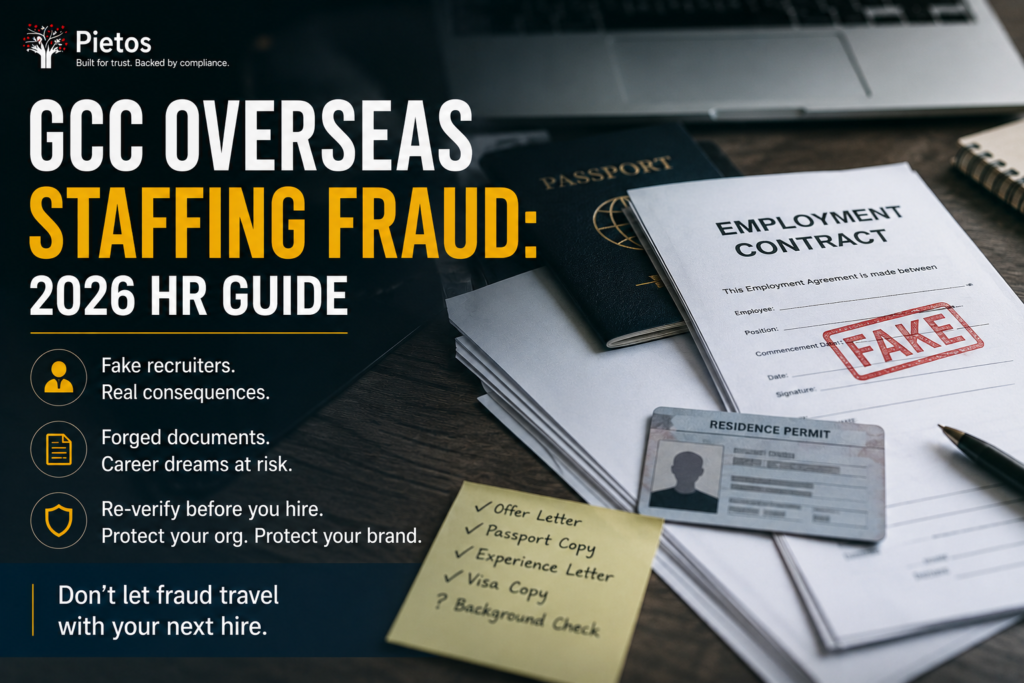
Every week, another Indian family loses its savings to a fake Gulf job offer. GCC overseas staffing fraud has moved past isolated village-level scams. It now runs through polished LinkedIn profiles, cloned company websites, and WhatsApp recruiters who sound entirely credible. A 2026 report from the Asia Pacific Group on Money Laundering, co-led with the UN Office on Drugs and Crime, even traced how fake recruitment funnels were used to harvest Indian bank accounts and SIM cards for cross-border cyber fraud rings. That is no longer a “labour migration” problem. It is a corporate risk problem.
For HR and talent acquisition leaders, this shift matters directly. Many organisations now route senior hires, GCC-linked technology talent, and cross-border contractors through staffing partners and manpower agents. When a candidate arrives with a Gulf work history, a “GCC experience certificate,” or documents from an overseas placement agency, your team inherits whatever fraud happened upstream. GCC overseas staffing fraud does not stay contained to the person it first targeted. It follows the candidate straight into your applicant pipeline.
This guide breaks down how the fraud actually works, what recent data shows, and the exact re-verification steps HR teams should run before any GCC-linked hire joins. It also covers which sectors face the sharpest exposure, why manual document review no longer catches sophisticated fakes, and how to build re-verification into a workflow your recruiters will actually follow, rather than a policy that exists only on paper.
Already seeing GCC-linked resumes in your pipeline? Book a free BGV consultation with Pietos to see where your current process leaves gaps.
What Counts as GCC Overseas Staffing Fraud?
GCC overseas staffing fraud covers a wide net of deceptive practices tied to recruitment for Gulf Cooperation Council countries — Saudi Arabia, the UAE, Qatar, Kuwait, Bahrain, and Oman. It includes unregistered agents who charge illegal fees, cloned job postings from real companies, forged offer letters and visas, and fake “GCC experience” credentials that candidates later present to Indian employers.
The Ministry of External Affairs regulates this space through the Overseas Employment and Protector General of Emigrants division, which handles emigration clearance under the Emigration Act, 1983. Every legitimate recruiting agent must register on the government’s eMigrate portal, and every foreign employer hiring through it must appear on record. Fraudsters route around this system constantly, which is exactly why the fraud persists at scale.
Three fraud types dominate the current wave:
- Unregistered agents who operate outside eMigrate entirely, often through WhatsApp and Facebook groups.
- Document forgery, where offer letters, visas, or employer stamps get fabricated using stolen templates.
- Credential laundering, where a candidate’s “GCC work history” itself cannot be verified against any real employer.
Each type eventually surfaces on an Indian employer’s desk, usually disguised as an impressive resume line.
Why the GCC Hiring Boom Is Creating a Fraud Window
India’s Global Capability Centre sector has expanded from roughly $19 billion in economic contribution in 2015 to more than $68 billion today, and GCCs increasingly compete directly with Gulf employers for the same talent pool. This overlap creates confusion that fraudsters exploit deliberately.
Recruitment fraud researchers point out that the GCC region itself is a prime target because it draws a huge, mobile international workforce chasing relocation, visas, and higher pay. A scammer can target candidates across several countries without ever setting foot in any of them. That structural gap, high demand paired with low friction and weak candidate verification habits, is precisely what fuels GCC overseas staffing fraud today.
The same dynamic bleeds into India’s domestic hiring market. Recent industry research found that 93% of full-time workers and active job seekers in India reported direct exposure to fake recruiters, counterfeit job postings, or impersonated corporate communication. Early-career candidates, the same group most likely to chase a first Gulf posting, face the highest exposure.
For HR teams, the takeaway stays blunt. If nearly every candidate in your pipeline has already encountered a fraudulent recruiter, you cannot assume any resume line involving overseas placement is automatically genuine. Verification has to become the default, not the exception.
Inside the Fraud Network: How Fake Recruiters Actually Operate
Investigative reporting on Indian recruitment networks describes a layered structure that looks almost corporate. A licensed or semi-licensed agent sits at the top, coordinating with recruiters from Gulf-based companies. Below that agent sits a chain of subagents, often reaching into villages and small towns, who mobilise candidates for interviews in cities like Delhi.
Genuine skill testing rarely happens on the spot. Instead, recruiters lean on a shortcut: a “GCC experience certificate.” If a candidate already claims prior Gulf work, recruiters assume competence without checking it. Candidates without that certificate face a much higher bar, sometimes ten years of domestic experience, before an agent will even present them to a foreign employer.
This layered subagent system creates two problems for corporate HR. First, fraudulent credentials get recycled and passed along multiple hiring chains, gaining false credibility each time. Second, the “GCC experience” a candidate lists on LinkedIn may trace back to an employer relationship that was never real to begin with. Left unchecked, GCC overseas staffing fraud effectively launders itself into a legitimate-looking resume line by the time it reaches your ATS.
Reports also flag a newer complication. Cheap AI tools now let fraud networks generate convincing job postings, employer emails, and even resumes at scale. The broken-English red flags that once made scams easy to spot are disappearing fast, which pushes the verification burden further onto structured, document-level checks rather than gut instinct.
The Documents Fraudsters Fake Most Often
Four document types show up repeatedly in GCC overseas staffing fraud cases, and HR teams should treat each one as a mandatory verification point rather than a formality.
Offer letters and employment contracts. Genuine Gulf job offers always pair an employer-signed contract with clear salary terms and a proper employment or work visa. The Ministry of External Affairs has explicitly warned that any offer routed through a tourist visa, rather than an employment visa, should be treated as a red flag immediately.
Recruiting agent registration. Every legitimate agent must carry a valid MEA license. Reports have documented cases where foreign employers’ own eMigrate login credentials were misused by agents to generate fake job offers without the employer’s knowledge. Even a seemingly official-looking eMigrate reference cannot be trusted at face value.
Visa and emigration clearance documents. Fabricated visas, forged emigration clearance stamps, and cloned government letterheads circulate widely enough that Indian missions in the UAE alone have historically fielded hundreds of verification requests a month from workers trying to confirm a company’s legitimacy before travelling.
Prior GCC employment history. This document lands directly on an Indian recruiter’s desk. A candidate’s claimed Gulf employer, job title, and tenure need the same rigour as any domestic employment check: direct confirmation against payroll or HR records, not a LinkedIn summary or a reference letter alone.
Pietos runs structured employment history verification and education verification checks that extend this same logic to international claims, cross-referencing what a candidate states against what the originating employer or institution actually confirms.
What 2026 Data Shows About the Scale of the Problem
The numbers from this year paint a sharper picture than earlier warnings did. The Cyber Scam Hubs and Human Trafficking Report 2026, produced jointly by the Asia Pacific Group on Money Laundering and the UN Office on Drugs and Crime, documented an India-linked case where an international syndicate used fake recruitment to obtain bank accounts, debit cards, and registered SIM cards. Those assets eventually reached cyber fraud operators based in the Philippines.
That case matters for two reasons. It shows GCC overseas staffing fraud increasingly connects to organised financial crime, not just individual exploitation. It also confirms that recruitment fraud has become a cross-border laundering tool, which raises the compliance stakes for any company whose hiring pipeline touches overseas placement agencies.
Separately, regional analysts covering Middle East hiring trends describe the GCC as a persistent target precisely because of its scale and mobility. A single fraud operation can run campaigns across several Gulf countries simultaneously, using the same scripts and cloned employer branding, without needing a physical presence anywhere near the candidates it targets.
For Indian HR leaders, both data points reinforce the same conclusion. GCC overseas staffing fraud is not shrinking as digital hiring matures. It is scaling alongside it, and legacy verification habits, a quick reference call or a glance at a PDF offer letter, no longer work as controls.
The Legal Framework HR Teams Should Actually Know
India regulates overseas recruitment through the Emigration Act, 1983, administered by the MEA’s Overseas Employment and Protector General of Emigrants division. The framework applies specifically to Emigration Clearance Required passport holders travelling to eighteen designated countries, including the Gulf states.
Two protections sit at the centre of this system. First, every recruiting agent must hold a valid government license to operate legally; unlicensed agents already violate the law before any fraud even begins. Second, the eMigrate portal exists specifically so workers and employers can verify agents and foreign employers before any money or documents change hands.
The government has also raised penalties over time, with unlicensed recruiting agents facing jail terms and fines under amendments to the Emigration Act. Complaints against recruiting agents can go directly through the Protector General of Emigrants office, through Indian missions abroad, or through the MADAD portal for citizens already overseas.
None of this framework, however, extends into your applicant tracking system. The law protects emigrating workers at the point of departure. It does nothing to verify, after the fact, whether a candidate’s claimed GCC employment history is genuine once they are applying to an Indian company. That verification gap is where corporate BGV has to step in.
Why Domestic Employers Are Exposed Too, Not Just Migrant Workers
It is tempting to treat GCC overseas staffing fraud as someone else’s compliance problem, a Gulf recruitment issue rather than an Indian HR issue. That framing misses how directly the risk transfers.
Consider three common scenarios. A GCC hiring a returning expatriate for a senior technology role relies partly on the candidate’s Gulf employment history to justify seniority and compensation. A logistics or manufacturing company hiring contract staff through a placement agency inherits whatever due diligence, or lack of it, that agency performed upstream. An IT services firm onboarding a “GCC-experienced” project manager may never independently confirm the claimed employer even exists.
In every case, a fabricated or exaggerated overseas credential inflates a candidate’s perceived value, skips your normal seniority checks, and, in worse cases, imports the same document-forgery risk that fuels moonlighting and dual-employment fraud domestically. Pietos has documented similar patterns in moonlighting detection cases, where fabricated employment history, whether domestic or overseas, consistently correlates with downstream fraud, IP exposure, or compliance violations.
There is also a narrower but sharper compliance angle for companies staffing GCC-linked roles directly. Pietos has flagged how pre-employment screening for GCC-bound roles already needs to satisfy both Indian consent law and destination-country visa medical requirements simultaneously. GCC-adjacent hiring carries layered compliance obligations most HR teams underestimate until an audit forces the question.
Which Sectors Face the Highest GCC Overseas Staffing Fraud Exposure
Not every industry carries equal risk, and HR teams should calibrate their verification depth accordingly.
IT and GCC-to-GCC talent movement. India’s own Global Capability Centre sector now competes with Gulf employers for the same engineering and analytics talent pool. A candidate moving between an Indian GCC and a Gulf-based technology employer can present overlapping, hard-to-distinguish credentials, which makes independent employer confirmation essential rather than optional.
Construction, logistics, and blue-collar staffing. This segment remains the most heavily targeted by classic GCC overseas staffing fraud: the subagent networks, the fabricated “experience certificates,” and the tourist-visa workaround. Companies sourcing contract labour through third-party agencies inherit this risk directly and should extend vendor due diligence to the agency itself, not only the individual worker.
Healthcare and clinical roles. Gulf healthcare systems recruit heavily from India, and clinical credentials carry higher stakes if fabricated. Any candidate citing Gulf clinical experience needs licensing-body confirmation in addition to standard employment verification.
BFSI and finance-adjacent roles. Financial institutions hiring candidates with Gulf banking or fintech experience face a narrower but sharper risk. A fabricated overseas credential here can mask undisclosed regulatory issues or prior misconduct that would otherwise surface through standard reference checks.
Across every sector, the common thread holds. The further a candidate’s claimed history sits from something your team can directly confirm, the more deliberately you need to verify it.
DIY Verification vs. a Structured BGV Partner
Many HR teams try to handle GCC-linked verification themselves before realising how much manual effort it demands. Here is how the two approaches actually compare.
| Verification Step | In-House / DIY | Structured BGV Partner (Pietos) |
|---|---|---|
| Agent license check | Manual eMigrate lookup, easy to skip under time pressure | Standardised, logged as part of every case |
| Employer confirmation | Depends on recruiter follow-through and language barriers | Direct outreach protocols, documented trail |
| Document authenticity | Visual review only, misses AI-generated fakes | AI-powered document forensics, pixel and metadata analysis |
| Turnaround time | Slow, inconsistent across recruiters | Standardised SLAs across high-volume hiring |
| Audit trail | Often incomplete or scattered across emails | Centralised, defensible documentation |
| Cost if missed | Bad hire cost, compliance exposure, reputational risk | Predictable per-candidate verification cost |
Handling GCC-linked hiring at volume and want a partner that closes these gaps? Get in touch with the Pietos team to see how a structured verification layer fits your current hiring flow.
The Real Cost of Skipping Re-Verification
It helps to walk through what actually happens when GCC overseas staffing fraud slips past HR unnoticed. A candidate joins with an inflated title, backed by a Gulf employment history that was never independently confirmed. Compensation gets benchmarked against that inflated seniority. Six months in, performance gaps expose the mismatch, but by then the company has absorbed onboarding costs, lost productive time, and possibly exposed sensitive systems or client relationships to someone whose actual track record looked nothing like their resume.
Industry estimates already put the cost of a single bad hire at roughly five times what a proper background verification would have cost upfront. Add a fabricated overseas credential to the mix, and the downstream risk compounds: reputational exposure if the fraud surfaces publicly, potential liability if the hire was staffed through a client-facing role, and renewed audit scrutiny on every other hire that came through the same recruitment channel.
There is a quieter cost too. Every unverified GCC hire that slips through normalises the shortcut for the next one. Recruiters learn, implicitly, that a Gulf work history on a resume does not actually get checked, and the entire hiring funnel becomes progressively easier for fraud networks to exploit.
Common Excuses Candidates Give, and Why They Do Not Hold Up
HR teams pushing back on unverifiable GCC credentials often hear the same handful of justifications. It is worth naming them directly.
“My previous employer’s HR does not respond to Indian companies.” A legitimate Gulf employer, particularly one large enough to justify the seniority a candidate is claiming, has an HR function that responds to standard employment verification requests. Persistent non-response is itself a data point.
“I was placed through an agent, so I do not have direct employer contact details.” This is precisely the scenario the eMigrate system exists to prevent. Ask for the agent’s registration details and cross-check them against the portal directly, rather than accepting the explanation at face value.
“My offer was on a visit visa because the company was still processing my work visa.” The Ministry of External Affairs has explicitly flagged this pattern as a red flag, not a normal administrative delay. Legitimate employers issue work or employment visas before travel, not tourist visas as a placeholder.
“The company has since shut down or restructured, so records are hard to trace.” This is sometimes genuine. It is also one of the easiest fabrications to construct, since it forecloses verification by design. Treat it as a prompt to lean more heavily on secondary evidence: payslips, bank credits matching the claimed salary, or work-visa stamps in the candidate’s passport.
None of these excuses should trigger automatic rejection. They should trigger a documented, deeper verification step before the offer proceeds.
Buyer Objections, Answered
“Our recruiters already ask for reference letters. Isn’t that enough?” Reference letters come from the candidate’s own network and carry no independent confirmation. A structured process confirms employment directly with the employer’s HR or payroll function, not through a name the candidate supplies.
“This will slow down our hiring timeline.” A standardised GCC verification layer, run in parallel with domestic checks, typically adds a defined turnaround window rather than an open-ended delay. Slower, verified hiring still beats fast, unverified hiring that later needs unwinding.
“We only hire a handful of GCC-linked candidates a year. Is this worth building?” Volume does not change the exposure per hire. A single fabricated senior credential can cost more in compensation misalignment and compliance risk than a full year of verification fees across every GCC-linked hire combined.
“Our current BGV vendor already covers this.” Not every BGV vendor extends the same rigour to international employment claims. It is worth asking directly whether your current partner runs independent Gulf employer confirmation or simply files away submitted documents. Pietos has written about the right questions to ask before trusting a verification vendor, and GCC-specific verification depth belongs on that list.
The Re-Verification Checklist Before Any GCC-Linked Hire Joins
Before onboarding a candidate with claimed Gulf work history or a placement-agency background, run through this checklist rather than relying on a resume summary alone.
- Confirm the recruiting agent’s license status against the eMigrate portal, if a candidate mentions being placed through an agent at any point in their history.
- Independently verify claimed GCC employment directly with the stated employer’s HR department, not through a reference the candidate supplies.
- Cross-check job titles and tenure against payslips, relieving letters, or provident-fund-equivalent records where the destination country offers them.
- Validate education credentials separately, since fraud rings frequently pair fake employment history with fabricated degrees.
- Run identity and address checks on the candidate’s Indian documentation, since GCC-linked fraud cases often overlap with broader identity fraud.
- Treat unverifiable “GCC experience certificates” as a red flag, not a shortcut past deeper screening.
- Document the entire verification trail, since the same paperwork protects you if a fraudulent hire later triggers a compliance or legal dispute.
This is not a one-time gate. Build it into your standard employee background verification workflow so every candidate with international employment history, GCC or otherwise, moves through the same structured layer instead of an ad hoc judgment call.
Building a Structured BGV Layer for International and GCC Hires
Most Indian BGV programs were designed around domestic verification: EPFO checks, university confirmations, criminal record searches, and address validation. International claims often get waved through with a lighter check, sometimes just a phone reference, because cross-border verification feels harder to execute.
That gap is exactly what GCC overseas staffing fraud exploits. Closing it does not require reinventing your BGV process. It requires extending the same rigour you already apply domestically to overseas claims specifically.
A workable structure looks like this. Route every candidate with claimed GCC employment through direct employer confirmation rather than reference letters. Pair that with standard identity verification and address verification on the Indian side, since fraud rings frequently pair fabricated overseas history with equally weak domestic documentation. For contract or vendor-sourced staff specifically, extend the same scrutiny to the staffing partner itself, not just the individual candidate.
Where roles involve sensitive access, senior leadership, or regulated sectors, add a social media and digital footprint check to confirm that publicly claimed project ownership or overseas tenure actually lines up with the candidate’s stated history. Inconsistencies here surface faster than most HR teams expect.
Why Manual Document Checks No Longer Catch This Fraud
A decade ago, forged offer letters and visa stamps left obvious traces: mismatched fonts, blurry seals, uneven spacing that a trained recruiter could spot on a second look. Generative AI has closed most of those gaps. A synthetic Gulf employment letter today can carry a convincing signature block, a matching letterhead, and metadata that looks entirely plausible at a glance.
This shift matters directly for GCC overseas staffing fraud, because the same tools that make phishing emails harder to spot also make fabricated offer letters, visas, and experience certificates harder to catch by eye. Manual review, however experienced the recruiter, reliably misses a large share of high-quality fakes once fraud moves to this level of sophistication.
Structural, pixel-level document analysis is built specifically to close that gap. Pietos’ AI-powered document forensics layer checks font structure, file metadata, and background pixel consistency across submitted documents, catching a large share of manipulated identity and employment paperwork before it ever reaches a hiring manager’s inbox. A cross-document consistency audit adds a second layer, mapping names, dates, and employment timelines across every document a candidate submits, since fraudulent applicants who alter one file in isolation almost always fail to keep the full document set internally consistent.
None of this replaces human judgment. It gives HR teams a reliable first-pass filter, so recruiters spend their attention on the cases that genuinely need a closer look instead of trying to catch every fabrication unaided.
What HR and TA Leaders Should Do This Quarter
Start with an audit, not an overhaul. Pull the last two quarters of hires who listed GCC or international employment history and check how many went through independent employer confirmation versus a reference call alone. That single exercise usually reveals how exposed your current process already is.
Next, formalise the re-verification checklist above into your standard offer-stage workflow, rather than leaving it to individual recruiter judgment. Fraud rings count on inconsistency across hiring managers to slip through.
Finally, brief your talent acquisition team on how the fraud network actually operates: subagents, cloned job postings, fabricated “GCC experience certificates.” The pattern becomes recognisable once recruiters understand the mechanics, and a recruiter who understands the mechanics catches inconsistencies faster than one relying on general caution alone.
Set a review cadence too. Fraud tactics evolve quarter to quarter, and a checklist written today can go stale within a year as fraud networks adapt to whatever verification step becomes standard. Revisit your GCC re-verification workflow alongside your regular BGV vendor review, and update it whenever a new document type or fraud pattern starts showing up in your own hiring data. Treat this as a living control, not a one-time policy document filed away after the first rollout.
A Quick Example: What This Looks Like in Practice
Picture a mid-sized IT services company in Gurgaon hiring a senior delivery manager. The candidate’s resume lists four years at a well-known Gulf-based technology employer, backed by a signed offer letter, a relieving letter, and a LinkedIn profile with matching dates. On paper, everything lines up.
A recruiter under deadline pressure would likely move this candidate straight to offer stage. A structured verification process, instead, routes the claimed employer through direct HR confirmation rather than accepting the documents at face value. In practice, this step alone catches a meaningful share of fabricated Gulf employment histories, because fraudulent candidates rarely expect anyone to actually call the employer they named.
Three outcomes typically follow such a check. The employer confirms everything, and the hire proceeds with genuine confidence rather than assumed confidence. The employer confirms a shorter tenure or a junior title than claimed, prompting a compensation and seniority conversation before the offer goes out. Or the employer has no record of the candidate at all, which stops a fabricated hire before it ever reaches your payroll.
None of these outcomes require exotic tooling. They require one discipline: treating a claimed Gulf employer the same way you would treat a claimed Indian employer, confirmed directly, not assumed from a polished PDF. Companies that build this single habit into their offer-stage workflow consistently report catching issues earlier, and cheaper, than companies that discover the same gaps after the candidate has already joined.
Frequently Asked Questions
No. While blue-collar recruitment carries the highest volume of cases, white-collar candidates, particularly in IT, healthcare, and finance, increasingly present fabricated or exaggerated Gulf employment history during domestic hiring in India.
Check the agent’s registration status directly on the government’s e Migrate portal. A licensed agent will appear on record; an unregistered one will not, regardless of how professional their communication looks.
Visa type. A genuine Gulf job offer pairs with an employment or work visa, never a tourist visa used as a workaround.
Scale the depth to the role’s seniority and access level, but apply the same core principle everywhere: confirm employment history directly with the employer rather than relying on the candidate’s own documentation or a reference letter alone.
A structured process, run in parallel with domestic checks rather than after them, adds a defined window rather than an open-ended delay. The exact turnaround depends on how quickly the claimed employer’s HR function responds.
It does not stand apart from it. GCC overseas staffing fraud verification should sit inside the same structured background verification process HR teams already run for domestic hires, extended to cover international claims with equal rigour.
The Bottom Line on GCC Overseas Staffing Fraud
GCC overseas staffing fraud has evolved from an isolated migrant-worker risk into a structural gap in Indian corporate hiring. The fraud networks are organised, increasingly AI-assisted, and now documented as connecting to broader financial crime. The regulatory framework protects workers at the point of emigration, but it stops short of protecting the employer who later hires that same candidate based on an unverified Gulf resume line.
Closing that gap comes down to one discipline: treat every claimed GCC employment history the way you already treat domestic employment history, confirmed directly, documented fully, and never assumed genuine because it sounds impressive. Companies that build this discipline into their standard offer-stage process, rather than treating it as an exception reserved for “suspicious” resumes, consistently catch fabricated credentials earlier and at far lower cost than companies that discover the gap after a bad hire has already joined.
Key takeaways for HR and TA leaders
- GCC overseas staffing fraud has shifted from a migrant-worker issue into a corporate hiring risk, and it now shows documented links to organised financial crime.
- Fraud networks run through layered subagent chains, cloned job postings, and increasingly convincing AI-generated documents.
- Visa type, agent registration on eMigrate, and direct employer confirmation remain the three fastest checks HR teams can run.
- Manual document review misses a growing share of high-quality fakes; structural, AI-assisted document forensics closes that gap.
- Re-verification should sit inside your standard BGV workflow, not operate as a separate, optional step reserved for “suspicious” candidates.
Hiring through a Middle East staffing agency, or bringing on a candidate with Gulf work history before they join your India operations? Re-verify before they start. Talk to a Pietos BGV consultant or get in touch with our team to build a verification layer that covers international claims as rigorously as domestic elated Resources




Pingback: NRI Background Verification India: The Complete 2026 Guide for HR Teams Hiring Returnees - Best Background Verification Company in India | Pietos
Pingback: GPT-6 Astra Hiring Fraud: Why India's BGV Process Hasn't Caught Up - Best Background Verification Company in India | Pietos