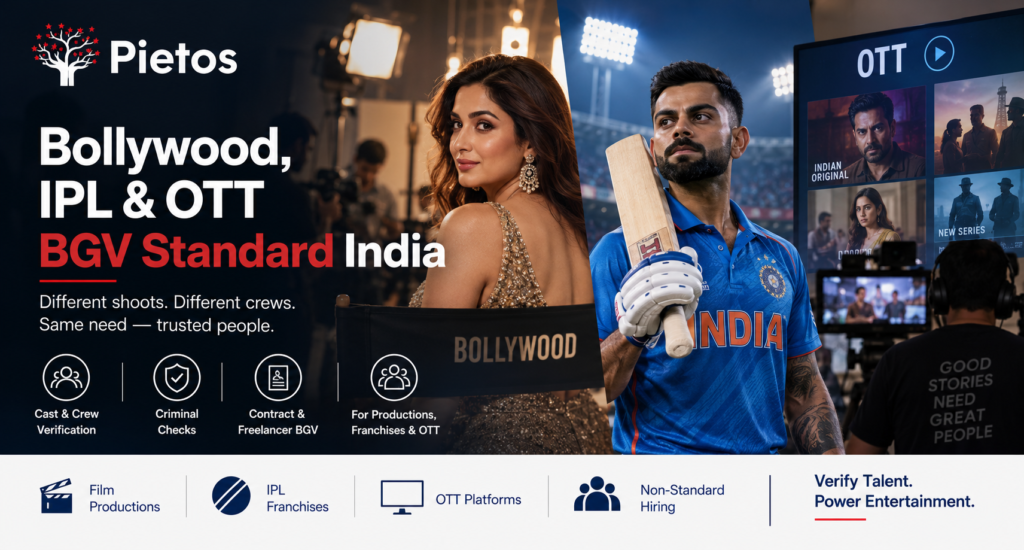
Entertainment industry background verification in India has a problem: almost nobody structures it properly. Standard corporate BGV assumes a full-time employee, a fixed HR file, and a single employer of record. Bollywood productions, OTT platforms, and IPL franchises run on none of that. They hire in bursts, through vendors, agencies, and word-of-mouth referrals, for people who’ll be gone in eight weeks.
That mismatch creates real exposure. A junior artist coordinator with a pending criminal case. A drone operator brought in through three layers of subcontracting with no verified identity on file. A background dancer roster assembled the night before a shoot. None of this shows up in a standard pre-employment check. Nobody designed standard checks for this hiring pattern.
Running productions or managing a franchise’s workforce? Pietos builds entertainment-sector BGV packages for non-standard hiring.
This guide breaks down why entertainment hiring needs its own verification standard. It covers what that standard should include. Then it shows how production houses, OTT platforms, and franchises can close the gap. None of this should slow down a shoot schedule — schedules never wait for HR paperwork.
Why Entertainment Hiring Breaks Standard BGV Models
Most background verification frameworks in India assume a simple model. One employer, one employee, one employment contract — verified once at onboarding. Entertainment hiring violates that assumption at almost every level.
A single film production can run through hundreds of people across its shoot schedule. Spot boys, junior artists, light and camera crew, security, drivers, caterers, and specialist technicians move through the set. A line producer or crew coordinator hires most of them, not a formal HR department. Contracts are verbal or single-page. Payment is often in cash, tranche by tranche. Nobody runs a criminal verification services India check on a background dancer. Nobody thinks of a background dancer as “staff.”
OTT platforms face a parallel version of the same problem. A platform commissioning fifteen originals in a year works with dozens of production houses. Each one brings its own crew, its own contractors, and its own standards — or lack of them. The platform’s brand carries the risk even when the hiring decision sat three vendor layers away.
IPL and franchise sports add a seasonal dimension. A franchise builds out a matchday workforce for a two-month season — ushers, ground staff, hospitality teams, security personnel. Then it disbands the whole team. Verifying that workforce with the same rigour used for a corporate office hire feels disproportionate. That feeling changes fast once something goes wrong at a stadium holding fifty thousand people.
None of these sectors are unaware of risk. They’re aware and under-resourced for it. The standard employee BGV services India model doesn’t map cleanly onto how they actually hire.
Bollywood Production Crews: The Verification Blind Spot
A film shoot is a temporary organisation. It assembles fast, operates at high intensity for weeks or months, and dissolves the moment the last shot wraps. That structure is exactly what makes crew verification fall through the cracks.
Three groups carry disproportionate risk on a typical production:
Below-the-line crew hired through labour contractors. A labour contractor frequently supplies spot boys, junior technicians, and general crew. That contractor may not run any verification at all. The production house’s exposure is real even though the hiring relationship is indirect.
Location and access personnel. Drivers, security guards, and anyone with access to cast trailers, equipment stores, or a shoot location carries elevated risk. That risk comes down to proximity — to people, to expensive gear, and to sensitive shoot material before release.
Freelance specialists brought in project-to-project. VFX artists, drone pilots, and stunt coordinators often move between productions on personal reputation and referral chains. A verified identity and a clean criminal record check rarely enter that conversation. Yet these roles carry real safety and IP exposure.
Building even a lightweight identity and address verification layer into crew onboarding closes most of this exposure. Run it digitally, in parallel with costume fittings and call sheets, rather than as a blocking gate. Done this way, it adds no days to pre-production.
OTT Platforms: Content Creators and Contract Technicians
OTT hiring looks less like traditional employment and more like a marketplace. Platforms commission through production houses. They work with individual creators on talent deals, and bring in post-production vendors for editing, sound, and colour work. Often, nobody meets in person before signing a contract.
This creates two specific risk categories platforms should treat as core, not optional, checks.
Creator and influencer-adjacent hires. Platforms increasingly commission creator-led originals and branded content. That means contracting with individuals who have public online profiles but no traditional employment history to verify against. Identity verification and a criminal record check matter more here, not less. The platform puts a real name and face in front of a large audience, with limited institutional vetting behind it.
Remote post-production vendors. Editors, colourists, and sound designers frequently work off unreleased footage from home studios or small vendor shops. A platform handing over pre-release content to an unverified vendor carries real IP and leak risk. Nobody designed the standard employee BGV services India check to catch this. The relationship isn’t employment — it’s a loosely governed vendor contract.
The Ministry of Information & Broadcasting’s oversight of OTT content standards has sharpened industry attention on platform accountability generally. That regulatory attention gives platforms a reasonable cue. They should tighten who gets access to unreleased material before release, not just what gets published after it.
IPL and Franchise Sports: Seasonal Workforce Risk
An IPL franchise usually vets its core cricketing and management staff well. Contracts, medical checks, and background reviews are standard at that tier. The exposure sits one layer down. It’s in the matchday and season-long operational workforce that scales up fast and disbands just as fast.
A single home match can require several hundred temporary staff. That list includes ushers, gate and frisking personnel, hospitality and catering teams, ground maintenance crews, and vendor-supplied security. Event staffing agencies contract much of this workforce on a per-match or per-season basis. Continuity between one season’s roster and the next stays limited.
The stakes here are different from a production set. A stadium environment involves public safety at scale, cash handling at concession points, and access to restricted zones. Think dugouts, VIP boxes, and player areas. A criminal verification services India check on gate and access-control staff is a proportionate response to that exposure. So is a basic identity and address check on the broader matchday workforce. This isn’t overkill for a seasonal role. It’s the minimum a venue holding tens of thousands of people should expect from its staffing vendors.
The BCCI oversees the franchise workforce structure at scale. That’s a useful reference point. Standardised verification needs to happen at the vendor level, not just the franchise level. A franchise is only as protected as the weakest staffing vendor it contracts with.
The Core Checks an Entertainment BGV Program Needs
Entertainment-sector BGV doesn’t need every check a bank or a fintech runs. It needs the right subset, run fast, at a price point that survives a per-project budget. Five checks form the practical baseline:
- Identity verification — PAN, Aadhaar, or passport cross-checked against issuing databases, confirming the person is who the crew list says they are.
- Address verification — especially relevant for crew and matchday staff drawn from outside the production or venue’s home city, where local references don’t exist.
- Criminal record screening — police and court database checks. Prioritise this for roles with location access, cash handling, or public-facing contact.
- Reference or agency-level checks — for crew that labour contractors or staffing agencies supply; verify the agency’s own vetting practices, not just the individual.
- Fast turnaround, digital-first execution — a check that takes ten days is functionally useless against a shoot schedule or a two-week franchise onboarding window.
Think unexplained employment gaps, mismatched documents, and unverifiable references. It applies just as directly to a production crew roster as it does to a corporate hiring pipeline.
Case Study: What a Skipped Check Cost One Production
A mid-sized production house was shooting a web series for a major OTT platform. It brought on a location manager through a referral from an existing crew member. The role carried real access: shoot locations, cast schedules, and coordination with local police and municipal authorities for permits.
No formal verification ran. The referral felt sufficient. The crew member vouching for him had worked with the production before, and pre-production was already three weeks behind schedule. Two weeks into the shoot, a location dispute escalated. A property owner claimed the location manager had misrepresented the production’s permit status to secure the site. That claim later connected to a pattern. Similar disputes had happened on two prior projects — ones nobody on the current crew had heard about.
The production lost eleven shoot days resolving the dispute and renegotiating the location. That cost dwarfed what an identity and reference check would have run at onboarding. A basic criminal and civil litigation screen would have surfaced the pattern. So would a call to two verified past productions, instead of relying on one internal referral. Either step could have caught it before the production lost a single shoot day.
Verifying a crew or matchday roster on a tight timeline? Talk to Pietos about a project-based screening package built for entertainment schedules.
The Regulatory Backdrop: OTT Rules, Cybercrime Exposure, and Industry Standards
Entertainment hiring in India doesn’t sit in a regulatory vacuum, even though people often treat it that way. The Ministry of Information & Broadcasting’s framework for digital media and OTT platforms keeps raising platform-level accountability. That, in turn, raises the bar for who platforms and their production partners choose to work with.
Trade bodies like the Indian Motion Picture Producers’ Association also play a role. They help set informal industry expectations around production conduct, even where formal verification standards remain thin. Incidents do occur — harassment, fraud, IP theft during post-production. When they do, the National Cybercrime Reporting Portal is the frontline reporting mechanism. That underscores why prevention through verification is cheaper than remediation after the fact.
None of this amounts to a mandated BGV standard for entertainment hiring. PSARA, by contrast, sets clear requirements for private security agencies. That absence of a formal mandate is precisely why the sector stays exposed. It’s also why production houses, platforms, and franchises benefit from adopting a verification standard voluntarily. They get ahead of where regulation will likely land.
A Framework for Building an Entertainment-Sector BGV Program
Production houses, OTT platforms, and franchises don’t need to build a corporate-grade BGV function from scratch. A right-sized framework works better than importing a heavyweight enterprise process. It’s similar in spirit to how Pietos structures background verification for startups and MSMEs, built for resource-constrained teams.
Step 1: Tier your roles by access, not by pay grade. A junior crew member with location and equipment access carries more risk than a well-paid but access-limited specialist. Build your check depth around exposure, not seniority.
Step 2: Push verification upstream to vendors and agencies. Where crew or staff arrive through a labour contractor or staffing agency, require the vendor to run baseline checks. Make that a contract condition. Then spot-audit a sample rather than re-verifying everyone in-house.
Step 3: Run checks digitally and in parallel with onboarding paperwork. Nothing about identity, address, or criminal record verification requires the person to be physically present at a police station. Digital-first checks fit inside a pre-production or pre-season window without adding a blocking step.
Step 4: Set a turnaround SLA that matches your calendar, not a generic industry average. A two-week franchise onboarding window or a ten-day pre-production schedule needs a partner who commits to a matching turnaround. A standard five-to-seven-day corporate SLA, applied without adjustment, won’t cut it.
Step 5: Re-verify for recurring rosters. Crew members and matchday staff often return season after season, or production after production. Re-screen them periodically. Don’t assume they’re clean just because they passed once, two years and several projects ago.
Objections HR and Production Heads Raise — And the Honest Answers
“We don’t have time to verify people we’re hiring for six weeks.” A digital-first check, run on identity and criminal record at minimum, typically returns within 48 to 72 hours. That’s well inside even a compressed pre-production window, and far cheaper than the cost of a disrupted shoot.
“Our crew comes through a labour contractor, so it’s not really our risk.” Legally and reputationally, it usually is. A production house or platform whose brand appears on the credits carries real exposure. That exposure covers who had access to its sets and its people. It doesn’t matter who signed the contractor’s own hiring paperwork.
“Verification feels disproportionate for a seasonal, low-pay role.” Pay grade and access risk aren’t the same thing. A low-paid gate attendant with stadium access can create real exposure. So can a junior crew member with location access. That exposure has nothing to do with salary.
“We’ve never had an incident, so this feels like unnecessary cost.” Teams usually resolve entertainment-sector incidents — location disputes, on-set theft, harassment complaints — quietly. They rarely trace the root cause back to a missing verification step. Absence of a known incident isn’t the same as absence of risk.
FAQ Section
It’s the process of confirming identity, address, and criminal record details for people hired into film, OTT, and sports-franchise workforces. That covers crew, contract staff, and seasonal personnel who typically fall outside standard corporate BGV processes.
Yes, especially where they have location, equipment, or cast access. Production houses carry reputational and legal exposure for crew conduct. That’s true whether the hiring relationship is direct or through a labour contractor.
Digital-first identity and criminal record checks typically return within 48 to 72 hours. That fits inside most pre-production and pre-season onboarding windows without delaying the schedule.
Platforms don’t always run the checks directly. But they carry brand and content-accountability exposure for the production partners and crews they commission work from. That exposure runs deeper under the current OTT regulatory environment.
Run identity and address verification for the general workforce. Prioritise criminal record screening for roles involving access control, cash handling, or restricted-zone entry, such as dugouts and VIP areas.
It’s built around short-tenure, vendor-mediated, project-based hiring instead of a single employer-employee relationship. It also demands faster turnaround and role-tiering based on access rather than seniority.
Related Resources
- Employee BGV services India — the core service page for production houses and platforms formalising a verification process for the first time.
- Criminal verification services India — the most critical check for crew, matchday staff, and vendor-supplied personnel with location or access exposure.
- Domestic worker background check India — a useful parallel for understanding how Pietos structures verification for informally hired, trust-dependent roles.
- Background verification for startups and MSMEs — the right-sized verification model most production houses and franchise operations should draw from, given their SME-scale HR functions.
- Background check red flags — what to look for once checks come back, including patterns entertainment-sector hirers should treat as non-negotiable stop signs.
External Sources
- Ministry of Information & Broadcasting — regulatory body overseeing OTT platform standards and content accountability.
- Indian Motion Picture Producers’ Association — the established industry body for Bollywood production, referenced here for its role in setting informal production conduct expectations. (Note for Diya: your draft listed imppa.in — the association’s verified official site is imppa.info; I’ve swapped it in.)
- BCCI — context source for the scale and structure of IPL franchise workforce operations.
- National Cybercrime Reporting Portal — official resource for reporting fraud, IP theft, and related incidents in an entertainment or production context.
- NASSCOM — reference point for screening standards from the technology sector, which entertainment operations are slowly beginning to adopt.
Verifying a crew or matchday roster on a tight timeline? Talk to Pietos about a project-based screening package built for entertainment schedules.”