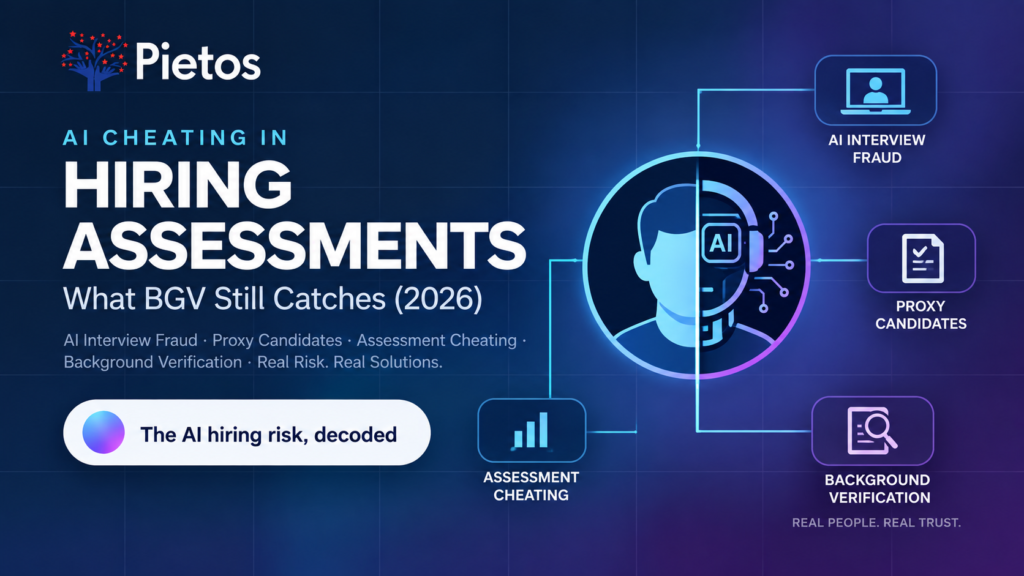
Every hiring process has a stage everyone assumes is safe. In India, that stage used to be the technical interview. It no longer is.
AI cheating hiring assessments is not a future risk HR teams should plan around. It is a present one, and it moved faster than most hiring stacks did. A candidate no longer needs a human stand-in to clear a coding round, a case study, or a live technical screen. A computer-use model can now read the question, work the problem, and feed back an answer in real time, while the candidate simply repeats it. The round recruiters built to save time has quietly become the round that needs the most scrutiny.
This guide breaks down how AI cheating in hiring assessments actually works today. It covers why OpenAI’s GPT-6 Astra changed the risk calculation for Indian employers specifically. Most importantly, it shows which parts of a structured background verification process still catch the fraud, even when the interview itself does not.
No HR or background verification brand in India has published a dedicated breakdown of this problem yet. This is that breakdown.
Talk to Pietos about auditing your interview-to-onboarding gap. A 20-minute call is usually enough to show exactly where an AI-assisted candidate could slip through your current process today.
How AI Cheating Spread So Fast Through Indian Hiring
Understanding why this happened so quickly helps explain why the usual defenses lag behind it. Three shifts converged at once, and none of them were unique to India, but their combination hit Indian hiring especially hard.
Remote and hybrid interviewing became permanent, not temporary. Video interviews became the default, not the exception. Along with that shift, the physical proximity that once made cheating obvious disappeared — a stranger walking into an exam hall, a second person visible in frame. A candidate sitting alone in their own room, on their own device, now controls the entire environment an interviewer sees.
At the same time, consumer AI tools crossed a usability threshold. Early chatbots required a candidate to actively copy questions, wait for an answer, and paste it back — clumsy enough that a sharp interviewer often noticed the lag. Newer, computer-use-capable tools remove almost all of that friction, watching the screen and responding as the conversation happens.
Finally, Indian hiring volume kept climbing faster than screening capacity. IT services firms, GCCs, and fast-scaling startups are all hiring at a pace that leaves recruiters running structured, repeatable interview formats with limited time to probe unusual answers. Repeatable formats are efficient. They are also exactly what a consistent, well-prompted AI model handles best.
None of these three shifts is reversible on its own. Companies are not going back to in-person-only interviews, and banning AI tools outright has no enforcement mechanism. That is precisely why the response has to move downstream, to the verification stage, rather than relying only on catching fraud at the moment it happens.
What AI Cheating in Hiring Assessments Actually Looks Like Today
AI cheating hiring assessments takes several distinct forms. They rarely look like what HR teams picture when they hear “AI cheating.” Nobody is smuggling a phone into an exam hall anymore. The fraud now runs quietly, in the background, on the same screen the candidate is being interviewed through.
Live Technical and Coding Rounds
A candidate opens a second window, or runs an AI agent locally, while a recruiter asks questions on video. The model reads the shared screen, drafts a working answer, and the candidate reads it back or retypes it with a short delay. Because the delay looks like normal thinking time, interviewers rarely notice.
Take-Home Assignments and Case Studies
These are the easiest to fake and the hardest to catch. A candidate can hand an entire assignment brief to an AI model, and receive a polished, coherent response within minutes. Unlike a rushed human answer, an AI-generated one carries no fatigue, no inconsistency, and no obvious shortcuts. It reads like the work of someone who had all the time in the world, because in a sense, they did.
Psychometric and Aptitude Testing
Structured, multiple-choice-style assessments are increasingly vulnerable too. A second device, positioned just out of camera view, can feed a candidate answers for logical reasoning, verbal ability, or even domain-specific aptitude tests. Meanwhile, proctoring software watches only for eye movement and browser tab switches.
Video Interviews With Real-Time Prompting
This is the newest and most concerning variant. Software overlays a transcript of the interviewer’s question directly onto the candidate’s screen, along with a suggested answer, generated in real time. The candidate never leaves the call. Nothing about the video feed looks unusual. The only signal is a slightly flat, overly structured way of speaking — a pattern many interviewers dismiss as nerves.
None of these tactics require deep technical skill from the candidate. Several already run as paid services on Telegram channels in India’s largest hiring hubs, the same networks that, until recently, mostly sold human proxy interviewers. Pietos’ earlier research into proxy candidate detection found that impersonation already operates as an organized, priced underground economy in Indian tech hiring. AI-assisted cheating did not replace that economy. It layered on top of it, and made the fraud both cheaper and harder to spot.
Why GPT-6 Astra Changes the Economics of Assessment Fraud
Every past wave of AI-assisted cheating had a ceiling. Chatbots could draft an answer. But a candidate still had to copy, paste, and manually adapt it under time pressure. That friction limited how far the fraud could scale.
What Astra Actually Does Differently
GPT-6 Astra removes much of that friction. Astra is OpenAI’s computer-use model. It is built to operate a browser, fill out forms, and complete multi-step tasks with far less human input than earlier models needed. On the OSWorld 2.0 benchmark, independent testing showed Astra completing computer-use tasks faster and more accurately than its predecessor. Outside coverage has already documented it being used for real-world tasks like job searching and form completion. That is the same capability set a hiring assessment measures: reading a prompt, reasoning through it, and producing a structured, correct output, unattended.
As covered in Pietos’ guide to GPT-6 Astra hiring fraud in India, the shift is not that AI can now write a good answer. Earlier tools already did that reasonably well. The real shift is delegation. A candidate can now hand the entire assessment to an agent running quietly in the background. The effort is minimal, and the seams are hard to spot. What once required a coached human stand-in now requires a subscription and a second monitor.
Why This Hits India Hardest
This matters more in India than in most markets, for one structural reason. Indian tech hiring runs at a volume and a pace that leaves little room for manual scrutiny of every round. Large delivery centers and GCCs interview hundreds of candidates a month. Recruiters are measured on time-to-fill, not on how many AI-assisted answers they catch. High volume, tight timelines, and a tool that removes almost all the effort from cheating: that combination is exactly where AI cheating hiring assessments spreads fastest.
See how Pietos structures a verification layer that assumes the interview stage may already be compromised — talk to our team about a sample audit.
Three Categories of Indian Employers Carrying the Sharpest Risk
The exposure from AI-assisted assessment fraud is not spread evenly. Three categories of Indian employers face it first, and face it hardest.
IT Services and GCCs
Technical screening rounds are the backbone of IT and Global Capability Center hiring in India. These firms run structured, repeatable interview processes at massive scale, often with junior recruiters conducting the first technical pass. That repeatability is exactly what makes the process easy to game consistently, because the same question banks and formats get reused across thousands of candidates.
BFSI and Fintech
Financial services hiring often includes technical or analytical assessments. Many of these roles have direct access to money movement, customer data, or trading systems. A candidate who fakes their way into one of these roles is not just a bad hire. They are a compliance and fraud exposure the moment they start work.
Campus and Early-Career Hiring
Fresher hiring in India already runs on high-volume, standardized aptitude and coding tests. These candidates also grew up using AI tools fluently. And they rarely have an established employment history a recruiter can cross-check informally. The result: a wide funnel with limited natural friction against AI-assisted answers.
A Realistic Scenario: How This Plays Out
Consider a mid-sized GCC in Pune, hiring for a backend developer role. A candidate applies with a resume that lists four years of experience across two companies, both plausible, both checking out on a quick LinkedIn search.
The technical round goes well. The candidate walks through a system-design problem cleanly, answers a tricky edge case in a coding exercise without hesitation, and communicates clearly throughout. The recruiter notes “strong hire” and moves the profile forward. Nothing about the call looked unusual, because nothing was designed to look unusual. A second monitor, positioned just outside the webcam’s frame, fed the candidate a working solution in real time.
Here is where the two defense layers diverge sharply. If the company stops at the interview, the candidate receives an offer. If the company runs structured verification in parallel, a different picture emerges. UAN-based EPFO verification shows the candidate’s actual tenure at their second listed employer was eleven months, not the two years claimed. A reference call, placed independently rather than through a number the candidate supplied, reveals the candidate’s actual title was junior, not the mid-level role on the resume.
Neither of those two facts had anything to do with the interview. The candidate may genuinely be technically capable, whether AI-assisted or not — that was never really the question. The question a verification layer answers is whether the rest of what the candidate claimed is true. In this scenario, it was not, and the gap only surfaces at the verification stage, days after the technical round already looked clean.
Where Assessment-Stage Defenses Run Out of Road
Most Indian employers already run some form of interview or assessment security: browser lockdown software, webcam proctoring, plagiarism checks on written answers, or tab-switch monitoring. These tools genuinely help. They also have a hard ceiling, and that ceiling is exactly where AI cheating hiring assessments now operates.
Proctoring software watches for behavior that looks like cheating: switching tabs, looking away from the camera, or opening a second application. A candidate reading a discreetly-placed second screen, or listening through an earpiece, can defeat every one of those signals without triggering a single flag. The software is watching the room. The fraud is happening in the candidate’s head, fed by a model they never had to visibly interact with.
Plagiarism detection catches copied text. It does not catch original, AI-generated text, because there is nothing to match it against. An Astra-drafted answer to a novel case study is unique every time, which means similarity-checking tools have nothing to flag.
This is not a criticism of assessment-stage tools. They remain necessary. But treating them as sufficient is the mistake. As Pietos has argued elsewhere, the AI interview round that once acted as an efficient first filter has quietly become the stage most vulnerable to an AI-native candidate. That means the round that follows it now has to do work the interview no longer reliably does.
Signals Recruiters Can Still Watch For
Assessment-stage tools have a ceiling, but that does not mean interviewers are powerless in the room. A few behavioral patterns remain useful early signals, even though none of them are conclusive on their own.
- Unnaturally consistent pacing. A candidate who answers every question, from the simplest to the hardest, at roughly the same speed and confidence level is worth a second look. Genuine expertise usually shows some variation — faster on familiar ground, slower and more exploratory on an unfamiliar edge case.
- Answers that avoid follow-up depth. AI-generated answers tend to be complete on the first pass but thin under follow-up. Ask the candidate why they chose one approach over an alternative. Or ask them to walk through a recent mistake. Either question often exposes the gap a scripted or AI-fed first answer hides.
- Eye movement toward a fixed off-screen point. This is a weaker signal than it once was, since experienced candidates know to vary where they look. Still, a consistent glance toward the same spot, timed just before each answer, is worth noting alongside other signals.
- Vocabulary that outpaces stated experience. A candidate two years into their career using precise, textbook-level terminology throughout, with no informal or approximate language at all, sometimes reflects AI-polished phrasing more than lived experience.
None of these signals should trigger an automatic rejection on their own. They are prompts to slow down and ask a sharper follow-up question, not proof of AI cheating in hiring assessments. Treat them as an invitation to dig deeper in the room, and let the verification stage confirm or clear what the interview alone cannot settle.
The Cost of Inaction
Treating this as a low-priority risk is an easy default, because a bad hire rarely announces itself immediately. However, the cost of an AI-assisted bad hire tends to surface exactly when it is most expensive to unwind.
A developer who cleared a technical round with AI assistance, but lacks the underlying skill the role actually requires, typically does not fail on day one. They fail slowly, over the first ninety days, as unsupervised tasks replace guided ones. By then, the company has already absorbed onboarding costs, assigned a mentor’s time, and delayed other hiring decisions that depended on the role being filled.
For BFSI and fintech employers, the exposure runs deeper. A candidate who inflated their experience to clear a technical screen is not just an underperformer once they gain access to systems handling customer funds or sensitive data. They are a compliance finding waiting to happen. Regulators do not treat “our interview process missed it” as a mitigating factor.
There is also a quieter, cumulative cost. Every AI-assisted candidate who succeeds without detection sends an informal signal: this company’s process can be gamed. In tightly networked hiring hubs like Bengaluru, Pune, and Gurugram, that signal travels fast, through the same referral and coaching networks already selling proxy-interview services. Weak detection does not just risk one bad hire. It invites more attempts.
For companies preparing for funding rounds, IPOs, or large enterprise contracts, a documented hiring-integrity process matters too. It is increasingly part of the trust package investors and partners expect to see. Treating AI cheating hiring assessments as someone else’s problem works fine, right up until it shows up in due diligence.
What Background Verification Can Still Catch
This is the part most HR teams miss: AI can fake an answer in real time. It cannot fake a verified employment history, a cross-checked reference, or a government database record. Structured background verification remains effective against AI-assisted hiring fraud precisely because it checks facts an AI model cannot generate — it can only verify what already happened.
UAN and EPFO Cross-Referencing
A candidate can use AI to produce a flawless, internally consistent resume, cover letter, and LinkedIn profile in a single sitting. What no model can do is alter historical Employees’ Provident Fund contribution records. Running a candidate’s Universal Account Number against EPFO data surfaces the truth fast. It shows whether claimed tenure, title, and even salary band match what previous employers actually reported. A candidate may have cleared a technical round with AI help. But if they never held the seniority their resume claims, this check surfaces the gap before onboarding.
Structured, Recorded Reference Checks
AI can help a candidate rehearse for a reference call. It cannot make a former manager describe specific projects they never actually worked on together. Pietos’ guide to why most Indian reference checks are done wrong flags one pattern worth repeating here. References who answer in a smooth, rehearsed sequence, hitting every expected point without pause, are giving off a coaching signal in their own right. A structured, recorded reference process closes that gap. Run it against independently-sourced contact details, not numbers the candidate supplies.
Liveness Detection and Biometric Cross-Referencing
AI-assisted cheating can also extend into video impersonation. A proxy candidate might wear a deepfake overlay, or simply read Astra-generated answers off a hidden screen. Liveness detection at the verification stage cross-references the person in front of the camera against government-issued ID data. This catches the identity mismatch a purely conversational interview cannot.
Consent and Document Audit Trails
Every compliant background check in India starts with candidate consent under the DPDP Act, 2023. That process, done properly, creates a documented, timestamped trail: who consented, when, and to what. A computer-use model completing a multi-field form may look identical to a human doing it manually. But the surrounding audit trail tells a different story. Device fingerprints, submission timing patterns, and document upload metadata give a trained verification team something concrete to review when a case looks unusual.
Pattern Recognition Across the Employment History
A single fabricated claim is hard to catch. A pattern of them is not. Structured BGV compares a candidate’s resume claims against multiple independent data points at once, rather than trusting any single source: education records, past employer HR systems, EPFO data, and reference feedback. Pietos has previously documented how discrepancies compound. Small gaps often look explainable on their own. Together, though, they reveal a candidate who never actually held the role, tenure, or credentials an AI-polished resume made look airtight.
Document and Metadata Forensics
AI tools make it trivial to generate a convincing experience letter, salary slip, or offer letter template. What they cannot easily fake is the metadata trail underneath a genuine document. That trail includes consistent formatting across a candidate’s full document set, letterhead details that match records on file, and timestamps that align with the claimed employment dates. A trained verification team, cross-referencing documents against known-good templates from the same issuing companies, catches inconsistencies an AI-generated document rarely gets exactly right.
Cross-Platform Consistency Checks
An AI model can make a resume, a LinkedIn profile, and a cover letter internally consistent with each other in a single session. Matching those claims against data the candidate does not control is much harder — GST or professional registration records for freelance claims, institutional verification for degrees, or court and police records for criminal history checks. Structured BGV checks the claim against the source, not against the candidate’s other documents. That is precisely the check a well-written, self-consistent application cannot pass on writing quality alone.
Building a Combined Assessment-Plus-BGV Defense
Neither assessment-stage tools nor background verification catch everything alone. Used together, they close most of the gap AI cheating hiring assessments has opened.
| Defense Layer | Catches | Misses |
|---|---|---|
| Proctoring and browser lockdown | Visible behavior: tab switches, unauthorized apps, external devices in frame | Off-screen prompting, earpiece-fed answers, discreet second devices |
| Plagiarism and similarity checks | Copied or lightly reworded text | Original AI-generated answers with no source to match against |
| Structured technical interviews | Basic knowledge gaps, poor communication | Real-time AI-assisted answers delivered fluently |
| Background verification (UAN/EPFO) | Fabricated tenure, title inflation, fake employers | Nothing about the interview performance itself |
| Structured reference checks | Coached or rehearsed references, unverifiable work history | Candidates with a genuinely clean, if AI-assisted, interview |
| Liveness and biometric checks | Identity mismatch, proxy candidates, deepfake overlays | Fraud where the candidate’s own identity is genuine |
Two Layers, Two Different Jobs
The practical takeaway: assessment tools defend the interview. Background verification defends the hire. A company relying on only one layer is trusting a single point of failure. That failure sits exactly where the threat is aimed.
A workable framework looks like this. First, treat the technical round as a useful signal, not a final gate. Pair it with a structured, verified employment-history check before an offer goes out, not after. Second, move reference checks earlier in the process. Run them in parallel with the final interview round, so results land before the offer, not after the candidate has already resigned from their previous job. Third, run UAN-based verification as standard for any role above entry level. Title and tenure inflation is the discrepancy AI-polished resumes most consistently hide. Finally, document every consent and verification step. A defensible audit trail matters as much as the check itself, if a dispute or compliance review ever follows.
A Practical 30-60-90 Day Rollout
Most HR teams do not need to overhaul their entire hiring process at once. A phased rollout keeps the change manageable while closing the highest-risk gaps first.
Days 1–30: Audit the current process to identify where the interview and verification stages currently sit relative to the offer. Most companies find verification happens entirely after an offer is extended, which is the single easiest change to fix. Start UAN-based checks for any role with financial, data, or client-facing access.
Days 31–60: Move structured reference checks earlier, running them in parallel with final interview rounds rather than after. Train recruiters and hiring managers on the specific signals covered in this guide — rehearsed reference answers, unusually fluent real-time technical responses, and document formatting inconsistencies.
Days 61–90: Extend the updated process across all hiring, not just high-risk roles. Build a simple internal dashboard tracking how often verification catches a discrepancy the interview stage missed. That number becomes the business case for keeping the process in place, long after the initial rollout effort fades from memory.
See how Pietos’ verification framework holds up against an AI-assisted candidate — request a sample BGV report built around exactly this scenario.
Buyer Objections, Answered
Objections About Process and Timing
“Our proctoring software already flags AI use.” Most proctoring tools flag visible behavior, not invisible prompting. A candidate can read answers off a second screen, outside the camera’s frame. A hidden earpiece works too. Both defeat browser-lockdown and tab-monitoring tools without triggering a single alert.
“This will slow down our hiring process.” Run a structured verification layer in parallel with the final interview rounds, not after an offer. It typically adds a few days at most. That delay is smaller than the cost of discovering a fabricated employment history six months into a role.
“Can’t we just ban AI tools during interviews?” A policy without enforcement is a suggestion. Banning AI use in a live interview is reasonable. But it does nothing to catch a candidate who ignores the policy. That candidate is exactly who a verification layer is built to catch.
Objections About Cost and Coverage
“Isn’t this just a problem for junior technical hires?” No. BFSI roles with money-movement access carry real exposure too. So do senior hires, whose resumes often get less scrutiny than junior ones. AI-assisted fraud scales across seniority levels, because the model does the same work regardless of who is prompting it.
“We already use a background verification vendor. Isn’t this covered?” Not necessarily. Many standard BGV packages confirm identity and basic employment dates. They stop short of UAN-based tenure cross-checks or structured, recorded reference calls. Ask your current vendor directly: would their process catch a resume that is internally consistent, but does not match EPFO or independent reference data?
“How much does adding this layer actually cost, compared to the risk?” A per-candidate verification check costs a fraction of what a single bad hire costs. Onboarding time, lost productivity, and rehiring effort add up fast. For roles with financial or data access, the comparison is not close. The real cost is not the verification fee. It is the hiring manager’s time spent unwinding a hire that should never have cleared the process.
Key Takeaways
- AI cheating hiring assessments has moved from a rare, high-effort exploit to a low-effort, subscription-priced tactic available to any candidate.
- GPT-6 Astra’s computer-use capability specifically targets the same skills a technical interview measures: reading, reasoning, and producing structured answers, unattended.
- IT services, GCCs, BFSI, and campus hiring pipelines in India carry the sharpest exposure, because of volume, standardization, and access risk.
- Proctoring and plagiarism tools remain useful but were never built to catch AI-assisted, off-screen prompting.
- Structured background verification — UAN/EPFO cross-checks, recorded reference calls, liveness detection, and documented consent trails — verifies facts an AI model cannot fabricate.
- The strongest defense combines both layers: assessment-stage tools to protect the interview, and verification-stage checks to protect the hire.
A Quick Checklist Before Your Next Offer Goes Out
Use this as a fast self-check against your current process, rather than a full audit.
- Does verification currently run before or after the offer letter goes out? If it runs after, that sequencing alone is the biggest gap to close.
- Are reference contacts sourced independently, or only from numbers the candidate supplies?
- Does your process include UAN-based EPFO cross-checking for tenure and title claims, or only basic identity and address verification?
- Do interviewers have a short, agreed list of follow-up questions designed to test depth, not just correctness?
- Is candidate consent for verification documented with a timestamped audit trail, or handled informally?
A “no” on more than one of these questions is a warning sign. It suggests AI cheating hiring assessments could currently pass through your pipeline undetected, no matter how strong your interview process looks on paper.
Frequently Asked Questions
Yes, in many cases. Computer-use models like GPT-6 Astra can read a shared screen, work through a coding or case-study problem, and generate a fluent, structured answer in real time, while the candidate reads or paraphrases it back with a short, natural-looking delay.
Only partially. Proctoring tools flag visible behavior, such as switching browser tabs or looking away from the camera. They do not catch a candidate using a discreetly placed second device or an earpiece, which leaves no visible signal to detect.
Background verification does not re-check the interview. It checks whether the candidate’s employment history, tenure, and references hold up against independent data, including EPFO records and structured reference calls. A candidate who used AI to pass a technical round, but inflated their resume, is still caught at this stage.
No, though remote interviews carry the highest exposure. In-person technical rounds are not immune either. A candidate can still receive AI-generated prompts through a hidden earpiece or smartwatch during an in-person assessment.
No. BFSI, fintech, and any role with structured assessments or standardized aptitude testing carries similar exposure. The risk is highest where hiring runs at high volume, with limited time for manual review per candidate.
Move structured reference checks and UAN-based verification earlier in the process. Run them in parallel with final interview rounds, not after an offer is extended. This ensures verification results are ready before a hiring decision is finalized.
The DPDP Act governs how candidate data is collected and processed during verification, not the cheating itself. But a properly documented consent trail, the kind structured BGV maintains, becomes useful evidence if a hiring dispute or fraud case needs review later.
Yes, provided the rejection follows a documented, consistently applied policy rather than a one-off decision. Most Indian employers disclose assessment conditions upfront. They then fold any discrepancy findings into the standard offer-withdrawal process already used for other background-check failures.
Most companies can add UAN-based checks and structured reference calls within one hiring cycle. These run alongside existing interview stages, rather than replacing them. The bigger change is usually sequencing: moving verification earlier, so results land before an offer, not after.
The Bottom Line
AI can pass your technical round. Background verification is the step it can’t fake — see how Pietos’ verification framework holds up in the Astra era. Talk to our team about auditing your current hiring pipeline before your next offer goes out.