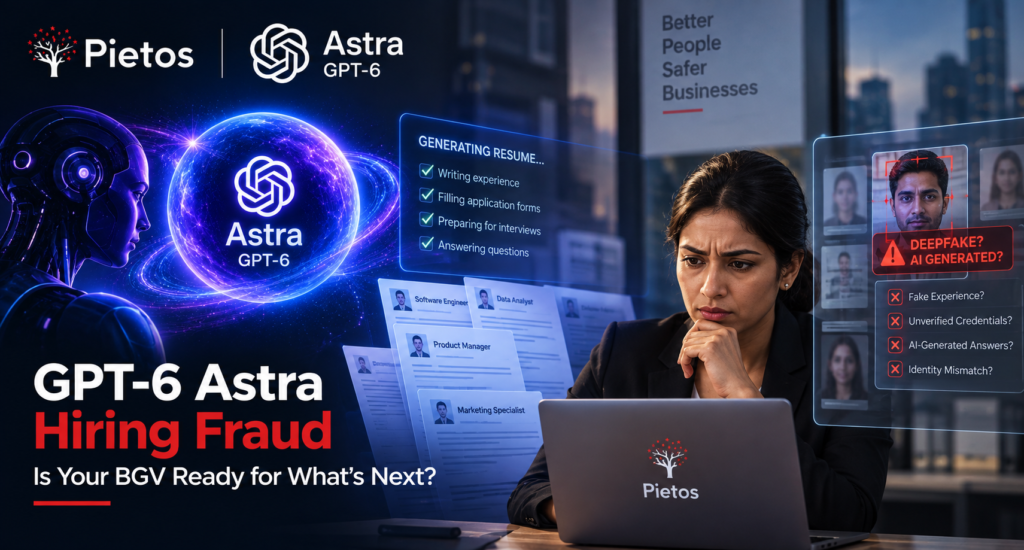
On September 3, 2026, OpenAI released GPT-6 Astra and called it, without much hedging, the start of the “AGI era.” The company’s own materials describe it as the world’s best computer-use model — a system that opens browsers, fills out forms, writes documents, and completes multi-step workflows the way a person would, without anyone clicking through each step. No background verification brand in India has published a single word on what that means for hiring. That silence is the opportunity — and the risk.
For HR and talent acquisition leaders, the headline is not “a smarter chatbot shipped.” It is that the tool your candidates now have access to can independently produce a polished resume, complete a BGV consent form, and hold up through an AI-screened interview round — all without a human directing every step. GPT-6 Astra hiring fraud is not a hypothetical for next year. It is a gap in your pipeline this quarter.
This guide breaks down what Astra can do, how that capability turns into hiring fraud, what India’s largest hiring engines — IT services, BFSI, NBFCs, GCC setups — are exposed to, and the verification checklist that actually catches what a computer-use model produces.
Wondering whether your current BGV vendor can catch AI-generated documents? Talk to Pietos about a verification audit before your next hiring cycle.
What GPT-6 Astra Actually Changed on September 3, 2026
Every previous generation of AI tools required a human to be the connective tissue. A candidate might use ChatGPT to draft a resume, then manually copy it into a job portal, then manually fill out a BGV consent form. Each of those steps was a chance for a recruiter to notice something off — a formatting inconsistency, a rushed answer, a form filled out too quickly to be genuine.
GPT-6 Astra removes that connective tissue. OpenAI positions it as a system that navigates software the way a person does: across browsers, spreadsheets, websites, and desktop applications, producing finished documents and carrying out multistep workflows rather than just describing how to do them. Independent benchmarking from AI research outlets confirms the model represents a sharp jump in agentic task completion compared with its predecessor, GPT-5.6 Sol — not just in single-turn writing quality, but in the model’s ability to complete long, unsupervised sequences of computer actions.
Translate that into a hiring context and the picture is stark. A candidate no longer needs to be a skilled prompt engineer or a patient copy-paster. They can hand a computer-use model an instruction — “apply for this role, tailor my resume, fill out every form” — and walk away. The system takes care of everything, document by document and form by form, without the hesitation cues a trained recruiter would normally pick up on.
From Chatbot Assist to Autonomous Candidate: How Astra Creates Hiring Fraud
This is the section every HR leader skims first, so it is worth being direct. GPT-6 Astra hiring fraud shows up in three specific places in your pipeline, and each one used to have a natural human checkpoint that AI has now quietly removed.
Fake resumes that pass every keyword filter
Resume fraud is not new — Pietos has covered how candidates fabricate employment history for years. What changes with Astra is production speed and consistency. Earlier AI writing tools produced resumes with a detectable rhythm: generic phrasing, repeated structures, occasional factual slips between the resume and the cover letter. A computer-use model can now cross-reference multiple documents in the same session, keeping dates, designations, and salary figures internally consistent across a resume, a LinkedIn profile update, and a cover letter simultaneously. The fabrication is no longer sloppy. It is coherent.
BGV consent forms filled out without a human in the loop
Every compliant background check in India starts with candidate consent under the DPDP Act, 2023. That consent step has always assumed a human is reading and responding to it. A computer-use model can complete a multi-field consent form — checkboxes, digital signatures, uploaded ID scans — in one autonomous pass. The form looks procedurally complete. Whether a real, informed person actually reviewed and agreed to it is a separate question that most portals have no way to answer.
Fabricated employment history that reads like the real thing
The hardest fraud to catch has always been the plausible lie, not the obvious one. Astra’s stronger reasoning and its ability to browse and reference real company information means fabricated employment history can now borrow real, verifiable details — an actual manager’s name found on LinkedIn, an actual project name pulled from a company’s public case studies — and weave them into a history that never happened. A recruiter cross-checking a candidate’s story against public information will find that the public information matches. It was built to.
See how AI-powered document forensics catches fabrication that looks internally consistent.
Why AI Interview Rounds Are Now the Weakest Link
Many enterprises added AI-screened interview rounds in the past two years specifically to scale hiring without adding recruiter headcount. That decision now needs a second look. An AI interview round tests whether a candidate can produce good answers under a structured prompt — exactly the task a frontier model like Astra is best at.
Pietos’ earlier research into proxy candidate detection found that impersonation services already operate as a structured underground economy in India’s major tech hubs, and that AI overlays on top of human stand-ins are becoming technically easier, even if still uncommon. Astra changes the economics of that fraud. Instead of paying a proxy interviewer, a candidate can run a computer-use model in the background, feeding it live questions and using its output — voice-cloned or simply read off-screen — as their own.
An AI interview round that once acted as an efficient first filter has quietly become the stage most vulnerable to an AI-native candidate. The round meant to save recruiter time is now the one that most needs a human, verified checkpoint after it.
What India’s IT and GCC Hiring Engines Are Exposed To
The exposure is not evenly spread. Three categories of Indian employers face the sharpest immediate risk.
IT services majors (TCS, Infosys, Wipro, HCL, Cognizant, and comparable firms). High-volume, keyword-driven hiring at scale was already vulnerable to templated resume fraud. Astra raises the ceiling on how convincing that template can be, at a moment when these firms are also running some of the largest AI-screened interview pipelines in the country.
GCC (Global Capability Centre) setups. Pietos’ work on GCC overseas staffing fraud already documented how fraud networks exploit the complexity of cross-border hiring — subagent chains, cloned job postings, layered verification gaps. A computer-use model adds a new layer: candidates who can autonomously produce consistent documentation across multiple jurisdictions in a single session.
BFSI and NBFC hiring. Financial-sector roles carry the highest downstream cost of a bad hire — fiduciary access, regulatory exposure, and reputational risk all compound quickly. These employers already run some of the most document-heavy BGV processes in India; they are also the ones an AI-native fraud attempt will target hardest, because the payoff for getting through is highest.
Key takeaway: the exposure is highest wherever hiring volume meets document-heavy screening — which describes most of India’s largest employers, not a fringe case.
The New BGV Checklist for the Astra Era
The checklist that worked against manual resume padding does not fully hold against autonomous, computer-use-generated fraud. Here is what HR and compliance teams need to add.
- Verify past the document, into the source. A resume claim is only as good as a direct call to the employer or university that issued it. Cross-document consistency checks matter, but they must be paired with source verification — not replaced by it.
- Treat every AI-screened interview as a pre-screen, not a decision point. Route every candidate who clears an AI interview round into a human-verified, live conversation before an offer goes out.
- Add liveness and identity anchoring at every stage, not just onboarding. A biometric check at joining can catch interview-stage impersonation only when the interview was recorded and the candidate’s identity can be matched against that recording.
- Audit your consent trail for autonomous completion patterns. Form-fill speed, IP and device consistency, and session behaviour can help identify whether a form was completed by a person or an automated agent.
- Re-verify UAN and EPFO history independently of anything the candidate submits. Autonomous document generation cannot fabricate a government database record.
- Build a documented, auditable fraud-catch trail. Under the DPDP Act, HR teams carry direct liability for how candidate data is verified and handled — a defensible process matters as much as a strict one.
How Pietos’ Multi-Layer Verification Catches What Astra Creates
None of the checklist above requires abandoning AI. It requires using verification tools that are built to catch AI-native fraud specifically, rather than legacy checks retrofitted for it.
Pietos’ AI-powered document forensics layer already analyses font structure, file metadata, and pixel-level consistency across every document a candidate submits — catching a large share of manipulated identity and employment paperwork before it reaches a hiring manager’s inbox. A cross-document consistency audit adds a second layer, mapping names, dates, and employment timelines across a candidate’s full document set, since even a highly capable AI-generated document set tends to break down under a full cross-check rather than a single-document review.
That forensic layer sits alongside direct-source verification — actual calls to employers and universities, not just database queries — and UAN-based employment history tracking through EPFO records, which no document-generation tool can fabricate. Combined with liveness detection and identity anchoring at the interview and onboarding stages, this is the layered approach Pietos’ guide to detecting fake resumes has long recommended — now applied specifically against an AI-native threat.
If your current BGV vendor cannot describe how their process defeats an autonomous, computer-use-generated application, that is the gap to close first. Get in touch with Pietos to run a verification audit against the Astra-era checklist above.
A 90-Day Plan for HR and TA Leaders
Days 1–30: Audit and prioritise. Map your current hiring pipeline against the three fraud points above — resume submission, consent capture, and AI interview rounds. Identify which stage has the weakest human checkpoint today.
Days 31–60: Pilot the fix. Run a batch of new hires through an upgraded verification layer that includes document forensics and post-AI-interview human verification. Compare the fraud catch rate against your historical baseline.
Days 61–90: Roll out and train. Extend the upgraded process across all hiring, and brief recruiters on what an AI-native application looks like — internally consistent but source-unverifiable — so the red flag pattern becomes second nature, not a one-off training slide.
Related Resources
| Anchor text | Destination | Why it’s linked here |
|---|---|---|
| AI-powered document forensics | pietos.com/document-forensics-ai-hiring-fraud | Direct technical answer to how Astra-generated documents get caught |
| How to detect fake resumes | pietos.com/detect-fake-resumes-hr-guide | Foundational resume-fraud framework this post builds on |
| Proxy candidate detection in India | pietos.com/proxy-candidate-detection-india | Covers the AI-interview impersonation risk in depth |
| GCC overseas staffing fraud | pietos.com/gcc-overseas-staffing-fraud-india | Cross-border hiring exposure this post references |
| DigiLocker background verification: 2026 HR guide | pietos.com/digilocker-background-verification-2026-hr-guide | Covers DPDP consent mechanics referenced in the checklist |
Frequently Asked Questions
It is current. GPT-6 Astra rolled out from September 3, 2026, and is already available through Chat GPT Plus, Pro, Business, and Enterprise tiers as well as the Open AI API. Any candidate with one of those accounts already has access to the capabilities this post describes.
Yes. AI-generated documents may look visually flawless, but they still tend to fail semantic and cross-document consistency checks — details that don’t line up across a candidate’s full document set even when each document looks clean on its own.
No. It stays useful as an early-stage filter for scale. The fix is adding a mandatory human-verified round after it, before any offer goes out — treating the AI round as a pre-screen rather than a hiring decision.
Independent source verification. A direct call to a claimed employer or university cannot be fabricated by any document-generation tool, which makes it the most reliable check to prioritise first.
External Sources
- GPT-6 Astra: A new generation of intelligence — OpenAI — official model announcement and capability documentation
- ‘Welcome to the AGI era’: OpenAI launches GPT-6 Astra — VentureBeat — independent reporting on the computer-use positioning
- GPT-6 Astra Explained — Zero to AI — accessible breakdown of Astra’s multimodal capabilities
- GPT Astra vs Google Project Astra: Not the Same Thing — CoderSera — clarifies the two “Astra” products for readers who conflate them
- NASSCOM — India’s IT industry body, for sector-level hiring and AI-adoption data
Think a candidate’s employment history doesn’t add up?
Go beyond surface-level checks. Explore how document forensics can uncover altered, fabricated, or inconsistent employment records.