Non-clinical staff BGV India is the hospital hiring gap that few teams audit. Most hospitals check a doctor’s council number. However, few check the ward boy who pushes the drug trolley. Yet non-clinical staff touch patient data, cash, controlled drugs and equipment on every shift.
This guide shows which roles carry the most risk. It also gives you a role-wise checklist, a clinical versus non-clinical comparison and a sample BGV brief. You can use all of it this week.
Not sure where your hospital’s gap sits? Pietos can map your non-clinical roles in one short call. Explore our employee background verification services in India.
Key takeaways
- Non-clinical roles have no council register, so hospitals often skip deep checks.
- Ward staff, billing, pharmacy, security, housekeeping and EPR admins carry the highest risk.
- The minimum standard is four checks: identity, criminal, address and reference.
- Contractor staff need the same checks, with proof you can audit.
- A tiered policy keeps hiring fast and risk low.
Why Non-Clinical Staff BGV India Is a Hospital Blind Spot
Hospitals in India run on two workforces. The clinical team holds degrees, council registrations and licences. The non-clinical team holds the keys.
Clinical hiring follows a clear path. Councils publish registers. Likewise, universities confirm degrees. As a result, most hospital HR teams know how to verify a doctor or a nurse.
In contrast, non-clinical hiring works differently. Recruiters often source ward boys, housekeeping staff and billing assistants through walk-ins, agencies or contractors. Because these roles have no council register, HR teams often skip deep checks to save time.
That shortcut creates risk. In fact, non-clinical staff work in the same wards, pharmacies and records rooms as clinicians. However, they face far less scrutiny. For instance, one weak hire can leak patient data, steal drugs or inflate a bill.
Pietos has already covered the clinical side in its healthcare hiring BGV India guide. This post extends that work to everyone else on your payroll, and on your contractors’ payrolls.
Which Non-Clinical Roles Carry the Highest Risk
Still, not every non-clinical role carries equal risk. Instead, risk depends on what the person touches. Next, the table below maps six common roles to their exposure.
| Role | What they touch | Main risk |
|---|---|---|
| Ward boys and attendants | Patients, trolleys, drug carts, patient belongings | Theft, patient harm, drug diversion |
| Billing and front-desk staff | Cash, insurance claims, patient identity records | Financial fraud, claim inflation |
| Pharmacy assistants | Schedule H and X drugs, stock registers | Drug theft, resale |
| Hospital security | Entry points, CCTV, visitor logs, mortuary | Access abuse, collusion |
| Cleaning and housekeeping contractors | Wards, ICUs, waste, records rooms | Theft, access without accountability |
| Admin and EPR staff | Patient records, billing, insurance data | Data theft, privacy breach |
Ward Boys, Attendants and Patient Escorts
First, ward boys have the most physical access. They move patients and equipment. Some also handle drug trolleys. Moreover, they see patients at their most vulnerable.
Consequently, a criminal and identity check matters more here than a degree check. Hospitals should also confirm real identity, because ward staff often join through contractors who cut corners.
Billing and Front-Desk Staff
Billing staff handle cash and insurance claims. They also see Aadhaar numbers, policy details and diagnoses. For example, a dishonest billing assistant can inflate a claim or pocket a cash payment.
Similarly, a front-desk employee can sell patient contact details to third parties. In addition, prior employment checks show whether a candidate left an earlier job over a financial dispute.
Pharmacy Assistants
Pharmacy assistants handle Schedule H and Schedule X drugs under the Drugs and Cosmetics Rules, 1945. The CDSCO publishes the regulatory framework for these drugs.
Because some of these drugs have street value, theft and resale are real risks. Additionally, an assistant with a substance abuse problem faces strong temptation. Instead of relying on one check, pair criminal checks with pre-employment drug testing for this role.
Hospital Security Guards
Security teams control entry, CCTV and visitor logs. In many hospitals, an outsourced agency supplies the guards. As a result, the hospital may never see the guard’s verification file.
Under PSARA, the agency must verify guard antecedents. Still, the hospital carries the reputational and legal exposure. Read Pietos’ guide to PSARA security guard verification to see what agencies must prove.
Cleaning and Housekeeping Contractors
Meanwhile, housekeeping staff enter every room, including ICUs and records rooms. Contractors also rotate workers often. Consequently, the person cleaning your ward today may appear on no list.
Therefore, insist on named, verified workers. Also require address verification services in India so that you can trace every worker on site.
Admin Staff Handling EPR Systems
First, admin and records staff access electronic patient records. Under the Digital Personal Data Protection Act, 2023, a hospital carries the legal duty to protect patient data. Therefore, an employee’s data leak becomes the hospital’s problem.
Before you issue system credentials, verify identity, past employers and criminal history.
Real-World Risk Patterns in Indian Hospitals
Hospitals rarely publicise internal fraud. As a result, verified case data stays thin. Even so, public reporting points to three recurring patterns. For this reason, treat the scenarios below as examples, not as named cases.
Pattern 1: Drug diversion. A pharmacy assistant removes small quantities of a Schedule H drug each week. Stock registers show minor “wastage”. Then, months later, an audit finds a large gap. Still, a criminal and past-employment check often shows an earlier red flag.
Pattern 2: Billing and claim fraud. A billing executive adds procedures that never happened. Initially, insurers pay. The hospital then faces a claim dispute and an audit. Employment history checks help here, because repeat offenders tend to move between hospitals.
Pattern 3: Data theft. An admin staffer copies patient lists and sells them to a lab or a marketing firm. Soon, patients complain about spam calls. However, the hospital cannot trace the source quickly. Therefore, identity and reference checks reduce the odds, and access logs help you trace the rest.
For national context, the National Crime Records Bureau publishes crime statistics. However, NCRB does not isolate hospital staff. Instead, use it for background, not for hospital-specific benchmarks.
The Cost of Inaction on Non-Clinical Staff BGV India
At first, skipping non-clinical checks feels cheap. In practice, one incident costs far more than a year of verification. To see why, consider six exposures.
- Patient safety. A person with a violent record can reach vulnerable patients.
- Financial loss. Drug theft and claim fraud drain margins quietly.
- Legal liability. Courts can hold employers responsible for negligent hiring.
- Data protection penalties. The DPDP Act allows penalties of up to ₹250 crore for failing to protect personal data.
- Accreditation risk. Assessors ask for evidence of verified staff files.
- Reputation damage. Patients and insurers lose trust fast after a public incident.
Meanwhile, the benefits of solving the problem are clear. First, you protect patients. Second, you cut leakage. Third, you pass audits with less stress. Moreover, you give your HR team a solid standard.
What NABH and Regulators Expect
NABH is the quality body for hospital accreditation in India. Visit NABH to read the current standards. Its human resource management expectations cover personnel records and credential verification. However, check the latest edition for exact wording on non-clinical roles.
In practice, assessors look for evidence, not intention. Therefore, a documented verification file for every role helps at audit time.
The Ministry of Health and Family Welfare sets national healthcare workforce policy. In addition, the Indian Nursing Council defines nursing roles and registration. Anyone outside those regulated registers falls under your non-clinical BGV policy. Draw that line in writing, and apply it consistently.
Non-Clinical Staff BGV India Checklist by Role
First, use this as your minimum standard. Every row includes four core checks: identity, criminal, address and reference. The last column adds role-specific checks.
| Role | Identity | Criminal | Address | Reference | Add-on check |
|---|---|---|---|---|---|
| Ward boy or attendant | Yes | Yes | Yes | Yes | Previous employer confirmation |
| Billing or front desk | Yes | Yes | Yes | Yes | Employment history |
| Pharmacy assistant | Yes | Yes | Yes | Yes | Drug test, qualification where claimed |
| Security guard | Yes | Yes | Yes | Yes | PSARA agency proof, training record |
| Housekeeping contractor staff | Yes | Yes | Yes | Yes | Contractor’s verification file |
| Admin or EPR staff | Yes | Yes | Yes | Yes | Employment and education, data-access agreement |
What Each Core Check Does
- Identity: Confirms the person is real and matches their Aadhaar, PAN or other government ID.
- Criminal: Searches court and police records. Pietos explains the method in its criminal verification services India page.
- Address: Confirms where the person lives, so you can trace them after an incident.
- Reference: Asks a past supervisor about conduct, attendance and honesty.
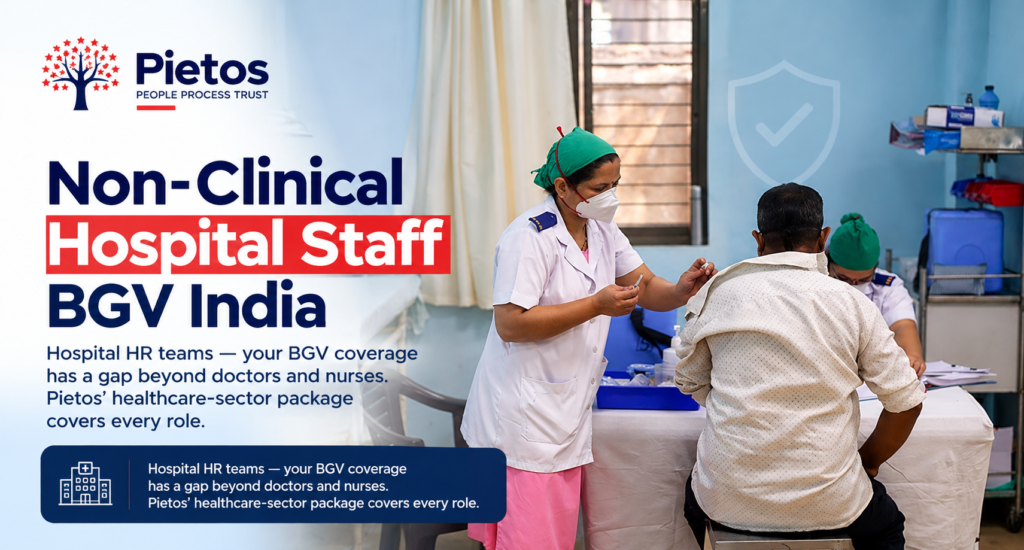
Hospital HR teams, your BGV coverage has a gap beyond doctors and nurses. Pietos’ healthcare-sector package covers every role. Email contact@pietos.com or call +91 11 49074103 for a role-by-role quote.
How Hospital HR Teams Structure BGV for Clinical vs Non-Clinical Roles
Strong hospitals do not run one BGV process for everyone. They run two tracks. For example, the clinical track verifies licences and degrees. In contrast, the non-clinical track verifies identity, conduct and whereabouts.
| Factor | Clinical roles | Non-clinical roles |
|---|---|---|
| Primary risk | Fake credentials, patient harm | Theft, fraud, data leaks, access abuse |
| Lead check | Council registration, degree | Criminal and identity |
| Public register | Yes (councils, universities) | No |
| Typical sourcing | Direct hiring, consultants | Walk-ins, agencies, contractors |
| Verification depth | Credentials, employment, criminal | Identity, criminal, address, reference |
| Refresh cycle | At licence renewal | Annually or at role change |
Three Patterns Hospital HR Teams Use
First, they tier roles by risk. Pharmacy and EPR roles get the deepest checks. Housekeeping gets the core four. As a result, spend follows risk.
Second, they verify in parallel. Identity and criminal checks start on day one. Address and reference checks run alongside. Consequently, turnaround stays short, even for high-volume hiring.
Third, they refresh checks. A guard who joined three years ago may have a new case today. Therefore, many hospitals re-verify high-risk roles every year. For a closer look at ongoing screening, see how criminal verification services India can support periodic re-checks.
Contractor and Outsourced Staff: Close the Liability Gap
Outsourcing does not outsource responsibility. Patients do not care who signs the guard’s salary. Instead, they care who let the wrong person into the ward.
In fact, this gap is the largest in most hospitals. Contractors supply housekeeping, security, ambulance drivers, canteen staff and sometimes billing support. However, the hospital rarely sees their verification files.
Four Contract Clauses That Work
- Verification warranty. The contractor confirms in writing that every worker has cleared identity, criminal, address and reference checks.
- Audit rights. The hospital can request any worker’s verification file at short notice.
- Named roster. The contractor shares a current list of workers on site. It updates the list on every change.
- Replacement rule. The contractor removes any worker who fails a check within a fixed number of days.
Verify the Verifier
Ask to see a sample file. Then confirm the check actually happened. For security staff, ask for proof of PSARA licensing and guard-level records. Pietos explains this distinction in its PSARA security guard verification guide.
Additionally, run a small spot check each quarter. Pick ten workers at random. Next, verify them independently. If results differ from the contractor’s file, report it at once.
Sample BGV Brief for Hospital Admin Staff
A clear brief saves days of back-and-forth with your BGV partner. For that reason, copy the template below. Then adjust it to your policy.
BGV brief: hospital admin and EPR staff
Hospital: [Name, city] Role: Medical records executive / billing executive / front-desk coordinator Risk tier: High (patient data and cash access) Candidate consent: Signed digital consent attached
Checks required
- Identity: Aadhaar and PAN match, photo match
- Criminal: court and police record search at current and permanent address jurisdictions
- Address: current and permanent, digital or field visit
- Employment: last two employers, designation, dates, reason for leaving
- Reference: one supervisor from the last employer
- Education: highest qualification
Turnaround: 5 working days. Flag any discrepancy within 24 hours.
Escalation: Report any criminal hit to HR head the same day.
Decision rule: Adverse findings go to the review committee. HR documents the outcome.
This template works because it ties each check to a risk. It also sets a decision rule before results arrive. Consequently, HR avoids random decisions under pressure.
Consent, Privacy and Fair Process
First, verification must stay lawful and fair. Therefore, always take written, informed consent before you start. Also, explain which checks you will run and why.
Moreover, the DPDP Act, 2023 expects you to collect only the data you need. Therefore, limit access to BGV reports. Next, store them securely. Finally, delete them when the purpose ends, in line with your retention policy.
Also, treat adverse findings carefully. Still, a minor, old or unrelated case may not justify rejection. Instead, set a written rule that links each finding to the role’s risk. For example, a cheque-bounce case matters more for billing than for housekeeping. In addition, document every decision. Candidates then receive consistent treatment, and you gain a solid record.
Buyer Objections and Straight Answers
Hospital leaders raise the same objections again and again. Here are honest answers.
“These roles are low-paid. Checks cost too much.” First, the check costs a fraction of one incident. A single drug theft or data leak can wipe out years of savings. Furthermore, a tiered policy matches spend to risk.
“Verification will slow down hiring.” It will not, if you run checks in parallel. For example, digital identity checks take minutes. Criminal and address checks run at the same time. As a result, most roles clear within days.
“Our contractor already verifies workers.” Instead, ask for the file. If the contractor cannot show it, the check did not happen. Therefore, trust the evidence, not the assurance.
“Many candidates lack proper documents.” This is common in ground-level hiring. For example, accept alternative government IDs. Then use a field visit to confirm address. Do not skip the check. Instead, adapt the method.
“Is this even legal?” Yes, when you take consent and act on findings fairly. Also, Pietos builds consent capture and audit trails into every case.
A Five-Step Rollout Plan for Non-Clinical Staff BGV India
You do not need a big project. Instead, you need a clear sequence.
- List every non-clinical role. Include contract roles. Count headcount for each.
- Assign a risk tier. Rate each role by what it touches: patients, drugs, cash or data.
- Set the minimum checks. Use the checklist table above as your starting point.
- Update contracts and offer letters. Add consent language and verification clauses.
- Audit quarterly. Sample files, check turnaround and review adverse findings.
First, run a pilot with one department. For instance, pharmacy is a good choice. Then expand to billing, security and housekeeping. Finally, bring contractors under the same policy. In practice, most hospitals complete this in one quarter.
Why Hospitals Choose Pietos for Non-Clinical Staff BGV India
Pietos Solutions Private Limited is a Delhi-based background verification company. We combine digital checks with field verification. That matters for ward, security and housekeeping roles, where documents alone do not tell the full story.
Our approach has four strengths:
- Role-based packages. We design checks around what each role touches.
- Hybrid verification. Digital identity checks pair with physical address visits across tier 2 and tier 3 cities.
- Audit-ready files. Every case carries consent, evidence and timestamps.
- Contractor coverage. We verify outsourced workers under the same standard.
Protect Your Patients, Your Data and Your Accreditation
Your clinical team already clears strict checks. Likewise, your non-clinical team deserves a clear standard too. Therefore, start with the roles that touch drugs, cash and records.
Ready to close the gap? Talk to Pietos about a healthcare-sector BGV package that covers every role. Email contact@pietos.com or call +91 11 49074103. You can also explore our employee background verification services in India.
Frequently Asked Questions About Non-Clinical Staff BGV India
Non-clinical staff BGV India is the background verification of hospital employees who do not provide medical care. It covers ward boys, billing staff, pharmacy assistants, security, housekeeping and admin teams. Core checks include identity, criminal record, address and references.
Pharmacy assistants, billing staff and EPR administrators need the deepest checks. This is because they handle controlled drugs, cash and patient data. Ward staff and security guards follow closely because they have physical access to patients.
No single law mandates BGV for every hospital role. However, accreditation standards, PSARA rules for guards and data protection duties push hospitals toward it. Check the latest NABH standards and your legal advice for exact obligations.
Timelines depend on the checks. For instance, digital identity checks finish quickly. However, criminal and address checks usually take several working days. Therefore, running checks in parallel keeps total turnaround short.
Yes. Contractor staff enter the same wards and records rooms as employees. Therefore, require contractors to verify every worker and to share proof on request.
It can, but it should act fairly. Link each finding to the role’s risk. Then document the decision. Instead, avoid blanket rules that ignore minor or unrelated cases.
Related Resources
| Anchor text | Destination | Why we link |
|---|---|---|
| Healthcare hiring BGV India | Healthcare BGV guide (Batch 1) | Clinical parent post; this article extends it |
| Criminal verification services India | Criminal verification page | Theft and fraud make the criminal check the primary screen |
| Pre-employment drug testing BGV | Drug testing guide (Batch 5) | Substance abuse is a specific risk in pharmacy and ward roles |
| PSARA security guard verification | PSARA guide (Batch 3) | Hospital security is a major non-clinical segment |
| Address verification services India | Address verification page | Ground-level trust for on-site support roles |
| Mental health BGV India | Mental health BGV guide | Companion post on the clinical-adjacent side |
Sources and Further Reading
- NABH (National Accreditation Board for Hospitals): accreditation standards for hospitals.
- Ministry of Health and Family Welfare: national healthcare workforce policy.
- CDSCO: Schedule H and X drug regulation.
- Indian Nursing Council: clinical role and registration boundaries.
- National Crime Records Bureau: national crime statistics.