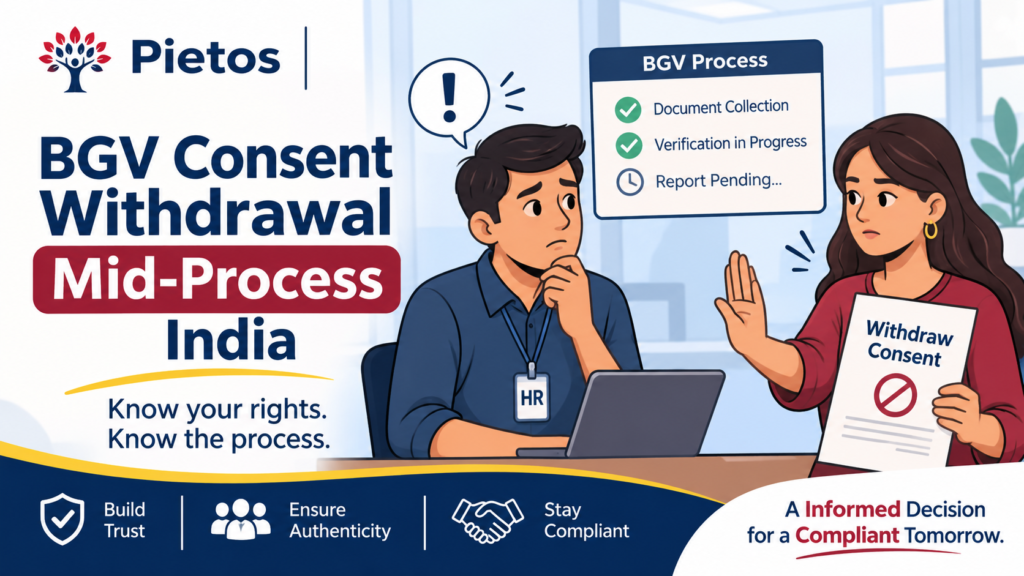
BGV consent withdrawal India is the question most HR teams cannot answer today. A candidate signs the consent form on Monday. Your vendor starts the checks on Tuesday. On Thursday, the candidate emails you: “I withdraw my consent.” What happens next?
In fact, most teams freeze. Some ignore the email and finish the report. Others delete everything and lose their audit trail. As a result, both paths create risk.
Therefore, this guide gives you a clear path. It explains Section 6 of the DPDP Act in plain words. It shows what to stop, what to keep and what to erase. It also gives you a response protocol and three scenario walkthroughs.
Handling a withdrawal right now? Pietos runs every step of a BGV process on a documented, legally structured trail. Email contact@pietos.com or call +91 11 49074103 and we will review your case.
Key takeaways
- A candidate can withdraw consent at any time under Section 6 of the DPDP Act.
- Withdrawal must be as easy as giving consent.
- Work done before the withdrawal stays lawful. Work done after it does not.
- You must stop processing and make your BGV vendor stop too.
- Erasure follows, unless a law requires you to keep the data.
- The main DPDP duties become enforceable on 13 May 2027. Build your process now.
What BGV Consent Withdrawal India Means in Practice
Consent withdrawal means a person tells you to stop a background check they approved earlier. For example, it can happen on day one or on day nine. It can come from a fresher or from a CXO hire.
Why does it happen? Candidates change their minds for many reasons. For instance, some accept a competing offer. Others feel uneasy about a criminal record search. A few simply read the consent form again and dislike what it covers.
However, the reason does not matter for compliance. The law gives the candidate a right. You must honour it.
In practice, the main problem is timing. Also, a BGV file has many moving parts. An education check may sit with a university. An address check may sit with a field agent. A court search may run on a vendor’s system. Therefore, one email from a candidate must reach all of these places quickly.
Three groups feel the pressure most:
- HR teams who must decide what to do with the open case.
- Compliance officers who must prove they acted on time.
- BGV vendors who must stop work that is already in progress.
In short, BGV consent withdrawal India is an operations problem as much as a legal one. You need a repeatable process, not a one-off reply.
Section 6 of the DPDP Act: The Right to Withdraw Consent
Section 6 of the Digital Personal Data Protection Act, 2023 sets the rules for consent. You can read the Act on the MeitY DPDP Act page. A clause-by-clause view of the consent section is also available on DPDPRules.org.
What the law says about withdrawal
Overall, five points matter for HR.
- Consent must be free, specific, informed and clear. A vague tick-box does not qualify.
- The candidate can withdraw at any time. The Act sets no minimum waiting period.
- Withdrawal must be as easy as giving consent. If the candidate agreed through a digital link, you cannot demand a notarised letter to undo it.
- Earlier processing stays lawful. Section 6(5) protects the work you did before the withdrawal.
- Processing must stop within a reasonable time. Section 6(6) also makes you ensure that your processors stop.
Next, Section 8(7) adds the erasure duty. You must erase the personal data when consent is withdrawn, unless a law requires you to keep it. You must also make your processors erase it.
When these duties start
Timing matters, so read this carefully. The DPDP Rules, 2025 were notified on 13 November 2025. Then, the Government phased in the duties. The main obligations, including consent, withdrawal and erasure, are due to start on 13 May 2027. That date is computed from the notification, and MeitY has publicly referred to it. The PIB explainer on the Rules gives the official overview.
So today, in November 2026, penalties for withdrawal failures are not yet live. Still, waiting is a poor strategy. Your BGV files from today will sit in your systems on 13 May 2027. Moreover, enterprise clients and auditors already ask for these controls. For example, our BGV audit checklist shows that auditors now examine consent trails first.
Withdrawal vs Refusal: Why the Difference Matters
Frequently, HR teams mix these two ideas. They are different events with different consequences.
| Point | Refusal | Withdrawal |
|---|---|---|
| When it happens | Before any check starts | After consent, at any stage |
| Data already collected | None, or very little | Documents, forms, partial results |
| Main HR question | Do we continue hiring? | What do we stop, keep and erase? |
| Vendor action | None needed | Stop work, confirm in writing |
| Erasure duty | Minimal | Triggered under Section 8(7) |
Our earlier guide, Can a candidate refuse a background check in India?, covers refusal in depth. In short, a candidate can say no up front. You may then decide not to proceed with the hire, if your policy says so and the role justifies it.
Withdrawal is harder. You already hold data. Also, you may already hold findings. Consequently, you need clear rules for each stage.
What Counts as Valid Consent Withdrawal? Verbal, Email or Written
The Act does not prescribe a format for withdrawal. It sets one test instead: ease. The candidate must be able to withdraw as easily as they gave consent.
Therefore, that test shapes your process. Consider the common channels.
| Channel | Treat as valid? | What HR should do |
|---|---|---|
| Email to HR or recruiter | Yes | Log the timestamp. Acknowledge within 24 hours. |
| Message through the consent portal | Yes | Trigger the stop workflow automatically. |
| Signed letter | Yes | Scan, log and act the same day. |
| WhatsApp or chat message | Treat as yes | Ask for a one-line confirmation, but start the stop now. |
| Verbal statement on a call | Treat as yes | Write a call note and send a confirmation email. |
Two cautions apply. First, do not insist on a rigid form. A strict format can make withdrawal harder than consent, which the Act does not allow. Second, do not guess. If a message is unclear, pause the processing and ask the candidate to confirm.
Practical tip: put a withdrawal link in every consent email. Then the candidate can use the same digital route in both directions. This single step removes most disputes about whether withdrawal was valid.
The Pietos BGV consent whitepaper explains how to build a consent record with the date, method and version. That same record proves when a withdrawal arrived.
Mid-check withdrawal? Pietos’ legally structured process documents every step and protects you from DPDP liability. Book a compliance review with our team.
What HR Can Do With Data Already Collected
This is the question that worries HR most. Overall, the answer has three layers.
Layer 1: Work done before withdrawal stays lawful
Section 6(5) says withdrawal does not make earlier processing illegal. So, you do not need to undo what you lawfully did. For example, a verified degree from last week remains a lawful act.
Layer 2: Processing must stop from the moment you act
After the withdrawal, you must stop using the data for the check. In practice, that means:
- Pause all open verification tasks.
- Stop new searches and field visits.
- Block access to the file, except for the compliance team.
- Tell your vendor to stop.
Layer 3: Erasure follows unless a law says otherwise
Section 8(7) requires erasure on withdrawal. However, you may keep data that another law requires you to retain. For example, tax or labour records may carry their own retention periods. Also, your legal team must name that law. A vague “we might need it” does not qualify.
Our guide on BGV data retention under DPDP shows how to set a retention schedule and prove you followed it.
As a rule, keep a thin audit record, and erase the rest. The audit record can show that consent existed, when it was withdrawn and when you erased the data. It should not hold the candidate’s documents or the detailed findings.
Can You Still Refuse to Hire After a Withdrawal?
Indeed, this question splits HR teams. Let us take it in two parts.
Not hiring because the check cannot finish
Many employers make BGV clearance a written condition of the offer. If the candidate withdraws consent, the condition cannot be met. As a result, the employer may decide not to proceed. This mirrors the position on refusal. Candidates can say no, and employers can decide whether to continue, if policy and role justify it.
To stay safe, follow three rules:
- Put the BGV condition in the offer letter, in writing.
- Apply the same rule to every candidate for the same role.
- Record a neutral reason, such as “verification not completed,” and nothing more.
Not hiring because of what you learned
However, this part is a grey area. Suppose the vendor found a mismatch in the candidate’s employment history before the withdrawal. In addition, that finding came from lawful processing. Section 6(5) protects it.
Yet you cannot keep using the file after withdrawal. You must stop processing and move to erasure. Therefore, the safest practice is to take the hiring decision at the moment you receive the withdrawal. Record the decision and a short reason code. Then erase the detailed findings.
However, courts and the Data Protection Board have not yet ruled on this point. Instead, treat it as a risk to manage, not a settled right. Ask your legal counsel to confirm the approach for your sector. Also, we are not a law firm, and this guide is not legal advice.
One more point: never punish the candidate for withdrawing. Do not blacklist them. Do not share their withdrawal with other employers. Such steps can create separate liability.
Open BGV Reports and Data Erasure Obligations
An open BGV report is a file that has started but not finished. It may hold partial results, uploaded documents and vendor notes. In effect, withdrawal turns that file into a live compliance task.
Follow this sequence:
- Freeze the file. Stop any new work.
- Close the report. Mark it “closed: consent withdrawn.” Do not issue a final clearance or a final adverse report.
- Identify what the law lets you keep. Name the specific statute for each item you retain.
- Erase the rest. Include copies in email, shared drives and HRMS exports.
- Confirm vendor erasure in writing. Ask for the date and the scope.
- Keep a thin audit record. Log the consent date, the withdrawal date and the erasure date.
What about data that sits in email threads? Unfortunately, many teams forget this. For example, recruiters forward documents. HR managers download PDFs. In short, each copy counts. As a result, your erasure sweep must cover inboxes and local folders, not only the BGV portal.
Our article on BGV report errors and candidate rights explains how correction and dispute rights sit alongside these duties. Also, a candidate who withdraws may still ask you to correct a record before you erase it. So plan for that request.
What BGV Vendors Must Do When You Notify Them
Under the DPDP framework, you are the Data Fiduciary. Meanwhile, your BGV vendor is the Data Processor. Still, outsourcing the check does not outsource your liability. Therefore, you answer to the candidate and to the Board.
As a result, your vendor contract must cover withdrawal. Check that it requires the vendor to:
- Stop all open checks within a stated number of hours.
- Tell any sub-processors, such as field agents or database partners, to stop.
- Erase working copies and confirm the date and scope in writing.
- Hand back or erase any documents in transit.
- Log every step with timestamps.
- Support your audit if the Board or a client asks.
Also ask what the vendor can stop. Some checks run in batches. A court search may already be complete. A field visit may be in the car. Therefore, your vendor should tell you the exact status within one working day.
Next, test the process. Send a mock withdrawal to your vendor once a year. Measure how long they take to confirm. Otherwise, a slow answer today becomes a compliance gap on 13 May 2027.
For a broader view of vendor duties, see our guide on BGV data retention under DPDP. It covers the vendor’s role in erasure and proof.
Consent Withdrawal Response Protocol for HR Teams
Use this seven-step protocol as a template. However, the time limits are our suggested internal service levels, not statutory deadlines. Adjust them to your policy.
| Step | Action | Owner | Suggested time |
|---|---|---|---|
| 1 | Log the withdrawal with date, time and channel | HR | Same day |
| 2 | Acknowledge to the candidate in writing | HR | Within 24 hours |
| 3 | Notify the BGV vendor to stop all work | HR | Within 24 hours |
| 4 | Vendor confirms stop status and sub-processor notice | Vendor | Within 48 hours |
| 5 | Record the hiring decision and a neutral reason code | HR and hiring manager | Within 3 working days |
| 6 | Erase data, except items a named law requires | HR, IT, vendor | Within 7 working days |
| 7 | Close the file with a thin audit record | Compliance | Within 10 working days |
Sample acknowledgement to the candidate
Dear [Name],
We received your message dated [date] withdrawing consent for your background verification. We have stopped all verification activity linked to your application. We have also asked our verification partner to stop and to confirm in writing.
We will erase the personal data we collected for this purpose, except any record that a law requires us to keep. We will confirm once erasure is complete. If you have questions, please write to [grievance contact].
Regards, [HR name]
Sample notice to the vendor
Subject: Consent withdrawn, stop work on case [ID]
The candidate withdrew consent on [date and time]. Please stop all work on this case now, including sub-processor tasks. Reply within 48 hours with: the status of each check, the list of sub-processors you informed, and your plan to erase working copies. Do not issue a final report.
Keep both messages short and neutral. Do not argue with the candidate. Also, do not ask them to reconsider in the same message.
Three Scenarios: Before, During and After an Adverse Finding
The scenarios below are illustrative. They show how the protocol works in real hiring situations. Names and companies are fictional.
Scenario 1: Withdrawal before checks begin
An NBFC extends an offer to a credit analyst. The candidate signs the consent form. Before the vendor starts, the candidate emails: “I changed my mind about the criminal search.”
Impact: Very little data exists. The file holds the consent form and an ID copy.
Action:
- HR logs the email and acknowledges it the same day.
- Then HR tells the vendor to hold the case.
- Next, HR asks whether the candidate wants to withdraw from all checks or only the criminal search.
- Because the role handles customer funds, HR explains that clearance is an offer condition. The candidate then decides.
Outcome: The candidate withdraws entirely and declines the offer. HR erases the ID copy and closes the file with a thin audit record.
Lesson: Early withdrawal is simple. However, it shows why separate consent matters. A candidate who objects to one check should not need to abandon the whole process. Our consent whitepaper shows how to unbundle consent by check.
Scenario 2: Withdrawal mid-process
A fintech startup hires a product manager. The vendor has completed identity and education checks. Employment verification is half done. A field address check is scheduled for the next day. Then the candidate withdraws consent by email.
Impact: The file holds verified documents and partial results.
Action:
- HR freezes the file within hours.
- Meanwhile, the vendor cancels the field visit and stops employment calls.
- Then the vendor confirms which checks finished and which did not.
- HR does not use the partial results to make a decision. Instead, HR records “verification not completed” as the reason.
- Finally, the company erases the documents and vendor notes after confirming no law requires retention.
Outcome: The company withdraws the offer under the written condition. The audit record shows that the company acted within 24 hours.
Lesson: The cancelled field visit is the key step. Indeed, a visit that goes ahead after withdrawal is processing without consent. Therefore, pre-agreed vendor stop times prevent this.
Scenario 3: Withdrawal after an adverse finding
A large retailer hires a store manager. The vendor finds a gap between the dates on the resume and the dates on the experience letter. Before HR reads the report, the candidate withdraws consent.
Impact: The file holds an adverse finding. The candidate may be trying to avoid the result.
Action:
- HR freezes the file and notifies the vendor.
- Next, HR asks legal counsel whether the company can act on a finding made before withdrawal.
- Then HR takes a decision at once. It records a neutral reason code and a note that a finding existed.
- Also, the company does not circulate the report or share the finding with others.
- Finally, the company erases the detailed findings, unless counsel names a law that requires retention.
Outcome: The retailer does not proceed with the hire. It keeps only the audit record and the decision note.
Lesson: This is the hardest case. Do not rush to keep the report “just in case.” In fact, retaining it without a legal basis is the larger risk. Decide quickly, record minimally and erase.
Penalty Exposure for Ignoring a Withdrawal Request
The DPDP Act sets a penalty schedule for the Data Protection Board. The headline numbers are large:
- Up to ₹250 crore for failing to maintain reasonable security safeguards.
- Up to ₹200 crore for failing to report a personal data breach.
- Up to ₹50 crore for other breaches of the Act or the Rules.
A failure to honour a withdrawal or to erase data would most plausibly fall under the last category. In practice, the Board decides the amount case by case. Also, it looks at the nature of the breach, its duration, the harm caused and the steps taken to reduce it.
How does a complaint reach the Board? First, the candidate writes to your grievance contact. Only if that fails can they approach the Board. The Board then investigates and can order corrective steps. Consequently, a fast, documented response at the grievance stage is your best defence.
Remember the timeline. Penalties for these duties apply from 13 May 2027. Even so, a candidate’s complaint can reach a client, a regulator or social media long before that date. Therefore, reputation risk starts now.
To understand the wider regulatory picture, read The Leaflet’s detailed reading of the DPDP Rules and the industry guidance published by NASSCOM.
The Cost of Doing Nothing
What happens if your team has no withdrawal process? Consider the risks one by one.
- Regulatory risk: A missed withdrawal can lead to a Board inquiry and penalty exposure.
- Client risk: Enterprise clients now ask for DPDP evidence in vendor audits.
- Legal risk: A candidate can claim that you processed data after consent ended.
- Operational risk: Vendors keep working, and costs keep running.
- Reputation risk: One public post about ignored privacy rights can damage your employer brand.
Unfortunately, the pain points are familiar. For example, HR teams chase vendors by email. Also, nobody owns the file. Meanwhile, documents sit in five inboxes. As a result, compliance finds out weeks later.
Now consider the benefits of a clear process:
- You respond in hours, not weeks.
- You prove compliance with a clean audit trail.
- You reduce penalty exposure before 13 May 2027.
- You protect your employer brand with candidates.
- You give enterprise clients evidence they can check.
In short, a withdrawal protocol costs little. Ignoring the issue costs far more.
Buyer Objections and Straight Answers
| Objection | Straight answer |
|---|---|
| “The DPDP duties are not in force yet.” | The main duties start on 13 May 2027. Files you open today will still exist then. Clients and auditors already ask for these controls. |
| “Withdrawals are rare. We will handle them case by case.” | Rare events are exactly where ad hoc handling fails. A tested protocol takes a day to set up. |
| “Our vendor handles this.” | Outsourcing the check does not outsource your liability. You are the Data Fiduciary. |
| “We need the report to defend a hiring decision.” | Keep a thin audit record and a reason code. Retain more only if a named law requires it. |
| “The employment exemption covers us.” | The exemption is narrow and untested for candidates. Consent is the safer base. Take legal advice before relying on it. |
How Pietos Handles Consent Withdrawal
Pietos runs background verification for NBFCs, startups and GCC setups across India. As a result, we build withdrawal into the process from day one.
Here is what that looks like:
- Separate consent: Candidates approve each check separately, so a partial withdrawal is possible.
- Digital withdrawal route: Candidates withdraw through the same link they used to consent.
- Instant stop workflow: We halt open checks, including field visits, as soon as we log a withdrawal.
- Sub-processor notice: We pass the stop instruction to every field partner.
- Written confirmation: We confirm status and erasure in writing, with dates.
- Audit trail: Every step carries a timestamp that you can show to a client or a regulator.
Overall, our view is simple. A BGV report is only as strong as the consent behind it. If you cannot prove consent and withdrawal, you cannot defend the result.
Frequently Asked Questions
Yes. Section 6 of the DPDP Act lets a person withdraw consent at any time. Also, you must stop processing within a reasonable time and make your vendor stop too.
The Act sets no required format. It requires that withdrawal be as easy as giving consent. Therefore, treat a clear verbal statement as a withdrawal. Log it and confirm it by email.
No. Section 6(5) keeps earlier lawful processing valid. However, the duty to stop applies from the time of withdrawal.
Yes, in most cases. Section 8(7) requires erasure on withdrawal, unless a law requires retention. Keep a thin audit record of the consent, the withdrawal and the erasure.
If BGV clearance is a written condition of the offer, you can decide not to proceed because the condition is unmet. Also, apply the rule consistently. Then record a neutral reason. Finally, take legal advice for sensitive cases.
This is a grey area. The finding came from lawful processing, but you must stop using the file after withdrawal. Decide at once, record minimally and ask counsel to confirm your approach.
The Board can impose penalties under the Act’s schedule. A withdrawal failure most plausibly falls under the residual category, up to ₹50 crore. However, the amount depends on the facts. These duties apply from 13 May 2027.
The candidate first writes to your grievance contact. If that fails, they can approach the Data Protection Board of India.
Ready to Fix Your Withdrawal Process?
A withdrawal email should trigger a plan, not panic. Pietos gives you separate consent, an instant stop workflow and a documented trail for every case.
Book a DPDP-ready BGV review with Pietos. Email contact@pietos.com, call +91 11 49074103 or visit pietos.com to speak with our team. Bring one live case, and we will show you how it would run.