Call us on: 9289301161/+91 11 49074103 or email us on contact@pietos.com
Trending Today

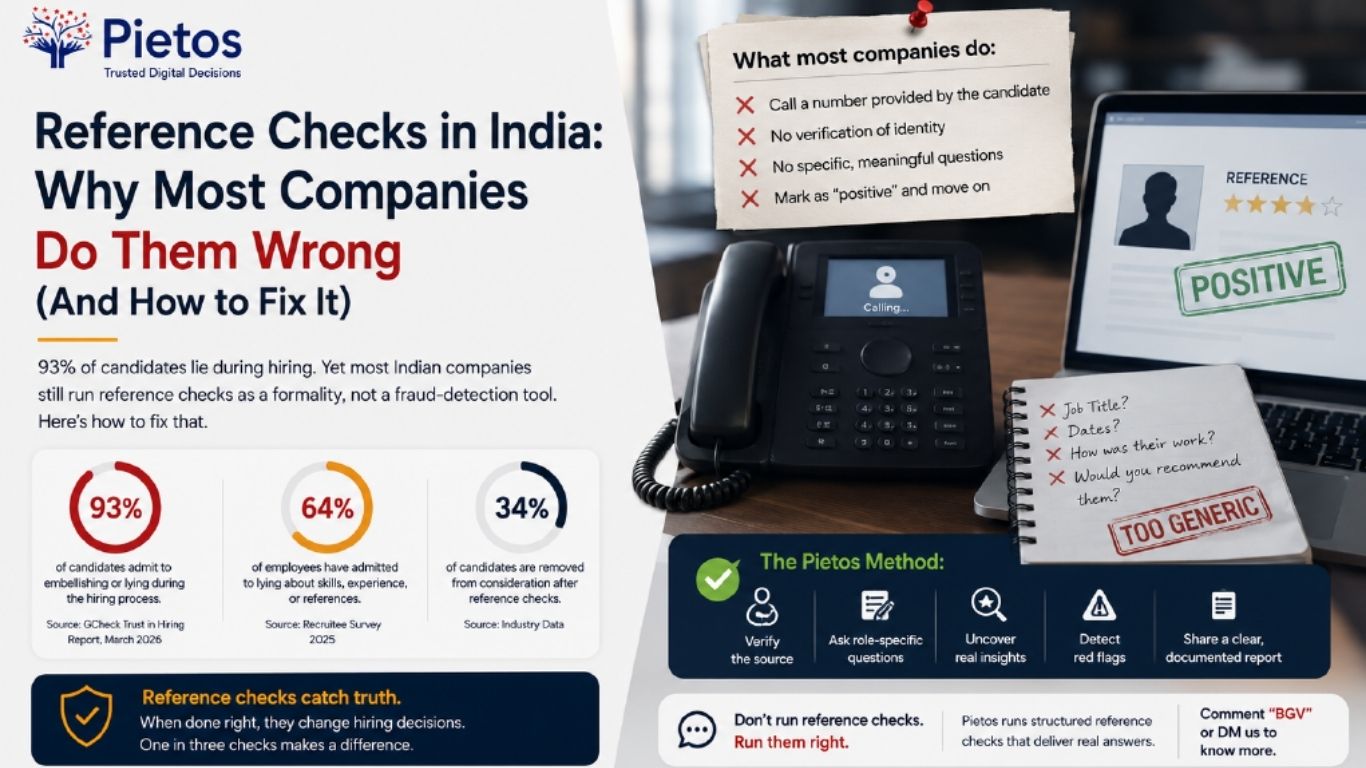
Let me describe what a reference check looks like at most Indian companies today. The recruiter calls a number the candidate provided. A voice answers friendly, confident. They confirm the candidate's job title, say they worked together for three years, describe the candidate as "hardworking and reliable," and end with "I'd definitely recommend them." The recruiter marks the reference as "positive," moves the hire forward, and logs it as complete.
That entire call took seven minutes. It produced nothing a determined candidate could not have staged. And in most Indian organizations, it is the entire reference check process. What nobody in that scenario acknowledged: the reference's identity was never verified. The phone number was provided by the candidate. The employment period was never cross-checked against any database. The reference said nothing specific about the candidate's actual work, the quality of their output, how they handled pressure, or why they left. And the recruiter asked no question that could not be answered by someone reading from a briefing script.
To view our core compliance structures, you can navigate anytime to our homepage to verify your active coverage.
93% of recent job seekers admit to embellishing or lying during the hiring process to appear more qualified, according to GCheck's Trust in Hiring Report released in March 2026, based on a survey of 1,500 recent job seekers.
61% exaggerated their expertise to better match a position, 59% inflated the impact or scope of previous roles, and 45% adjusted employment dates to hide gaps. A 2025 Recruitee survey found that 64% of employees have admitted to lying about skills, experience, or references at least once in their careers. Despite this, approximately 34% of candidates are removed from consideration after their references are checked—meaning one in three reference checks changes the outcome of a hiring decision in a meaningful way when done properly.
At Pietos Solutions Private Limited, we run structured professional reference checks as part of comprehensive BGV packages for clients across Delhi, Noida, Gurgaon, and the wider NCR. We have spoken to hundreds of references, caught dozens of fabricated ones, and built a methodology that actually produces actionable intelligence. This guide documents what we have learned, including the seven specific mistakes most Indian companies make, how to fix each of them, and the exact questions that get honest answers in the Indian professional context.
Hiring embellishment is particularly pronounced among Gen Z, according to the GCheck 2026 Trust in Hiring Report. This matters for Indian hiring because a disproportionate share of new hires entering the workforce—particularly in IT, D2C, and services—are under 30. The cohort with the highest incidence of resume exaggeration is also the fastest-growing segment of the workforce.
More than a third of small business employers have caught an applicant providing a fake reference. And more than half—52%—have changed their mind about a candidate after speaking with a reference. Studies suggest that 30-35% of resumes contain discrepancies, ranging from exaggerated job titles to completely fabricated experience and credentials. Research shows that a bad hire can cost companies at least 30% of an employee's annual salary.
In the Indian context specifically, reference checks carry additional weight because two of the most common fraud patterns in NCR hiring—fabricated employment designations and coached fake references—are exactly what a well-structured reference check is designed to surface. A candidate who has fabricated their designation from Senior Associate to Manager cannot sustain that story when a former colleague is asked: "Can you describe the scope of their team responsibilities and who they reported to?"
In our BGV practice at Pietos Solutions Private Limited, we see the same process failures across organizations of every size and sector. These are structural deficiencies baked into how most Indian HR teams have been taught to run reference checks.
This is the foundational error from which all other errors flow. The candidate selects their references and provides the contact details. The HR team calls those details without independently verifying that the reference is who they claim to be, that they worked at the organization the candidate has stated, and that the phone number or email belongs to a real person in a real professional role. Fake references are more common than ever, and relying on them can lead to hiring someone who is unqualified, untrustworthy, or even dangerous.
The fix: Independently verify the reference's identity and current employer before any conversation. Look them up on LinkedIn. Confirm their company email address via the official company website domain. Call the company's main line and ask to be transferred to the reference—do not use the direct number the candidate provided.
Most Indian companies, when they run reference checks at all, speak to one person. This is inadequate for any hire above entry level. A single reference—even a genuine one—presents a single-angle view that is easily managed.
The fix: For mid-to-senior hires, Pietos Solutions recommends a minimum of two professional references: ideally a former direct manager and a peer or team member who worked alongside the candidate.
The reference check is treated as a post-offer formality—something to tick off between the offer and the start date—rather than as an input into the decision. When the check is done after the offer is signed, it has already lost most of its decision-making value. The hiring manager is committed, the candidate has resigned, and the cost of reversing the decision is high.
The fix: Treat the reference check as a pre-decision step, not a post-offer box to tick. At Pietos Solutions, we recommend completing reference checks in parallel with the final interview round so that the results are available before the offer goes out.
A former direct manager who worked closely with the candidate for two years and can describe specific projects is a fundamentally different source from a former colleague the candidate was friendly with but who had no visibility into their actual work output.
The fix: The reference check process at Pietos Solutions scores references on three dimensions before the conversation begins: relationship proximity (direct manager vs. peer vs. acquaintance), tenure overlap (duration of shared professional experience), and recency (how long ago did they work together).
The most important moment in a reference check is when the reference pauses before answering, hedges with "I'm sure they have grown since then," or pivots away from a direct question. In Indian professional culture, there is a strong social norm against saying overtly negative things about a colleague. References express reservations through hesitation, qualifications, and deflection.
The fix: A trained reference checker hears these signals and follows them—asking a follow-up that invites elaboration, or asking the same question a different way.
Most Indian companies store reference check results as a single-line note: "Reference positive." This is not documentation. In the event of a future dispute—a hire who is terminated or a hire who files a wrongful dismissal claim—a documented record of what was asked and what was said is your legal protection.
The fix: At Pietos Solutions, every reference check conversation is recorded (with consent, as required under the DPDP Act 2023), summarized in a structured report, and stored with a complete audit trail.
Because we run reference checks professionally, we see distinct fraud patterns in Delhi NCR:
| Stage | Process Step | Core Focus & Risk Mitigated |
|---|---|---|
| Stage 1 | Reference Selection Review & Briefing | Flags peer-only references; collects explicit DPDP-compliant consent. |
| Stage 2 | Reference Identity Verification | LinkedIn, domain check, and EPFO/UAN overlap cross-referencing. Eliminates coached friends. |
| Stage 3 | Structured Telephone Interview | Conducted entirely by telephone (or video) to eliminate easy text/email fabrication. Runs 25-40 minutes. |
| Stage 4 | Signal Analysis & Report Writing | Analyzes evidence quality, hesitation patterns, and output consistency. |
| Stage 5 | Discrepancy Escalation | Escalates material concerns directly to the client HR team with a recommended response. |
Here is a set of questions drawn from our structured reference template that produce genuine intelligence:
This is a verification question dressed as an open one. A genuine reference can describe the role in operational detail. A brief fake one typically retreats to job-title-level descriptions.
Genuine references either have a specific, detailed story with context and an outcome, or they have to think for a moment before recalling one. Brief references typically deflect to generic praise. The absence of a story is as informative as the story itself.
In Indian professional culture, this question is uncomfortable. But a genuine reference who valued the candidate will give you a real developmental observation, framed fairly. A briefed reference will produce an implausible reverse-positive: "They work too hard."
In over a decade of professional reference checking, the single most consistently predictive question in a reference check conversation is: "If you had an appropriate opening, would you hire this person again?" This single inquiry often reveals more than lengthy conversations about strengths and weaknesses.
Indian professional culture creates strong social pressure against overtly negative reference responses. A former manager who has serious reservations about a candidate will rarely say "No, this person was incompetent." Instead, they give a positive-sounding response to every specific question. The rehire question forces a binary. A hedged or qualified "yes" or a pause before any answer is a red flag that warrants immediate follow-up.
The Digital Personal Data Protection Act 2023—officially notified by the Ministry of Electronics and Information Technology (MeitY)—has completely changed the compliance landscape for reference checks in India.
There is no universal statutory requirement for reference checks across all employers. However, sector-specific requirements exist: the Reserve Bank of India (RBI) Know Your Employee guidelines effectively require employment verification for BFSI hires, which encompasses formal reference confirmation. India's four new Labour Codes — consolidated and implemented on November 21, 2025 — do not specifically mandate reference checks, but the broader due diligence obligations for employers in regulated sectors make them essential practice. Regardless of legal mandate, reference checks reduce legal liability significantly: an employer who can demonstrate structured pre-employment due diligence is in a far stronger position in any future dispute than one who relied on unverified candidate self-representation.
A standard Pietos reference check — including reference identity verification, structured telephone conversation, and written report — takes 2 to 5 working days per reference. For urgent checks where the reference is immediately reachable, turnaround can be achieved in 24 to 48 hours. For senior executive checks requiring independent reference sourcing, allow 5 to 7 working days.
A candidate can decline to provide references, but an employer is not obligated to proceed with the hire if verification cannot be completed. If a candidate's reason for refusing references is that all their previous employers "were not good experiences," this itself is material information for the hiring decision. Pietos recommends making the reference check requirement explicit in the offer process rather than presenting it as optional.
This is extremely common in India, particularly among large corporations whose HR policies restrict them from giving substantive references and limit responses to confirming employment dates and titles. When a former employer will only confirm dates and title — and nothing more — this is not a failed reference. It is a constrained one. Pietos handles this by: accepting the employment confirmation as a partial positive, seeking an alternative reference from the same employer (a former manager who is willing to speak personally rather than in their official HR capacity), and supplementing the reference check with EPFO verification to cross-check the factual employment data.
Yes, in India, there is no general statutory prohibition on asking references about a candidate's departure circumstances. However, defamation law applies: a reference who makes materially false statements about a candidate that damage their reputation or employability could face a civil claim. This is why most corporate HR policies restrict official reference responses to factual employment confirmation. Pietos structures questions about departure in a way that invites factual description rather than evaluative judgment, reducing defamation risk for the reference and producing more reliable information for the employer.
Yes, and in specific circumstances — particularly promotions to senior roles, role changes that involve access to sensitive financial data or intellectual property, or investigations into performance or conduct concerns — running additional reference checks on existing employees is both legally permissible (with explicit consent) and practically valuable. Pietos can structure ongoing reference verification for existing staff with the appropriate DPDP-compliant consent framework.
Employment verification confirms factual data: dates, employer name, designation, and sometimes reason for exit — through direct HR contact or EPFO/UAN cross-referencing. It is a structured data confirmation exercise. A reference check is a qualitative conversation with someone who worked with the candidate, designed to assess performance, behaviour, and fit. Both are components of a comprehensive BGV package. Employment verification provides the factual backbone; the reference check provides the human intelligence layer. Pietos runs them as complementary checks — employment verification first, to establish the factual framework, and reference check conversations with verified contacts second.
Approximately 34% of candidates are removed from consideration after their references are properly checked. That means roughly one in three of the candidates your organization is advancing past the reference stage should have been stopped there—if the check had been run properly.
The Indian hiring market in 2026 is under pressure from a surge in resume fraud enabled by AI tools, a strict compliance layer under the DPDP Act, and a talent market forcing high hiring velocity. In this environment, the reference check—when run with structure, intent, and specialist expertise—is one of the most cost-effective risk-mitigation tools available.