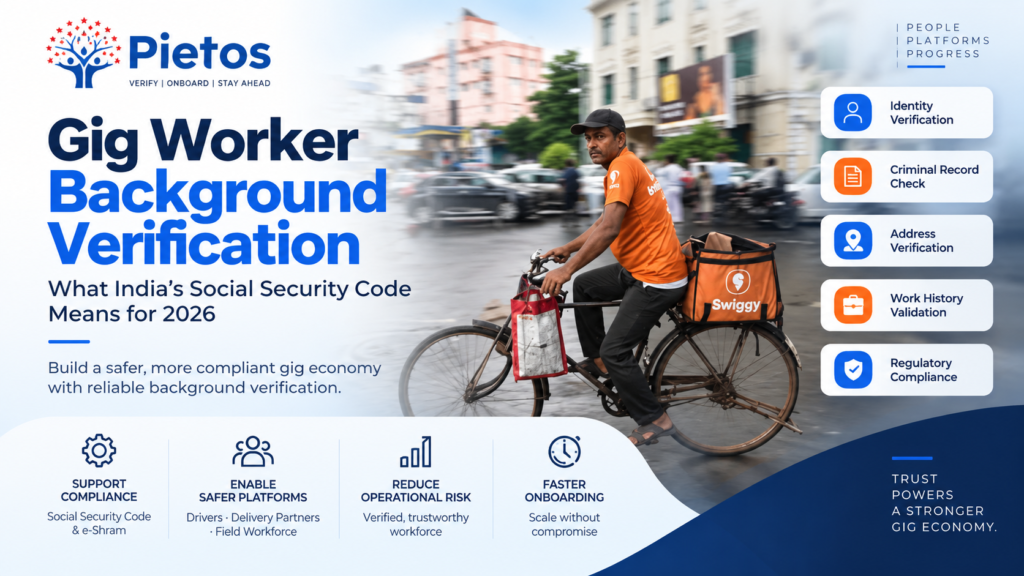
Gig worker background verification just moved from best practice to legal obligation. India’s Code on Social Security, 2020, requires aggregators to register their gig and platform workers. The Social Security (Central) Rules, 2026 add teeth to that requirement. Delivery platforms, ride-hailing apps, quick-commerce companies, and staffing firms that place gig talent all fall inside the new perimeter.
This shift matters for one simple reason: registration and social security benefits only work if the worker’s identity is real. A platform cannot register a synthetic identity, pay accident insurance premiums against a fake Aadhaar, or defend a wage dispute with an unverifiable worker record. Gig worker background verification is the mechanism that makes compliance possible, not an optional add-on to it.
This guide breaks down what changed. It covers what HR and operations teams must do before their next onboarding cycle, and how a defensible verification process works at gig-hiring speed. It also walks through common objections and a step-by-step rollout framework that does not slow down onboarding, with a comparison table and FAQ section to make the compliance picture easy to reference later. Talk to Pietos about gig worker background verification →
What India’s Social Security Code Changes for Gig and Platform Workers
The Code on Social Security, 2020 formally defines gig and platform workers as a distinct category, separate from traditional employees and independent contractors. That distinction matters because it creates obligations that did not exist before.
Aggregators must now contribute to a social security fund for their gig workforce. Workers must register on the e-Shram portal to receive benefits. And crucially, the Social Security (Central) Rules, 2026 place the registration and data-sharing burden on the aggregator, not just the individual worker.
For any company running gig operations at scale, this converts a loosely tracked contractor base into a formally documented workforce. Documentation only holds up if the underlying identity is accurate.
Who Counts as a Gig Worker Under the New Rules
The law defines a gig worker broadly. Anyone who performs work outside a traditional employer-employee arrangement and earns through a platform or aggregator qualifies. That includes delivery riders, cab drivers, home-service technicians, and freelance logistics staff who work through an app-based marketplace.
This definition captures a large and fast-moving workforce. Quick-commerce alone onboards thousands of delivery staff every month across tier 1, 2, and 3 cities. Ride-hailing and home services follow a similar pattern. Consequently, any verification gap at the point of onboarding now compounds quickly, across a workforce the law formally recognises.
The Aggregator Registration and e-Shram Obligation
Under the new rules, aggregators must share worker details with the government through the e-Shram portal, the national database for unorganised and gig workers. Every registered worker receives a Universal Account Number, known as a UAN, linked to their Aadhaar.
This UAN becomes the worker’s portable identity across platforms. It is also, from a verification standpoint, a high-trust data point. It originates from a government-regulated source rather than a document the worker uploads themselves.
For HR and compliance teams, this changes the verification conversation. Gig worker background verification no longer means a manual document check squeezed into a rushed onboarding flow. It means cross-referencing government-issued identity data before a worker ever picks up an order or logs a trip.
The registration obligation also creates a paper trail that did not exist before. Once a worker’s details sit inside a government database, any mismatch with the company’s internal onboarding data becomes visible. Visible gaps invite scrutiny. This is a structural shift, not a paperwork update.
What “Aggregator” Means in Practice
The rules define an aggregator broadly, covering any digital intermediary that connects a buyer of a service with a gig worker who supplies it. Food delivery, ride-hailing, home services, logistics matching, and even some staffing marketplaces fall under this definition.
Consequently, the obligation is not limited to a handful of well-known consumer apps. Mid-size logistics platforms, regional delivery networks, and B2B staffing marketplaces all carry the same registration and data-sharing duty. Many of these companies have not yet built the verification infrastructure the rule assumes they already have.
Why Gig Worker Background Verification Is Now a Compliance Requirement
Before the Social Security Code, verifying a gig worker was a risk-management choice. A platform could weigh the cost of checks against the cost of fraud and decide for itself. That calculus has changed.
Registering a worker on e-Shram under a false or unverified identity is no longer just a fraud problem. It becomes a compliance failure with a government portal, tied to a legal mandate. Regulators can audit aggregator data. Therefore, an identity mismatch discovered during an audit carries a different weight than one discovered internally.
This is why gig worker background verification now sits inside the compliance function. It belongs alongside DPDP Act consent management and labour code documentation, not only with fraud or trust-and-safety teams.
The Cost of Onboarding Without Verification
Speed has always been the gig economy’s competitive edge. Platforms compete on how fast a worker can go from signup to first delivery. That pressure historically pushed verification to the back of the queue, or skipped it altogether for high-volume roles.
The data on what that costs is specific. Independent onboarding research makes the trade-off concrete. Charging low-income candidates upfront fees for onboarding kits or checks drives an immediate 4% to 6% drop-off, per Pietos’ 2026 gig economy onboarding research. Friction at the wrong point loses workers. Skipping verification loses something bigger: a defensible compliance record.
Under the new rules, an unverified worker is not just a fraud exposure. It is a registration the aggregator cannot defend if a regulator asks who that worker actually is.
Expert practitioners in the HR technology space echo this shift. Industry analysis of India’s evolving labour codes backs this up. Staffing and platform companies are moving verification earlier in the funnel. Why? Post-incident remediation costs far more than upfront checks, a pattern documented in CIEL HR’s analysis of the new labour codes and staffing. The direction across the industry is consistent: verify first, onboard second.
Need a fast, compliance-ready check before your next onboarding batch? See how Pietos verifies gig workers in minutes →
The Business Risk Nobody Is Pricing In Yet
Most compliance conversations stop at “register the worker.” Few go further to ask what happens when a registered identity turns out to be wrong. That gap is where the real exposure sits.
Consider a mid-size quick-commerce operator onboarding 2,000 delivery riders a month across three cities. Without identity cross-checks against Aadhaar and UAN records, a meaningful share of onboarded riders will carry mismatched or duplicated identities. India’s gig workforce is projected to reach 23.5 million workers by 2030, per Pietos’ background verification research on India’s gig economy. At that scale, even a small error rate creates thousands of unverifiable records.
Each bad record carries three layers of risk. First, the accident insurance and social security benefit tied to that worker’s registration becomes a liability the company cannot substantiate. Second, any incident involving that worker becomes harder to resolve. A safety issue, a customer complaint, or a dispute all need a verified identity trail to investigate properly. Third, a regulatory audit of aggregator data turns every unverifiable record into a documented gap.
None of these risks require intent or negligence. They simply require skipping a verification step that used to be optional and is not optional anymore.
A Realistic Scenario: The Duplicate Identity Problem
Picture a logistics company running a festive-season hiring surge, onboarding 400 delivery riders in ten days across two cities. Under time pressure, the onboarding team accepts uploaded Aadhaar photos without cross-checking the number against the UIDAI database.
Three months later, a delivery-related dispute lands with the company’s legal team. The rider named in the complaint cannot be matched to any verified record. The uploaded document belonged to a different person than the one who actually worked the shifts. The company now faces the dispute itself, plus a registration on e-Shram that does not correspond to a real, verifiable individual.
This scenario is common precisely because gig hiring rewards speed. A verification layer that runs in the background closes this gap. It adds no extra steps for the worker, so it avoids the friction that pushed teams to skip checks in the first place.
The fix costs far less than the fallout. An API-based identity check adds seconds to a signup flow. A duplicate-identity dispute, by contrast, can take weeks to untangle, involve legal review, and leave a permanent gap in the company’s e-Shram registration data. Weighed side by side, the upfront check is the cheaper option every time.
What a Compliant Gig Worker Background Verification Process Looks Like in 2026
A defensible process does three things well. It confirms identity against a government-regulated source. It checks for red flags relevant to the worker’s role. And it keeps checking, rather than stopping after day one. Each layer below maps to a specific step in a compliant workflow.
Identity: Aadhaar, e-Shram UAN, and PAN Cross-Checks
Identity verification is the foundation. A worker’s Aadhaar number confirms who they are. Their e-Shram UAN, once assigned, links that identity to their registration for social security benefits. Cross-checking both closes the gap between “a document was uploaded” and “a real person was confirmed.”
Pietos’ UAN verification guide explains why this data point carries more weight than self-submitted documents. It comes directly from EPFO’s regulated infrastructure, not from the worker. PAN verification adds a second, independent government cross-check, which catches synthetic identities that a single-document check would miss.
For gig platforms onboarding at volume, this cross-check needs to run in seconds, not days. Manual review does not scale to thousands of monthly onboardings.
Identity cross-checks also protect the worker, not just the platform. A verified UAN prevents duplicate registrations from splitting one worker’s social security contributions across two identities. Left unchecked, that split delays or blocks their access to benefits later.
Criminal Record and Address Verification at Onboarding Scale
Identity confirms who the worker is. Criminal record and address checks confirm whether that worker is safe to put in front of customers, inside homes, or behind the wheel. Delivery, ride-hailing, and home-service roles all carry direct customer contact, which raises the stakes on this layer.
Address verification for gig workers spread across tier 2 and tier 3 cities has historically been slow. Field-only verification cannot keep pace with distributed onboarding. Digital-first address checks, paired with periodic field spot-checks, close that gap without adding days to the process.
Criminal record checks should scale to the role, not apply a blanket standard. A warehouse-based logistics role and a home-visiting service technician carry different risk profiles. A well-designed verification tier reflects that difference instead of treating every gig role the same.
Continuous Monitoring Instead of One-Time Screening
A worker verified on day one is not automatically safe on day 400. Circumstances change. A one-time screen misses everything that happens after onboarding.
Continuous or periodic re-screening catches new criminal records, licence suspensions, or flagged incidents without waiting for a contract renewal to trigger a fresh check. For a workforce this large and this mobile, ongoing monitoring is the difference between a compliance program and a compliance moment.
Platforms that treat verification as a single gate at onboarding often assume the risk profile of a worker stays fixed after day one. It does not. A clean record at signup says nothing about an incident that happens in month six. Building re-screening into the workflow, rather than leaving it to manual follow-up, keeps the compliance record current instead of stale.
What the Data Shows About Gig Workforce Growth and Verification Gaps
The scale of India’s gig economy makes the verification gap harder to ignore each year. A NITI Aayog report puts the scale in perspective. India had 7.7 million gig workers in 2020–21. That figure is projected to reach 23.5 million by 2030, per Pietos’ gig economy background verification guide.
That growth trajectory outpaces most companies’ internal verification capacity. A workforce built through informal referrals and rapid onboarding rarely comes with the identity infrastructure the Social Security Code now assumes exists. HR technology research points the same way. Expanding social security coverage for gig and platform workers ranks as one of 2026’s defining HR shifts, per greytHR’s HR management trends report.
Two numbers matter most for planning purposes. First, the projected workforce growth rate means verification infrastructure built for today’s volume will fall behind within two to three years if it cannot scale. Second, upfront friction drives measurable drop-off. Fees or slow manual checks push workers away before they ever complete onboarding, based on the research cited earlier in this guide. Verification has to solve both problems at once: scale with the workforce, and stay invisible to the worker completing it.
Data Privacy Sits Inside This Compliance Picture Too
Gig worker background verification does not operate in isolation from India’s data protection law. Every identity check involves personal data — Aadhaar numbers, PAN details, address history. The DPDP Act governs how that data gets collected, used, and stored.
A compliant process captures explicit consent before any check runs. It states clearly what data will be verified and why. It also applies a defined retention window rather than holding worker data indefinitely. This matters twice over under the new rules. It matters once for the verification itself, and again for the e-Shram registration data the platform shares with the government.
Platforms that treat DPDP compliance and Social Security Code compliance as two separate workstreams often duplicate effort or leave gaps between them. Building both into a single consent and audit trail at onboarding closes that gap. Compliance teams then defend one record, not two disconnected ones.
Traditional BGV vs. Gig-Ready Background Verification
Standard corporate BGV was built for salaried hiring: slower cycles, smaller volumes, and predictable onboarding dates. Gig hiring breaks all three assumptions. The table below shows where the two approaches diverge.
| Factor | Traditional BGV | Gig-Ready Background Verification |
|---|---|---|
| Turnaround time | 5–10 business days | Minutes to hours for identity, 24–48 hours for full checks |
| Volume handling | Dozens to hundreds per month | Thousands per month, across cities |
| Identity source | Self-submitted documents | Aadhaar, e-Shram UAN, PAN government cross-checks |
| Screening cadence | One-time, at hiring | Continuous or periodic re-screening |
| Geographic reach | City-specific field teams | Digital-first, with field checks for tier 2/3 |
| Compliance mapping | General HR policy | DPDP Act plus Social Security Code registration data |
Gig-ready verification is not a lighter version of traditional BGV. It is a redesigned process built for the volume, speed, and regulatory shape of platform work.
Companies that force gig hiring through a traditional BGV workflow tend to hit the same wall. Turnaround times built for salaried hiring cannot absorb thousands of monthly applicants without becoming a bottleneck. The fix is not to skip steps. It is to rebuild the workflow around API-first checks that scale horizontally, rather than manual review queues that scale only by adding headcount.
Buyer Objections HR and Ops Leaders Raise — And the Real Answers
“Verification will slow down our onboarding.” This objection assumes verification means manual review. API-based identity checks against Aadhaar, UAN, and PAN return results in minutes, not days. Speed and compliance are not actually in tension once the process runs through direct government data channels.
“We already collect Aadhaar copies during onboarding.” Collecting a document is not the same as verifying it. A copied Aadhaar card confirms nothing on its own. It does not show whether the number is active, whether it belongs to the submitter, or whether someone has already used it under a different name.
“Our worker volume is too high for this to be cost-effective.” Volume is exactly why verification pays for itself. A single fraud incident, wage dispute, or regulatory finding at scale costs more than the per-check cost of verifying every worker. High volume increases the value of catching problems early, not the cost of doing so.
“We’re not sure this applies to our platform yet.” The Social Security (Central) Rules, 2026 apply to any aggregator matching workers to customers through a digital app or marketplace. If that describes the business model, the obligation applies now, not after the first audit.
“Our verification vendor only handles salaried-employee BGV.” Not every BGV provider supports the identity sources gig hiring depends on, particularly UAN and e-Shram data. Before renewing a vendor contract, confirm the provider can run these specific checks at API speed, not just traditional document verification.
“We worry this will feel invasive to workers who just want to start earning.” A well-built verification flow runs in the background. The worker simply completes standard onboarding steps they already expect, such as submitting Aadhaar details. It need not feel like a separate hurdle, provided it sits inside the existing signup flow rather than bolted on afterward.
A Practical Framework for Rolling Out Gig Worker Verification Without Slowing Onboarding
Rolling out gig worker background verification does not require rebuilding the onboarding funnel from scratch. It requires sequencing the right checks at the right moment.
- Map the worker categories. Separate delivery, driving, and home-service roles, since each carries different risk profiles and different check requirements.
- Integrate identity checks at signup. Run Aadhaar and PAN cross-checks the moment a worker submits their details, before they reach any customer-facing stage.
- Capture the e-Shram UAN early. Treat UAN capture as a required onboarding field, not a follow-up task, so registration data stays accurate from day one.
- Layer in role-specific checks. Add criminal record and address verification for customer-facing and high-trust roles before activation.
- Automate re-screening triggers. Set a fixed cadence, such as every six or twelve months, for ongoing checks rather than relying on manual follow-up.
- Document the consent trail. Every check needs a DPDP-compliant consent record, so the verification process itself withstands an audit.
- Connect verification to your existing stack. API integration into your onboarding app or HRMS removes manual handoffs and keeps the process invisible to the worker.
- Assign clear ownership. Decide upfront whether compliance, HR, or operations owns verification exceptions. This prevents a flagged record from sitting unresolved while teams debate who should act on it.
Each step adds minutes, not days, when the underlying checks run through direct API connections rather than manual review queues. The sequencing matters more than the individual checks: identity first, role-specific screening second, and monitoring as an ongoing layer rather than an afterthought.
Related Resources
| Anchor Text | Destination | Why It’s Linked |
|---|---|---|
| 2026 gig economy onboarding data | Gig Economy Onboarding: 2026 India TAT & Fraud Report | Backs the onboarding drop-off and fraud figures cited above |
| gig economy background verification | Gig Economy & Background Verification guide | Core service page for gig-specific BGV |
| labour codes background verification guide | Labour Codes Background Verification: What HR Must Do Now | The Social Security Code sits inside the broader labour codes shift |
| UAN verification guide | UAN Verification: Complete Guide for HR & BFSI | Explains the UAN cross-check referenced throughout this piece |
| DigiLocker background verification guide | DigiLocker Background Verification: 2026 HR Guide | Complementary identity-document verification layer for high-volume onboarding |
Frequently Asked Questions
The obligation applies to any aggregator matching workers to customers through a digital platform. Company size does not matter. Smaller platforms are not exempt.
No. Aadhaar confirms identity, but a compliant process also checks the worker’s e-Shram UAN registration and, for customer-facing roles, criminal and address records.
Identity cross-checks against Aadhaar, UAN, and PAN typically return results within minutes through API-based verification. Full checks, including criminal and address records, generally complete within 24 to 48 hours.
The platform can pause activation, request clarification, or decline onboarding, depending on internal policy. A documented, consistent process matters more than any single outcome.
Yes. Under the DPDP Act, every check requires documented consent from the worker before verification runs, and that consent record must be retained.
Both. A compliant program includes periodic re-screening for existing workers, not just a one-time check at initial onboarding.
Yes. The Social Security Code defines gig and platform workers by how they earn, not by hours worked. Part-time and full-time gig workers fall under the same registration and verification expectations.
Run a retroactive verification sweep against the existing gig workforce, not just new hires going forward. Regulators generally look more favourably on a documented remediation effort than on a gap left unaddressed after the rule took effect.
E-Shram registration issues the worker’s UAN. That UAN becomes a government-sourced data point. A compliant process cross-checks it against the worker’s declared identity, alongside Aadhaar and PAN.
Key Takeaways
- The Social Security (Central) Rules, 2026 make gig worker registration, and by extension identity verification, a legal obligation, not a discretionary safeguard.
- Government-sourced identity data, including Aadhaar, e-Shram UAN, and PAN, carries more verification weight than self-submitted documents.
- Speed and compliance are not opposing goals. API-based checks return results in minutes and fit inside existing onboarding funnels.
- One-time screening leaves a gap. Continuous or periodic re-checks keep a gig workforce compliant well past the onboarding moment.
- DPDP consent and Social Security Code registration data should sit in one audit trail, not two separate systems that compliance teams have to reconcile later.
- The cost of a single unverified worker, once a dispute or audit surfaces it, almost always exceeds the cost of verifying every worker upfront.
Gig worker background verification is no longer a line item to defer until after an audit finds the gap. It is the layer that makes every other part of Social Security Code compliance defensible.
Companies that build this now, before enforcement tightens further, avoid the scramble of retrofitting compliance under audit pressure. Companies that wait will still need to build it — just under worse conditions, and likely with existing gaps to fix first. Talk to Pietos about a gig worker background verification workflow built for onboarding speed →