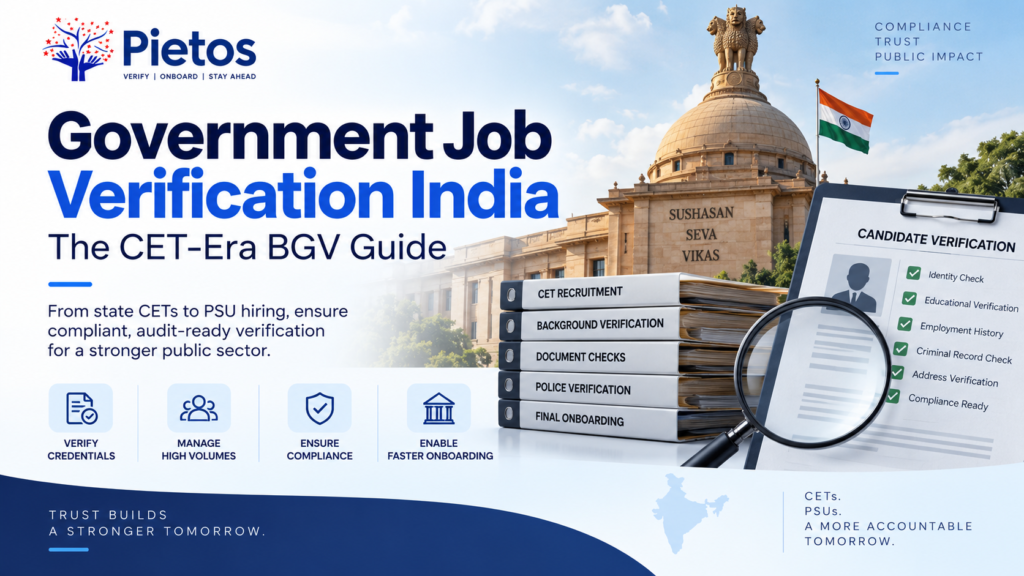
Government hiring in India is entering a higher-volume, faster-moving phase. State-level Common Eligibility Tests — CETs — now consolidate dozens of separate department exams into one qualifying test. Rajasthan’s RSSB CET, Haryana’s HSSC CET, and Madhya Pradesh’s Vyapam CET already run at this scale. More states are following the same model. This changes the shape of the verification problem for HR and compliance teams. Recruitment boards now shortlist larger candidate pools in shorter cycles. Every one of those candidates still needs identity, education, criminal, character, and address verification before an appointment letter goes out.
Government job verification India requirements haven’t gotten lighter because the exams got more efficient. If anything, they’ve gotten heavier. More candidates move through the pipeline at once, and departments have less time per candidate to catch a problem before onboarding. This guide covers what’s actually changing in government job verification India today, what a CET-era verification process needs to include, and where the real risk sits for recruitment boards and the contractors who support them.
Struggling to verify candidates fast enough to keep up with your CET shortlist volume? Talk to Pietos about public-sector BGV capacity.
Old Model vs. CET Model: Why Verification Teams Feel the Difference
Under the old model, each department ran its own process. SSC, a state PSC, a railway zone, a state subordinate board — each built its own shortlist and handed verification a manageable, department-specific batch. Batch sizes were predictable. Timelines were set locally. A verification team could plan capacity months in advance, because the exam calendar barely changed year to year.
The CET model breaks that predictability in three ways. First, one exam now feeds multiple departments. A single result window can trigger several parallel shortlisting cycles instead of one. Second, batch sizes scale with the CET’s total registered pool, not with any single department’s historical hiring rate. Verification demand can spike well beyond what past years would suggest. Third, the CET score carries a multi-year validity window. RSSB CET runs three years, and the national CET is planned for three years once it launches. The same candidate pool can resurface for verification more than once, against different departments. Neither department will necessarily know the candidate was screened before.
None of this makes CET a bad system. It’s a real efficiency gain for candidates and for the exam-conducting bodies. But it shifts the operational burden downstream, onto whoever runs verification. That shift is exactly what this guide covers.
What “CET” Actually Means for Government Job Verification India Right Now
State CETs are live — Rajasthan, Haryana, MP, and others
Rajasthan’s RSSB CET is the clearest example of a functioning state-level system. RSSB issued the Graduate Level 2026 notification under Advertisement No. 09/2026, dated 1 July 2026, under the Rajasthan Subordinate and Ministerial Service (Common Eligibility Test) Rules, 2022. Passing the test alone doesn’t guarantee a job. Candidates still have to qualify separately in the main departmental recruitment exam or interview run by the relevant recruiting agency. The CET score itself stays valid for three years from the result date, under a Personnel Department notification dated 16 January 2025.
Haryana’s HSSC CET and Madhya Pradesh’s Vyapam CET follow a broadly similar structure: one qualifying score, a fixed validity window, and downstream main exams run by individual departments. Other states are developing comparable systems. The operational patterns in this guide will keep repeating as more state boards adopt the model.
The National CET (NRA CET) is still pending — here’s the honest status
The government approved the National Recruitment Agency back in August 2020 to run a single national CET, replacing the Tier-1 prelims for SSC, RRB, and IBPS, under policy guidance from the Department of Personnel and Training. Six years on, it still hasn’t launched. As of early 2026, coverage of the exam consistently describes the notification as “expected soon,” and no official NRA website had gone live. Government HR teams shouldn’t build a compliance program around NRA CET dates that keep slipping. But they should treat it as a near-certain future addition to the current state-CET landscape, and build verification processes flexible enough to absorb it when it does land.
| State CET (e.g., RSSB, HSSC) | National NRA CET | |
|---|---|---|
| Status in 2026 | Live, active, issuing real notifications | Announced 2020, still pending |
| Scope | Subordinate and ministerial state services | Group B/C posts under SSC, RRB, IBPS |
| Score validity | 3 years (RSSB CET) | Planned 3 years, not yet operational |
| Verification implication today | Immediate — feeds live shortlists now | Prepare for it, don’t build around a launch date |
Why CET-Driven Hiring Puts Pressure on Background Verification
Volume, not just process, is the new challenge
A department that used to run its own prelims for 2,000 applicants now receives a shortlist drawn from a CET pool that can run into the hundreds of thousands. Verification teams built around a few hundred candidates a quarter must now clear several times that number. Turnaround time can’t stretch to match, because onboarding timelines for government roles stay fixed by service rules, not by verification capacity.
A single eligibility score feeds multiple departments
One CET score qualifies a candidate for shortlisting across several recruiting bodies. A verification gap in one department’s process can resurface in another department’s hiring cycle, for the same person. That’s a structural risk that didn’t exist when each department ran its own separate prelims and its own separate screening.
Three-year validity means verification can’t be a one-time event
A candidate who clears CET this year might not get shortlisted for a specific department role until eighteen months later, near the end of the score’s validity window. Identity, address, and even character status can change meaningfully in that time. A process built only around “check once at CET registration” misses this. The check that matters most is the one done close to the actual appointment, not the one done at exam time.
Running BGV for a department that recruits off a state CET shortlist? Book a public-sector BGV capacity review with Pietos.
What Government and PSU Background Verification Actually Covers
Identity and Aadhaar-linked verification
Government roles require confirmed identity before any offer is finalised. This typically means Aadhaar-based identity matching alongside PAN and voter ID cross-checks, since government systems and payroll run on these identifiers. CET registration itself often uses Aadhaar-based authentication. That gives verification teams a natural checkpoint to cross-reference against: does the person appearing for the department interview match the person who registered for and appeared at the CET centre?
Educational eligibility verification
CET levels tie to specific educational qualifications — 10th, 12th, or graduate level. Verification has to confirm the degree or certificate is genuine, and that it matches the level the candidate claimed when registering for that CET tier. A document existing isn’t enough on its own. This means checking directly with the issuing board or university, not accepting a scanned mark sheet at face value, since mark sheet forgery remains one of the more common failure points in high-volume hiring.
Criminal and antecedent verification
Government roles, especially those with public-facing authority or access to sensitive systems, require criminal record and antecedent checks across district and high courts, plus police verification where the role demands it. For law-enforcement-adjacent, revenue, or public-safety postings, this check typically goes deeper than a standard corporate criminal screen, covering pending cases and not just past convictions.
Character and conduct verification (a government-specific layer)
Private-sector BGV rarely includes formal “character and antecedent” verification the way government appointments do. This means confirming there’s no pending disciplinary action, no dismissal from prior government service, and no conduct history that would disqualify the candidate under applicable service rules. General BGV vendors without government experience often miss this layer entirely, because it simply doesn’t exist as a category in most corporate screening packages.
Address and domicile verification
Many state CETs and the roles they feed into carry domicile or residency requirements tied to state quotas and reservation categories. Address verification here isn’t just about traceability. It has to hold up against category and domicile claims made at the application stage. That means combining physical field visits — especially important in tier 2 and tier 3 districts — with digital record cross-checks against local revenue and municipal records.
Where CET-Era Hiring Creates New Verification Risk
Proxy candidates and identity substitution
Higher-volume, more anonymous testing pipelines create more opportunity for someone other than the registered candidate to appear at later stages. As a result, biometric cross-checks against CET registration data are becoming a standard control. This ranks among the highest-stakes risks in the entire CET pipeline. A successful substitution doesn’t just compromise one hiring decision — it compromises the multi-year validity of the CET score itself.
Fabricated or inflated educational claims
A CET tier ties to a specific qualification level, so the incentive to misrepresent education rises with the stakes of that tier — a fake degree, an inflated result, or a certificate from an unrecognised institution. Pietos’s own analysis of Indian hiring pipelines has found that resume and credential discrepancies show up in roughly 30–35% of candidate submissions across sectors. There’s no reason that rate would run lower in a high-stakes, high-volume government pipeline.
Category and domicile misrepresentation
Reservation and domicile benefits attached to many state government roles create a direct incentive to misstate category or residency status. Most private-sector BGV programs simply don’t build for this verification category. It needs specialist handling in government-linked screening, because general vendors optimised for corporate onboarding speed often lack the process — or the local relationships with issuing authorities — to verify these claims properly.
Document forgery at scale
More candidates moving through the same pipeline in less time creates more opportunity for forged mark sheets, fabricated experience letters, and manipulated caste or domicile certificates. A screening process not built for volume can let these slip through. Forgery detection at scale depends on checking directly with issuing authorities, rather than judging documents by appearance — slower per candidate, but far more reliable across a large pool.
The Business Risk of Getting Government Job Verification India Wrong
The cost of a verification gap in government hiring isn’t abstract. A single proxy-candidate or forged-credential appointment that surfaces after joining can trigger a formal inquiry, delay the entire recruitment cycle for that post, and create reputational exposure for the recruiting board. That exposure runs higher than in private hiring, because government appointments — including those overseen by apex bodies like UPSC — are public record. One CET score can feed multiple department shortlists, so a verification failure caught late in one department’s process can mean the same unverified candidate is already active, or under consideration, in another department’s pipeline. The cost of inaction compounds instead of staying contained to a single hiring decision. That’s the core argument for building verification capacity ahead of CET volume, rather than reacting to it after a problem surfaces.
DPDP Act Compliance in Government-Linked Background Checks
Government and PSU verification work involves some of the most sensitive personal data categories under India’s Digital Personal Data Protection Act — identity numbers, category and caste certificates, and criminal history among them. A compliant process needs documented candidate consent before any check begins. It needs purpose limitation, so data collected for verification isn’t reused elsewhere. It needs defined retention and deletion timelines once the hiring decision is made. For departments and PSUs, this isn’t optional. DPDP compliance is now a baseline expectation for any vendor touching candidate data at government scale, and recruitment boards should treat a vendor’s DPDP posture as a disqualifying factor, not a nice-to-have, during procurement.
A Practical BGV Framework for CET-Recruited Government Roles
- Pre-screening alignment. Match verification scope to the specific CET tier and department. A Group B role and a Group C role carry different depth requirements.
- Identity lock. Confirm identity against CET registration data before any other check begins. This closes the proxy-candidate gap early.
- Parallel-track verification. Run education, criminal, address, and character checks concurrently, not sequentially, to keep pace with fixed onboarding timelines.
- Category and domicile cross-verification. Validate reservation and domicile claims against the issuing authority, not just the submitted certificate.
- Consent and DPDP documentation. Capture and store consent records separately from verification output, with a defined retention window.
- Escalation protocol. Define what happens when a discrepancy surfaces after a candidate has already cleared later exam stages. CET’s multi-stage structure guarantees this will happen sometimes.
- Revalidation trigger. For candidates shortlisted well into their CET score’s validity window, re-run identity and address checks. Don’t rely solely on data collected at registration time.
Case Example: What High-Volume Public-Sector Screening Looks Like
A state recruitment board running a graduate-level CET shortlist for multiple subordinate services needs verification across identity, education, criminal record, character and conduct, and domicile. Every shortlisted candidate needs this, inside a fixed onboarding window set by service rules. In a typical cycle, several thousand candidates clear the qualifying threshold and move into department-specific main exams within weeks of each other. Therefore, verification has to start well before final selection is confirmed, not after.
The verification partner has to run checks in parallel and flag category or domicile mismatches before appointment letters go out. It also has to keep a clean, DPDP-compliant consent trail across a candidate pool that can dwarf a typical corporate hiring cycle. The partner also needs field presence in the tier 2 and tier 3 districts where most domicile and address checks originate, since digital-only verification can’t confirm a residency claim where local records aren’t yet digitised. This is the operating model government and PSU verification work needs to be built around, not retrofitted for.
Handling a shortlist this size in-house is where most verification timelines break. See how Pietos structures public-sector BGV for scale.
Common Objections, Answered
“Our internal HR team already handles verification — why bring in a partner?” Internal teams built for a department’s historical hiring rate are usually sized for hundreds of checks a cycle, not the thousands a CET-fed shortlist can generate. The gap shows up as delay, not failure. Appointment letters slip past service-rule deadlines while verification catches up.
“Won’t outsourcing this create a data security risk?” Usually, the reverse is true. A vendor with a documented DPDP-compliant process, defined retention timelines, and ISO-aligned data handling reduces exposure compared with an internal process improvised to handle unexpected volume.
“Character-and-antecedent verification sounds like something only a government office can do.” It’s a defined process, not an internal-only function. It depends on relationships with local police stations, prior-employer government offices, and issuing authorities — relationships an experienced public-sector BGV partner already maintains.
Choosing a Background Verification Partner for Government and PSU Hiring
Government and PSU verification work isn’t a scaled-up version of corporate BGV. It has its own document types, its own character-and-antecedent layer, and its own category and domicile verification requirements that general vendors rarely build for. When evaluating a partner, HR and compliance leads should look for demonstrated experience with government-specific checks, not just corporate criminal and education checks. They should also confirm a hybrid physical-plus-digital model that works in tier 2 and tier 3 districts. Documented DPDP compliance and the operational capacity to clear a CET-scale shortlist inside a fixed appointment timeline matter just as much.
A useful test for a shortlisted vendor: ask them to walk through one candidate file end to end. How does identity get locked against CET registration data? What’s the process when a category or domicile discrepancy gets flagged and escalated? Where do consent records get stored, separately from verification output? What happens if a discrepancy surfaces after a candidate has already cleared a later exam stage? A vendor with real government and PSU experience will have a specific, repeatable answer for each question. A vendor whose experience is mostly corporate will typically improvise — a useful signal in itself.
Turnaround time benchmarks to ask for
Turnaround time in government verification depends heavily on whether address and domicile checks require a physical field visit, and on how digitised local records are in the candidate’s home district. For example, digital-first identity and education checks can often finish within a few working days. Field-based address and domicile verification in less-digitised districts can take a week or longer. Question any partner quoting a single flat turnaround figure across every check type, regardless of district or check depth — government verification at CET scale rarely compresses that cleanly.
Compliance and trust signals worth checking
Beyond DPDP compliance, confirm a vendor’s data handling aligns with recognised information-security practice, such as ISO/IEC 27001 principles. In addition, check that they can produce audit-ready documentation for every check performed. Finally, verify they hold existing working relationships with the police stations, issuing boards, and municipal offices a government verification process depends on. Those relationships take time to build. They can’t get assembled quickly once a CET shortlist is already in hand.
What This Means for Government Job Verification India Readiness Now
State CETs aren’t a future problem to plan for. They’re an active hiring mechanism generating shortlists today, and the verification demand attached to them is already real. Boards and departments that wait until a CET-fed shortlist lands on their desk are starting the clock too late. Building the relationships, field presence, and DPDP-compliant process this guide describes takes longer than a single hiring cycle allows.
The more practical approach treats verification capacity planning as part of CET readiness itself, alongside exam logistics and result processing. Before the next CET result window closes, ask a hard question: can our current verification process — internal or outsourced — clear a shortlist several times larger than our historical average? It needs to happen inside the same fixed onboarding timeline, without cutting corners on category, domicile, or character checks that general corporate BGV doesn’t cover. For most departments and PSUs relying on processes built for the pre-CET hiring rate, the honest answer is not yet. That gap is exactly what a specialist government job verification India partner exists to close.
Key Takeaways
- State-level CETs (Rajasthan, Haryana, MP, and others) are live and already driving higher-volume government hiring in 2026.
- The national NRA CET remains pending, but public-sector HR teams should build verification processes flexible enough to absorb it once it launches.
- Government verification includes a character-and-antecedent layer, plus category and domicile checks, that general corporate BGV programs typically don’t cover.
- DPDP Act compliance is a baseline requirement, not an optional add-on, given the sensitivity of the data involved.
- Volume and fixed onboarding timelines — not just process complexity — are the real operational pressure CET-era hiring puts on verification teams.
Frequently Asked Questions
Not yet. It was approved in 2020 but has been repeatedly delayed, and no official notification or website had gone live as of late 2026. State-level CETs are the active system driving hiring right now.
Rajasthan (RSSB CET), Haryana (HSSC CET), and Madhya Pradesh (Vyapam CET) are among the states running active state-level Common Eligibility Tests as of 2026, with other states developing comparable systems.
Verification typically starts once a candidate is shortlisted for a specific department’s main exam or interview stage, not at CET registration — the CET score itself is only a qualifying filter.
Government verification adds a formal character-and-antecedent check, plus category and domicile verification tied to reservation policy, neither of which is standard in most private-sector screening programs.
Turnaround depends whether address and domicile verification require a physical field visit, but a well-structured process should run identity, education, and criminal checks in parallel to stay inside a department’s fixed onboarding window.
This is why an escalation protocol needs to be agreed before verification starts, not after a problem surfaces. Departments typically need a documented process for re-examining the appointment under applicable service rules. That process runs far cleaner when the original verification file is complete and DPDP-compliant. It also needs to clearly document when and how the discrepancy was identified.
Yes, but only if they run a genuinely hybrid model rather than a digital-only platform that subcontracts field work inconsistently. For government and PSU hiring specifically, physical presence in tier 2 and tier 3 districts is often the difference between confirming a domicile claim and simply accepting a submitted certificate at face value.