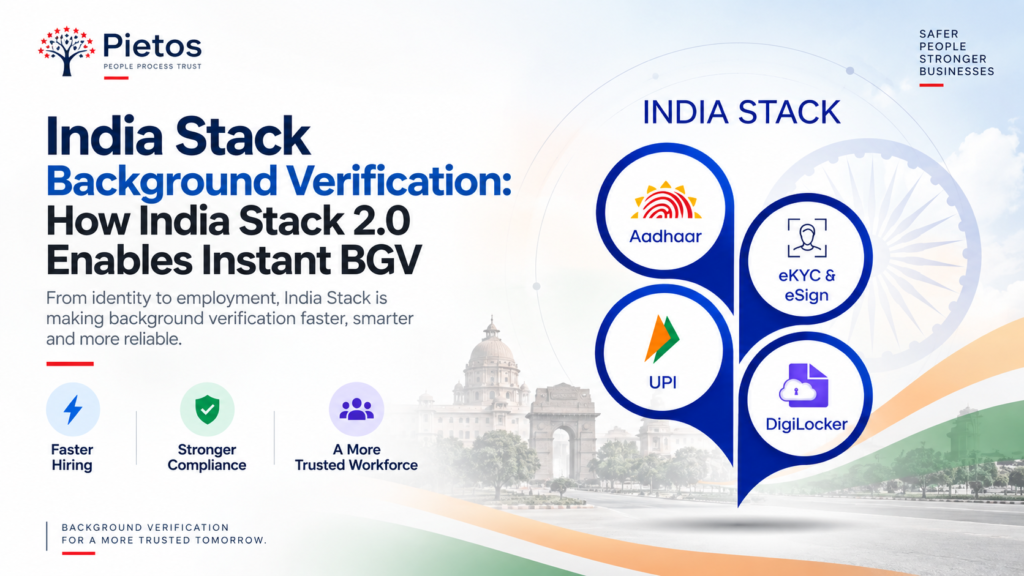
India Stack background verification is no longer a future idea. It is live infrastructure, and it already changes how fast a company can hire. For most HR teams, background verification still means a week or more of waiting. A candidate accepts an offer. Their file goes to a vendor. Someone calls a university registrar. Someone else emails a former employer. Days pass before an HR manager gets a clear answer.
That timeline is breaking down. India Stack is the set of open digital public infrastructure APIs built around identity, data, and payments. It has quietly become the backbone for a faster kind of verification. DigiLocker holds verified documents. PAN 2.0 anchors identity to a single QR-coded record. UAN links a candidate’s entire formal employment history to one number. Together, these layers let a BGV provider confirm education, identity, and employment in hours instead of days.
This piece breaks down what India Stack 2.0 actually contains, how each layer maps to a specific verification check, and why almost no background verification company has built its process around this infrastructure yet. It also lays out the real business risk of staying on a manual, paper-first BGV process while competitors move faster.
Pietos already runs verification on India Stack rails. See how instant BGV actually works.
What India Stack 2.0 Means for Background Verification
India Stack is not one product. It is a layered set of government-backed digital public infrastructure. India Stack 2.0 refers to its current, matured state, where identity, documents, employment data, and consent-based data sharing all run on working APIs.
The original India Stack delivered Aadhaar-based eKYC, UPI payments, and DigiLocker document storage. According to IndiaStack.org, the platform has already processed 67 billion digital identity verifications and supports ten operational Account Aggregators handling consent-based data sharing. In addition, UIDAI reports that Aadhaar-based eKYC brought bank onboarding costs down from roughly twenty-three dollars to fifteen cents per check once digital rails replaced manual verification. That scale matters for BGV. It shows the underlying rails are proven at a population level, not a pilot level.
India Stack 2.0 adds two pieces that change background verification specifically. First, PAN 2.0 upgrades the Permanent Account Number into a QR-coded, dynamically verifiable identity document. Second, a more mature Account Aggregator framework, regulated by the RBI, lets a candidate consent to share specific data with a specific verifier, without a manual document handoff.
For a BGV company, this shift means fewer manual touchpoints. A verification check that once depended on a human calling a registrar can now run through an API. That API confirms the same fact against a government-linked source, with the candidate’s explicit consent built into the request from the start.
The Four Layers of India Stack Powering Instant BGV
Four India Stack components map directly onto the checks that make up a standard BGV report. Each layer replaces one manual step with an API call, and together they form the backbone of modern India Stack background verification.
DigiLocker: The Document Layer
DigiLocker, run by MeitY, is the document verification layer of India Stack. It stores digitally signed, government-issued documents, including education certificates, PAN, driving licences, and increasingly, passport verification records. Any document pulled from DigiLocker carries a digital signature from the issuing authority. As a result, it is legally equivalent to a physical original under the IT Act, 2000.
For BGV, this changes education verification directly. Instead of a verifier emailing a university and waiting for a manual reply, a candidate can pull their degree certificate straight from DigiLocker, already signed by the board or university. Because the signature is already authenticated, the verifier’s job shrinks from “confirm this is real” to “confirm this matches the candidate.”
Read our full breakdown of DigiLocker background verification
PAN 2.0: The Identity Layer
PAN 2.0 is the identity anchor of India Stack background verification. The Cabinet Committee on Economic Affairs approved the PAN 2.0 project to modernize the existing PAN and TAN system into a single, QR-coded digital identifier. Every PAN card under this system carries a dynamic QR code. A verifier can scan that code to pull real-time identity data, rather than relying on a static printed number.
For employee verification, PAN 2.0 closes a long-standing gap. Fake or duplicate PAN cards used to slip through manual checks fairly easily. However, a QR-based, API-verifiable PAN makes identity fraud measurably harder to pull off. Our detailed guide on PAN 2.0 employee verification (confirm live slug before publishing — placeholder based on standard naming) covers the mechanics in full.
UAN: The Employment History Layer
The Universal Account Number, issued through EPFO, is the single most useful India Stack node for employment verification. Every formal-sector employee accumulates PF contributions under one UAN across every employer they have had. Because of this, one API call against UAN data can surface a candidate’s entire formal employment timeline. That includes gaps, overlaps, and employer names that do not match what the candidate listed on their resume.
This is the layer that catches resume fraud fastest, and it is a core reason India Stack background verification outperforms manual calling. See our UAN verification guide for the full process.
Account Aggregator: The Consent Layer
The Account Aggregator framework, regulated by the RBI, is the piece that makes everything above legally clean. It lets a candidate grant time-bound, purpose-specific consent for a verifier to pull specific data. Crucially, this happens without the candidate ever handing over login credentials or raw documents outside a controlled channel.
For a BGV company, this layer solves the consent problem that the DPDP Act now demands. In other words, verification stops being “we collected your documents and hope you agreed,” and becomes “you explicitly authorized this specific check, for this specific purpose, for this specific window of time.”
From Seven-Day BGV to Same-Day BGV: The Speed Shift
The practical impact of India Stack background verification is turnaround time. A traditional BGV process, dependent on manual calls and physical document collection, typically takes five to seven working days for a standard check. It often takes longer for address or court record verification in smaller cities.
| Verification Check | Traditional TAT | India Stack-Powered TAT | Primary India Stack Layer |
|---|---|---|---|
| Education verification | 3–5 days | 2–6 hours | DigiLocker |
| Identity verification | 1–2 days | Minutes | PAN 2.0 |
| Employment history | 4–7 days | Same day | UAN |
| Address verification | 5–10 days | 1–3 days (hybrid physical + digital) | Aadhaar + physical check |
| Consent collection | 1–2 days (paper forms) | Instant | Account Aggregator |
The gap is largest for education and employment checks. These two categories most often bottleneck an entire BGV report. Background verification is following the same cost and speed curve that banking followed a decade earlier, just a few years behind.
Faster BGV does not mean lighter BGV. Talk to Pietos about how we keep accuracy high while cutting turnaround time.
A Same-Day BGV Walkthrough
Here is what India Stack background verification looks like end to end, using a typical mid-market hiring scenario.
A fintech NBFC extends an offer to a candidate on a Monday morning. Instead of a PDF form, the candidate receives a consent link that afternoon. Within minutes, they authorize three checks through an Account Aggregator-based flow: education, identity, and employment history. By Monday evening, the system has already pulled their degree certificate from DigiLocker, complete with the issuing university’s digital signature. Their PAN 2.0 record confirms identity through the QR-linked database. Their UAN pulls a full EPFO employment timeline, flagging one employer gap that the recruiter can raise directly with the candidate.
By Tuesday morning, the HR manager has a report covering three of five checks, less than twenty-four hours after the candidate accepted the offer. Only the address verification, which still needs a physical visit in this case, and any court record check remain open. Those close within one to three additional days. Compare that to a traditional process, where the same report might not land until the following week. The candidate, meanwhile, has far less time to consider a competing offer, and the employer has far less exposure to no-shows.
Why No BGV Brand Has Mapped India Stack to Verification Yet
This is the gap worth naming directly. No major BGV brand in India has published a clear, public explanation of how India Stack maps onto its verification workflow. Search results return plenty of general explainers on DigiLocker or PAN 2.0, written for consumers or fintech audiences. None of the established verification players, including AuthBridge, IDfy, SpringVerify, OnGrid, or First Advantage, have positioned themselves publicly as an India-Stack-native BGV provider.
There are a few reasons for this gap. Most legacy BGV companies built their infrastructure years before PAN 2.0 existed. Retrofitting a workflow around new government APIs takes real engineering investment, not just a marketing update. Many still depend heavily on manual calling teams for education and employment checks, which is a slower process to automate than it sounds. Because India Stack 2.0 components like PAN 2.0 are still rolling out nationally, some vendors appear to be waiting for full adoption before rebuilding around it.
That gap is exactly why this is a strong moment for a company already running verification on this infrastructure to say so clearly and specifically.
What India Stack Background Verification Looks Like in Practice
A candidate accepts an offer. Instead of receiving a PDF form to fill out and scan, they get a consent link. They authorize specific checks through an Account Aggregator-based flow. From there, the process runs largely on its own.
Their education certificate pulls directly from DigiLocker, already signed by the issuing board. Meanwhile, their PAN gets validated through the QR-linked PAN 2.0 record, confirming identity in real time. At the same time, their UAN pulls a full employment timeline from EPFO records, flagging any mismatch against their resume automatically. Address verification still runs a hybrid model, combining Aadhaar-linked data with a physical check where required, since address is the one layer India Stack does not fully digitize yet.
The HR team gets a report the same day for the digital-native checks, with address and any court record checks following within one to three days. There is no manual document chase, no candidate scanning and re-scanning documents, and no week of silence while an HR manager waits on a vendor.
The Business Risk of Staying on Manual, Paper-First BGV
Slow verification is not a neutral cost. It compounds into three specific business risks, each of which shows up on a different line of the business.
Offer drop-off risk. A candidate who accepts an offer and then waits a week or more for BGV clearance has time to consider, or receive, other offers. Every extra day of BGV turnaround is a day of exposure to candidate drop-off. This risk is sharpest in competitive hiring markets like fintech, GCC, and tech-enabled services, where multiple offers in flight is the norm rather than the exception.
Fraud exposure risk. Manual verification depends on a human calling a registrar or an HR contact. This is exactly the process that ghost employers, fabricated employment letters, and proxy candidates are built to exploit. API-based checks against UAN and PAN 2.0 data are structurally harder to fake, because they pull from a government-linked source rather than a phone call that can be coached or faked entirely.
Cost of scale risk. A manual BGV process scales linearly with headcount. More hires mean more calling agents, more follow-ups, and more delays stacking on top of each other. An API-based process scales closer to flat, since the marginal cost of one more verification call is far lower once the integration exists. Companies hiring at volume, including NBFCs, GCCs, and gig-economy platforms, feel this gap most acutely, often without realizing how much it is costing them.
None of these risks are hypothetical. They show up as extended time-to-fill metrics, candidate no-shows after offer acceptance, and verification failures discovered only after a bad hire has already caused damage to a team or a client relationship.
Objections HR Leaders Raise About API-Based BGV — and the Honest Answers
“Isn’t faster verification less thorough?” Not when the underlying data source is stronger. A DigiLocker-sourced education certificate is digitally signed by the issuing authority itself. That is a more reliable data point than a phone call to a registrar’s office, not a weaker one. Speed here comes from removing manual steps, not from skipping checks that matter.
“What about candidates who do not have DigiLocker or a PAN 2.0 card yet?” Adoption is not universal, especially outside metro cities. A working India Stack background verification process needs a fallback path. Manual verification for candidates whose documents are not yet digitized should run in parallel, so it does not stall the rest of the report. This is exactly where a hybrid physical-plus-digital model matters most for tier 2 and tier 3 hiring.
“Is consent-based data sharing actually compliant with India’s data protection law?” Yes, and it is built for exactly this purpose. The Account Aggregator framework requires purpose-specific, time-bound consent before any data moves. That structure aligns directly with DPDP Act requirements for lawful, consented data processing. If anything, it is a stronger compliance position than a static paper consent form signed once and stored indefinitely.
“Can we trust an API-based report as much as a manually verified one?” A government-issued API response is not weaker evidence than a human phone call. It removes the risk of a verifier being misled by a fabricated reference, since the check runs against a primary government-linked data source instead of a secondary human contact who can be persuaded or mistaken.
A Practical Framework: Evaluating an India-Stack-Ready BGV Partner
Use these four questions to evaluate whether a BGV vendor is actually built on India Stack, or just claims to be “digital” without the infrastructure behind it.
- Does the vendor integrate directly with DigiLocker for document pulls? Or does it still ask candidates to scan and upload documents manually? Direct integration is the difference between real automation and a digitized version of the same manual process.
- Can the vendor verify PAN through the QR-based PAN 2.0 system? Or does it still rely on manually checking a static PAN number against a database? QR-based verification catches fraud that static checks routinely miss.
- Does UAN-based employment verification run automatically, surfacing a full formal employment timeline? Or does the vendor still depend on calling each listed employer one by one? The UAN check should be the fastest part of the report, not the slowest.
- Is consent collected through a proper Account Aggregator-based flow, with purpose and time limits attached? Or through a generic form that a candidate signs once and forgets about? This directly affects DPDP Act compliance exposure down the line.
A vendor that answers yes to all four is running genuine India Stack background verification. A vendor that answers yes to only one or two is partway there at best.
The Compliance Layer: DPDP Act and Consent-Based Verification
India’s Digital Personal Data Protection Act changes what “consent” needs to mean for a BGV process. A blanket consent form, signed once at onboarding, no longer meets the bar for lawful processing of sensitive personal data. The DPDP Act requires purpose limitation and clear, revocable consent, not a one-time signature buried in an offer packet.
This is where India Stack’s Account Aggregator framework becomes a compliance asset, not just a speed asset. Consent captured through an Account Aggregator flow is inherently purpose-specific and time-bound by design. As a result, it maps naturally onto DPDP Act requirements. A BGV provider built on this framework has a structural compliance advantage over one still using static paper or PDF consent forms, and that advantage only grows as enforcement tightens.
What This Means for Tier 2/3 Hiring and Blue-Collar Workforces
India Stack adoption is not evenly distributed across the country. Metro, white-collar candidates are far more likely to already have an active DigiLocker account and digitized education records. Tier 2 and tier 3 candidates, and much of India’s blue-collar and gig workforce, still depend more heavily on physical documents and in-person address checks.
This is exactly why a pure API-based model does not work for every hiring segment, and why a hybrid physical-plus-digital approach still matters. The highest-value use of India Stack right now is speeding up the checks it can fully digitize: education, identity, and formal employment history. Meanwhile, a BGV partner still needs strong physical verification capability for address checks and for candidates outside the digital-native segment. A partner built for India’s actual workforce mix, not just its metro tech hiring, needs both capabilities working together at once.
Pietos runs this hybrid model at scale, digital-first where India Stack supports it, physical-plus-digital where it does not. See how we verify across tier 1, 2, and 3 cities.
The Data Behind the Shift
The numbers behind India Stack back up the claim that this infrastructure is ready for background verification, not just banking and payments. As mentioned earlier, IndiaStack.org reports 67 billion digital identity verifications processed to date, alongside ten operational Account Aggregators actively moving consented data between institutions. That is not a small pilot. It is national-scale infrastructure that BGV has simply been slow to adopt.
Consider what this means in practical terms. EPFO manages formal employment records for tens of millions of active subscribers, each tied to a single UAN. Every one of those records already exists in a government-linked database, ready to answer a single, specific question: does this candidate’s claimed employment history match what the government has on file? A BGV process built on manual calling cannot match that speed, no matter how large the calling team is.
DigiLocker tells a similar story. Since its 2015 launch under the Digital India program, adoption has grown from a niche government initiative into a platform most digitally active Indians interact with regularly, whether for a driving licence, a PAN card, or increasingly, education certificates.
How This Changes BGV Vendor Contracts and SLAs
A shift in underlying infrastructure should change what HR teams ask for in a vendor contract, not just what they expect informally. Three specific terms are worth renegotiating with any BGV partner.
Turnaround time SLAs. A vendor genuinely running India Stack background verification should commit to same-day turnaround for education, identity, and employment checks, with a separate, longer SLA for address and court record checks. If a vendor’s contract still lists five to seven days across the board, that is a strong signal they have not rebuilt their process around this infrastructure yet.
Consent documentation. Ask specifically how consent gets captured. A vendor using Account Aggregator-based consent should be able to show a time-stamped, purpose-specific consent record for every check, not a single signed PDF covering everything indefinitely. This detail matters directly for DPDP Act audit readiness.
Fallback process for non-digital candidates. Because India Stack adoption varies by geography and candidate segment, ask how the vendor handles candidates who do not yet have DigiLocker or a QR-based PAN. A strong partner runs a parallel manual process for these cases, so one candidate’s lower digital footprint does not stall the whole report or force a slower baseline for everyone.
Reputational Risk: The Fourth Cost of Staying Manual
Beyond offer drop-off, fraud exposure, and scaling cost, there is a fourth risk worth naming on its own: reputational exposure when a bad hire surfaces publicly. A fabricated employment history or a falsified education credential that slips through a manual BGV process does not just create an internal HR problem. In regulated sectors like BFSI and NBFC lending, a verification failure can trigger compliance scrutiny, client questions, and in some cases, regulatory reporting obligations.
India Stack background verification reduces this exposure at the source, because the underlying data comes from a government-linked system rather than a reference that can be coached or fabricated. That does not eliminate risk entirely, but it closes the single largest gap that manual, call-based verification has always struggled with.
What to Expect When You Switch to an India Stack-Ready BGV Partner
Moving from a legacy, manual-first BGV vendor to one built on India Stack background verification is not a disruptive migration. Most HR teams can expect a straightforward transition across three phases.
Phase one: integration and mapping. In the first one to two weeks, the new vendor maps your existing check list, education, identity, employment, address, and any sector-specific checks, onto the India Stack layers that can handle them digitally. This step also confirms which checks still need a manual or hybrid path for your specific candidate mix, particularly if you hire across tier 2 and tier 3 cities.
Phase two: parallel run. Many HR teams choose to run a small batch of candidates through the new process alongside their existing vendor for two to four weeks. This lets the team compare turnaround time and report quality directly, without fully committing before seeing results. In most cases, the digital-native checks show a visible speed difference within the first batch.
Phase three: full transition. Once the parallel run confirms accuracy and turnaround, the full candidate pipeline moves over. From this point, HR teams typically see same-day reports for education, identity, and employment checks becoming the default, not the exception, with address and court record checks following the same one-to-three-day pattern as before.
The single biggest mindset shift is not technical. It is realizing that BGV turnaround time is no longer a fixed cost of hiring. It is a variable that depends entirely on which infrastructure a vendor has actually built.
Frequently Asked Questions
India Stack background verification means running BGV checks through India’s digital public infrastructure. It primarily uses DigiLocker for documents, PAN 2.0 for identity, and UAN for employment history, instead of relying on manual calls and physical document collection.
Education and identity checks that traditionally take three to five days can complete in hours through DigiLocker and PAN 2.0 integration. Employment history checks through UAN, which traditionally take four to seven days, can often complete the same day.
Yes. Documents pulled from DigiLocker carry digital signatures from the issuing authority and are legally equivalent to physical originals under the IT Act, 2000. PAN 2.0 and UAN data come directly from government-linked sources.
Partially. Digital adoption is stronger in metro areas. A reliable BGV process for tier 2 and tier 3 candidates still needs a hybrid model that combines India Stack data with physical verification where digital records are not yet available.
When built on the Account Aggregator framework, yes. That framework requires purpose-specific, time-bound consent before data moves, which aligns with DPDP Act requirements more directly than a static paper consent form.
Public information on this is limited. As of now, no major Indian BGV brand has published a detailed account of its India Stack integration. Pietos has built its verification workflow directly on DigiLocker, PAN 2.0, and UAN infrastructure.
Ask whether checks run through direct DigiLocker and PAN 2.0 integration, whether UAN-based employment verification is automated, and whether consent runs through an Account Aggregator flow. A vendor offering true India Stack background verification should answer yes to all three without qualification.
No. It replaces the manual steps behind document, identity, and employment checks. Address verification and court record checks in many regions still require a hybrid model that combines digital data with physical, on-ground verification.