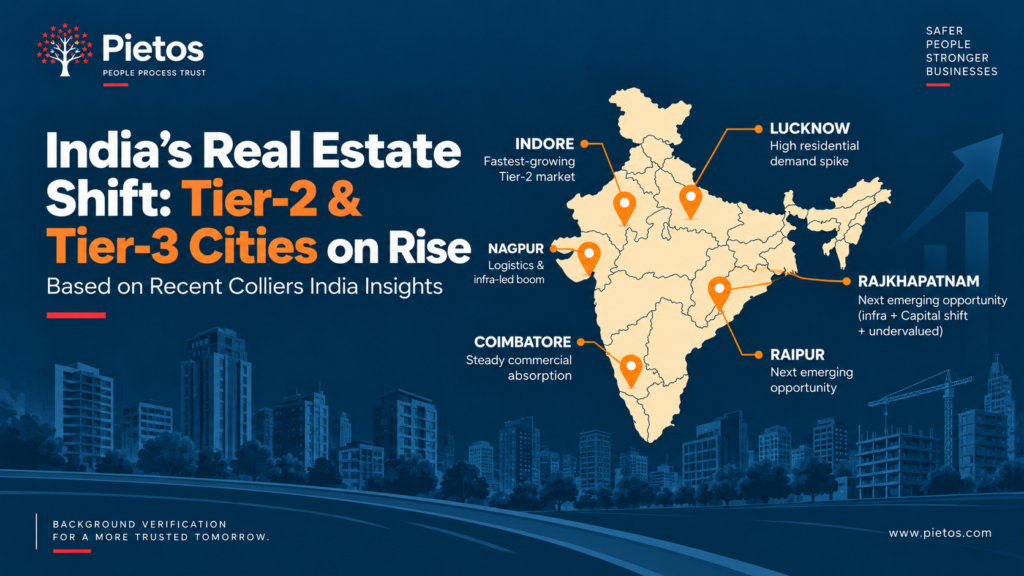
Background verification tier 2 cities India is no longer a niche HR concern. It is a boardroom question. Companies that hired only in Delhi, Mumbai, and Bengaluru for a decade are now opening desks in Indore, Coimbatore, and Bhubaneswar. Most of them are learning, the hard way, that background verification tier 2 cities India does not work like metro BGV.
This shift is not a temporary blip. It is a structural rebalancing of where India works. Global Capability Centres want cheaper real estate. Startups want talent that isn’t being poached every quarter. Manufacturing and logistics firms want to sit closer to their factories. All of them need to hire fast, and all of them need to verify who they are hiring.
No HR or BGV brand has covered this shift with real city-level detail yet. Most content still treats “tier 2 hiring” as a single, generic trend. It isn’t. Indore behaves nothing like Kochi. Lucknow behaves nothing like Nagpur. A verification process built for one will not automatically work for the other.
The gap shows up fastest at the operational level. A TA leader who has only ever hired in Bengaluru assumes a background check takes three to five days everywhere, because that has always been true for them. They brief a new tier-2 opening the same way, promise the same timeline to a hiring manager, and then spend the next six weeks explaining delays nobody predicted. This guide exists to close that gap before it costs you a hiring cycle.
If your TA team has never run background verification tier 2 cities India before, this guide walks through where the boom is happening, why it is catching HR leaders off guard, and what actually breaks when metro-built BGV processes meet tier-2 realities.
Struggling to verify hires outside your usual metro cities? Talk to a Pietos verification specialist about your tier-2 hiring rollout.
Why India’s Hiring Boom Skipped the Metros
For twenty years, corporate India’s centre of gravity sat in five cities. That grip is loosening fast, and the numbers are no longer subtle.
Industry data backs this up clearly. Tier-2 cities are projected to account for roughly 32% of all planned hiring in India, closing in on the 53% share still held by tier-1 hubs. Global Capability Centres alone have seen a 40% surge in their share hosted in tier-2 locations. Overall hiring activity across tier-2 and tier-3-plus cities has climbed 25% to 35% in a single year. Tier-3-plus cities, smaller still, are showing early signs of their own 15% to 25% hiring surge.
Three structural forces are driving this shift, and none of them look temporary.
Cost discipline. Real estate, compensation, and attrition all run cheaper outside metros, and CFOs have noticed. Senior management compensation in tier-2 cities has already climbed to an average of roughly ₹28 lakh per annum, with cities like Thane and Kochi now competing directly with satellite offices of Mumbai and Bengaluru firms. This is not a discount workforce chasing lower pay. It is a parallel workforce commanding near-metro salaries, which changes how seriously companies need to take the hiring process there.
Infrastructure investment. Government programmes have upgraded transport, power, and digital connectivity across roughly a hundred smaller cities. That removes the old excuse that tier-2 India “isn’t ready” for serious corporate offices. Airports, expressways, and fibre rollouts have quietly closed the operational gap that used to justify staying metro-only.
Talent density. Engineering colleges, finishing schools, and a wave of returning migrant professionals have built genuine skilled workforces in cities that used to only export talent to metros. A software engineer who left Coimbatore for Bengaluru in 2015 is, in many cases, now choosing to work from Coimbatore instead.
Put together, these forces mean the tier-2 hiring boom is not a cost-cutting fad. It is where a growing share of India’s serious, salaried, skilled workforce now lives and works. Any company scaling past its home metro needs a hiring process, and a verification process, built for that reality.
Top 10 Unexpected Tier-2 Hiring Hotspots in India (2026)
Some of these cities will surprise even seasoned TA leaders. None were on a standard five-city hiring map five years ago. Here is where the boom is concentrating, and why each city made the list.
| Rank | City | Why It’s Booming |
|---|---|---|
| 1 | Indore | Manufacturing and IT-enabled services hub; strong tier-2 talent pool with low attrition |
| 2 | Jaipur | BFSI back-offices and startup satellite teams drawn by cost and connectivity to Delhi NCR |
| 3 | Lucknow | Government-driven infrastructure push plus growing BPO and retail hiring |
| 4 | Coimbatore | Established engineering and manufacturing base now adding tech and GCC roles |
| 5 | Kochi | Senior management salaries rival metro benchmarks; strong fintech and IT talent |
| 6 | Thane | Functions as a cost-efficient extension of Mumbai’s corporate corridor |
| 7 | Nagpur | Logistics hub status plus new industrial corridors pulling in warehouse and ops hiring |
| 8 | Bhubaneswar | Emerging IT-SEZ activity and a young, education-heavy talent base |
| 9 | Chandigarh | Strong BFSI and consulting satellite presence with better quality-of-life draw for mid-career hires |
| 10 | Visakhapatnam | Port-driven logistics and manufacturing growth alongside a new IT push |
City-by-City Breakdown
Indore leads this list for a reason few outsiders expect. It built a manufacturing base decades ago, and it has quietly layered IT-enabled services on top of it. Attrition here runs lower than in most metros, which matters enormously for companies tired of re-hiring the same seat three times a year.
Jaipur benefits from geography as much as talent. It sits close enough to Delhi NCR for easy oversight, cheap enough to beat NCR real estate, and deep enough in BFSI-trained graduates to support back-office and support functions at scale.
Lucknow surprises people because its hiring boom is government-led first, private-sector second. Infrastructure spending has pulled in BPO and retail chains that previously skipped Uttar Pradesh entirely outside Noida.
Coimbatore has always had engineering talent. What’s new is the type of company hiring it. GCCs and product companies are now opening satellite teams there, not just manufacturing units, because the workforce already understands precision and process discipline.
Kochi is arguably the biggest surprise on this list. Senior management pay here rivals metro benchmarks, and fintech and IT firms are treating it as a genuine leadership hub, not a junior-staff outpost.
Thane technically sits inside the Mumbai Metropolitan Region, but functionally it behaves like a tier-2 extension. Companies use it to cut real estate cost without losing proximity to Mumbai’s client base.
Nagpur’s growth comes from geography again, this time logistics geography. New industrial corridors and its central location make it a natural warehousing and operations hub for companies serving both north and south India.
Bhubaneswar is pulling in IT-SEZ activity faster than most people track. It has a young, education-heavy population and government incentives that are starting to show real results in hiring volume.
Chandigarh draws a specific kind of hire: mid-career professionals who want BFSI or consulting-grade work without the metro grind. Quality of life is doing real recruiting work here.
Visakhapatnam rounds out the list on the back of port-driven logistics and manufacturing growth, with a newer IT push layered on top that is only starting to show up in hiring data.
What Ties These Ten Cities Together
The pattern across all ten is consistent. Each city shows real, sustained job creation across BFSI, manufacturing, logistics, and technology roles, not a one-quarter spike. Each also has meaningfully better digital and physical infrastructure than it did five years ago, which is what makes serious corporate hiring possible there in the first place. Companies expanding into any of them face the same question: can their verification process actually keep up with where they now need to hire, given how differently each city behaves once you look past the headline hiring numbers?
Which Sectors Are Actually Driving This Boom
The tier-2 hiring surge is not evenly spread across industries. Three sectors are pulling most of the volume, and each brings a different verification challenge.
BFSI back-offices and support functions dominate cities like Jaipur and Chandigarh. These roles handle sensitive financial data from day one, which means identity and education verification cannot be an afterthought. A single unverified hire in a loan-processing back-office carries real regulatory exposure.
Manufacturing and industrial roles anchor the boom in Indore, Coimbatore, Nagpur, and Visakhapatnam. These hires often come from a wider geographic catchment than office roles, pulling candidates from surrounding tier-3 towns and rural districts. That widens the address-verification challenge considerably, since a factory in Nagpur might be hiring from villages two hours outside the city.
Global Capability Centres and IT-enabled services are the newest entrants in Kochi, Bhubaneswar, and Coimbatore. GCCs in particular bring global compliance expectations, often from US or EU parent companies, layered onto an Indian verification process that was never built with those standards in mind.
Understanding which sector is driving hiring in a given city tells you what kind of verification risk to expect before a single candidate applies.
A fourth pattern worth watching: retail and quick-commerce hiring, which is scaling fast in Lucknow and Visakhapatnam as national chains extend delivery and store networks into non-metro India. These roles carry high volume and high turnover, which puts a premium on a verification process that stays fast and consistent even at scale, rather than one built for occasional, low-volume hiring.
Compliance Considerations for Tier-2 Hiring in India
Tier-2 expansion does not pause a company’s compliance obligations. If anything, it raises the stakes, because HR and compliance teams have less local familiarity with each new location.
India’s Digital Personal Data Protection Act governs how candidate data gets collected, stored, and processed during verification, regardless of which city the candidate lives in. A vendor without a clear DPDP-compliant consent and data-handling process creates real legal exposure, especially as companies verify candidates across dozens of new cities at once.
Labour code reforms have also tightened documentation requirements for fixed-term and contract workers, a hiring category that shows up disproportionately in tier-2 manufacturing and logistics roles. Verification records now need to hold up not just for hiring decisions, but for labour-compliance audits down the line.
Companies moving into tier-2 cities for the first time should treat compliance as part of the verification brief, not a separate legal exercise handled after the fact.
State-level variation adds another layer. Labour law enforcement, court digitisation, and data-handling practices differ meaningfully between states, which means a verification approach that works cleanly in Madhya Pradesh may need adjustment in Odisha or Andhra Pradesh. A vendor with genuine multi-state, district-level experience will already understand these differences. One built for a handful of metro states will be learning them on your hiring cohort’s time.
Why Background Verification Tier 2 Cities India Breaks the Metro Playbook
Metro BGV workflows assume three things. Structured addressing. Dense field-agent coverage. Reliable digital records. None of those assumptions hold once a company crosses into tier-2 territory, and this is exactly where most HR teams get caught off guard.
Addressing gets messier. Address formats in smaller cities are inconsistent, and formal addressing systems are often incomplete outside city centres. A field agent visits, confirms the person lives there, and files a report. In metros, this step is routine. Once a company expands beyond Delhi, Mumbai, or Bengaluru, address verification derails more hiring timelines than any other part of background verification.
Field-agent coverage thins out fast. A check that takes two days in Gurugram can take eight in a tier-3 district. Vendors quote one turnaround time and deliver another, because their actual agent network is thinner than their sales deck suggests. Coverage claims and coverage reality diverge often once you move past tier-2 into tier-3 and tier-4 India.
Digital record depth drops. Identity and education checks that resolve instantly in Bengaluru sometimes need manual escalation elsewhere, because the underlying digital databases simply have less coverage outside the top ten cities.
The business cost compounds daily. Every day a background verification tier 2 cities India check sits pending is a day a hiring manager cannot onboard, a seat stays empty, and the internal business case for the expansion gets a little harder to defend. HR teams scaling into smaller cities keep hitting the same wall, and it rarely gets flagged until the third or fourth delayed start date.
Key takeaway: a vendor quoting identical turnaround time for tier-1 and tier-3 addresses is either padding metro numbers or under-delivering in smaller cities. Ask for tier-wise SLAs, not one blended average, before you sign anything.
Expanding hiring to Indore, Jaipur, Lucknow, or Coimbatore? See how Pietos verifies candidates across 900+ Indian cities.
What a Tier-2-Ready BGV Partner Actually Needs to Prove
Most BGV vendors built their process around five metros and then stretched it thin. A partner that is genuinely tier-2 ready looks different. Look for four specific capabilities before you sign anything.
Real district-level field coverage. Ask for the actual field-agent map, not a coverage claim on a slide. A verification partner needs genuine district-level presence, not a thin sub-agent layer stretched across states.
Digital-first identity checks. DigiLocker-based verification pulls government-issued proof directly from source, cutting forgery risk before a field visit even happens. This matters more, not less, once you move outside metros, where document fraud is harder to catch through manual review alone.
Tier-wise SLAs, in writing. A single blended turnaround time hides the truth about tier-3 performance. Demand a separate number for tier-1, tier-2, and tier-3 addresses, and hold the vendor to it.
A track record with mid-market or startup clients scaling outside metros. A vendor built only for enterprise, single-city hiring will not have solved the district-level problems that startups and NBFCs run into first, because they usually hit tier-2 expansion earlier in their growth curve.
A Five-Point Framework for Screening Tier-2 Hires
Use this checklist before your next tier-2 hiring push. Each step closes a gap that trips up first-time tier-2 employers.
1. Map your cities first. Know exactly which tier-2 or tier-3 cities are in scope before you brief a vendor. List every city where you expect volume in the next twelve months, not just the one you’re opening this quarter. A vague brief gets a vague, blended SLA back, and you will not find out the SLA was blended until a candidate is already waiting.
2. Ask for tier-wise TAT, in writing. Not a blended average. A specific number for each tier, with consequences written into the contract if the vendor misses it. If a vendor cannot break their turnaround time out by city tier, that itself is a signal they have not built district-level infrastructure.
3. Pair digital identity checks with physical address verification. Digital alone misses too much in thinner-infrastructure cities. The two need to work as one connected process, not two separate vendors that don’t talk to each other and hand off reports with gaps between them. Ask specifically how your vendor decides when a case needs a physical visit versus when digital confirmation is enough.
4. Build in a re-verification path. Outdated addresses and record mismatches happen more often outside metros, where formal addressing systems are less complete. Your vendor needs a fast correction process, not a “final report, no changes” mindset that leaves candidates and HR teams stuck arguing over a stale record.
5. Pilot before you scale. Run one hiring cohort through the full process in a new city before committing volume hiring there. A twenty-person pilot exposes vendor weaknesses, gaps in field coverage, and turnaround surprises far more cheaply than a two-hundred-person rollout does. Treat the pilot data as a go or no-go gate before opening the location fully.
The Real Cost of Getting Tier-2 Verification Wrong
The risk here is not abstract. Several major logistics and warehouse enterprises have already scaled back their hiring plans in tier-3 towns, choosing instead to centralise hubs in better-connected tier-1 and tier-2 areas, purely to avoid the high cost and long timelines of rural background verification. That is a quiet form of geographic exclusion, and it usually starts as a verification problem, not a strategic decision.
Delayed background checks cost more than a late start date. They stall entire regional expansion plans. A hiring manager who cannot fill three seats in Nagpur for six weeks starts questioning whether the expansion made sense at all, even when the underlying business case was sound. The verification bottleneck, left unaddressed, quietly undermines a decision the leadership team already made.
Inconsistent reports create a second, less visible cost. When address checks come back clean in one city and unreliable in another, HR teams lose confidence in the process itself. They start double-checking vendor reports manually, which defeats the entire point of outsourcing verification in the first place.
There is also a candidate-experience cost that rarely makes it into an internal business case. A strong candidate in Kochi or Nagpur who accepts an offer and then waits three extra weeks for verification to clear starts fielding other offers in the meantime. Tier-2 talent markets are tighter than they look from a metro vantage point, and a slow verification process can cost a company its best hire before day one.
Finally, there is a reputational cost that compounds across a growing tier-2 footprint. Word travels fast in smaller professional communities. A company known locally for a slow, confusing onboarding process finds its employer brand damaged in exactly the cities it is trying to build a reputation in for the first time.
Building an Internal Tier-2 Hiring Playbook
Most of the pain described above is preventable with a simple internal playbook, built once and reused every time HR opens a new tier-2 city.
Document city tiers explicitly. Classify every location your company hires in in, whether tier-1, tier-2, or tier-3, and attach the expected verification timeline to each. New hiring managers should be able to see this before they open a requisition, not discover it after a candidate is already waiting.
Set hiring-manager expectations upfront. A hiring manager who knows a tier-3 verification takes seven to ten days plans the offer and joining date accordingly. One who assumes a metro timeline ends up frustrated and pushing HR for updates that don’t exist yet.
Centralise vendor performance data. Track actual turnaround time by city, not just by vendor overall. A vendor performing well in Jaipur and poorly in Nagpur needs a different conversation than one performing poorly everywhere.
Review the playbook every two quarters. Tier-2 infrastructure changes fast. A city that was verification-slow eighteen months ago may have improved significantly as digital record coverage expands. An outdated playbook underestimates cities that have genuinely caught up.
Buyer Objections and Honest Answers
“Tier-2 verification will slow us down more than it helps.” It will, if your vendor lacks real district coverage. It won’t, if you demand tier-wise SLAs upfront and pilot the process before scaling. The slowdown comes from the vendor gap, not from verification itself.
“We’ll just skip physical checks and go fully digital.” Digital-only verification misses too much in cities where address databases are thinner. A hybrid approach, digital where it works and physical where it doesn’t, consistently outperforms an all-digital shortcut in tier-2 and tier-3 India.
“Our current metro vendor already covers the whole country.” Ask for their actual field-agent map before you believe that. Many vendors quote pan-India coverage on paper while running a thin sub-agent layer that only shows its weaknesses once a real hiring cohort moves through it.
“This is too small a hiring volume to build a new process for.” Tier-2 hiring rarely stays small. Companies that plan for five tier-2 hires this quarter are often planning for fifty next year, once the cost and talent case proves out. Building the right process now avoids a costly redo later.
“Our compliance team says this adds too much process overhead.” A well-scoped tier-2 verification brief actually reduces overhead, because it prevents ad-hoc, city-by-city decisions later. Compliance teams generally prefer one documented framework applied consistently over dozens of one-off calls made under hiring pressure.
“Candidates in smaller cities won’t tolerate a slower process.” The opposite tends to be true. Candidates in tier-2 cities are often less familiar with corporate BGV timelines than metro candidates who have been through it before, and clear communication about timeline matters more than raw speed. A company that explains the process well retains candidates even through a longer verification window.
What a Tier-2 Verification Workflow Actually Looks Like, Day by Day
It helps to walk through what a well-run process looks like in practice, rather than in theory.
Day 1 to 2: Digital identity and document checks. As soon as a candidate accepts an offer, identity, PAN, and education records move through digital checks. In tier-2 cities, this stage usually runs close to metro speed, because digital identity infrastructure like Aadhaar and DigiLocker has strong national coverage even where address databases are thin.
Day 2 to 4: Employment history verification. Previous employer confirmation depends on how digitised the candidate’s past employer is. A candidate coming from a large enterprise verifies fast. A candidate coming from a small local business in a tier-3 town often needs a phone-based or field-based confirmation instead, which adds a day or two.
Day 3 to 7: Address verification. This is where tier-2 and tier-3 timelines diverge most from metro benchmarks. A field agent needs to physically confirm the address, and if the vendor’s agent network is thin in that district, this step alone can stretch past a week. Strong vendors use geo-tagged photo or video verification to speed this up wherever candidates can self-verify safely.
Day 5 to 8: Criminal record and court checks. Coverage depends on how digitised the relevant district and state courts are. Some states have strong e-court integration. Others still require manual court-registry checks, which take longer and need a genuinely local presence to execute well.
A candidate hired in Bengaluru might clear every stage inside three working days. The same role, hired in a tier-3 district near Indore, can reasonably take seven to ten days if the vendor has real infrastructure there, and considerably longer if it doesn’t. Knowing this timeline upfront lets HR teams set honest expectations with hiring managers instead of promising a metro turnaround they cannot deliver.
It’s worth noting that within this workflow, the address-verification stage alone accounts for most of the tier-2 versus metro gap. Identity checks, education verification, and even employment history checks generally run close to metro speed almost everywhere in India today, because those data sources have digitised faster than physical address records have. Companies that understand this can set accurate, stage-by-stage expectations instead of assuming every part of the process runs equally slower in a tier-2 city. It also tells HR exactly where to focus vendor scrutiny: not on the whole process, but specifically on how a vendor handles address confirmation outside metro limits.
A Quick Example: What Good Tier-2 Verification Looks Like
A microfinance company recently needed to authenticate more than 3,000 field employees across 40 cities, many of them tier-2 and tier-3 locations. Using digital address verification through geo-tagged images and geolocation checks, alongside physical verification where digital coverage fell short, the entire cohort was verified within 72 hours. That outcome only happens when digital and physical verification work as one connected system, not two disconnected vendors handing off reports to each other.
The Business Case for Getting This Right the First Time
None of this is purely a compliance exercise. There is a direct revenue and efficiency argument for building tier-2 verification correctly from the start.
Faster time-to-productivity. Every day shaved off a tier-2 verification cycle is a day earlier a new hire starts generating value, whether that’s a factory line running at full headcount in Nagpur or a support team fully staffed in Jaipur. Across a hiring cohort of fifty or a hundred people, even a two- or three-day improvement per hire compounds into weeks of recovered productivity.
Lower re-hiring cost. Poor verification, whether too slow or too shallow, leads to either lost candidates or bad hires that surface problems later. Both are expensive. A bad hire in a role handling customer or financial data can cost far more than the verification fee that would have caught the issue upfront.
Defensible expansion decisions. When a tier-2 or tier-3 expansion runs smoothly on the hiring side, it strengthens the internal case for further expansion. When it runs into repeated delays traced back to verification, that friction gets remembered the next time someone proposes opening another non-metro location, even if the underlying business case was strong.
Treat tier-2 verification as an enabler of the expansion strategy, not a compliance checkbox bolted onto the end of it. Companies that make this shift consistently outpace competitors still running every hiring decision through a metro-only lens.
Ready to Hire Beyond the Metros with Confidence?
The tier-2 hiring boom is not slowing down, and neither should your onboarding timelines. Companies that treat background verification tier 2 cities India as an afterthought end up with delayed start dates, inconsistent reports, and hiring managers who stop trusting the process.
Talk to a Pietos verification specialist about your tier-2 and tier-3 hiring rollout. Pietos combines district-level field coverage with digital-first identity checks across 900-plus Indian cities, so your expansion timeline does not slow down waiting on a background check.
FAQ Section
Address formats are less standardised, field-agent coverage is thinner, and digital record depth drops outside the top ten cities. Turnaround times run longer unless a vendor has genuine district-level presence.
Indore, Jaipur, Lucknow, Coimbatore, Kochi, Thane, Nagpur, Bhubaneswar, Chandigarh, and Visakhapatnam are among the fastest-growing non-metro hiring hubs, driven by manufacturing, BFSI, logistics, and GCC expansion.
It depends on the vendor’s actual field coverage. A check that closes in two days in a metro can take a week or more in a tier-3 district if the vendor lacks local agents. Always ask for tier-wise SLAs before signing.
Partially. Digital identity checks work well almost everywhere, but address verification in many tier-2 and tier-3 locations still needs a physical field visit, because digital address databases are thinner outside major cities.
Several logistics and warehouse companies have scaled back tier-3 hiring plans specifically to avoid the cost and delay of rural background verification, choosing to centralise in better-connected tier-1 and tier-2 hubs instead.