A candidate clears every interview round. Their references check out. Their degree is genuine. Six weeks later, they collapse on the factory floor during a routine shift, and the post-incident audit reveals nobody confirmed they were medically fit for the role in the first place.
This scenario repeats across Indian manufacturing, logistics, and healthcare hiring every year. Pre-employment medical checks exist to prevent exactly this outcome. Yet most HR teams treat them as an afterthought, bundled loosely into onboarding paperwork rather than run as a structured, auditable process.
This guide explains what pre-employment medical checks cover, which Indian laws mandate them, which sectors carry legal exposure, and how to build a screening process that protects your workforce and your compliance record.
📩 Not sure if your hiring process needs medical screening? Talk to Pietos about mapping your risk by role.
What Are Pre-Employment Medical Checks?
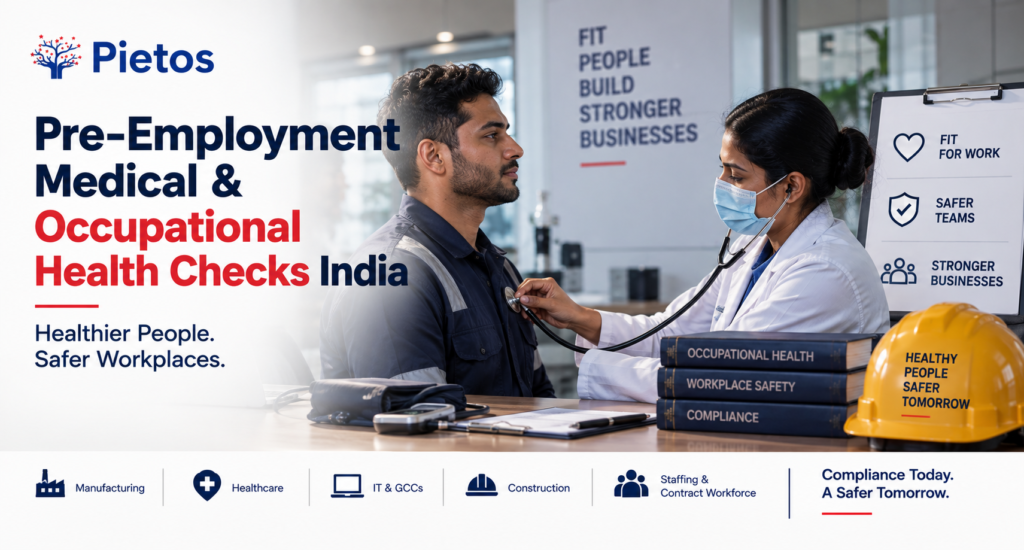
Pre-employment medical checks confirm a candidate is physically and medically fit to perform a specific job before they join. A certifying surgeon, government-approved doctor, or authorised medical examiner conducts the assessment. The employer receives a fitness certificate, not a full medical report, which protects the candidate’s privacy while satisfying compliance needs.
The scope varies by role. A desk-based software hire rarely needs anything beyond a basic wellness check. A crane operator, pilot, or food-processing worker faces a legally mandated examination tied to the specific hazards of their job.
This distinction matters. Indian law does not require blanket medical testing for every hire. It requires targeted screening for roles where unfitness creates safety, public health, or liability risk.
Why This Sits Outside Standard Background Verification
Background verification confirms a candidate is who they claim to be. It checks identity, education, employment history, and criminal records. Pre-employment medical checks answer a different question: can this person safely perform the job?
Many HR teams assume a routine pre-joining fitness certificate covers substance use, vision standards, or cardiac fitness for physically demanding roles. It rarely does. A standard fitness check confirms general health, not role-specific medical clearance under sector law.
Treating medical screening as a separate, mapped requirement — rather than a footnote inside BGV — closes a real compliance gap. For a broader view of how this fits inside a complete hiring risk framework, see Pietos’ guide to employee background verification services in India.
The Legal Framework Behind Pre-Employment Medical Checks in India
India does not have one central law that forces every employer to run pre-employment medical checks. Instead, obligations sit inside sector-specific legislation, safety codes, and internal company policy. HR teams that assume the rule is either universal or optional both get it wrong.
Factories Act, 1948
The Factories Act, 1948 remains the anchor law for occupational health checks in manufacturing. Section 41-C requires that workers assigned to any hazardous process, as defined in the First Schedule, undergo medical examination before starting work. A certifying surgeon appointed by the state government must conduct or supervise the exam, not just any registered doctor.
The resulting fitness certificate is valid for twelve months. Employers must renew it annually for workers in hazardous roles. DGFASLI, the Directorate General of Factory Advice Service and Labour Institutes, oversees technical enforcement of this requirement across states, working alongside state factory inspectorates.
Many employers run a general biochemistry panel or chest X-ray and assume it satisfies the Act. It doesn’t, unless the panel explicitly includes every test prescribed for that worker’s specific hazardous-process classification.
Aviation: DGCA Medical Standards
Aviation sits at the strictest end of India’s medical screening spectrum. The Directorate General of Civil Aviation mandates Class 1, Class 2, and Class 3 medical certificates depending on the role — pilots, cabin crew, and air traffic controllers each face distinct standards. DGCA also runs random and pre-employment psychoactive substance checks across airlines and ground handling staff.
This sector shows what full regulatory maturity looks like. Every other industry in India is moving toward this level of scrutiny, not away from it.
Food Processing: FSSAI Fitness Certificates
Food safety law treats employee fitness as a public health control, not an HR formality. The Food Safety and Standards Authority of India requires food handlers to hold a medical fitness certificate confirming they are free from infectious and contagious disease before they can work in food preparation or processing roles.
Restaurants, catering companies, and food manufacturers that skip this step carry direct exposure under the Food Safety and Standards Act, separate from any BGV gap.
National Policy Layer: Ministry of Health and ILO Standards
Two ministries share responsibility for occupational health in India. The Ministry of Labour and Employment, through DGFASLI and DGMS, handles workplace-level enforcement. The Ministry of Health and Family Welfare sets the broader national health policy framework that underpins these standards.
Globally, the International Labour Organization publishes guidance on pre-employment medical examinations that many Indian enterprise clients now reference in vendor pre-qualification, especially companies with export contracts or multinational parent companies.
Key takeaway: Pre-employment medical checks in India are governed by a patchwork of sector rules, not one blanket law. HR teams must map their obligation role by role, not company by company.
📩 Unsure which of these frameworks applies to your workforce? Pietos maps sector-specific medical screening requirements as part of a full BGV rollout.
Which Sectors Actually Need Medical Screening
Not every employer carries the same legal exposure. Four sectors face the tightest scrutiny in India today.
- Manufacturing and factories — any hazardous process under the Factories Act First Schedule
- Aviation and ground handling — pilots, crew, and technical staff under DGCA rules
- Food processing and hospitality — food handlers under FSSAI fitness rules
- Healthcare — clinical staff, especially those with patient contact or controlled-substance access
Outside these sectors, medical screening becomes a risk-management decision rather than a strict legal mandate. Logistics companies bidding for pharma distribution contracts, insurers underwriting workforce policies, and enterprise clients increasingly list substance and fitness screening as a vendor pre-qualification clause, even without a direct statutory trigger.
Startups and MSMEs often assume this compliance layer only applies to large factories. It doesn’t. A 50-person food processing MSME carries the same FSSAI exposure as a 5,000-person enterprise. For a broader look at how smaller organisations should structure hiring risk controls, see Pietos’ guide to background verification for startups and MSMEs.
What a Pre-Employment Medical Check Actually Covers
Scope depends entirely on role classification. A typical structured process includes:
- General physical examination — vision, hearing, blood pressure, basic mobility
- Role-specific fitness assessment — respiratory and cardiac checks for physically demanding roles, colour vision for driving or technical roles
- Infectious disease screening — mandatory for food handlers and healthcare staff under sector rules
- Hazard-specific tests — chemical exposure markers, lung function, or hearing thresholds tied to the specific hazardous process
- Certifying surgeon sign-off — required for Factories Act hazardous-process roles; a general practitioner’s certificate does not satisfy this requirement
The employer receives a fitness-for-role certificate, valid for a defined period, not the underlying medical data. This structure protects candidate privacy under the DPDP Act while still giving HR a defensible compliance record.
The Cost of Skipping Occupational Health Screening
Skipping medical screening rarely causes an immediate problem. The cost shows up later, and it compounds.
Legal exposure. Courts increasingly hold employers responsible for on-duty incidents involving unfit or impaired staff, particularly in manufacturing and transport roles. A missing fitness certificate turns a workplace accident into a negligence claim.
Regulatory penalties. Factory inspectors can flag missing hazardous-process certifications during a routine audit. FSSAI inspectors can do the same for food handlers. Both carry fines and, in repeat cases, licence risk.
Contract loss. Enterprise clients and insurers now treat occupational health screening as a vendor pre-qualification checkbox. A logistics or manufacturing vendor without documented screening can lose a bid before pricing even enters the conversation.
Insurance disputes. Workforce insurance claims tied to a workplace injury can be contested if the employer cannot show the employee was certified fit for that specific role.
None of these costs appear on day one. They appear during an audit, a claim, or a lawsuit — exactly when a company has the least room to fix a documentation gap retroactively.
📩 Build a complete pre-hire picture — combine BGV with occupational health screening through Pietos’ partner network.
Medical Checks vs Drug Testing vs Background Verification
HR teams frequently conflate three distinct processes. They serve different purposes and often require different vendors or specialists.
| Check Type | What It Confirms | Who Conducts It | Legal Basis |
|---|---|---|---|
| Background verification | Identity, education, employment history | BGV company | DPDP Act, employer policy |
| Pre-employment drug testing | Recent substance use | Accredited lab or certifying doctor | Sector policy, DGCA mandate in aviation |
| Occupational medical check | Fitness for specific role | Certifying surgeon or approved medical examiner | Factories Act, FSSAI, DGCA |
Pietos has already mapped the second layer in detail. See the full breakdown in pre-employment drug testing in India: a 2026 HR guide, which covers the same patchwork-of-regulation problem from the substance-screening angle.
Running these three checks through disconnected vendors creates duplicate paperwork, inconsistent turnaround times, and gaps nobody notices until an audit. A coordinated process, where BGV and medical screening share a single case file, closes that gap.
Building a Compliant Pre-Employment Medical Check Process
A structured process protects both the candidate and the employer. Five steps make it defensible.
- Classify the role. Determine whether the position falls under a hazardous process, a DGCA category, an FSSAI food-handler definition, or none of the above.
- Identify the correct examiner. Hazardous-process roles need a certifying surgeon appointed by the state government. General fitness checks can use any registered medical practitioner.
- Set the certificate validity window. Factories Act certificates expire after twelve months. Build renewal reminders into your HRIS, not a spreadsheet someone forgets to check.
- Store records securely and separately. Medical data carries stricter DPDP handling requirements than identity or education records. Keep it in a segregated, access-controlled file.
- Audit annually. Cross-check active hazardous-process employees against valid certificates once a year, ideally alongside your existing BGV audit cycle.
For a template you can adapt to run this alongside your existing verification checklist, see Pietos’ BGV audit checklist for ISO and client reviews.
Common Mistakes HR Teams Make
Three patterns show up repeatedly across Indian mid-market companies.
Assuming one certificate covers everything. A general pre-joining fitness certificate does not automatically satisfy Factories Act, FSSAI, or DGCA requirements. Each has distinct scope and examiner rules.
Letting certificates lapse silently. Twelve-month validity windows rarely make it into HR renewal calendars. By the time an inspector asks, half the workforce is technically non-compliant.
Treating it as a one-time onboarding task. Occupational health obligations are ongoing, not a box ticked at joining. Periodic re-examination is a legal requirement for hazardous-process workers, not a nice-to-have.
Fixing these three issues alone closes most of the compliance gap Indian factory inspectors and FSSAI auditors flag during routine visits.
How Pietos Approaches Occupational Health Screening
Pietos runs employee background verification for BFSI, healthcare, manufacturing, and MSME clients across India. Occupational health screening sits as a natural extension of that work, not a separate silo.
Through Pietos’ partner medical network, HR teams get role classification support, access to certifying surgeons where required, and a single case file that tracks both BGV status and medical fitness certification. That means one audit trail, one renewal calendar, and one point of contact instead of three disconnected vendors.
This matters most for companies scaling fast — a startup opening its first manufacturing unit, or a healthcare chain adding a new facility — where compliance gaps open quietly during periods of rapid hiring.
📩 Ready to close the gap between BGV and occupational health compliance? Talk to Pietos about building a coordinated screening process for your next hiring cycle.
FAQ Section
It depends on the role. The Factories Act mandates it for hazardous-process workers, FSSAI mandates it for food handlers, and DGCA mandates it for aviation roles. Outside these categories, it’s a risk-management choice, not a legal requirement.
Only a certifying surgeon appointed by the relevant state government can sign off on a hazardous-process fitness certificate. A general practitioner’s letter does not satisfy this requirement.
Under the Factories Act, a hazardous-process fitness certificate is valid for twelve months from the date of issue. Employers must renew it annually.
Not automatically. Drug testing is a separate screening step, governed by different sector policies, and should be requested explicitly if required for the role.
No. Legal obligations under the Factories Act apply based on the process, not the size of the company. A 20-person unit running a hazardous process carries the same certification requirement as a large factory.
Pietos maintains a single case file per candidate covering identity, education, employment, and medical fitness status through its partner medical network, so HR teams manage one audit trail instead of several disconnected vendor records.