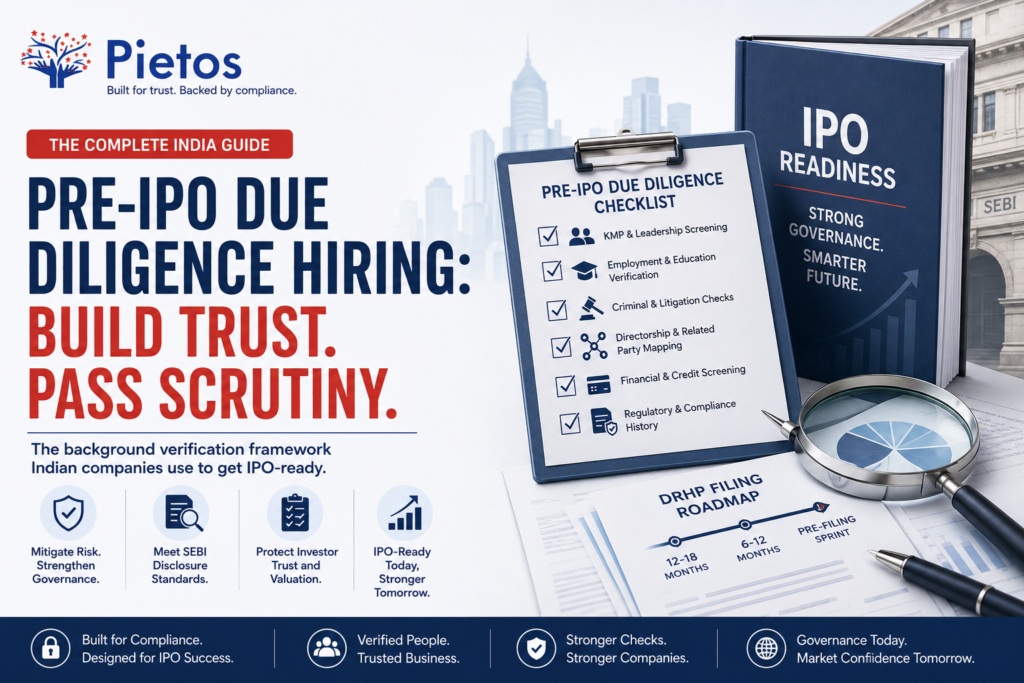
Pre-IPO due diligence hiring used to sit quietly inside HR. Not anymore. SEBI’s 2025 ICDR amendments changed that. Background checks on your key managerial personnel and senior management are now a disclosure obligation, not just a hiring formality. If your company is heading toward a DRHP filing, this matters directly. The people you’ve already hired can affect what your prospectus says. So can the people you’re about to hire.
This guide breaks down what pre-IPO due diligence hiring actually covers. It explains why regulators now care about it. And it shows how to build a screening framework that holds up under investor and SEBI scrutiny.
If your company is starting to map its own IPO governance timeline, Pietos’ background verification guide for startups walks through the early screening milestones you’ll need before you scale hiring further.
What Is Pre-IPO Due Diligence Hiring?
Pre-IPO due diligence hiring is the formal process of verifying a company’s leadership before an IPO filing. It covers identity, credentials, employment history, litigation record, and financial background. The scope includes key managerial personnel (KMPs), senior management, and board members.
It differs from routine employee background verification in three ways.
- Scope. It covers directors and promoters, not just new hires.
- Depth. It includes litigation, regulatory action, and related-party mapping. Standard checks rarely go this deep.
- Timing. It runs on the IPO timeline. It’s tied to DRHP filing, not the onboarding calendar.
In practice, this means something specific. A founder verified once at hiring may need re-screening later. The disclosure standard changes the moment a company becomes IPO-bound.
Why Pre-IPO Due Diligence Hiring Is a SEBI Compliance Issue
Background verification of leadership used to be a governance best practice. It was optional, more or less. SEBI’s ICDR amendments changed that. The regulator now requires specific disclosures about the people running the company. Your due diligence hiring process feeds directly into your offer document.
SEBI’s KMP Disclosure Rules and Background Verification for Pre-IPO Companies
SEBI’s 2025 amendments to the ICDR Regulations require issuers to disclose all criminal proceedings involving KMPs. Regulatory and statutory actions against senior management must be disclosed too. This is mandatory. It applies even if your own materiality policy wouldn’t have flagged the matter.
For a company preparing its DRHP, this creates a practical problem. You cannot disclose what you haven’t verified. A process built only for identity and employment checks will miss exactly what SEBI wants disclosed: litigation history and regulatory action.
The 24-Hour Reporting Rule for Pre-IPO Transactions
The same amendments add a tight deadline. Any pre-IPO placement disclosed in the draft offer document must be reported to stock exchanges within 24 hours. That leaves almost no room for last-minute discovery. If a related-party transaction surfaces after a placement, the company is already on the clock.
This is why due diligence hiring can’t be a one-time event. Scheduling it a few weeks before filing isn’t enough. It needs to run continuously, starting when the company begins planning its listing seriously.
Key takeaway: SEBI’s 2025 ICDR amendments turned background verification from an HR best practice into a disclosure input. Litigation and regulatory-action checks on KMPs are no longer optional.
The Real Cost of Skipping IPO Readiness Background Screening
Skipping or rushing background verification doesn’t just create compliance risk. It creates the kind of headline risk that follows a company long after listing.
When Reported Revenue Does Not Survive Scrutiny
In December 2025, SEBI barred BSE SME-listed drone company DroneAcharya Aerial Innovations, its founders, and several advisors from the securities market for up to two years, with penalties totalling ₹75 lakh. SEBI’s investigation found that roughly 35% of the company’s FY24 revenue, about ₹12.35 crore, came from two entities that had no real business with the company. Several of the listed customer addresses turned out to be ordinary residences.
The order also found that of the ₹27.98 crore in IPO proceeds earmarked for purchasing drones, only ₹70 lakh was actually spent on drones. The rest was routed through inflated invoices and questionable purchases that SEBI said were disconnected from any real business activity.
None of this was a manufacturing defect. It wasn’t a market downturn either. This was a governance failure. Proper due diligence hiring, paired with financial verification, should have caught it before listing, not after.
When Related-Party Deals Break Investor Trust
A separate 2025 case shows the same pattern from a different angle. SEBI barred the promoters of listed company Gensol Engineering, brothers Anmol and Puneet Singh Jaggi, from the securities market and from holding director or KMP positions, after finding they diverted a large share of ₹977.75 crore in loans meant to buy electric vehicles for BluSmart, an EV ride-hailing platform the same promoters co-founded and a related party of Gensol under SEBI’s LODR framework.
BluSmart, the electric mobility company itself, suspended ride bookings across its key cities within a day of SEBI’s order against its closely linked affiliate. Thousands of drivers were left without income, and a planned fundraising round for BluSmart collapsed.
No single bad actor caused this collapse. A governance structure let undisclosed related-party dealings between the two companies go unchecked for too long. These aren’t edge cases. They show what happens when a company skips verifying the people closest to the top, and the entities connected to them, with the same rigor it applies to its financial statements.
What a Pre-IPO Due Diligence Hiring Framework Should Cover
A complete framework has four layers. Skip any one, and you leave a disclosure gap.
Identity, Education, and Employment Verification
This is the baseline layer. It’s also where most discrepancies still turn up. HireRight’s 2021 Global Benchmark Report found that 70% of Indian employers had discrepancies in candidates’ employment histories, and a later HireRight regional survey found 43% of Indian respondents commonly found discrepancies in education credentials, a notably higher rate than the rest of the Asia-Pacific region.
For a KMP whose credentials appear in your prospectus, this matters more than usual. An unverified degree isn’t a minor HR issue anymore. Neither is an inflated job title. Both become factual claims your company is about to publish. Pietos’ identity verification stack checks these details against government-issued ID databases before they reach a filing.
Criminal, Litigation, and Regulatory Record Checks
This layer covers criminal records and civil litigation. It also covers any past action by a regulatory or statutory authority against the individual. SEBI’s 2025 amendments specifically require issuers to disclose this for KMPs and senior management.
A due diligence hiring process built for standard onboarding rarely covers this depth. Pietos runs automated court and EPFO record checks across district courts, high courts, and national tribunals, which closes exactly this gap.
Directorship and Related-Party Mapping
Every current and past directorship held by a KMP needs mapping. So does every related-party relationship those directorships create. This is exactly the blind spot in the Gensol-BluSmart case above. Map it early, and your legal team gets time to structure disclosures properly. Wait until the DRHP review, and you’ll likely find the conflict too late.
Financial and Credit Screening for Key Managerial Personnel
Financial history checks matter too. So does credit history and any history of financial default. Together, they help assess reputational and governance risk, since KMP conduct stays under continuous scrutiny once a company is public.
| Verification layer | Standard employee BGV | Pre-IPO due diligence hiring |
|---|---|---|
| Identity and employment | Yes | Yes |
| Education verification | Usually | Yes, with source verification |
| Criminal record check | Sometimes | Always, SEBI-relevant |
| Litigation and regulatory action | Rarely | Mandatory disclosure input |
| Directorship and related-party mapping | No | Yes |
| Financial and credit screening | Rarely | Yes, for KMPs and senior management |
| Trigger for re-screening | New hire only | DRHP filing, placements, board changes |
Building a Background Verification Timeline for Pre-IPO Companies
Due diligence hiring works best on a schedule. Tie it to your IPO timeline, not a single pre-filing sprint.
12 to 18 Months Before DRHP Filing
Start by mapping every KMP, senior manager, and board member who needs disclosure-grade verification. Establish a baseline for each person: identity, education, employment, litigation, and directorships. This is also the stage to close gaps in existing employee records. First Advantage’s Q4 2024 India Employment Screening Trends Report found discrepancy rates exceeding a 9.83% average across BFSI, BPO, manufacturing, retail, services, and telecom.
6 to 12 Months Before DRHP Filing
Deepen the checks here. Add related-party mapping and financial screening for anyone joining the KMP list. Re-verify anyone whose role, title, or directorships have changed since the baseline check. This is also when legal and HR should agree on a shared disclosure log, so nothing falls between departments.
The Final Pre-Filing Sprint
In the weeks before filing, refresh every check older than 90 days. Confirm no new litigation, regulatory action, or undisclosed related-party transaction has appeared. Given the 24-hour reporting rule for pre-IPO placements, this stage needs speed. A slow verification process simply won’t keep up.
Data Privacy and the DPDP Act: Screening Without Overreach
Background verification involves processing personal data. That puts it inside India’s data protection framework. The Digital Personal Data Protection Act, 2023, is India’s first comprehensive personal data law, and its implementing rules are rolling out in phases, with the DPDP Rules notified in November 2025 and enforcement being phased in from there.
For pre-IPO due diligence hiring, this has two practical implications. First, document consent for every check you run. Don’t assume it. Second, handle KMP data under a system with clear access controls and data-minimisation practices, ideally one certified against a recognised standard such as ISO/IEC 27001.
Thorough screening and responsible data handling aren’t in tension. If your verification partner treats them as separate problems, reconsider that partner. Pietos runs its screening infrastructure under strict data security protocols for exactly this reason.
Common Objections to Pre-IPO Due Diligence Hiring
“Our KMPs were already checked when we hired them.” A hiring-stage check answers a different question. SEBI’s requirement covers ongoing litigation and regulatory action, and those can arise well after someone joins. A one-time check at onboarding won’t catch what happened since.
“This will slow down our DRHP timeline.” Run on a 12 to 18 month schedule, due diligence hiring adds almost no time to filing. The work is already done by the time legal needs it. It’s the rushed, last-minute version that causes delays.
“We’re a small team. This feels like overkill.” SEBI’s disclosure rules don’t scale down for company size. A smaller KMP list actually makes disciplined verification easier to run, not harder. Fewer people means fewer gaps to track.
“Won’t this create friction with our leadership team?” Framed correctly, it rarely does. Most experienced executives have already been through this at a previous company. Position it as a standard governance step every IPO-bound company takes.
A Practical KMP Background Check India Checklist
Use this as a working checklist with your legal and HR teams:
- List every KMP, senior manager, and director who will appear in the DRHP.
- Verify identity documents against government-issued ID databases.
- Verify educational qualifications directly with issuing institutions.
- Verify employment history, including titles and reasons for leaving.
- Run criminal record checks in every jurisdiction the individual has lived or worked in.
- Check litigation records, civil and criminal, for each individual.
- Confirm whether any regulatory or statutory authority has taken action against them.
- Map current and past directorships for related-party exposure.
- Run financial and credit history checks for KMPs and senior management.
- Document consent for every check, in line with the DPDP Act.
- Set a re-verification cadence tied to DRHP milestones, not a fixed calendar date.
- Maintain an audit-ready report for each individual, ready for legal review at any point.
How to Choose a Partner for Pre-IPO Due Diligence Hiring
Not every background verification vendor is built for IPO-grade work. Before you commit to a partner, ask these questions:
- Do they understand SEBI’s ICDR disclosure requirements, or only standard employment screening?
- Can they run related-party and directorship mapping, not just identity and employment checks?
- What’s their turnaround time for a full KMP-level check, and can they meet a 24-hour reporting window if needed?
- Are they certified against a recognised data security standard, such as ISO/IEC 27001?
- Can they produce audit-ready reports your legal team can hand straight to underwriters?
A vendor built for volume hiring will answer some of these well. A partner built for pre-IPO due diligence hiring should answer all of them without hesitation. Pietos’ employee background verification services are built around this exact checklist.
Pietos runs pre-IPO due diligence hiring for companies preparing to file their DRHP, from KMP mapping to SEBI-aligned disclosure support. Talk to our team before your next board meeting. Schedule a consultation with Pietos →
FAQs
It’s the process of verifying a company’s key managerial personnel and senior management before an IPO filing. That includes identity, credentials, litigation history, and financial background. The goal is meeting SEBI’s disclosure requirements.
SEBI doesn’t mandate a specific screening process. But its 2025 ICDR amendments do mandate disclosure of criminal litigation and regulatory action involving KMPs and senior management. In practice, that makes thorough verification necessary.
Most governance advisors recommend starting 12 to 18 months before the expected DRHP filing. Add deeper checks in the final 6 to 12 months.
Yes. SEBI’s disclosure rules apply based on the role, KMP or senior management, not the size of the company.
It requires documented consent for processing personal data. It also encourages data-minimisation and access controls. Both should be built into any pre-IPO screening process.
Standard checks usually cover identity, education, and employment. Pre-IPO due diligence hiring adds litigation, regulatory action, related-party mapping, and financial screening. These feed directly into SEBI’s disclosure requirements.
Key Takeaways
- SEBI’s 2025 ICDR amendments made KMP litigation and regulatory-action disclosure mandatory, turning background verification into a compliance input.
- Skipping proper due diligence hiring has directly preceded major governance failures at listed Indian companies, including the 2025 DroneAcharya and Gensol-BluSmart cases.
- A complete framework covers identity, litigation, related-party mapping, and financial screening, not just employment history.
- Screening should run on a 12 to 18 month timeline tied to your DRHP filing, not as a last-minute sprint.
- Data privacy under the DPDP Act and thorough screening work together when the process is built correctly from the start.