Introduction
When a new hire walks into your office on Day 1, there are a hundred small signals — how they present themselves, the documents they hand the HR team, the badge photo, the face that matches the resume. Fraud is possible, but it is at least slightly harder.
Now imagine that same hire logging in from a co-working space in Pune, a rented flat in Hyderabad, or a hometown in rural Rajasthan — and you have never met them in person. Your only contact has been a video call, a shared Google Doc, and an email thread.
This is the new normal. And it has fundamentally changed what Background Verification (BGV) means in India.
India’s remote and hybrid workforce has grown at a pace that most HR systems were not built to handle. According to NASSCOM, India’s tech sector alone saw remote work adoption jump by over 70% post-2020 and it has not fully reversed. Startups, GCCs (Global Capability Centers), BPOs, and even traditional enterprises are now hiring across states without requiring physical presence — not just for tech roles, but for finance, operations, customer success, and leadership.
The problem? BGV processes at many companies have not caught up. They were built for on-site hiring, and remote hires are either processed through the same old workflow — which now has significant gaps — or skipped altogether because “it’s just a contract” or “they’re only a remote resource.”
Both approaches are costly mistakes.
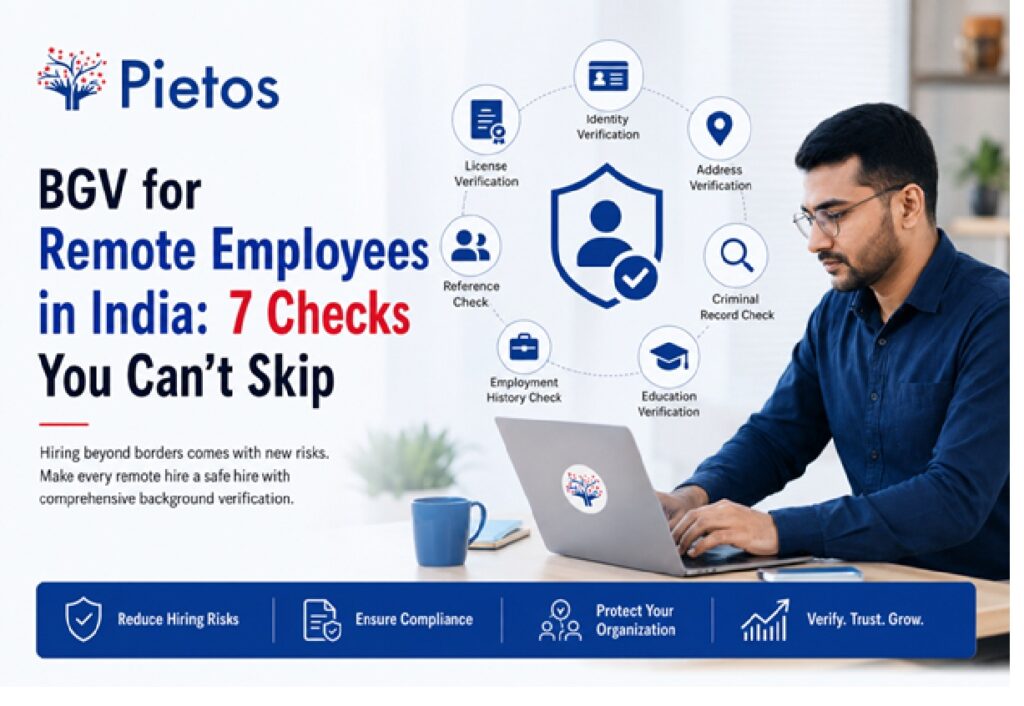
This article breaks down the 7 background checks that are non-negotiable when hiring remote employees in India, why each one matters specifically in a remote context, and how companies can build a BGV process that is both thorough and efficient — without slowing down their hiring velocity.
Whether you are an HR manager at a 200-person startup, a compliance head at a listed enterprise, or a founder making your first remote hire, this guide gives you the framework to hire confidently.
Why BGV for Remote Employees Is a Different Challenge
The Physical Absence Problem
Traditional BGV was designed around physical proximity. An HR manager could walk to the document verification desk. A manager could meet the candidate before joining. A security team could check an ID at the gate.
Remote BGV eliminates all of those natural checkpoints. Every interaction is mediated through a screen. Documents are uploaded — not handed over. Interviews happen on Zoom. The candidate’s actual environment, behavior, and identity are never directly observed.
This creates three specific risk categories that are much more pronounced in remote hiring:
1. Identity Fraud Risk When candidates know they won’t be physically present, there is a higher incentive — and a lower barrier — to submit fraudulent documents. India has seen a significant rise in cases where candidates submit digitally altered Aadhaar cards, fake degree certificates, or manipulated experience letters. A 2023 AuthBridge industry report found that approximately 1 in every 12 background checks in India uncovers a discrepancy — and this number is higher in remote hiring.
2. Data Security Risk Remote employees often access sensitive company data, internal systems, proprietary code, and client information from personal devices and home networks. Hiring someone with an undisclosed criminal history or a fabricated identity into such a role creates serious data risk.
3. Jurisdictional Complexity When you hire someone from a different state in India, verifying their documents through local authorities is harder. Police verification norms vary by state. Educational institution verification requires navigating different university processes. Address verification cannot be done by HR doing a drive-by. All of this adds layers of complexity that a standard BGV checklist doesn’t address.
Remote ≠ Lower Risk
There is a persistent — and dangerous — mental model in some companies that remote employees are lower risk than on-site employees because “they don’t have access to physical assets.” This ignores the modern reality:
- Remote employees access cloud systems with sensitive client and financial data
- They may handle customer PII (personally identifiable information)
- They can become insider threats, leaking IP or code to competitors
- Their misconduct may be harder to detect until significant damage has occurred
The bottom line: remote hiring requires MORE rigorous BGV, not less.
The State of Remote Work in India: Numbers That Matter
Before diving into the checks, it is worth grounding this discussion in data.
Statistics Callout Box
- India had approximately 15 million remote workers as of 2023 (NASSCOM estimate)
- 74% of Indian organizations plan to permanently shift some roles to remote/hybrid (PwC India survey)
- BGV discrepancy rates in India range from 8% to 12% across industries (AuthBridge Annual Report 2023)
- Employment fraud in India increased by 45% between 2020 and 2023 (KPMG India Fraud Survey)
- 34% of HR managers in India report they have experienced resume fraud from remote candidates specifically (LinkedIn India HR Trends 2023)
These numbers are not meant to make hiring scary. They are meant to underscore the business case for a rigorous, well-structured BGV process.
Check 1: Identity Verification
What It Is
Identity verification confirms that the person you are hiring is exactly who they claim to be. This involves cross-referencing government-issued IDs — Aadhaar, PAN card, passport, or voter ID — against the candidate’s submitted details.
Why It Is Non-Negotiable for Remote Hires
Without physical interaction, you have no way of confirming that the person who appeared on the video interview is the same person who submitted the documents, or that either of those people is who they claim to be.
Proxy interviews — where a more qualified person appears for the technical or HR interview on behalf of the actual hire — are a known and documented problem in India’s IT industry. A landmark case in 2022 involved a Bengaluru-based software company that onboarded 11 remote engineers, 6 of whom had used proxy candidates for technical interviews. The company discovered the discrepancy only after a code quality audit 3 months into employment.
What a Strong Identity Check Covers
- Aadhaar verification via UIDAI APIs or authorized agencies (not just document scan)
- PAN card verification via NSDL/UTI portals
- Liveness check: A video-based or AI-driven check that confirms the submitting person is present and real — not a photograph or a static screen
- Face match: Comparing the face on the ID document to the live face of the candidate
- Name and date of birth cross-match across all submitted documents
Pro Tip
Request candidates to submit a short video selfie alongside their documents — holding their Aadhaar card up to the camera, with the current date written on a slip of paper in frame. It is a low-tech but effective anti-fraud measure that many BGV vendors have now automated.
Check 2: Address Verification
What It Is
Address verification confirms that the candidate actually resides at the address they have declared — which, for remote employees, is also their primary work location.
Why It Matters More for Remote Workers
For on-site employees, address verification is important but not operationally critical — you can contact them through the office. For remote employees, their declared address is everything:
- It is where they work, meaning it affects data security (can sensitive information leave a shared or public space?)
- It is required for police verification in many states
- It is relevant for payroll, tax filings, and labor law compliance
- An incorrect or fake address makes all downstream HR and legal processes unreliable
Types of Address Verification
| Method | Suitable For | Speed | Reliability |
| Physical field agent visit | All address types | 3–7 days | High |
| Digital + Postal (OTP couriered to address) | Urban/suburban | 5–10 days | Medium-High |
| Utility Bill + ID Cross-check | Supplementary | 1–2 days | Medium |
| Geo-tagged selfie at address | Quick check | 1 day | Low-Medium |
For remote hires, the most reliable approach is a physical field agent visit combined with a digital cross-check using utility bills or rental agreements.
What Address Verification Uncovers
- Candidates who list a false address (common among those with criminal histories in their actual location)
- Candidates working from unauthorized shared spaces or co-working environments that may violate data security policies
- Candidates who are actually based in a different state or country than declared (tax and labor law implications)
Check 3: Criminal Record Check
What It Is
A criminal record check verifies whether a candidate has any pending cases, FIRs (First Information Reports), convictions, or legal proceedings in Indian courts and police records.
Why It Cannot Be Skipped
Remote employees often work with:
- Customer financial data
- Proprietary source code
- Internal communication systems
- Access to SaaS tools and admin accounts
Hiring someone with an undisclosed fraud conviction or cybercrime history into a remote role — where they work unsupervised — is a significant liability.
What a Criminal Check in India Covers
Court Record Check: Searches across district courts, high courts, and in some cases, the Supreme Court database for any litigation history.
Police Verification (Character Certificate): Issued by local police stations. For remote employees, this needs to be done at the candidate’s current address jurisdiction. Note: this varies significantly by state.
CIBIL/Financial Fraud Check: For finance-adjacent roles, checking for any financial fraud or wilful default listings.
Global Sanctions & Watchlist Check: Relevant for companies with international clients or those operating in regulated sectors — checks against OFAC, UN sanctions lists, and Interpol notices.
Expert Insight “Criminal background checks in India are often the most underinvested step in BGV. Companies spend heavily on educational and employment verification but skip or rush the criminal check because it takes longer. For remote hires with data access, this is the single riskiest oversight.” — HR Risk Consultant, BFSI sector, Mumbai (name withheld for confidentiality)
Important Caveat
India does not have a single centralized criminal database accessible for private BGV vendors. This means comprehensive criminal checks require coordination with multiple state-level records. A serious BGV partner will explain exactly which jurisdictions they can cover — be skeptical of any vendor promising a “complete national criminal check” through a single database query.
Check 4: Employment History Verification
What It Is
Employment history verification confirms the accuracy of a candidate’s work history — companies worked at, roles held, tenure dates, and reason for leaving.
Why Remote Candidates Are Higher Risk for Resume Inflation
Remote roles often attract a larger pool of applicants, many of whom are aware that verification is harder. A 2023 study by AuthBridge found that employment-related discrepancies account for 45% of all BGV findings in India — making it the single largest category of fraud.
Common misrepresentations include:
- Inflated job titles (Executive → Senior Executive → Head of)
- Extended tenure dates to cover employment gaps
- Claimed experience at companies where the person was a contractor or freelancer
- Entirely fabricated companies
What a Strong Employment Check Covers
- Direct employer contact: Calling or emailing the HR/manager at the declared organization — not just sending a form
- Employment confirmation letter cross-check: Verifying authenticity of submitted letters
- LinkedIn and professional profile cross-check: Discrepancies between resume and public profile are a red flag
- Dates of joining and exit: Should match Form 16, EPF records, and employer HR records
- Reason for leaving: Terminations are often concealed — a strong check will surface this
- EPFO record check: India’s Employees’ Provident Fund Organisation (EPFO) maintains records for most formal sector employees. Cross-referencing EPFO data with declared work history is highly reliable
Pro Tip
For senior or specialist roles, also verify whether the candidate is currently serving a notice period elsewhere — a common scenario in remote hiring where candidates start new roles while technically still employed.
Check 5: Educational Credential Verification
What It Is
Educational credential verification confirms that the degrees, diplomas, and certifications claimed by the candidate are genuine and were legitimately awarded by the institution.
The Scale of the Problem in India
Fake degree mills and document forgery are unfortunately not rare in India. The University Grants Commission (UGC) has periodically published lists of fake universities in India — the most recent list has over 20 institutions. Beyond fake institutions, genuine institutions also see cases where candidates submit forged mark sheets or degrees.
For remote hires, the risk is compounded: candidates know that HR teams are unlikely to physically visit the institution for verification, which makes digital document forgery feel lower risk.
What Educational Verification Covers
- Degree authenticity check: Direct verification with the registrar’s office of the awarding institution
- Year of passing and grades confirmation: Match against submitted documents
- Board verification for school certificates: For roles where 10th/12th marks are claimed
- National Academic Depository (NAD) check: India’s digital repository of academic records — most central universities and many state universities have integrated with NAD
- International degree verification: For candidates with foreign degrees, verification through the relevant country’s authentication authority (e.g., World Education Services for US degrees)
Statistics Callout Box The UGC has identified 24 fake universities in India as of 2024. India has also seen multiple state-level scandals involving widespread sale of fake degrees from private universities. Educational discrepancy rates in BGV hover around 3–5% nationally — but this number is significantly higher in certain sectors and states.
Check 6: Reference Check
What It Is
A reference check involves speaking directly with former managers, colleagues, or other professional contacts provided by the candidate to understand their work quality, character, and professional conduct.
Why Reference Checks Are Often Done Wrong
Many companies treat reference checks as a formality — a checkbox exercise where someone calls the number provided by the candidate, gets generic positive feedback from a planted reference, and files it away.
This is worse than useless.
For remote hires, a structured reference check is particularly valuable because it gives you direct insight into how the person works independently, manages their time, communicates asynchronously, and handles accountability — all of which are non-observable in a remote setup.
A Structured Reference Check Framework
Questions to ask:
- In what capacity did you work with [candidate] and for how long?
- What were their primary responsibilities?
- How would you rate their ability to work independently without direct supervision?
- Describe a situation where they managed a complex task remotely.
- What is one area where they struggled most?
- Would you rehire them if given the opportunity? (The most telling question — watch for hesitation)
- Are you aware of any conduct concerns that resulted in disciplinary action?
Red Flags:
- Reference is a personal friend or family member (very common in India — always verify the professional relationship)
- Reference cannot describe specific work scenarios
- Reference gives only vague, generic praise and avoids specifics
- Reference hesitates or adds qualifiers when asked about rehiring
Pro Tip
Do not rely only on references provided by the candidate. For senior roles, consider reaching out directly to former employers you can independently identify — LinkedIn makes this feasible. This approach, called “backdoor referencing,” surfaces information that curated references would not.
Check 7: Professional License & Certification Verification
What It Is
For roles that require specific licenses or certifications — chartered accountants, lawyers, architects, doctors, project management professionals (PMP), cloud certifications, financial advisors — this check verifies that claimed credentials are active, valid, and legitimately awarded.
Why It Matters in the Remote Economy
The growth of remote work has accelerated a parallel growth in online certifications, courses, and professional credentials. Some are legitimate and rigorous. Others are low-quality or outright fraudulent. A candidate claiming an AWS Solutions Architect certification, a SEBI-registered investment advisor license, or a Bar Council registration — all things that can now be verified digitally — should have those claims confirmed before onboarding.
What This Check Covers
| License/Credential Type | Verification Source |
| CA / ICAI qualification | ICAI member search portal |
| Company Secretary (CS) | ICSI member portal |
| Bar Council registration | State Bar Council database |
| Medical Council (MBBS, MD) | National Medical Commission / MCI database |
| SEBI registration | SEBI SCORES portal / intermediary database |
| PMP / PMI certifications | PMI’s online certification verification |
| AWS / GCP / Azure | Vendor verification portals (Credly, Acclaim) |
| IRDAI License | IRDAI agent/advisor verification portal |
For technology roles, also verify coding skills through assessments rather than certification alone — certifications tell you someone passed a test; structured assessments tell you whether they can actually do the work.
Common Mistakes Companies Make in Remote BGV
Even companies with formal BGV policies make avoidable errors when handling remote hires. Here are the most consequential ones:
Mistake 1: Treating Remote Hires as Lower-Priority Verification
Some companies apply the same BGV effort they would to a contract worker for all remote employees, regardless of role. Any employee with data access — which is nearly every remote employee — deserves the full verification stack.
Mistake 2: Accepting Soft Copies Without Liveness Verification
Candidates uploading PDFs of Aadhaar and PAN is not the same as identity verification. Without a liveness check, you are looking at a file that may have been altered.
Mistake 3: Outsourcing BGV and Then Not Following Up
BGV vendors are only as good as their turnaround discipline. Many companies outsource verification and never build in a process to review results before Day 1 access is granted. This creates a window where unverified employees are onboarded.
Mistake 4: Not Doing Address Verification for Remote Roles
“We don’t need to know where they live — they’re not coming to the office.” Wrong. The candidate’s address is their work location. It affects compliance, tax, security, and legal jurisdiction.
Mistake 5: Conducting Reference Checks via Email
Email-based reference checks yield sanitized, carefully written responses. A phone call surfaces tone, hesitation, and unsolicited information that email never will.
Mistake 6: Skipping Continuous Monitoring
BGV is not a one-time activity for long-term employees. An employee who was clean at joining can develop legal issues years later. Periodic re-verification — especially for employees with sensitive data access — is a best practice many companies in India have not yet adopted.
BGV Timelines: How Long Should Each Check Take?
One of the most common questions HR teams ask is: how long does a full remote BGV take?
| Check | Typical Turnaround | Expedited Turnaround |
| Identity Verification | 1–2 days | Same day (digital) |
| Address Verification | 5–7 days | 3 days (field + digital) |
| Criminal Record Check | 7–15 days | 5–7 days |
| Employment History | 5–10 days | 3–5 days |
| Educational Credentials | 5–10 days | 3–7 days |
| Reference Check | 3–5 days | 1–2 days |
| License/Cert Verification | 1–3 days | Same day (digital) |
| Full Stack (parallel) | 10–15 days | 7–10 days |
Most of the delay in BGV comes from sequential processing — waiting for one check to complete before starting the next. A good BGV partner runs all checks in parallel from Day 1, which dramatically reduces overall turnaround.
Pro Tip: Issue a conditional offer letter that includes a BGV clearance clause. This allows you to begin the onboarding process — equipment procurement, system provisioning, team introductions — while BGV is in progress, without granting full data access until the check is cleared.
BGV for Remote Employees: Compliance Framework in India
What Laws and Regulations Apply
India does not have a single national law mandating BGV for all employers. However, several sector-specific and general regulatory frameworks create legal obligations or strong advisories:
1. IT Act, 2000 (and amendments) Organizations handling personal data have a duty of care. Hiring an employee with a cybercrime history into a data-handling role without verification could be construed as negligence in the event of a breach.
2. DPDP Act, 2023 (Digital Personal Data Protection Act) As India’s first comprehensive data protection law comes fully into effect, organizations will be required to demonstrate data security practices — including access control and employee trustworthiness. BGV is part of this framework.
3. SEBI Regulations Financial sector entities regulated by SEBI are explicitly required to conduct background checks on employees who handle securities or client accounts.
4. RBI Guidelines Banking and NBFC sector employers must follow RBI’s Know Your Employee (KYE) guidelines, which include identity and address verification.
5. IRDAI Regulations Insurance companies are required to conduct criminal and identity checks on agents and employees before licensing.
6. Labor Law Compliance When hiring remote employees across state lines, state-specific Shops and Establishments Acts may apply. BGV records may be required during labor inspections or in cases of dispute.
For a detailed breakdown of BGV compliance by industry sector in India, the NASSCOM HR Compliance Toolkit provides a useful starting reference for tech companies.
Frequently Asked Questions
BGV is not universally mandated by law for all remote employees in India, but it is required in certain regulated sectors (BFSI, insurance, listed companies) and strongly advisable for all organizations. Failure to conduct BGV can create legal liability in the event of fraud, data breach, or employee misconduct, especially under the DPDP Act, 2023.
Address verification for remote employees involves a combination of physical field agent visits, digital cross-checks against utility bills or rental agreements, and postal verification (where an OTP or signed letter is sent to the declared address). Physical field verification remains the most reliable method for high-trust roles.
No. Under India’s DPDP Act, 2023, and general data protection principles, employers must obtain explicit informed consent from candidates before conducting background verification. Most BGV processes include a candidate consent form as the first step.
KYC (Know Your Customer) is a regulatory process used primarily by financial institutions to verify customer identity. BGV (Background Verification) is a broader HR process used by employers to verify the identity, credentials, criminal history, and professional background of job candidates and employees. Both use overlapping tools (Aadhaar verification, PAN check) but serve different purposes.
A full-stack BGV (all 7 checks) conducted in parallel typically takes 10–15 working days. Expedited processes with digital-first verification can reduce this to 24 hours–10 days. Criminal checks and education verification are usually the longest-running components.
BGV costs in India vary widely based on the depth of checks, the vendor, and the role level. Entry-level BGV packages (identity + address + criminal + education) typically range from ₹500 to ₹1,500 per candidate. Comprehensive checks for senior or high-trust roles can run ₹3,000–₹8,000 or more. For volume hiring, most BGV vendors offer tiered pricing.
Yes — this is called post-hire BGV and is practiced by some companies, particularly for roles where speed of joining was critical. However, it is riskier: if a serious discrepancy is found after the employee has already been granted access to systems and data, the remediation process is significantly more complex. Conditional offer letters with BGV clearance clauses are a better approach.
The standard process is to flag the discrepancy to the hiring manager and HR, give the candidate an opportunity to explain or provide additional documentation, and then make a judgment call based on the nature and severity of the discrepancy. Not all discrepancies are disqualifying — minor date inconsistencies may be explained. Fabricated degrees or undisclosed criminal convictions typically are. Each case should be evaluated on its merits, with legal counsel involved for serious findings.
Aadhaar is a strong foundational document for identity verification in India, but it should not be used in isolation. A complete identity check combines Aadhaar verification (via UIDAI) with PAN card verification and a liveness check to confirm the live person matches the document. For high-trust roles, additional government IDs (passport, voter ID) should be cross-referenced.
Continuous monitoring means periodically re-running background checks on existing employees — typically once a year or triggered by role changes — rather than limiting verification to the pre-hire stage. This is increasingly standard practice in financial services, defense contracting, and data-sensitive technology companies. It helps catch criminal cases, financial defaults, or license revocations that occur after the initial hire.
Legally, requirements differ — full-time employees have more formal obligations tied to payroll, provident fund, and labor law. But from a risk management perspective, a remote contractor with access to your codebase or client data poses the same access risk as a full-time employee. Smart organizations apply the same BGV stack to high-access contractors regardless of employment type.
India’s state-level variation in records (police verification norms, address verification procedures) makes multi-state remote hiring complex. Working with a national BGV partner who has operational coverage across states — including Tier 2 and Tier 3 cities — is essential. Always confirm vendor coverage for specific geographies before onboarding.
Conclusion
Hiring remotely in India is now a permanent fixture of how companies build teams — not a pandemic-era workaround. The talent advantages are real: access to a national talent pool, reduced overhead, and greater flexibility for employees and employers alike.
But remote hiring done without rigorous background verification is a liability waiting to be realized.
The 7 checks covered in this article — identity, address, criminal, employment history, education, references, and professional licenses — form the non-negotiable baseline for any organization that takes its people’s risk seriously. None of them are optional. None of them are interchangeable. Together, they give you a clear, verifiable picture of who you are actually bringing into your organization.
The question is not whether you can afford to invest in a strong BGV. It is whether you can afford not to.
If your current BGV process was built for in-office hiring — or if you don’t have a structured process at all — now is the time to fix it. The cost of a thorough background check is a fraction of the cost of a bad hire, a data breach, or a regulatory fine.
Pietos Ltd helps organizations design, implement, and optimize BGV processes for the modern remote workforce. Whether you are setting up a first-time verification framework, auditing an existing BGV workflow, or looking for a reliable BGV execution partner, our team works with HR, compliance, and operations leaders across India’s fastest-growing companies.
📞 Ready to build a BGV process that actually works for remote hiring? Book a free BGV strategy consultation with Pietos Ltd →
🔍 Learn how Pietos Ltd structures remote hiring risk frameworks Explore our HR Risk & Verification Services →