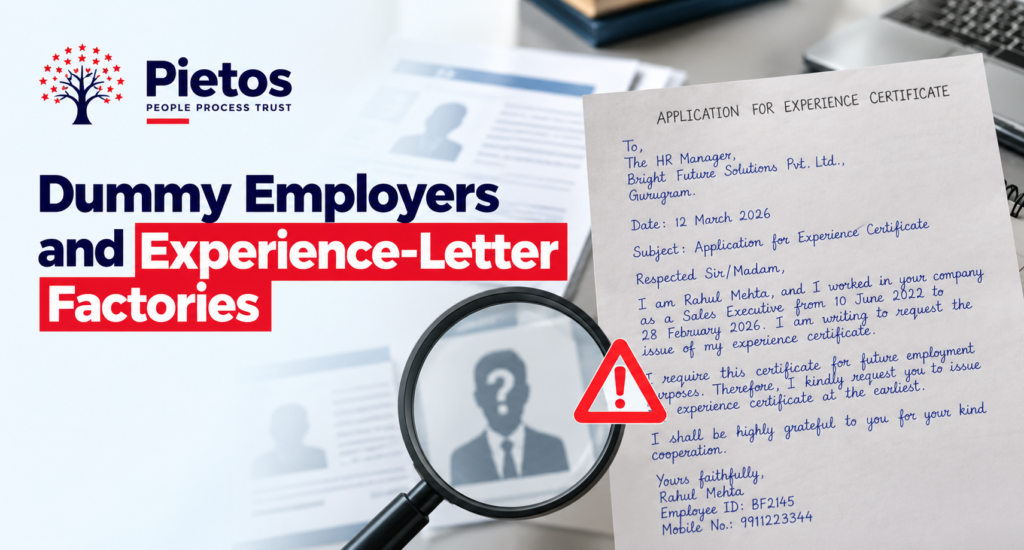
Fake experience letter India rackets now run on dummy companies that pass a phone check. Here is how HR teams catch them.
The fake experience letter India HR teams see today rarely looks fake. In fact, it carries a logo, a signature and a working phone number. Worse, the company behind it often exists on paper. That is the real problem with dummy employers.
Most HR teams already screen for fake degrees and forged payslips. However, a dummy company beats both checks. Specifically, it issues clean documents, answers verification calls and even shows a registration number. As a result, the candidate clears background verification with a spotless report.
First, this guide explains how fake experience letter India rackets work. It also gives you a five-question employer test built on public government records. You can run it this week. Moreover, it works whether you verify in-house or through a partner.
Want a second pair of eyes? Pietos checks whether the employer is real, not just whether the letter looks real. Talk to our verification team or write to contact@pietos.com.
Key takeaways
- A fake letter is a symptom. The dummy employer is the cause.
- Four public registries answer “does this employer exist?” in minutes.
- A missing record is a flag, not proof. Patterns across sources decide the case.
- Match the depth of the check to the risk of the role.
What a Fake Experience Letter India Fraud Really Looks Like
Letter fraud used to mean a candidate editing a PDF at home. Today, however, it is a business. For example, agencies sell complete career histories. They bundle the letter, the payslips and a verification contact. In short, the candidate buys an employer.
The letter is the last step in the chain. First, someone creates or borrows a company identity. Next, the operator writes the offer letter, the relieving letter and the experience letter. Then comes the supporting paperwork. For instance, it includes payslips, a Form 16 and sometimes bank statements. Finally, the operator sets up a contact who confirms the story.
Notice the order. After all, the letter comes last. Therefore, checking the letter alone starts at the wrong end.
What counts as a dummy employer. A dummy employer has no real operations. Instead, it exists to vouch for people who never worked there. For example, some are registered firms with a genuine company number. Meanwhile, others borrow the name of a respected brand.
Every HR team needs a working definition. So use this one. A dummy employer is any entity that cannot show real trading, real payroll and real people during the period a candidate claims.
Who Gets Targeted by Fake Experience Letter India Rackets
Dummy employers do not spread evenly. Instead, they cluster where hiring is fast and verification is thin. Knowing the pattern helps you decide where to look first.
Hiring surges and volume drives. When a company hires hundreds of people in weeks, checks get squeezed. For example, campus seasons, festive peaks and new branch launches all compress timelines. Recruiters then accept letters at face value. Consequently, fabricators time their applications to these windows.
Mid-career jumps into regulated roles. For example, a candidate with six years of invented experience can leap into a manager role. Banks, NBFCs and fintechs attract these jumps because pay rises sharply with experience. In addition, regulated roles carry cash, data or approval powers. Therefore, the payoff for a successful lie is high.
Remote and cross-border roles. Remote hiring removes the office visit. Similarly, cross-border roles make local checks harder. As a result, a candidate can claim an overseas employer that HR cannot easily call. Our notes on overseas staffing fraud patterns show how these gaps get exploited.
Notice-period and gap shortcuts. Some candidates carry unexplained gaps or a rushed exit. In that case, a purchased relieving letter can paper over the problem in a day. As a result, HR sees a clean exit that never happened.
How Fake Experience Letter India Factories Build Dummy Companies
Understanding the build helps you test it. Indeed, each part of a dummy company leaves a different trace.
A paper company with a real registration number. First, some operators register a genuine private limited company or LLP. The fee is small, so the company gets a CIN. However, it never trades, hires or files PF returns. Its registration proves only that someone paid a fee.
A cloned brand that borrows trust. Second, others skip registration. Instead, they copy the name, logo and letterhead of a well-known employer. Then they change one letter in an email domain. Next, they add a mobile number that rings with a friendly “HR” voice. Consequently, a quick phone check feels like a pass.
A staffed verification desk. Third, the strongest rackets run a desk. People answer calls and emails in the employer’s name. Then they confirm designation, dates and salary on cue. In many cases, they follow a script built from the candidate’s resume. As a result, the HR reference check confirms the lie.
Back-filled payslips and bank trails. Payslips form the next layer. For example, factories generate monthly slips that match the claimed salary. In addition, some add bank statements with matching credits. Meanwhile, the PF line often stays blank or reads “not applicable”. That gap matters, and we return to it below.
Why genuine small firms can look similar. Be careful, though. Some real employers also lack GST or PF coverage. For example, tiny startups, partnerships and new firms often sit outside the net. Therefore, one missing record never proves fraud. Patterns across several sources do.
Why Standard Checks Miss a Fake Experience Letter India Case
Most verification flows were built for a different threat. In short, they assume the employer is real and the candidate lies about details. Dummy employers flip that assumption.
The reference call proves nothing. A reference call confirms that someone answered. However, it does not confirm who answered. Likewise, an email from a lookalike domain proves only that the domain works. For that reason, a call-back alone cannot clear a candidate.
Document forensics has a ceiling. Forensic tools catch edited fonts, pasted signatures and altered metadata. However, factories now generate clean documents from scratch. Therefore, a freshly produced letter has nothing to detect. As a result, a forensic scan can return a clean score on a fully fictional job.
Our guide to detecting fake resumes covers the document layer. Meanwhile, this post covers what that layer cannot see. Our breakdown of fake degrees and fake payslips covers the related paperwork.
Offer-stage pressure
Hiring managers want people on board fast. Therefore, background checks often start after the offer, not before. By then, the candidate has resigned from the old job. Moreover, HR feels pressure to clear the file. Under that pressure, a clean-looking report wins.
Scope gaps in verification checklists
Many checklists say “employment verification” and stop at an HR email. Few say “confirm the employer exists”. As a result, vendors do exactly what the checklist asks. They send the email, get a reply and mark the case clear. To fix this, rewrite the scope. Name the registry and payroll checks in your contract.
The numbers show the scale
The EY employment fraud study, as Pietos summarises it, found discrepancies in 85% of employment history checks. Also, the sample covered more than one million verifications. Not every discrepancy is a dummy employer. Even so, employment history is clearly the weakest link in hiring. Our analysis of the EY employment fraud report shows how CHROs can respond.
The Business Cost of Hiring on a Fake Experience Letter India Candidate
Fake experience is not a paperwork problem. It is a business problem. Every fake experience letter India hire puts money, clients and compliance at risk.
Direct costs you can count. First, you pay salary for skills the person lacks. Next, you pay recruiters, onboarding and training a second time. In addition, projects slip while the team covers the gap. Pietos’ BGV ROI model uses twice the annual CTC as a cautious loss estimate for one bad hire.
A simple ROI example
Numbers make the case clearer. Pietos’ ROI model assumes a mid-senior hire at ₹18 lakh CTC. Twice that figure therefore gives ₹36 lakh of exposure per bad hire. Next, suppose 1.5% of 80 such hires carry a material misrepresentation. The expected exposure then reaches ₹43.2 lakh. Meanwhile, verification at ₹2,500 per hire costs ₹2 lakh. As a result, the net value is about ₹41.2 lakh.
These figures are assumptions, not guarantees. Even so, the gap between cost and exposure is wide. Also, replace the inputs with your own discrepancy rate for a sharper answer.
Regulatory and client risk. Regulated sectors face more. For example, an NBFC branch manager with invented credit experience can approve bad loans. Similarly, a GCC engineer with a fictional security background can touch client data. Consequently, one hire can trigger audit findings, client escalations and lost contracts.
Our guides on hiring fraud in NBFCs and GCC overseas staffing fraud show how these cases unfold.
The cost of doing nothing.
| Exposure | What happens when you skip employer checks |
|---|---|
| Quality of hire | You pay for skills the person never built |
| Compliance | Audit findings and regulator questions follow |
| Client trust | Clients lose confidence after a breach or a miss |
| Team morale | Honest candidates lose offers to fabricators |
| Revenue | Delayed projects push out billing |
Meanwhile, the employer check costs a fraction of any of these losses.
Fix the Reference Call to Catch a Fake Experience Letter India Scam
Reference calls still matter. However, they need a new method. If you follow these rules, the call becomes evidence.
First, never dial the number on the letter. Instead, find the switchboard number from the company website, the GST address or another source you trust. Second, speak to someone who is not the candidate’s named referee. Ask for HR, payroll or the reporting manager’s office.
Third, ask for specifics. Request project names, team size, reporting lines and the office location. Genuine colleagues answer easily, but a script sounds rehearsed. Fourth, ask a question only a real payroll team can answer, such as the PF code on the payslip.
Finally, send a written confirmation request to an email address on the company’s own domain. Compare the domain’s age and spelling with the letter. Also, a new or lookalike domain is another flag. Together, these steps turn a courtesy call into a real check.
The Five-Question Test That Catches a Fake Experience Letter India Case
You do not need special software to start. You need five questions, five public sources and one worksheet. Then ask the questions in this order. Cheap checks come first.
Question 1: Did the company legally exist? (MCA)
Start with the Ministry of Corporate Affairs. Its MCA portal offers company master data for free. Also, basic searches need no login. Then search by company name or CIN. Finally, read four fields: status, date of incorporation, registered office and last filing dates.
Next, compare the incorporation date with the candidate’s joining date. If the company incorporated after the claimed joining date, stop. That is a hard red flag.
Status needs care. For example, a struck-off status today does not prove fraud. However, it demands a clear account of when the firm stopped operating.
The scale of inactive firms is large. In a written Lok Sabha reply in July 2025, the government said it had struck off 1,85,350 companies between 2021-22 and mid-July 2025. Also, the peak year was 2022-23, with 82,125. Moreover, the same reply noted that the Companies Act, 2013 does not define “shell company”. Therefore, you must define the test yourself.
Question 2: Did the business actually trade? (GST)
Next, open the GST portal’s Search Taxpayer page. Search by GSTIN or PAN. The result shows the legal name, trade name, registration date, status and principal place of business. Also, cancelled or suspended registrations deserve a closer look.
At the time of writing, the portal does not search by business name. So ask for the GSTIN from the employer’s invoices or letterhead. Then compare the trade name and address with the letter. Therefore, a mismatch points to a cloned identity.
However, small service firms below the threshold may hold no GSTIN. So treat a missing record as a prompt for more checks. The main GST portal lists other search options.
Question 3: Did the employer actually employ people? (EPFO)
Now move to the EPFO. First, use the establishment search on the EPFO portal to confirm the employer holds a PF code. Also, the search lets you check the registered address, working status and payment history.
Second, ask for the candidate’s UAN history. With the candidate’s consent, the service history lists each employer, joining date and exit date. Our UAN verification guide explains the process step by step.
In fact, a dummy employer rarely files PF returns for the person. Consequently, a claimed three-year tenure with zero contributions is the strongest single signal. For example, in one Pietos verification, a previous employer had shut down years earlier. Meanwhile, the candidate’s UAN showed only 18 months of contributions.
Note the limits. EPFO coverage generally starts at 20 employees. Some roles also sit outside PF. So a gap needs an explanation, not an accusation.
Question 4: Did money actually flow? (payroll trail)
Then test the payroll trail. First, ask for three consecutive payslips, the Form 16 and the matching bank credits. Next, compare the PF deduction on each slip with the EPFO passbook. If a slip shows a deduction and the passbook shows nothing, the slip is fiction.
Similarly, check where the salary credits come from. Credits from the employer’s named account look normal. However, credits from random personal accounts do not.
Question 5: Does the employer have a fraud trail? (eCourts)
Finally, search the company and its directors on eCourts. Party name search needs at least three characters, and it covers district courts. However, High Courts run a separate portal on the main eCourts site. Tribunals such as the NCLT sit outside the system.
Then look for cheating cases, recovery suits and complaints against the firm. Indeed, a company named again and again in fraud cases is not a safe reference.
Score the answers, not the documents. First, put each answer on one worksheet. Then mark it Pass, Gap or Fail. One Gap is normal. However, two Gaps need a call or field check. Any Fail pauses the process until the candidate explains.
Capture the same eight fields every time
A consistent worksheet makes patterns visible. Record these fields for every claimed employer:
- Legal name and CIN
- Incorporation date and current status
- Registered address
- GSTIN and registration status
- EPFO establishment code
- The candidate’s UAN contributions for the claimed period
- Payroll match result
- Court search result
Eventually, the sheet becomes a risk database. For example, you may notice three candidates citing the same unfamiliar employer. That cluster is itself a red flag.
What to do when sources disagree. Sources will sometimes conflict. MCA may show an active firm while EPFO shows no contributions. Still, do not guess. First, ask the candidate for an explanation and supporting proof. Next, request a field visit or a call to a verified switchboard number. Finally, record the outcome. Documented reasoning protects both sides.
Run the five-question test without the legwork. Pietos verifies employers against MCA, GST and EPFO records, then adds field checks where records run thin. Book a free consultation to see a sample employer report.
Red Flags in a Fake Experience Letter India Case
Overall, patterns beat single signals. Use this table when you review a file.
| Signal | Genuine employer | Dummy employer |
|---|---|---|
| MCA record | Incorporated before the joining date | Incorporated after joining, or no filings |
| Address | Matches MCA, GST and the letter | Shared flat or three different addresses |
| Email domain | Company-owned domain | Free email or lookalike domain |
| Phone line | Switchboard that routes to HR | One mobile number answers everything |
| PF record | Establishment code and contributions | No code or no contributions |
| Payslips | PF deduction matches the passbook | PF line blank or deduction unmatched |
| Online footprint | Staff profiles, hiring posts, news | Few staff, copied website text |
| Reference style | HR checks records and asks for consent | Instant praise with no specifics |
No single row convicts a company. However, three or more rows in the right-hand column justify a field check.
How Deep to Go: Match Checks to Role Risk
Full five-question checks on every hire may slow volume hiring. Therefore, scale the depth by role.
| Role tier | Examples | Minimum employer checks |
|---|---|---|
| High risk | Finance heads, credit officers, IT admins, GCC leads | All five questions plus a field or call check on any Gap |
| Medium risk | Managers, engineers, sales leads | MCA, UAN history and payslip match |
| Lower risk | Experienced entry roles | MCA check and UAN history |
Therefore, regulated employers should lean toward the top row. For example, NBFCs and fintechs carry cash and data risk in many mid-level roles.
Sector Playbooks: Where Fake Experience Letter India Risk Peaks
Different sectors face different dummy-employer risks. So use these playbooks to set your priorities.
NBFCs and microfinance. Branch managers, collection staff and credit officers handle cash and approvals. Therefore, prioritise employer existence and payroll checks for these roles. Field verification matters most in smaller towns, where digital records run thin.
GCCs and IT services. Technical leads and security administrators access client systems. Consequently, a fictional employer hides real risk. First, combine registry checks with UAN history. Moreover, add checks on overseas employers where the candidate claims them.
Startups and growth-stage firms. Fast-growing companies hire quickly and often skip checks. However, one fabricated senior hire can damage investor and customer trust. Start with MCA and UAN checks for every leadership role. Then expand to the full test.
Healthcare, education and security services. These sectors trust staff with vulnerable people. In addition, regulators care about staff credentials. Therefore, treat the claimed prior employer as part of the safety case. It is not an HR formality.
A 30-Day Plan to Stop Fake Experience Letter India Fraud
You can close this gap in a month. Here is a simple plan.
- Days 1–5: Pull your last 50 offers. Then count how many claimed employers you checked against government records.
- Days 6–10: Write a policy that defines a verified employer. Then use the working definition from this guide.
- Days 11–15: Add a consent line to application and BGV forms. Also cover UAN history and registry checks.
- Days 16–20: Build the five-question worksheet. Next, add Pass, Gap and Fail columns.
- Days 21–25: Pilot the test on high-risk roles. Then track the Gap and Fail rate.
- Days 26–30: Review the results. Finally, set a clear escalation path for any Fail.
After 30 days, you will know your real exposure. Moreover, you will have data to defend your budget.
Metrics worth tracking. Measure the programme from day one. First, track your Gap rate and Fail rate by role tier. Also track the average time per employer check. In addition, count the cases caught before the offer and after joining. Over a quarter, these numbers show whether the checks pay for themselves.
What to Do When You Find a Fake Experience Letter India Case
Finding one case should trigger a process, not panic. So follow these steps in order.
- Preserve the evidence. Save every document, screenshot and registry result with dates.
- Pause, do not accuse. Then mark the file as on hold. Keep your messages calm and factual.
- Offer a fair hearing. Give the candidate a short window to explain. Honest mix-ups do happen, such as a renamed or merged employer.
- Decide under written policy. Apply the same rule to every candidate. Consistency protects you in disputes.
- Document the adverse finding. Record the facts, the sources and the reason for your decision.
- Check the cluster. Search your files for other candidates who cited the same employer, referee or consultancy.
- Take legal advice. Do this before any blacklisting or external reporting.
Run a Look-Back Audit on Current Employees
Your risk may already sit on the payroll. Therefore, a look-back audit makes sense. Start small and stay lawful.
First, list employees in sensitive roles who joined before you added employer checks. Next, pick those whose claimed employers you never verified through registries. Then run MCA and EPFO checks on those employers using records you already hold. Before you touch any new personal data, review your consent terms under DPDP. Finally, escalate only clear mismatches to legal and HR leadership.
Risk concentrates in sensitive roles. Therefore, start there and expand only if needed.
Seven Vendor Questions to Test Fake Experience Letter India Defences
Use these questions in your next vendor review.
- Do you confirm that the employer exists, or only that someone replied?
- Which registries do you check: MCA, GST, EPFO and courts?
- How do you handle employers without PF or GST coverage?
- Do you run field checks where digital records run thin?
- How do you separate a Gap from a Fail in your reports?
- How do you handle candidate consent and data retention?
- Do you flag clusters, such as many candidates citing the same employer?
Overall, a vendor that answers all seven clearly understands the dummy employer problem. In contrast, a vendor that answers “we call the HR” does not. Therefore, make these questions part of every renewal.
Handling Objections From Leadership and Candidates
Every new check meets resistance. Here are the common objections and clear responses.
“We already call the previous employer.” A call proves that someone picked up the phone. However, it does not prove who they are. Registry checks, in contrast, prove the employer exists.
“This will slow our hiring.” Run employer checks in parallel with other documents. Also, digital checks can finish within a day. Meanwhile, a bad hire costs months.
“Candidates will refuse consent.” Candidates with real histories have little to hide. First, explain the purpose clearly. If a candidate still refuses, record that fact and decide using your policy.
“Our candidates come from startups with no PF.” Then use other proof. For example, ask for the Form 16, bank credits and a named colleague who can confirm the role.
“Honest candidates will feel distrusted.” Present the check as standard for every hire. Moreover, explain that it protects honest candidates from losing roles to fabricators. Also, clear and consistent communication reduces friction.
“We have no budget.” Compare the check with the loss. After all, twice the CTC is a cautious estimate for one bad hire. Consequently, a single prevented case covers many checks.
Legal and Privacy Guardrails Under DPDP
Employer checks use personal data, so handle them with care. First, get written consent before you view UAN history. Second, use the data only for verification. Third, keep the record only as long as you need it. In addition, brief your verification vendor on these limits in writing. These steps protect candidates, and they protect you.
Fake Experience Letter India Scenarios: How the Test Works
These are composite scenarios based on patterns HR teams report. The names and figures are illustrative.
Scenario 1: The NBFC credit manager
A candidate claims four years as a credit manager at “Sunrise Capital Services”. The letter looks perfect. Also, the reference call goes well. However, the MCA record shows the company incorporated 14 months before the interview. As a result, Question 1 fails in ten minutes. HR stops the process before any offer goes out.
Scenario 2: The GCC engineering lead
A candidate claims five years at a mid-size product firm. MCA and GST both look healthy. Question 3 then raises a flag. Yet the EPFO record shows no contributions for the candidate. The payslips, however, show a PF deduction every month. Next, a field visit finds the registered address is a shared desk. Also, the “HR contact” number matches the candidate’s referee. Consequently, HR withdraws the offer.
Scenario 3: The honest candidate with a renamed employer
A candidate lists a company that no longer appears on MCA under that name. At first glance, it looks like a Fail. HR therefore asks for an explanation. The candidate shows a merger notice and a UAN history that matches the new entity. As a result, the check passes. This case shows why the worksheet needs a Gap category and a fair hearing.
Why HR Teams Trust Pietos for Employer Verification
Pietos is a Delhi-based background verification company founded in 2015. Moreover, it serves NBFCs, fintechs and GCC setups. In addition, its hybrid model combines digital checks with field verification across tier 2 and tier 3 cities. Pietos is also an MSME-certified vendor.
For employment claims, the Pietos process covers:
- UAN and EPFO validation
- Company registry checks, including MCA, GSTIN and CIN
- Direct HR reference checks
- Payslip and bank statement correlation
- Court record searches
Pietos’ digital checks can return within 24 hours. Meanwhile, field checks add depth where records run thin. Read how we handle a fake employment certificate for more detail.
Fake Experience Letter India FAQ
Do not start with the letter. Instead, start with the employer. Check the company on MCA, its GSTIN, its EPFO code and its court record. Then compare the candidate’s UAN history with the claimed dates. After all, a real job leaves a trail across these sources.
UAN history is the strongest single check for formal employment. However, it misses firms outside PF coverage. Therefore, combine it with MCA, GST and payroll checks for a complete picture.
No. Real firms close, and candidates may have worked there before closure. Compare the closure and incorporation dates with the claimed tenure. A mismatch matters, but a closure alone does not.
Registry checks take minutes when you have the right identifiers. Also, UAN verification depends on consent and EPFO response. Digital partners like Pietos can often return results within 24 hours. However, field checks take longer.
Yes. Use MCA records, GST status, Form 16, bank credits and a named colleague reference. Also, treat the lack of PF as a Gap, not a Fail.
Document each check and its result. Next, give the candidate a fair chance to explain. Then record the finding under your policy. Seek legal advice before any blacklisting or external reporting.
Conclusion: Verify the Employer, Not the Letter
A fake experience letter India fraud succeeds when HR checks paper instead of people. In fact, dummy employers have changed the game. Documents now look perfect, and phone calls get answered. Public records, however, still tell the truth.
First, run the five-question test. Then score every answer. Finally, scale the depth to the role. Above all, verify the employer before you trust the letter.
Stop verifying letters. Start verifying employers. Pietos checks the company, the payroll trail and the people behind every claim. Call us on 9289301161 or +91 11 49074103. Email contact@pietos.com. Or book your free consultation today and protect your next hire before day one.