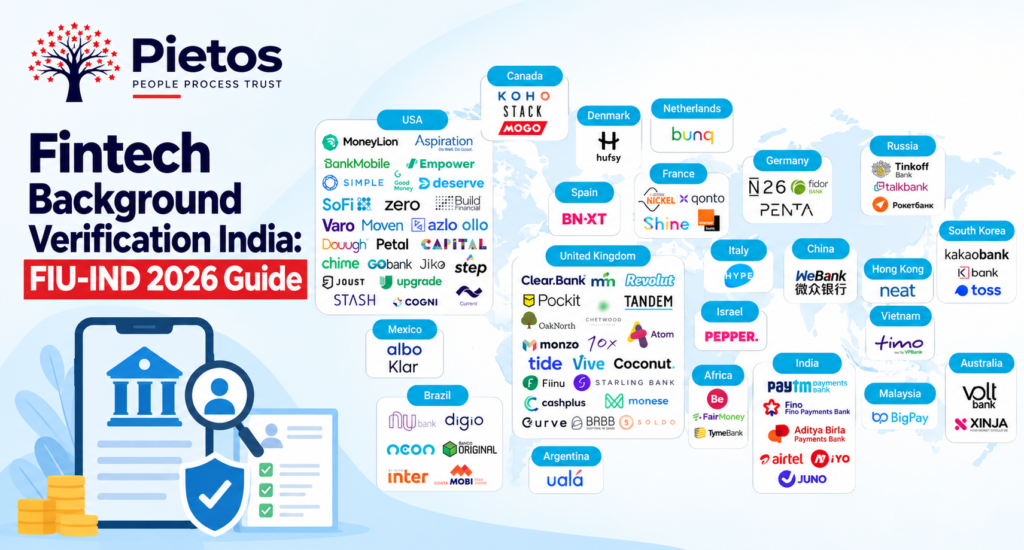
Fintech background verification India is now a regulatory question, not just an HR habit. Specifically, on 8 January 2026, FIU-IND tightened KYC rules for crypto and virtual digital asset companies. Now every customer faces liveness checks, penny-drop bank proofs and income checks. However, they say little about the people who run those checks.
That gap is where the risk hides. For example, a compliance officer with a fake resume can approve thousands of weak KYC files. Meanwhile, AI tools help candidates forge financial histories faster than ever.
Therefore, this guide shows you how to close the gap. First, you will learn which roles need which checks. Then you will see how to verify regulator-linked credentials. Finally, you will build a hiring file that stands up to an audit.
Hiring for a fintech, neobank or crypto team? Pietos builds FIU-IND and SEBI-aligned BGV packages for regulated financial roles. Talk to Pietos about fintech background verification India or write to contact@pietos.com.
Key Takeaways
- FIU-IND’s 8 January 2026 guidelines raise KYC standards for customers. They do not vet your staff.
- Run identity, employment, criminal, education and credit checks on every regulated role.
- Verify a Principal Officer before the FIU-IND filing, not after.
- Match check depth to role risk. A developer and a Compliance Officer need different files.
- Use separate consent, purpose limits and vendor audits to stay inside the DPDP Act.
What Is Fintech Background Verification India?
Fintech background verification India is the process of confirming a candidate’s identity, work history, education, criminal record and financial standing. It happens before you hire them into a regulated finance role. It goes deeper than a standard employee check. The reason is simple, because fintech staff handle customer money, personal data and regulator-facing filings.
A strong program covers six areas:
- Identity: Aadhaar, PAN and passport checks through official sources.
- Employment: UAN and EPFO records plus direct employer confirmation.
- Education and licences: degrees, certifications and professional registrations.
- Criminal and court records: district court, High Court and Supreme Court searches.
- Credit and financial history: bureau reports for roles that touch money.
- Sanctions and adverse media: watchlist sweeps for senior and compliance hires.
Pietos runs these six checks through a hybrid model. First, digital APIs deliver speed. Then field verifiers add depth where records are thin. In its guide to NBFC background verification in 2026, Pietos explains why API-only models miss fraud when a physical check would catch it.
Why FIU-IND’s 2026 Guidelines Change Hiring
What the 8 January 2026 Guidelines Require
First, FIU-IND updated its AML and CFT guidelines for virtual digital asset service providers on 8 January 2026. Signzy’s summary of the FIU-IND guidelines lists the main changes, so here is the short version. Crypto firms now need to:
- Collect a selfie with liveness detection.
- Record geo-coordinates, date, timestamp and IP address at onboarding.
- Verify bank accounts with a penny-drop test.
- Collect PAN and income or profession details.
- Refresh KYC every six months for high-risk clients and yearly for others.
In addition, the guidelines discourage ICO and ITO activity. Furthermore, all service providers must register with FIU-IND as reporting entities. Meanwhile, Business Standard reported that 49 crypto exchanges registered with the regulator in 2024-25.
The Gap Nobody Talks About
Every control above depends on a human. For example, KYC analysts approve files. Likewise, compliance officers write policy. Meanwhile, engineers build the liveness flow. Therefore, a fake credential at any of these desks weakens the control itself.
The guidelines tell you how to verify a customer. However, they do not tell you how to verify the person who verifies the customer. Fintech background verification India fills that gap.
KYC Operations Teams: The Overlooked Control Point
Most fintech leaders think about KYC as software. In practice, people sit inside every step. For instance, analysts review exceptions. Also, team leads override failed checks. Meanwhile, engineers tune the thresholds. Therefore, the January 2026 controls only work when the people behind them are honest and skilled.
Where Staff Can Weaken Each Control
- Liveness detection: an analyst can approve a failed selfie as a manual exception.
- Geo-tagging and IP capture: an engineer can loosen location rules to cut rejection rates.
- Penny-drop checks: an ops member can mark a name mismatch as a match.
- Income and profession checks: a sales lead can nudge customers toward a convenient profession.
- Periodic KYC refresh: a team lead can close high-risk refresh tasks without real review.
None of these actions needs advanced hacking. Instead, each needs only access and motive. As a result, your screening should grow with the access a person holds.
What to Screen for in KYC Teams
First, run identity, address and criminal checks on every analyst. Next, add employment checks for team leads. Finally, re-screen anyone with override rights each year. Pair these checks with access logs, so you can trace every manual exception.
Outsourced Teams and Contract Staff
Many fintechs outsource KYC calls, collections and support to BPOs. Because these agents often see Aadhaar, PAN and bank details, they carry real risk. Yet they rarely appear in the main HR system.
Your regulator still holds you accountable. Moreover, the DPDP Act treats a careless vendor as your problem. Therefore ask every partner for proof that it screens its own staff. Also, request sample reports, check depth and re-screening dates.
If a partner cannot show that proof, treat it as a red flag. Alternatively, run the checks yourself through your BGV provider. Either way, no one should touch customer files without a verified identity and a clean criminal search.
The Business Risk Behind a Bad Fintech Hire
Fintech leaders often treat BGV as a cost line. However, regulators and auditors see it differently. They see a control. Without it, your risk grows in four places.
Pain Points HR and Compliance Teams Report
- Unverified experience: candidates claim AML work they never did.
- Slow offers: manual checks push strong candidates to competitors.
- Audit gaps: teams cannot show why they hired a senior compliance leader.
- Vendor blind spots: the BGV partner holds Aadhaar and PAN data with weak controls.
The Cost of Inaction
First, FIU-IND can issue directions and financial penalties for each failure to meet PMLA duties. Second, a weak hire can leak or misuse customer data. The DPDP Act allows penalties up to ₹250 crore, as Pietos explains in its Delhi NCR BGV guide.
Third, partner banks and investors ask for evidence of your controls. As a result, a thin hiring file slows every due-diligence request. In short, one bad hire can cost more than a decade of screening fees.
How AI Changes Fintech Background Verification India
Synthetic Histories Are Now Cheap
OpenAI released GPT-6 Astra on 3 September 2026. OpenAI says the model pairs computer use with work on professional tasks. It can also produce polished documents, spreadsheets and presentations.
That is good news for productivity. However, the same skill helps a bad actor. A candidate can now generate a clean payslip, a trading statement or a regulator-style certificate in minutes.
Why Fintech Feels This First
Because of this, a fintech hire with fabricated compliance experience is easier to fake and more costly to miss. Consider three examples:
- A forged “AML head” experience letter from a defunct firm.
- Fake trading track records built from edited broker statements.
- Doctored certificates that mimic a regulator-facing credential.
However, visual checks no longer catch these. As a result, you need source-level verification. That means checking records directly with the issuer, the employer or an official database.
Pietos also pairs AI-based document forensics with human verifiers. The human step matters most when the document looks perfect.
Principal Officer Verification Under PMLA
Designated Director vs Principal Officer
PMLA rules require reporting entities to appoint a Designated Director and a Principal Officer. Crypto and VDA service providers have carried this duty since March 2023. First, the Designated Director sits at board level. Second, the Principal Officer runs AML compliance day to day.
The Principal Officer also files reports with FIU-IND. Further, FIU-IND treats this person as its main contact. During registration, both officers attend an in-person meeting with the regulator.
What to Verify Before You Appoint
Because a Principal Officer carries personal accountability, you should verify more than you would for any other hire.
- Identity and PAN: confirm both through official sources.
- Employment history: call prior regulated employers and confirm the AML scope of the role.
- Education and certifications: check degrees and any AML credentials with the issuer.
- Criminal and court records: search every jurisdiction where the candidate lived.
- Regulatory actions: search SEBI, RBI and FIU-IND orders for the candidate and past employers.
- Credit history: pull a bureau report, with separate consent.
- Conflicts: check directorships and related-party links.
Pietos packages these seven checks into one senior-role file. Your board then has a clear record when it signs the appointment resolution.
Why Crypto and VDA Hiring Is Unusually Hard
Crypto firms have operated under PMLA since March 2023. However, the rules keep changing. Therefore, few candidates have deep, proven experience. Meanwhile, employers feel pressure to hire fast, and fast hiring invites weak checks.
Three factors make crypto hiring harder than banking:
- Thin talent pool: the regime is new, so real FIU-IND experience is rare.
- Title inflation: many people claim “compliance lead” after a short stint.
- Fast change: January 2026 added liveness, geo-tagging and penny-drop duties.
Because experience is rare, claims need proof. For example, ask candidates for filings they handled, systems they used and regulators they dealt with. Then confirm each answer with the former employer.
Also, run a criminal verification check on every VDA hire. Financial crime history matters most in this sector, since money laundering is the core risk.
Red Flags to Catch in Fintech Background Verification India
Checks produce data. Still, your team has to read it. These patterns often signal a deeper problem.
Resume and Document Red Flags
- Experience at a firm that closed or merged, with no contact you can verify.
- AML titles with no mention of STR filing, sanctions screening or regulator contact.
- Career gaps that line up with enforcement action against a former employer.
- Certificates with no issuer number or date you can confirm.
- Salary slips that do not match UAN contribution records.
Interview and Reference Red Flags
- Vague answers on tools, volumes and escalation steps.
- References who only offer personal email addresses.
- Reluctance to give separate consent for each check.
- Different job titles across the resume, LinkedIn and reference calls.
How to Respond to a Red Flag
Do not reject a candidate on one flag. Instead, collect proof. Next, ask the candidate to explain the mismatch. Then verify the answer at the source. In fact, many flags have an honest cause, such as a company rebrand.
However, a pattern of flags deserves escalation. Then send it to your compliance head and record the decision. That record protects both the company and the candidate.
How to Verify SEBI, RBI and FIU-IND Compliance Credentials
No single database confirms every compliance credential. Instead, you build proof from several sources. So use this five-step method.
- Request registration details. Ask for certificate numbers, dates and issuing bodies.
- Check public registers. SEBI lists registered intermediaries on sebi.gov.in. RBI publishes lists of NBFCs and authorised entities on rbi.org.in.
- Search enforcement orders. SEBI orders and RBI penalty notices are public. FIU-IND publishes order summaries on fiuindia.gov.in.
- Confirm with the former employer. Ask about role scope, reporting lines and exit reason in writing.
- Test the knowledge. Use a scenario interview on STR filing, risk rating and sanctions screening.
Note that SEBI does not license crypto exchanges. Instead, FIU-IND handles AML duties for that sector. However, fintechs that offer broking, advisory or wealth products fall under SEBI. Listed fintechs also follow SEBI’s disclosure rules.
Not sure which roles at your company need a credential check? Pietos maps your role matrix against RBI, SEBI and FIU-IND duties in a free consult. Request a role-matrix review for your fintech background verification India program.
Credit and Financial Checks for Roles That Handle Client Funds
Which Roles Need a Credit Check
Credit checks help when a role touches client money. For example, think of treasury staff, loan officers, cashiers, payments operations and senior finance leaders. Pietos’s financial background check guide explains the roles that warrant this check and how to run it fairly.
A credit report shows loan defaults, settlements and heavy debt. However, those signals do not prove fraud. Still, they flag pressure that can lead to misuse of funds.
A Real Example From the Field
For example, a private bank in Noida reviewed a candidate whose credit score was 412. The report showed four defaults, so the bank passed on the hire. As a result, Pietos reports, the bank avoided a regulatory red flag during an RBI audit.
Keep It Legal and Fair
Credit checks are lawful when you obtain explicit, separate consent. Also, you must tie them to the role. Yet running them for every junior hire fails the data minimisation test. Therefore, document why each role needs the check.
Finally, grade findings as minor, moderate or severe. Then judge each case with context instead of a blanket rule.
Role-Based Matrix for Fintech Background Verification India
One package for every role wastes money and misses risk. However, a matrix fixes both problems. Use it to match the check depth to the damage a person can do.
| Role | Main risk | Minimum checks | Add for senior hires |
|---|---|---|---|
| Compliance Officer | Fake AML experience, weak policy | Identity, employment, education, criminal and court | Regulatory order search, sanctions and PEP sweep |
| Principal Officer | Personal PMLA liability, FIU-IND filings | All checks above, plus credit | Conflict of interest check, reference from regulated employer |
| Developer / Security Engineer | Code tampering, data theft, IP loss | Employment, education, criminal | Address check, reference, access review |
| KYC / Ops Analyst | Collusion, weak file approval | Identity, address, criminal, employment | Periodic re-screening |
| Sales / Relationship Manager | Mis-selling, collusion with fraudsters | Identity, employment, criminal, reference | Credit check if handling cash |
| Treasury / Loan Officer | Embezzlement, asset fraud | Credit, court records, employment, identity | Source-of-wealth review for leaders |
Pietos also publishes a similar BFSI matrix in its NBFC and microfinance BGV guide. It pairs loan officers with credit and court checks. Likewise, it pairs fintech engineers with employment and criminal checks.
Neobanks, NBFCs and Crypto Firms: Where the Rules Differ
Fintech is not one regulatory world. Instead, your regulator decides which risks lead your hiring file. This table shows the main differences.
| Business type | Lead regulator | Core rule set | Top hiring risk | Priority check |
|---|---|---|---|---|
| Crypto / VDA exchange | FIU-IND | PMLA, Jan 2026 KYC guidelines | Thin AML talent, fake experience | Credential and regulatory order checks |
| NBFC / digital lender | RBI | Scale-Based Regulation, KYC directions | Field fraud, collusion | Criminal, credit, address |
| Neobank (partner-bank model) | Partner bank under RBI | Outsourcing and KYC duties flow down | Data theft, weak vendor control | Employment, criminal, access review |
| Wealth / broking fintech | SEBI | LODR, advisory and broking rules | Insider trading, conflicts | Conflict, sanctions, adverse media |
Because most Indian neobanks run on a partner bank’s licence, the bank’s RBI duties pass down to the fintech. The productgrowth.in fintech compliance checklist shows how RBI, FIU and CERT-In duties overlap for product teams.
A 7-Step Fintech Background Verification India Framework
Use this framework to build a program from scratch. It works well for both a 30-person startup and a 3,000-person lender.
Steps 1 to 3: Design the Program
- Tier your roles. Rate each role low, medium or high risk based on money, data and regulator access.
- Write the matrix. List the checks for each tier. Then get board or committee sign-off.
- Collect itemised consent. Ask for separate consent for each check, especially credit and criminal records.
Steps 4 to 7: Run and Prove It
- Start with fast digital checks. Identity and employment through APIs usually finish within 24 hours.
- Add depth by tier. Layer in court records, credit and physical address checks for high-risk roles.
- Verify regulator-linked claims. Use the five-step method from earlier for SEBI, RBI and FIU-IND credentials.
- Grade, record and re-screen. Use green, amber and red ratings. Also store the decision rationale. Then re-screen tier-one roles every year.
Pietos’s BGV guide for banks and NBFCs offers a similar risk-tier approach. It also lists the mandatory checks for each role family.
Worked Example: Hiring a Principal Officer in 30 Days
Here is an illustrative timeline for a crypto exchange that needs a new Principal Officer before an FIU-IND filing. However, treat it as a planning model, not a case study.
Days 1 to 15: Build the File
- Days 1 to 3: Define the role scope. Then get board approval for the check package. Collect itemised consent.
- Days 4 to 7: Run identity, PAN and employment API checks. Start court record searches early, because they can take five to nine business days.
- Days 8 to 15: Call former regulated employers. Then verify certifications. Also search SEBI, RBI and FIU-IND orders.
Days 16 to 30: Decide and Appoint
- Days 16 to 20: Pull the credit report. Next, run the conflict-of-interest review. Then complete the sanctions and PEP sweep.
- Days 21 to 25: Hold a scenario interview with an external AML expert. Then grade every finding green, amber or red.
- Days 26 to 30: Pass the board resolution. Then issue the appointment letter. Finally, file with FIU-IND.
Notice the order. First, slow checks start. Then fast checks fill the gaps. As a result, the board never waits on a single late report.
What Auditors Expect From Your Fintech Background Verification India File
Regulators and partner banks rarely ask for your policy first. Instead, they ask for proof. A strong file lets you answer in minutes instead of weeks.
The Eight Items Every File Needs
- Signed, itemised candidate consent.
- The completed check report with dates.
- The source of each verification, such as employer, court or bureau.
- A decision note for every amber or red finding.
- The name and role of the approver.
- A re-screening log for high-risk roles.
- The vendor contract with DPDP clauses.
- A retention and deletion schedule.
Pietos’s guide to a BGV audit checklist for ISO and client reviews walks through the evidence auditors usually request from BFSI and fintech clients.
Pietos Insight: Record the Decision, Not Just the Result
Teams often store the report and forget the reasoning. Yet the reasoning is what an auditor tests. Why did you hire someone with one amber finding? Who approved it? What did you check next?
When you write those answers down, the file defends you. When you skip them, the same file looks careless.
DPDP, Consent and Vendor Risk
Background checks create a pile of sensitive data. For example, Aadhaar, PAN, bank records and court history sit in one file. Under the DPDP Act, your company is the data fiduciary. Meanwhile, your BGV vendor is the data processor.
Here is the catch. Even so, you stay accountable for what the vendor does. Pietos’s DPDP guide for HR teams explains why contracts need flow-down duties and audit rights.
Four Vendor Questions to Ask
- Where does the vendor store candidate documents, and who can access them?
- How fast does the vendor report a breach to you?
- Does the vendor list every sub-processor?
- How does the vendor delete data when your retention period ends?
Breach speed matters because CERT-In directions expect cyber incident reports within six hours, as the productgrowth.in checklist notes. Therefore, your vendor contract must support that clock.
Also, for retention rules, read Pietos’s guide on BGV data retention under DPDP.
Buyer Objections and Straight Answers
“Our recruiters already vet candidates.” Recruiters check fit. However, they rarely check source records. Moreover, they carry no audit trail. A BGV file does.
“Checks will slow our hiring.” Digital identity and criminal checks often finish within 24 hours. Meanwhile, physical address checks take two to five business days. Court record checks can also take five to nine business days. So start them in parallel with the offer.
“Credit checks feel unfair.” They are fair when you limit them to money-handling roles and obtain separate consent. In addition, you can grade findings and review context.
“We are too small for this.” However, regulators do not scale duties down for small teams. Furthermore, a small team often has one person holding every key.
“BGV costs too much.” Compare the fee with the cost of one bad Principal Officer hire. That cost includes penalties, rework and lost partner trust. Still, the math rarely favours skipping checks.
How to Choose a Partner for Fintech Background Verification India
Vendors differ more than their brochures suggest. Most fall into one of three models. Then compare them against the risks you face.
| Model | Speed | Depth | Reach in tier 2 and 3 cities | Best fit |
|---|---|---|---|---|
| API-only | Fast | Shallow where records are thin | Weak | Low-risk, high-volume roles |
| Field-led | Slow | Deep | Strong | Address and ground-truth checks |
| Hybrid (digital plus field) | Fast on digital, steady on field | Deep where it counts | Strong | Regulated and senior fintech roles |
Five Questions to Ask Any Vendor
- Which checks run through APIs, and which need a human verifier?
- How do you catch forged documents that look clean?
- Where do you store candidate data, and for how long?
- How fast will you report a breach to us?
- Can you show a sample report with green, amber and red grading?
A good vendor answers these in plain words. However, a weak vendor hides behind jargon. Besides the answers, notice how quickly the vendor replies. Also, slow replies in a sales cycle often predict slow reports later.
Benefits of Getting Fintech Background Verification India Right
When you build a structured program, four gains follow:
- Lower fraud risk: you catch fake credentials before they reach production systems.
- Faster audits: your hiring files answer regulator and partner questions in one pass.
- Stronger trust: investors and partner banks see a mature control environment.
- Better hires: honest candidates welcome a fair, transparent process.
Besides these gains, you also protect your team. Honest employees, after all, do not want to work beside someone with a forged resume.
How Pietos Delivers Fintech Background Verification India
Pietos is a Delhi-based background verification company founded in 2015. It serves NBFCs, fintechs and other regulated employers. Moreover, its model combines digital speed with on-ground checks across India, including tier 2 and tier 3 cities.
Here is what you get:
- Role-based packages for compliance, technology, operations and sales.
- Identity, employment, education, criminal, court, credit and address checks.
- A two-layer quality process, which Pietos reports at 99.8 percent accuracy.
- DPDP-aware consent, retention and breach handling.
- Clear green, amber and red reports your board can read.
Unlike API-only vendors, Pietos adds human verification where records are thin. As a result, you get depth without losing speed.
Ready to Secure Your Regulated Hires?
FIU-IND raised the bar for your customers, so raise it for your own team too. Start first with your Principal Officer, your compliance team and everyone who touches client funds.
Book a fintech background verification India review with Pietos. We will map your roles, set your check depth and give you a clear rollout plan.
- Email: contact@pietos.com
- Phone: 9289301161 or +91 11 49074103
- Web: pietos.com
Frequently Asked Questions
Fintech background verification India confirms a candidate’s identity, employment, education, criminal record and financial standing before they join a regulated finance role. It focuses on roles that handle customer money, data or regulator filings.
First, FIU-IND’s published guidance centres on customer due diligence and compliance governance. It requires a Designated Director and a Principal Officer. It also expects training and audit controls. However, it does not list a fixed employee screening package. Still, those duties make structured screening a practical necessity.
Run identity, PAN, employment, education, criminal, court, regulatory order and credit checks. Also add a conflict-of-interest review. Then confirm the AML scope of past roles with former employers.
Yes, but you need explicit, separate consent. You must also tie the check to a role that handles money or credit decisions. Also, keep reports only as long as your retention policy allows.
Digital identity and criminal database checks often finish within 24 hours. Physical address checks take two to five business days, while court record searches can take five to nine business days. However, international checks take longer.
Often, yes. Neobanks usually rely on a partner bank, so outsourcing and data security controls lead. NBFCs face more field fraud and collusion risk, so criminal, credit and address checks lead.
Related Resources
- NBFC background verification 2026: the core guide for NBFC and lending hiring.
- RBI and SEBI mandated background checks: regulatory duties and role-based checks for banks and NBFCs.
- Financial credit background check India: when and how to run credit checks.
- Vendor liability under DPDP: why you stay accountable for your BGV vendor.
- Criminal verification services: court and criminal record checks for financial hires.
Trusted Sources
- Signzy: FIU-IND KYC guidelines, January 2026: summary of liveness, penny-drop and KYC refresh duties.
- FIU-IND official portal: the regulator for PMLA reporting entities.
- Reserve Bank of India: RBI directions, including digital lending and KYC.
- SEBI: LODR rules and registered intermediary lists.
- productgrowth.in: Fintech compliance checklist 2026: a wide view of RBI, PMLA, CERT-In and DPDP duties.
- OpenAI: GPT-6 Astra announcement: source for the AI capability context.