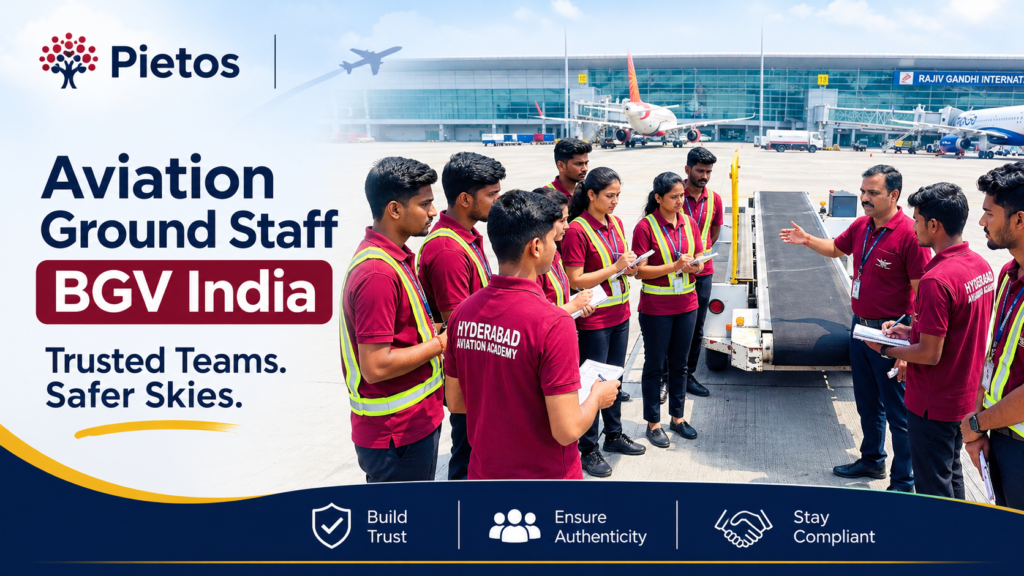
Ground staff BGV India is now a security duty, not an HR formality. Every baggage handler, ramp agent and fuelling operator works beside aircraft, cargo and passengers. Therefore, one weak hire can turn into a security breach within a single shift.
Many airlines know this. However, plenty of hiring teams still run one standard check and hope the regulator catches the rest. That plan fails. BCAS clears people for airside entry. It does not design your hiring process, and it does not protect your brand.
This guide explains ground staff BGV India step by step. You will learn who the rules cover, what BCAS and DGCA each expect, and what HR must submit for an Airport Entry Permit (AEP). Also, you will see how to build one process that meets airline HR needs and BCAS timelines together.
Hiring for your airline’s ground operations? Pietos provides BCAS-aligned background verification that goes beyond what a standard check covers. Talk to the Pietos team
Key takeaways
- BCAS grants airside access through the AEP. DGCA regulates aviation safety and licensed roles. The two are not the same check.
- Ground staff BGV India works best when you start verification the day the offer goes out.
- Criminal history sits at the centre of AEP clearance, so verify it first.
- Drug testing rules differ by role. Confirm what applies to yours.
- ICAO Annex 17 expects background checks before unescorted access, and repeat checks after.
Why Ground Staff BGV India Matters More in 2026
Airports keep growing. New terminals open, airlines add routes, and ground handlers hire in bulk. In August 2026, the Prime Minister said new airports and routes are creating jobs for young Indians, a point the Ministry of Civil Aviation highlights on its homepage. As a result, onboarding pressure rises every quarter. Meanwhile, the risk per hire stays just as high.
The Insider Threat Is the Real Risk
ICAO calls this danger the insider threat. Insiders can share confidential information and help others reach restricted areas. They can also do their jobs badly and let prohibited items through. Therefore, ICAO’s insider threat toolkit lists background checks and vetting among its core measures. You can explore the wider framework on the ICAO website.
The Compliance Gap Is Real Too
ICAO audit data from December 2024 shows weak global compliance with Annex 17 Standard 4.2.3 on airport identification systems. In Asia-Pacific, effective implementation sits near 17 percent. That figure covers the whole region, not India alone. Still, it shows how hard identity control is to get right.
What This Means for HR
Your hiring file is the first control. Later controls, such as gate screening, depend on it. Consequently, a gap at hiring travels with the employee for years. Ground staff BGV India closes that gap before it opens.
Who Needs Ground Staff BGV India? Roles and Risks
“Ground staff” is a wide label. However, risk differs sharply by role. Start by mapping every role that touches the airside, the cargo or the aircraft.
| Role | What they touch | Main risk |
|---|---|---|
| Baggage handlers | Passenger bags, belt systems, aircraft holds | Theft, smuggling, tampering |
| Ramp agents | Aircraft stands, ground power, pushback gear | Safety breaches, unauthorised access |
| Fuelling crew | Hydrants, bowsers, fuel records | Sabotage, fuel theft, safety lapses |
| Catering staff | Galley carts, sealed trolleys, supplies | Hidden contraband |
| Cargo handlers | Freight, mail, dangerous goods | Smuggling, tampering, theft |
| CUTE terminal operators | Check-in systems, boarding data | Data misuse, identity fraud |
| Cleaning and security staff | Cabins, terminals, restricted zones | Access abuse, theft |
CUTE stands for Common User Terminal Equipment. Operators use it to check passengers in across airlines. Therefore, these roles hold passenger data even though they never touch an aircraft.
Contract and Third-Party Workers
Many ground staff work for contractors. Your airline may not hire them directly. Even so, the operational and reputational risk still lands on you. Write verification duties into every ground handling contract. Then audit those duties on a fixed schedule.
Screeners Need Extra Care
Security screeners work under BCAS protocols. They need BCAS-mandated AVSEC certification before they take up duty. Hence, verify their identity and history before you sponsor the course. A failed clearance after training wastes both money and time.
BCAS vs DGCA: What Each Regulator Expects
Hiring teams often mix up the two regulators. The mix-up costs weeks. So, separate them early.
BCAS: The Security Gatekeeper
The Bureau of Civil Aviation Security (BCAS) sits under the Ministry of Civil Aviation. It sets aviation security standards and oversees the AEP system. BCAS guidelines tie AEP issue to security vetting and character and antecedent verification. In BCAS terms, an AEP is the photo identity card, smart card or temporary permit that allows entry to an aerodrome or part of it.
DGCA: The Safety Regulator
The Directorate General of Civil Aviation (DGCA) regulates aviation safety. It licenses pilots, maintenance engineers and air traffic controllers. It also issues civil aviation requirements on training, medical standards and operations. Its portal hosts the Aircraft (Security) Rules, 2011 and the Bharatiya Vayuyan Adhiniyam, 2024. In addition, it links to the e-Sahaj system for security clearance from the Ministry.
The Ministry of Civil Aviation: The Policy Layer
The Ministry frames national policy and publishes acts, rules and circulars. Its homepage lists e-Sahaj under important links. Therefore, start there when you need the policy context behind a BCAS or DGCA rule.
| Question | BCAS | DGCA |
|---|---|---|
| Core role | Aviation security | Aviation safety and licensing |
| Grants | Airside access through the AEP | Licences and approvals for pilots, engineers and controllers |
| Typical check | Police and antecedent verification | Medical fitness and licence validity for licensed staff |
| Link to ground staff | Direct, for airside and restricted areas | Indirect, through safety training and operator rules |
| Portal | e-Sahaj and regional offices | eGCA |
Why the Difference Matters in Hiring
Some airlines ask for a DGCA clearance for a ramp agent. In general, no DGCA licence applies to check-in, ramp or cargo roles. Instead, the gate is the BCAS-backed AEP. Meanwhile, DGCA expectations show up in safety training, operator manuals and audit findings. Confirm the current position with your compliance team, because rules change.
AEP Requirements: What HR Must Submit
The AEP lets a person enter the aerodrome or a restricted part of it. Without one, nobody works airside. Because of this, AEP planning belongs in your hiring plan, not after it.
How the AEP Process Works
The steps vary by airport, so confirm them with your regional BCAS office. In broad terms, the flow looks like this:
- The sponsoring entity, such as an airline or ground handler, holds a valid security clearance.
- HR submits the employee’s application through the e-Sahaj portal.
- The police run a background check on the applicant.
- The employee completes the AVSEC training the authority prescribes.
- An AEP committee approves the application, and the permit is issued.
India told ICAO that no person receives an AEP without background checks and AVSEC training. So, plan both before the joining date.
What HR Typically Submits
Lists differ by airport and permit type. Even so, most files include these items:
- A completed application on the e-Sahaj portal
- Identity proof and address proof
- Recent passport-size photographs
- Employment and education history
- A sponsor or authorisation letter from the employer
- Police verification details, and often a Police Clearance Certificate
- The AVSEC training certificate for roles that need it
Temporary permits exist as well. Airports issue them for short-term needs, such as contractors on a project. However, the same logic applies: no clean background, no access.
Where Delays Hide
Delays rarely come from one place. Instead, they stack up. A Hindustan Times report in October 2018 said AEP issue took three to four months at the time. The Ministry then proposed a faster route with a one-month target. Today’s timelines differ by airport, so ask your regional office for current norms.
Therefore, the best fix is clean data. Wrong names, mismatched addresses and missing documents often cause rework. Fix them before you file.
Need AEP-ready files without the rework? Pietos checks identity, address and criminal history before you file, so your submission goes in clean. Book a ground staff BGV consultation
Antecedent Verification for Airside and Landside Staff
Antecedent verification checks a person’s past conduct and background. For ground staff BGV India, it usually means police-backed checks plus employment and address history.
Airside Roles Need Deeper Checks
Airside workers reach aircraft, baggage and cargo. Therefore, the antecedent check must go deeper. It typically covers identity, current and past addresses, criminal records and police verification.
Landside Roles Need Proportionate Checks
Landside staff work in sales offices, call centres and head offices. However, they may still handle passenger data or payments. So, run standard BGV and add role-specific checks.
| Layer | Airside roles | Landside roles |
|---|---|---|
| Identity | Mandatory, strict | Mandatory |
| Police and antecedent check | Required for the AEP | Role-based |
| Criminal and court record | Deep, multi-district | Standard |
| Address | Current and past | Current |
| Employment | Full history | Last two employers |
| Drug and medical | Role-based | Rarely needed |
Why Police Verification Alone Falls Short
Police verification matters. However, it covers one jurisdiction at a time, and it runs slowly. Pietos’ tenant verification guide notes that police-only checks often take 7 to 21 working days. Meanwhile, a digital-plus-field approach runs several checks in parallel. As a result, HR sees problems earlier.
Criminal Verification Protocol for Ground Staff BGV India
Criminal history is the centrepiece of BCAS clearance. So, treat it as your main gate, not a box to tick. Pietos’ criminal verification services in India cover court and police records. You can run that search in parallel with your AEP filing.
The Six-Step Criminal Check
- Collect consent. Take specific, recorded consent before any search starts.
- Match identity. Confirm name, parent’s name, date of birth and address history.
- Search every relevant district. Cover the current address, the permanent address and past residences.
- Classify each finding. Separate relevant offences from unrelated or minor ones.
- Review adverse results in writing. Give the candidate a fair chance to explain, then record your decision.
- Re-screen on a schedule. Repeat the check at every AEP renewal or at least yearly.
Which Offences Matter Most
Not every record carries the same weight for airside work. Focus your review on these groups:
- Theft, robbery and criminal breach of trust
- Smuggling and customs offences
- Narcotics offences
- Violence and serious assault
- Forgery and document fraud
- Any offence linked to security threats
Handling Pending Cases and Old Matters
A pending case differs from a conviction. Likewise, an old, minor and unrelated matter differs from a recent theft charge. However, the final AEP decision sits with BCAS and the police. Therefore, your BGV file informs your hiring decision. It does not replace theirs.
Drug Testing for Safety-Sensitive Aviation Roles
Aviation runs on fitness. A fuelling operator under the influence puts everyone nearby at risk. Therefore, many employers add drug screening for safety-sensitive roles.
Pietos explains where testing applies in its guide to pre-employment drug testing BGV in India. The guide covers aviation alongside other sectors. It also explains consent and record retention.
Who Needs Testing
DGCA’s rules on alcohol and psychoactive substances centre on licensed and safety-critical personnel. Ground roles often fall under airline or airport operator policy instead. So, check your operator manual and your client contracts. Confirm the current civil aviation requirement for your roles with your compliance team. If no rule applies, set a clear policy and apply it evenly.
How to Run a Defensible Test
- Get written consent before testing.
- Use an accredited lab or a certifying doctor.
- Keep a clear chain of custody for each sample.
- Apply the same policy to every candidate in the same role.
- Set a retention period, then delete records on schedule.
Drug Testing Is Not Medical Fitness
Medical fitness and drug screening answer different questions. Pietos’ guide to pre-employment medical checks in India covers occupational health screening for physical roles such as ramp and fuelling work. Also, alcohol testing follows its own protocol. Therefore, order each check on purpose, not by habit.
ICAO Annex 17 and Ground Staff Screening
Annex 17 to the Chicago Convention sets global aviation security standards. ICAO publishes it, and member states, including India, build their national programmes around it.
What the Standard Requires
In the current edition, Standard 3.5.2 calls for background checks on three groups. They are people who carry out security controls, people with unescorted access to security restricted areas, and people with access to sensitive security information. The standard also calls for recurrent checks at intervals the national authority sets.
Standard 4.2.3 adds identification systems for people and vehicles. Together, these standards form the base of every AEP system.
What This Means for Your Process
- Check people before they get access, not after.
- Repeat checks on a set schedule.
- Verify identity at every access point.
- Keep records that show when and how you checked.
Where India Fits
India turns these standards into local rules through BCAS guidelines and the AEP system. Consequently, an HR team that follows Annex 17 logic sits close to what auditors expect.
How to Structure a Ground Staff BGV India Process
Build one process with five gates. Each gate answers one question. Together, they meet airline HR needs and BCAS timelines.
| Gate | Question | Checks | Typical timing |
|---|---|---|---|
| 1. Consent and identity | Is this person who they claim to be? | Consent, Aadhaar and PAN match, face match | Day 0 to 1 |
| 2. Antecedents and criminal | Does any record matter for airside work? | Court and police search, address history | Day 1 to 5 |
| 3. Employment and references | Did they work where they say? | Employer confirmation, UAN trail, references | Day 1 to 5 |
| 4. Fitness | Is the person fit and safe for this role? | Medical check, drug screen where required | Day 2 to 5 |
| 5. AEP and re-screen | Can they enter airside and stay cleared? | e-Sahaj filing, AVSEC training, annual re-check | Set by the authority |
Pietos lists a standard turnaround of 3 to 7 business days for comprehensive checks. Digital identity checks finish much faster. However, authority-run steps, such as police reports and AEP committee approval, set their own pace.
Run the Gates in Parallel
Sequential checks waste time. Parallel checks save it. So, start gates one to four on the day the candidate accepts the offer. File the e-Sahaj application as soon as identity and criminal results come back clean.
Pietos’ guide to BGV turnaround time in India explains why 7 to 10 working days no longer works for high-volume hiring. In aviation, the clock has two parts. Your BGV vendor controls one part. The police and BCAS control the other. Therefore, ask vendors for check-wise turnaround targets, not one blended number.
Hire at Scale Without Cutting Corners
Airlines add bases and seasonal peaks fast. In those moments, volume breaks weak processes. Pietos’ mass onboarding logistics BGV playbook shows how logistics teams verify hundreds of workers at once. Ground staff onboarding shares the same pressure. You face batch intake, field checks across many districts and tight start dates.
Also, check local steps with your airport operator. At Airports Authority of India airports, the AAI website and the airport office are good starting points for pass counters and security clearance contacts.
An Illustrative Scenario
This scenario is illustrative, not a client case. Picture a ground handler opening a new base with 120 ramp and baggage roles. Offers go out on Monday. HR sends consent links the same day. Digital identity checks clear within a day. Meanwhile, field address and court checks run across the candidates’ home districts.
By the end of week one, HR files clean applications on e-Sahaj for most candidates. A few files show discrepancies, so they go to written review. Because the files are clean, the police and BCAS stage moves without rework. As a result, the base opens on schedule.
Keep an Audit Trail
Audits can ask for verification records, AEP validity and access logs. Therefore, store consent, search dates, findings and decisions in one case file. Set a retention period and delete records when it ends. This habit also keeps you aligned with India’s data protection rules.
The Cost of Inaction on Ground Staff BGV India
Pain Points
- Joining dates slip when AEP files bounce back.
- Training money disappears when a clearance fails.
- Theft and smuggling rise when weak hires reach the ramp.
- Airline partners lose trust after one incident.
Business Risks
BCAS guidelines let it act on AEPs when a sponsoring entity loses its security clearance. So, one weak control can threaten a whole team’s access. Meanwhile, a security incident can stop operations, trigger audits and damage your brand for years.
The Simple ROI Formula
Net value = (risk exposure × probability of a bad hire) − cost of verification. Even a small chance of a serious incident outweighs the cost of checks. Also, clean files cut rework and save HR hours.
Benefits of Solving It
- Faster, cleaner AEP filing
- Fewer failed clearances after training spend
- Lower theft, smuggling and safety risk
- Audit-ready records
- Stronger standing with airline and airport partners
Buyer Objections and Honest Answers
‘BCAS already vets our people.’ BCAS vets people for access. It does not verify employment, education or fitness for your role. Moreover, you pay for AVSEC training before the permit arrives. Verify first, then sponsor.
‘BGV will slow our joining dates.’ Sequential checks do. Parallel checks do not. In fact, early verification protects joining dates, because it catches problems before the AEP stage.
‘Our ground handler does this for us.’ Maybe. Still, the risk lands on your brand. Write verification standards into the contract and audit them.
‘Verification costs too much.’ Compare it with the cost of one failed clearance after training. Furthermore, one theft or one safety breach costs far more than a full check.
‘Candidates drop out while we wait.’ Slow checks cause that. Pietos’ guide on BGV candidate ghosting shows how faster verification keeps good candidates engaged.
Why Aviation Teams Choose Pietos for Ground Staff BGV India
Pietos is a Delhi-based background verification company founded in 2015. It serves clients across India with a digital pipeline and a physical field network. Its digital pipeline targets a median turnaround of 48 to 72 hours. In addition, Pietos builds role-based packages for safety-sensitive sectors, including aviation, pharma and defence.
Here is what an aviation client gets:
- Identity, criminal and court, address, employment and education checks in one case file
- Drug testing and occupational health screening through partner networks
- Consent and record handling designed around India’s data protection rules
- Check-wise turnaround targets in writing, not one blended promise
Build a BCAS-Ready Hiring Process Before Your Next Batch
BCAS decides who enters the airside. You decide who gets that far. Ground staff BGV India sits between those two decisions. Strong verification protects your people, your passengers and your licence to operate.
Start small. Map your roles, fix your consent flow, and run criminal checks in parallel with AEP filing. Then add drug testing and fitness checks for safety-sensitive roles. Finally, re-screen on a schedule.
Ready to verify your next ground staff batch? Pietos builds BCAS-aligned verification for ramp, baggage, cargo, catering and terminal roles, with criminal, identity, address and drug screening in one case file. Email contact@pietos.com, call +91 11 49074103, or book a demo today.
Ground Staff BGV India FAQ’s
Ground staff BGV India is the background verification of airline and airport ground workers. It covers identity, criminal records, address, employment and, where needed, drug and medical checks. It runs alongside the BCAS permit process, not in place of it.
BCAS guidelines link AEP issue to security vetting and character and antecedent verification, which includes police checks. However, BCAS does not verify your employment history, education or role fitness. Employers cover those through their own BGV.
BCAS handles aviation security and issues airside access through the AEP. DGCA handles aviation safety and licenses roles such as pilots, engineers and controllers. Most ground roles need the BCAS permit, not a DGCA licence.
HR typically submits an e-Sahaj application, identity and address proof, photographs, employment history, a sponsor letter and police verification details. Lists vary by airport and permit type, so confirm with your regional BCAS office.
It depends on the role and the operator’s policy. DGCA’s rules centre on licensed and safety-critical personnel. For other ground roles, many airlines set their own policy. Confirm the current rule with your compliance team.
Industry guides put standard BGV at 3 to 10 working days. Pietos lists 3 to 7 business days for comprehensive checks. However, police reports and AEP approval follow the authority’s timeline, so start early.
Industry guides put standard BGV at 3 to 10 working days. Pietos lists 3 to 7 business days for comprehensive checks. However, police reports and AEP approval follow the authority’s timeline, so start early.
Yes, contract workers usually apply through a sponsoring entity that holds security clearance. Because of this, your contract should require verification standards from that entity. Audit those standards on a fixed schedule.