
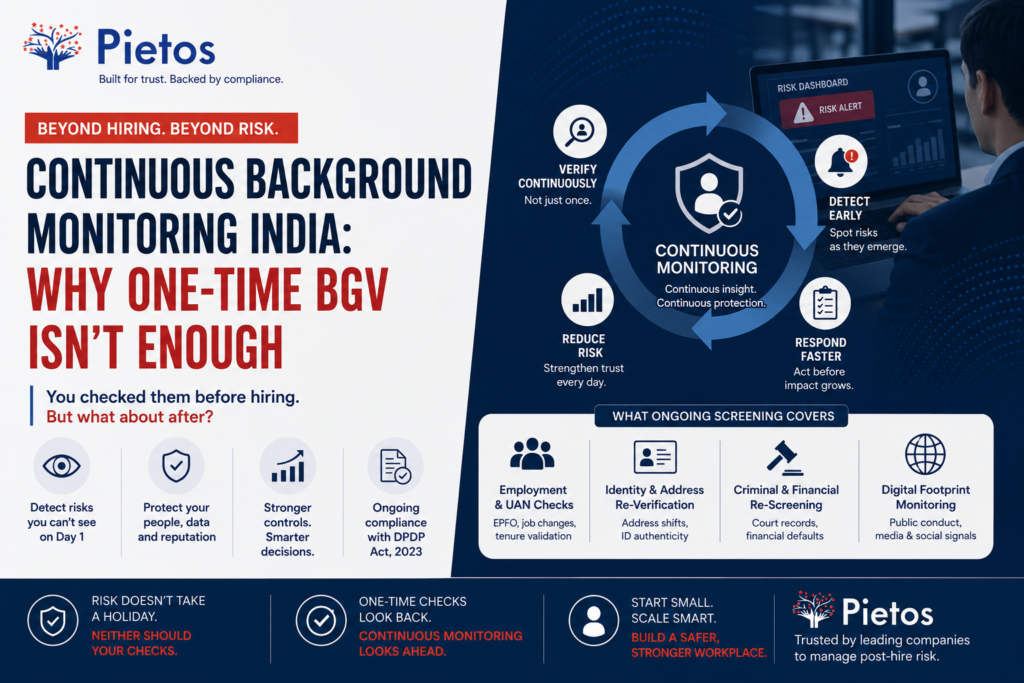
Continuous background monitoring India programs exist because a one-time check freezes risk at a single date. Most Indian companies verify a candidate once, before day one, and never look again. That single snapshot tells you who someone was on their joining date. It tells you nothing about who they became eighteen months later.
Employees change jobs on the side, rack up undisclosed debt, get named in a new FIR, or start a second income stream that competes with yours. None of that shows up in a report filed before they ever sat at their desk. A pre-hire check is a photograph. Risk is a video, and most Indian employers are still only holding the photograph.
This gap matters more now than it did five years ago. Remote and hybrid work removed the everyday visual and social cues — the raised eyebrow from a colleague, the noticed absence — that once surfaced problems early. A manager who once might have noticed a distracted, distant, or over-leveraged employee across a shared desk now sees the same person only through a scheduled video call. The informal, human layer of monitoring has thinned out considerably, even as the underlying risks it used to catch haven’t gone anywhere.
Insider threats have grown more frequent, with 76% of organizations reporting a rise in the past year and formal insider threat programs now in place at 64% of organizations. Most of those programs are built for cybersecurity monitoring — watching for data exfiltration, credential misuse, and system access anomalies. Very few extend to structured, recurring background re-verification of the underlying person: their employment status, financial pressure, legal standing, and identity. That’s the specific gap continuous background monitoring India is designed to close, and it’s the gap this article addresses in detail.
For an Indian HR or compliance leader, the practical question isn’t whether risk changes after hiring. It obviously does. The real question is whether your current screening budget and process are built to notice that change, or whether they stop the moment an offer letter gets signed.
If your last BGV check on current employees happened at onboarding and nothing since, you’re not alone — and you’re not exposed in a way that’s hard to fix. Keep reading, then talk to Pietos about what a post-hire screening layer would look like for your headcount.
What Continuous Background Monitoring Actually Means
Continuous background monitoring India programs exist because a one-time check freezes risk at a single date. Most Indian companies verify a candidate once, before day one, and never look again. That single snapshot shows who someone was on their joining date. It shows nothing about who they became eighteen months later.
Employees change jobs on the side. They rack up undisclosed debt. Some get named in a new FIR, or start a second income stream that competes with yours. None of that shows up in a report filed before they ever sat at their desk. A pre-hire check is a photograph. Risk is a video, and most Indian employers still hold only the photograph.
Why the Gap Keeps Widening
This gap matters more now than it did five years ago. Remote and hybrid work removed the everyday visual cues that once surfaced problems early — the raised eyebrow from a colleague, the noticed absence. A manager who once might have spotted a distracted, distant, or over-leveraged employee across a shared desk now sees that same person only through a scheduled video call. The informal, human layer of monitoring has thinned out, and the risks it used to catch haven’t gone anywhere.
<Insider threats have grown more frequent, with 76% of organizations reporting a rise in the past year and formal insider threat programs now in place at 64% of organizations. Most of those programs cover cybersecurity monitoring — watching for data exfiltration, credential misuse, and system access anomalies. Very few extend to structured, recurring background re-verification of the underlying person: employment status, financial pressure, legal standing, identity. That specific gap is what continuous background monitoring India closes, and it’s the gap this article covers in detail.
For an Indian HR or compliance leader, the practical question isn’t whether risk changes after hiring. It obviously does. The real question is simpler: does your current screening process notice that change, or does it stop the moment an offer letter gets signed?
If your last BGV check on current employees happened at onboarding and nothing since, you’re not alone — and you’re not exposed in a way that’s hard to fix. Keep reading, then talk to Pietos about what a post-hire screening layer would look like for your headcount.
What Continuous Background Monitoring Actually Means
Continuous background monitoring India refers to scheduled, recurring re-verification of active employees. It isn’t a single check at hiring. It’s a repeating cycle, run every 6, 12, or 24 months depending on role risk. Most cycles re-check employment and provident fund records, address, identity, and criminal record status. Finance-adjacent roles often add credit and asset checks too.
This isn’t surveillance of daily behavior. No one watches emails, monitors keystrokes, or tracks location in real time under this model; those activities belong to IT security controls, with their own rules and consent requirements, and they usually sit with the IT security or InfoSec function rather than HR. Continuous background monitoring works differently. It re-verifies a defined set of facts on a fixed schedule, and employees know that schedule in advance.
Why the Distinction Matters for Compliance
The distinction matters for two reasons. First, it changes what you build or buy: a monitoring vendor that re-runs verification checks, not a surveillance tool that logs behavior. Second, it changes your DPDP Act exposure. Periodic fact re-verification and continuous behavioral tracking carry very different consent, proportionality, and data-minimization obligations. Conflating the two — telling employees you’re introducing “monitoring” without specifying which kind — triggers unnecessary anxiety and legal risk at once.
A well-scoped continuous background monitoring India program looks less like a surveillance rollout and more like an insurance renewal in practice. It runs quietly, on a schedule, checking a defined set of facts. It only becomes visible to an employee when a check turns up something worth a conversation. Most employees notice nothing beyond a brief consent renewal each cycle — which is exactly the point.
One-Time BGV vs Continuous Background Monitoring India: The Real Difference
Most HR leaders assume a strong pre-hire BGV process already covers them. It covers the moment of hire. It doesn’t cover anything after.
| Dimension | One-Time Pre-Hire BGV | Continuous Background Monitoring |
|---|---|---|
| Timing | Before joining, once | Recurring, every 6–24 months |
| What it catches | Resume fraud, fake degrees, past employment gaps | New moonlighting, new legal cases, new financial distress, address changes |
| Data used | Historical records only | Historical + newly generated records (EPFO, court filings, credit bureaus) |
| Compliance basis | Standard onboarding consent | Separate, purpose-specific consent under DPDP Act rules |
| Business value | Reduces hiring risk | Reduces sustained operational and reputational risk |
| Typical owner | Talent acquisition / HR | Compliance, HR, and risk teams jointly |
What the Comparison Reveals
The pattern across the table is simple. Pre-hire BGV answers “should we hire this person.” Continuous monitoring answers “should we still trust this person with what they currently have access to.” Those are different questions, and a company that only ever asks the first one is flying blind on the second.
Consider how much authority builds up over an employee’s tenure that never existed on day one. A finance executive hired at a junior level two years ago may now approve six-figure vendor payments. A support hire may now sit on a client’s confidential data pipeline. Access grows steadily with tenure and promotion, yet the background check that vetted the person stays frozen at the point they had none of that access yet. Continuous background monitoring India closes exactly that widening gap between accumulated trust and the age of the last verified fact.
Why This Also Matters for Audits
There’s also a practical audit angle most HR teams underweight. When a regulator, client, or board asks “how do you know your current workforce is still low-risk,” a pre-hire BGV file dated three years ago isn’t a credible answer. A recurring, dated, DPDP-compliant re-verification cycle is. That difference often separates a company that passes a vendor security audit from one that has to explain a gap in writing.
Key takeaway: A background check with no expiry date isn’t a control — it’s a certificate. Controls need renewal cycles.
Why Post-Hire Risk Doesn’t Stop at Onboarding
The assumption that hiring risk and employment risk are the same thing is where most gaps start. They aren’t. Hiring risk is about who you let in. Employment risk is about what happens to that person, and around that person, for the years they stay.
The Cost of Doing Nothing After Day One
Skipping post-hire monitoring isn’t neutral. It’s a cost you’re deferring, and it compounds. <cite index=”22-2,22-3″>The 2026 Ponemon and DTEX Cost of Insider Risks Global Report found the average annual cost of insider risk reached $19.5 million per organization in 2025, up from $17.4 million the year before.</cite> <cite index=”22-2″>Negligent employees caused 53% of incidents, malicious insiders accounted for 27%, and credential theft made up the remaining 20%.</cite> Read that split carefully: more than half the cost sits in negligence, not malice — exactly the category a periodic re-verification cycle catches early, before a negligent gap turns into an exploited one.
Detection speed matters just as much as detection at all. <cite index=”22-1″>The average time to contain an insider incident fell to 67 days in 2025, yet only 13% of incidents were contained within 30 days.</cite> Every extra week a compromised or dishonest employee stays undetected adds a week of continued exposure — to fraud, to data leakage, to reputational damage that surfaces only when a client or regulator starts asking questions.
What the Detection Lag Reveals
Indian banking data tells the same story from a different angle. RBI’s own reporting on banking sector fraud shows that a large share of the value involved in any given year’s disclosures relates to activity that occurred in earlier years and simply went uncaught until later. That detection lag makes the whole case for continuous monitoring in one data point: the fraud didn’t happen on the day someone found it. It happened earlier, and it sat undetected because nothing in the process looked again.
For an Indian BGV buyer, the translation is concrete. An employee with quiet financial distress is a fraud risk in finance and procurement roles. Someone running an undisclosed second job is a productivity and confidentiality risk in client-facing roles. A pending criminal case turns a customer-facing or leadership hire into a safety and reputational risk. None of these show up in the file you built before they joined.
Why This Risk Concentrates in Regulated and High-Trust Sectors
Not every role carries the same post-hire exposure, but certain sectors carry structurally more of it. Banking, financial services, and insurance sit at the top of that list, precisely because employees in these roles routinely gain approval authority, access to customer funds, and visibility into sensitive financial data as their tenure grows.
The Reserve Bank of India’s own fraud reporting shows the scale involved. Banks reported tens of thousands of fraud cases in recent financial years, with the value involved running into tens of thousands of crores annually. A recurring theme stands out across RBI’s reporting years: a large share of that value traces back to fraud that occurred well before anyone reported it. That gap between occurrence and detection is precisely where a continuous, scheduled re-verification layer earns its cost. It doesn’t just add a new check — it shortens the distance between something going wrong and someone noticing.
BFSI is the clearest example, but the same logic extends to any sector where tenure quietly expands access: IT services firms holding client source code, healthcare providers holding patient records, logistics and manufacturing firms managing high-value inventory, and D2C or e-commerce companies handling customer payment data at scale. If the role’s access grows with time served, the screening attached to that role should grow with it too.
This is also where a tiered approach earns its keep financially. A BFSI institution doesn’t need deep financial re-screening across its entire back-office headcount. It needs that depth concentrated on roles with direct fund access or approval authority, while lighter checks cover the rest. The goal is proportional coverage, not maximum coverage everywhere at equal cost.
What Changes Between Hiring and Year Two
People’s financial, legal, and professional situations shift constantly. A candidate with a clean credit file at 24 can carry heavy undisclosed debt at 27. A clean criminal record at hiring says nothing about a case filed last quarter. An EPFO record with one employer at onboarding can show a second, overlapping employer eighteen months later — the exact signature of moonlighting risk Pietos already tracks through EPFO and UAN-based verification.
None of these changes are hypothetical. They’re the ordinary texture of a multi-year career: an undisclosed side job, a loan taken out during a personal emergency, an address change that never reached HR, a legal dispute that surfaced only after the fact. Individually, each looks unremarkable. Left unchecked for years, they become exactly the blind spot that turns into a fraud case or a reputational incident a company has to explain after the damage is done.
Continuous background monitoring India isn’t a luxury control reserved for large enterprises. Mid-sized companies with client data access or regulatory obligations carry the same exposure, with fewer resources to absorb a surprise. A 200-person BPO with one compromised finance executive faces the same category of loss as a 2,000-person enterprise — just with a thinner balance sheet.
Pietos already runs EPFO and UAN checks for dual-employment detection at hiring. Extending that same verification into a recurring post-hire cycle is a natural next step — see how our moonlighting detection framework works, then ask us about turning it into an ongoing program.
What Continuous Background Monitoring India Should Actually Cover
Not every check needs repeating at the same frequency. A well-built program tiers checks by how fast the underlying fact can change and how much damage a stale answer causes. Some facts, like an employee’s core identity, rarely change and don’t need annual re-verification. Others, like EPFO-linked employment status or financial standing, can shift meaningfully within a single year and deserve a shorter recheck cycle.
Four categories cover most of the risk surface HR and compliance teams actually care about after hiring. Each one answers a different question, and together they give a reasonably complete post-hire risk picture without requiring an intrusive, all-encompassing monitoring program.
EPFO and UAN-Based Employment Checks
Re-running EPFO and UAN checks on a 12-month cycle catches dual employment, undisclosed parallel jobs, and unexplained service gaps. EPFO records are timestamped and government-verified, which makes them one of the few facts in this list that can’t be talked around in an interview. An employee can explain away a rumor or a colleague’s suspicion, but a second, overlapping EPFO contribution record with a different employer’s establishment ID is much harder to explain — which is exactly why this check carries so much weight.
Pietos already applies this exact logic in its moonlighting detection India framework, and the same UAN-history approach extends cleanly into a recurring post-hire cycle. In practice, this means an annual pull of UAN-linked service history for every employee in a monitored tier, automatically flagged wherever a second active contribution appears alongside your own.
Address and Identity Re-Verification
Physical address checks confirm an employee still lives where their records say they do — relevant for background-sensitive roles, field staff, and anyone handling cash or physical assets. An address mismatch alone rarely signals wrongdoing, but paired with other flags, it’s often the first visible sign that something in an employee’s circumstances has shifted since hiring.
Digital-first address verification, using geo-tagged and time-stamped photo captures rather than a physical field visit, keeps this fast and low-friction to repeat annually instead of once. Employees also find this check the least intrusive of the four, which makes it a sensible default for the standard-risk tier across a full headcount, even where deeper financial or criminal re-screening stays reserved for higher-risk roles only.
Financial and Criminal Record Re-Screening
For finance, procurement, and leadership roles, periodic credit bureau and court record checks catch new financial distress or pending litigation that didn’t exist at hiring. This is the single highest-value check for fraud-adjacent roles, since financial pressure remains one of the most consistent predictors behind internal fraud cases. An employee under sudden debt pressure with access to vendor payments or client funds is a materially different risk than the same employee was on their joining date.
Criminal record re-screening plays a similar role for any role involving physical access, safety responsibility, or public-facing trust. A pending case filed after hiring won’t appear anywhere in an onboarding file — by definition, only a check that runs again can catch it.
Digital Footprint and Public Conduct Signals
A lighter-touch, consent-bound review of public professional conduct — not private surveillance — can flag reputational risks tied to senior or client-facing roles. This typically covers publicly available professional presence and conduct relevant to the role, not private messages, personal social accounts, or off-duty activity unrelated to work.
This check needs the tightest DPDP Act guardrails of the four, since it touches data an employee may consider personal even when it’s technically public. Scope it narrowly, disclose it explicitly, and limit it to senior or externally-facing roles where public conduct carries direct business risk. It isn’t a check that belongs in a standard, company-wide tier.
Key takeaway box:
- Tier checks by role risk, not by company-wide default.
- EPFO/UAN and financial checks catch the fastest-changing, highest-impact facts.
- Every recurring check needs its own consent record — reusing onboarding consent doesn’t hold up.
Running Continuous Background Monitoring India Under the DPDP Act
Compliance is where most continuous monitoring plans quietly stall, and it’s also the part buyers get most wrong.
Where the Legitimate-Use Provision Ends
<cite index=”29-1″>Under the DPDP Act’s legitimate use provisions, a data fiduciary can process personal data for employment-related purposes, or to safeguard the employer from loss or liability, without separate consent in specific defined situations.</cite> That provision covers some employment-context processing, but it isn’t a blanket license for recurring checks that go beyond the original hiring purpose. Treating it as a blanket exemption is the single most common compliance mistake HR teams make when they try to build this in-house.
For anything beyond the narrow legitimate-use carve-out, <cite index=”27-1″>the consent obtained must be free, specific, informed, unconditional, and unambiguous, involving a clear affirmative action tied to a specified purpose.</cite> Consent gathered for pre-hire verification stayed specific to that purpose; it doesn’t automatically extend to a check run eighteen months later. In practice, every recurring monitoring cycle needs its own consent capture, its own stated purpose, and its own audit trail — not a checkbox ticked once at onboarding and never revisited.
What This Means in Practice
Here’s why that legal text carries real weight for HR teams, not just legal teams. <cite index=”24-1″>The Digital Personal Data Protection Act, 2023 requires a Data Fiduciary to be able to prove that notice was given and consent was obtained in accordance with the Act and its rules.</cite> That burden of proof sits with the employer, not the verification vendor. A compliant continuous monitoring partner — one that builds consent capture, retention limits, and audit trails into the process by default — is worth more than a cheaper checklist vendor who leaves that exposure with you.
Three practical guardrails follow directly from this. First, notice has to arrive before the check runs, not after, naming the specific categories of data under re-verification. Second, retention has to tie to a defined purpose and period — data collected for a 2026 re-verification cycle shouldn’t sit indefinitely in a vendor’s system once that cycle closes. Third, every finding needs a documented chain of custody, so a regulator or employee who asks how a decision was reached gets a clear, dated answer instead of an informal HR conversation nobody wrote down.
Pietos structures every recurring check the same way it structures pre-hire checks: purpose-bound consent, minimal necessary data collection, and a retention window tied to that stated purpose. Nothing about “continuous” should mean “unbounded.”
Buyer Objections About Continuous Monitoring, Answered
Every HR leader who considers this seriously runs into the same handful of concerns before committing budget. None of them are unreasonable, and none of them are reasons to skip the program — they’re reasons to scope it carefully.
Cost, Scope, and Employee Experience
“Won’t this feel like surveillance to employees?” Only if the rollout is built and communicated like surveillance. Position it as a periodic re-verification policy — the same logic as an annual health check, not a daily watch — and it reads as a governance control, not distrust. Transparent notice at rollout, tied to a clearly stated purpose, keeps this defensible under DPDP and acceptable to staff.
“Isn’t this expensive to run across our whole headcount?” Not if it’s tiered. Run EPFO and address checks on your full base annually, and reserve financial and criminal re-screening for finance, procurement, and leadership roles. That keeps cost proportional to actual risk exposure. Most companies don’t need uniform depth — they need the right depth in the right roles. In practice, a well-tiered program costs a fraction of even one undetected fraud incident, which is the comparison that matters when a CFO asks for a business case.
“What if we find something on a long-tenured employee?” That’s the point of the program, not a flaw in it. A finding triggers an internal review process, not an automatic termination. The value lies in catching the signal early enough to act deliberately, instead of finding out from a client complaint or a regulator’s letter.
Ownership and Overlap With Existing Controls
“Do we have the compliance capacity to manage this ourselves?” Most HR teams don’t, and that’s the honest answer. Consent management, retention limits, and audit trail generation across a recurring cycle demand exactly the operational load a specialist BGV partner like Pietos already absorbs, rather than something to build in-house from scratch.
“How is this different from what our IT security team already monitors?” IT security monitoring watches systems — logins, data transfers, unusual access patterns. Continuous background monitoring India re-checks facts about the person — employment status, address, financial standing, legal record. The two complement each other rather than overlapping. A mature risk program eventually runs both, coordinated through a shared escalation process instead of two disconnected policies that never talk to each other.
A Practical Rollout Framework for HR Teams
Steps 1–3: Map, Tier, and Get Consent Right
- Map role risk tiers. Identify which roles carry financial approval authority, client data access, or public trust exposure. These get the deepest, most frequent checks. Start with finance, procurement, senior leadership, and any role with direct client or customer data access — usually 15–20% of headcount, but carrying the majority of post-hire exposure.
- Set check frequency by tier. High-risk roles: 12-month cycles covering EPFO, financial, and criminal checks. Standard roles: 24-month cycles covering EPFO and address verification only. Resist running every check on every employee at the same depth — it drives up cost without a matching gain in risk coverage.
- Rebuild consent, don’t reuse it. Draft a standalone, purpose-specific consent notice for recurring checks, separate from onboarding paperwork. State clearly what you’re checking, why, and how often, so employees see this as a governance policy rather than a surprise.
Steps 4–5: Choose a Partner and Set the Escalation Path
- Choose a DPDP-compliant partner. Confirm the vendor builds retention limits and audit trails into every cycle, not just the first one. Ask specifically how they handle consent renewal and data disposal after each cycle closes — a vendor without a clear answer here hands you a liability, not a solution.
- Define an escalation path before findings appear. Decide who reviews a flag, what triggers a conversation with the employee, and what triggers formal action — before the first report lands, not after. Involve HR, legal, and the relevant business head in setting this path, so a finding doesn’t turn into an ad-hoc debate under time pressure.
Companies that build the escalation path in step 5 before running a single check avoid the most common failure mode: finding a real issue with no agreed process for what happens next. A program that surfaces a genuine risk and then stalls on “what do we do about it” delivers very little of the value it was built for.
None of these five steps demand a large team or a long timeline. Most mid-sized Indian companies can move from “we only check people once” to a working, tiered, DPDP-compliant program within a single quarter — provided they agree on risk tiers and the escalation path upfront, rather than improvising mid-rollout.
A one-time BGV report tells you who someone was on their first day. Continuous background monitoring India tells you who they are now. If your current employees haven’t been re-verified since they joined, that’s a gap worth closing before it becomes a headline. Book a consultation with Pietos to scope a tiered, DPDP-compliant continuous monitoring program built around your actual headcount and risk profile.
Build In-House or Partner With a Verification Vendor?
Once the rollout framework is agreed, most HR teams face one more decision: run continuous background monitoring India internally, or route it through an existing BGV partner. Both are workable, but they carry very different operational costs.
What Running It In-House Actually Requires
Running it in-house means someone owns consent form design, EPFO/UAN data pulls, credit bureau and court record access agreements, retention scheduling, and audit trail generation — indefinitely, across every re-verification cycle. A small compliance team already stretched across onboarding checks, policy work, and regulatory reporting usually can’t sustain that load. In most cases, the program either never launches, or it launches once and quietly stops being maintained after the first cycle.
What a Specialist Partner Takes Off Your Plate
Routing it through a specialist partner shifts that operational load to a team already built for it. A partner running pre-hire BGV at scale typically already has the EPFO/UAN integration, the bureau relationships, and the consent-management infrastructure the recurring program needs. Extending an existing pipeline into a repeating cycle is largely a matter of configuration, not a new build from scratch — usually the faster, lower-risk path for companies without a dedicated data-privacy function.
The Real Test Isn’t Year One
The right test isn’t “can we technically do this ourselves.” Most compliance teams could, eventually. The real test is whether the program will still be running, correctly and compliantly, in its third year — not just its first. A program that quietly lapses after year one because nobody owned the renewal cycle provides less protection than no program at all, since it creates a false sense of coverage that leadership assumes still exists.
Related Resources
- Moonlighting Detection in India: The Complete EPFO/UAN Guide — Anchor: “moonlighting detection India framework.” Reason: directly extends the EPFO/UAN logic this article recommends for recurring checks.
- Ghost Employee Fraud India: How WFH Payroll Scams Get Caught — Anchor: “ghost employee fraud in remote payroll.” Reason: shows another post-hire risk category continuous monitoring helps surface.
- The Enterprise Guide to Employee Background Verification Services — Anchor: “enterprise background verification framework.” Reason: gives readers the pre-hire foundation this article builds on.
- Automated Background Verification Services (Enterprise ROI) — Anchor: “automated, DPDP-aligned verification platform.” Reason: shows the tech infrastructure that makes recurring checks operationally feasible.
- Digital Background Verification vs Physical Checks — Anchor: “digital-first address verification.” Reason: supports the address re-verification check recommended in this piece.
Frequently Asked Questions
Continuous background monitoring India is a recurring, scheduled re-verification of active employees — typically every 6 to 24 months — covering EPFO/UAN employment records, address, identity, and, for higher-risk roles, financial and criminal record checks. It re-checks facts that can change after hiring, rather than relying on a single pre-employment snapshot for the entire duration of someone’s tenure
Yes, when it’s run with purpose-specific consent, minimal necessary data collection, and a defined retention period. Reusing onboarding consent for later checks does not meet the DPDP Act’s requirements for specific, informed consent, so every recurring cycle needs its own notice and consent capture, along with a documented audit trail the employer can produce if asked.
Continuous background monitoring re-verifies factual records — employment, address, legal, and financial status — on a set schedule. It does not track daily behavior, communications, or location, which fall under separate IT security and monitoring policies with their own consent and proportionality requirements.
Roles with financial approval authority, client data access, procurement responsibility, or public-facing trust carry the highest post-hire risk and should sit in the most frequent, deepest monitoring tier, while lower-risk roles can sit in a lighter, less frequent tier without losing meaningful coverage.
A common tiered approach re-checks high-risk roles annually and standard roles every 24 months, adjusting frequency to how quickly the underlying risk — financial, legal, or employment status — tends to change for that particular role.




Pingback: Insurance Agent Background Verification: IRDAI 2026 Rules - Best Background Verification Company in India | Pietos