You have found a tenant. The rent matches your ask, the move-in date works, and the conversation felt easy. Now comes the part most landlords rush past: tenant background verification India requires before any lease should legally begin. Skipping it feels harmless in the moment. It rarely stays harmless for long.
Millions of flats change hands every year across Bangalore, Pune, Gurgaon, and Mumbai, and most of those handovers happen on trust alone. A friendly conversation is not proof of identity. A confident tenant is not proof of a clean record.
Landlords often assume verification is something only large corporations or property management firms bother with. That assumption costs them. An individual landlord holds just as much financial and legal exposure as a company, often with far fewer resources to recover from a bad tenancy. This guide walks through what tenant background verification India actually involves, which checks the law requires, and how landlords can complete the process without losing weeks to paperwork.
Worried about the tenant you’re about to sign? Pietos runs a full tenant verification report in 48 hours, starting at ₹499. You’ll know exactly who is moving in before you hand over a single key.
Why Tenant Background Verification India Has Become Urgent
Rental housing in India is growing faster than the systems built to police it. Metro migration keeps rising every year, and most of that population rents before it ever buys. Bangalore, Pune, and Gurgaon add thousands of new tenants monthly, pulled in by IT campuses, startups, and co-living platforms that market speed over scrutiny.
Speed is exactly the problem. Listings move fast, brokers push for quick closures, and landlords sign agreements within days of a first meeting. Tenant background verification India processes exist precisely because this speed leaves no room for real due diligence. A landlord who skips the check is betting an entire property on a first impression.
The National Crime Records Bureau tracks property and fraud-related offences in its annual crime statistics. Indian metros consistently report cases involving forged identity documents used to secure rental housing. <cite index=”41-1″>Forgery, cheating, and fraud cases make up a meaningful share of registered crime nationally</cite>, according to NCRB data. That single fact should change how every landlord treats the handover process.
Co-living operators already know this. Most large platforms run mandatory checks before onboarding a resident. Individual landlords, though, still rely on gut feeling. Tenant background verification India services step in to close that gap. They bring corporate-grade screening within reach of a single flat owner with no HR team behind them.
How Big Is the Tenant Verification Gap in India?
Ask ten landlords in any Bangalore apartment complex whether they verified their current tenant. Most will describe a broker introduction, a security deposit, and little else. Formal verification remains the exception, not the norm, even in cities with explicit police mandates.
Gurgaon illustrates the gap well. New residential towers keep filling with tenants who relocate from other states for IT and startup jobs. Turnover is high, leases are short, and landlords rarely meet a tenant more than once before handover. Pune shows a similar pattern near its IT corridors. PG operators and independent landlords compete for the same renters, and many cut corners to close deals faster.
Housing societies increasingly notice the cost of this gap. Resident Welfare Associations across Bangalore and Pune now demand proof of verification before issuing a gate pass. Unverified tenants have created real security incidents in the past. Tenant background verification India services exist to close this exact gap. Demand for them is rising fastest in the cities growing fastest.
The Real Risks of Skipping Tenant Verification
Landlords who skip verification usually discover the cost only after damage is done. Here are the risks that show up most often.
- Identity fraud. A tenant signs with a fake or borrowed Aadhaar, then disappears after a dispute, leaving no traceable identity behind.
- Subletting without consent. The person you interviewed moves out within weeks and quietly rents the flat to someone else.
- Rent default with no recourse. Without verified employment or income proof, a tenant who stops paying is hard to trace or hold accountable.
- Criminal history. A tenant with an active case or a history of property disputes settles into a residential building undetected.
- Legal exposure for the landlord. In several states, an unverified tenant linked to unlawful activity can create liability for the property owner, not just the tenant.
- Damage to society reputation. One bad tenant in a housing complex often triggers stricter, slower onboarding rules for every future resident.
- Insurance complications. Some home insurance policies require proof of tenant due diligence before covering damage or liability claims tied to a rented unit.
- Difficulty during resale. A property with a history of tenant disputes can face extra buyer scrutiny, even years after the tenancy ends.
Cost of inaction rarely feels immediate. It shows up months later, as a police notice, a missing security deposit, or a resident welfare association demanding answers you cannot give. Tenant background verification India processes exist to move that cost forward, into a 48-hour check, instead of backward, into a legal mess.
Consider a pattern that repeats across metro societies every year. A landlord rents a two-bedroom flat to a “corporate professional” who pays the first two months on time. By month three, the flat has three additional occupants nobody agreed to. The original tenant has vanished, and the security deposit barely covers the cleanup. None of this required forged documents. It only required a landlord who never checked proof of employment or a previous address.
Red Flags to Watch For Before You Skip a Check
Certain warning signs should push a landlord straight toward a verification report, not away from one.
- A tenant who insists on cash-only rent with no formal receipts.
- Reluctance to share a permanent address, only a current one.
- An ID document that looks edited, mismatched, or low-resolution.
- A broker who discourages verification, citing “time pressure.”
- A tenant unwilling to provide a previous landlord’s contact number.
- Vague or shifting answers about current employment.
None of these guarantee bad intent on their own. Together, they are exactly the pattern a proper tenant background verification India process is built to catch.
What a Complete Tenant Background Verification India Process Covers
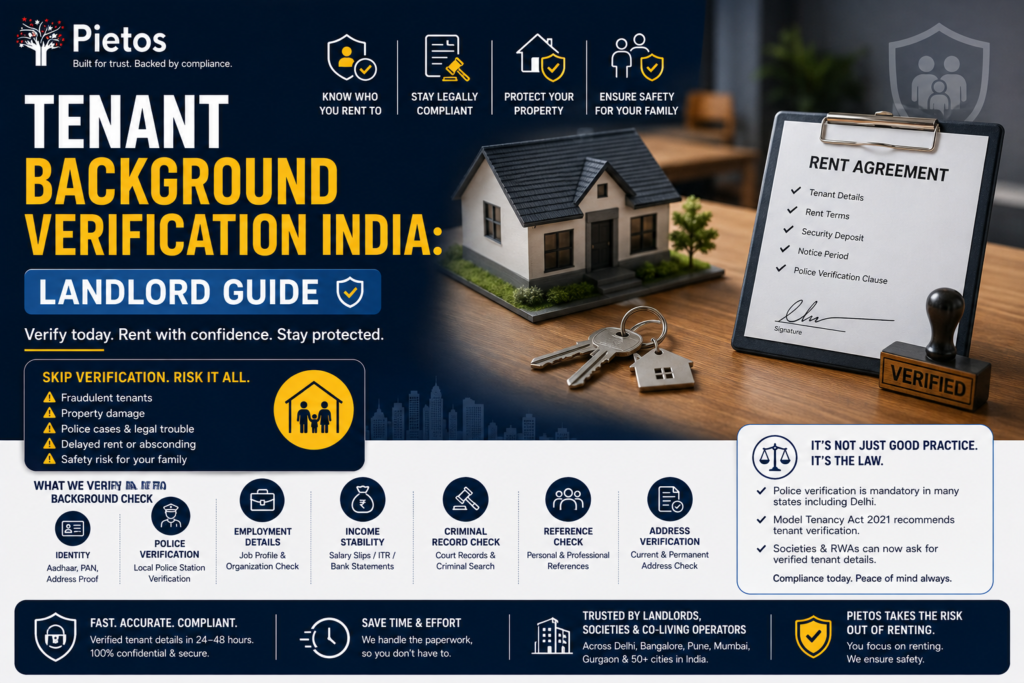
A proper check goes well beyond glancing at an Aadhaar card. Below is what a thorough tenant background verification India process actually includes.
Identity Verification
This step confirms the tenant is who they claim to be. Verifiers cross-check Aadhaar, PAN, passport, or a driving licence against government databases, and they confirm the photograph matches the applicant. Fake or tampered IDs get flagged at this stage, before an agreement is ever signed.
Address History Verification
Verifiers confirm the tenant’s current and permanent addresses through a mix of document checks and, where needed, physical field visits. This step catches applicants who list an address they never actually lived at. That pattern surfaces often in Tier 2 and Tier 3 rental markets, where formal address records stay thinner.
Criminal Record Check
A criminal background screen checks police and court databases for pending cases, past convictions, or ongoing investigations linked to the applicant. This is the single most important check for a landlord’s peace of mind. It is also the check individual landlords are least equipped to run on their own.
Employment and Income Verification
Confirming where a tenant works, and roughly what they earn, tells a landlord whether the rent is sustainable long term. It also gives a second, independent contact point if a dispute ever arises.
Reference and Previous Landlord Checks
A quick call to a former landlord often reveals more than any document. Did the tenant pay on time? Did they leave the property in good condition? Was there a dispute at move-out? These answers rarely surface anywhere else.
A tenant background verification India report should combine all five checks, not just one. A landlord who only does an Aadhaar check has confirmed identity, nothing more. Criminal history, address history, and financial stability all remain unknown.
Documents a Landlord Should Collect Before Verification
Gathering the right paperwork upfront speeds up every step that follows. A landlord should collect these before submitting a tenant for verification.
- Aadhaar card or another government-issued photo ID
- PAN card, where available
- Two recent passport-sized photographs
- Signed copy of the rent agreement
- Proof of the landlord’s ownership, such as a sale deed or property tax receipt
- Previous landlord’s name and contact number, if the tenant has one
Having this ready before the tenant moves in avoids the common trap of chasing documents after the lease has already started, when a landlord’s leverage is weakest.
Delhi Police Tenant Verification and Other State-Level Legal Rules
In several Indian cities, tenant verification is not optional. Delhi is the clearest example.
Under Section 188 of the Indian Penal Code, Delhi landlords who fail to register a tenant with local police can face fines or, in some cases, imprisonment. The process runs through the official Delhi Police portal. Landlords submit tenant identity documents, a signed rent agreement, and proof of ownership through the Citizen Services section. Processing typically takes anywhere from a few days to three weeks, depending on whether a field visit is required.
Mumbai, Bangalore, and Pune run comparable systems through their own city police departments. Portal names and required documents differ by state. None of these are unified into one national process yet. That gap is exactly why so many landlords give up halfway through and skip the step entirely.
How Verification Rules Differ by City
Mumbai landlords file tenant details through the Mumbai Police citizen portal. Larger societies often insist on this before allocating a parking slot or gate pass. Bangalore routes verification requests through Karnataka Police’s citizen services, and enforcement tends to be stricter in gated communities than in standalone buildings. Pune follows a similar model under Maharashtra’s police framework. Processing times stretch during peak rental seasons around May and June, when students and new employees flood the market. Gurgaon landlords work through Haryana Police procedures, which mirror Delhi’s process but run on a separate portal.
The common thread across every city: none of these police systems check employment history, previous landlord references, or subletting risk. They confirm identity and, where the local station follows up, a criminal record. Everything beyond that needs a dedicated tenant background verification India service.
This is where the legal requirement and the practical service diverge. The police check confirms identity and, occasionally, criminal history. It does not verify employment, cross-check previous landlords, or investigate subletting risk. A landlord who only files a police verification form has completed the legal minimum, not a full tenant background verification India process.
Filed a police verification form and still feel uncertain? Pietos layers a full verification report on top of it. It covers identity, address, employment, and criminal history in one document, so you stay covered legally and practically.
The Model Tenancy Act 2021 and What It Means for Landlords
The central government approved the Model Tenancy Act in June 2021 to modernise India’s outdated rental laws. According to the official <cite index=”13-1″>press release from the Press Information Bureau, the Model Tenancy Act aims to balance the rights of tenants and landlords and create an accountable, transparent renting ecosystem</cite>. States adopt the Act through their own legislation. Coverage still varies across India.
For landlords, the Act’s relevance to background checks is indirect but important. It formalises the landlord-tenant relationship through mandatory written agreements and a Rent Authority registration process. That means the paper trail a landlord builds during verification now carries more legal weight than it did a decade ago. A PRS India legislative brief notes that the Act sets up a three-tier dispute resolution mechanism to speed up eviction and rent disputes. That mechanism only works if the landlord already holds verified, accurate tenant information going in.
In short: better tenancy law does not replace tenant background verification India practices. It rewards landlords who already have their documentation in order.
Adoption still varies widely across states, and several have not yet enacted the Act’s provisions into local law. A landlord in a state that has adopted the Act gains access to the Rent Authority and its faster dispute resolution track. A landlord elsewhere still relies on general civil courts, where cases can stretch for years. Either way, verified tenant records strengthen a landlord’s position the moment a dispute reaches any forum.
Data Privacy and Consent: What Landlords Must Know
Collecting a tenant’s Aadhaar, PAN, and employment details means handling sensitive personal data. India now regulates that handling directly. The Digital Personal Data Protection Act, 2023 governs how any individual or organisation collects and stores personal information. Its rules apply even to a single landlord holding a tenant’s documents on a phone.
The official Act text published by the Ministry of Electronics and Information Technology requires clear consent before personal data is collected. It also limits how long that data can be retained without a valid purpose. A landlord who photocopies a tenant’s Aadhaar and keeps it indefinitely, without saying why, sits on shaky legal ground once the Act’s remaining provisions take effect.
Practically, this means two things for a landlord running tenant background verification India checks. First, always inform the tenant why documents are being collected and how they will be used. Second, use a verification service built around privacy-by-design practices, one that encrypts stored data and limits access, instead of passing sensitive documents over WhatsApp. Professional verification services are built around this compliance requirement. Individual landlords rarely are.
Tenant Verification for PG, Co-living, and Rental Platforms
Individual landlords are not the only ones who need this process. PG operators and co-living platforms house dozens, sometimes hundreds, of tenants under one roof, which raises the stakes considerably.
A single unverified resident in a co-living property puts every other resident at risk, not just the operator’s reputation. Most organised co-living brands already run background checks as a condition of onboarding. They treat tenant background verification India as standard operating procedure, not an optional extra.
Smaller PG operators, though, often skip this step to keep costs down and rooms filling quickly. That decision usually backfires. One serious incident — theft, harassment, or worse — can shut down a PG’s reputation on local rental groups within days. A verification cost of a few hundred rupees per resident is a small price against that risk.
Housing societies that lease out common areas to co-living operators increasingly ask for proof of tenant screening before approving new occupancy. This mirrors the same due-diligence standard applied in the employee background verification process that corporate HR teams already follow.
How Much Does Tenant Background Verification Cost in India?
Cost is often the deciding factor for landlords weighing whether to verify at all. Here is a realistic breakdown.
Police-only verification through official portals is typically free online, though offline or assisted submissions can run ₹250 to ₹500. Professional tenant background verification India services generally start around ₹499 for a basic identity and address check. A full report, with criminal history, employment verification, and previous landlord references, runs ₹1,000–₹1,500.
Set against the potential cost of a rent default, a subletting dispute, or a legal notice under Section 188, a few hundred rupees is a minor expense. Most landlords who verify once keep doing it for every future tenant. The alternative — dealing with a bad tenancy after the fact — costs far more in time and stress.
DIY Police Verification vs a Professional Tenant Background Verification India Service
Many landlords ask whether the free police portal is enough on its own. Here is an honest comparison.
| Factor | DIY Police Verification | Professional Tenant Background Verification India Service |
|---|---|---|
| Cost | Free to ₹500 | Starts around ₹499–₹1,500 per report |
| Turnaround | 7–21 working days | Typically 24–48 hours |
| Identity check | Yes | Yes |
| Criminal record check | Sometimes, depends on jurisdiction | Yes, consistently |
| Address history verification | No | Yes, including field visits |
| Employment/income verification | No | Yes |
| Previous landlord reference | No | Yes |
| Legal compliance (Section 188 etc.) | Yes | Often bundled alongside the police filing |
| Effort required from landlord | High — forms, station visits, follow-up | Low — submit tenant details, receive report |
The police process satisfies the law. A tenant background verification India service satisfies the law and gives the landlord an actual risk picture before signing.
How Pietos Verifies a Tenant, Step by Step
Pietos built its tenant verification process around the gap most landlords fall into: legal compliance without practical protection. Here is how the process runs.
- Submit tenant details. Share the tenant’s name, phone number, and ID document online. No station visit required.
- Document authentication. Pietos checks the submitted Aadhaar, PAN, or passport against issuing databases to confirm it is genuine.
- Address and field verification. A field agent confirms the tenant’s stated address with geo-tagged photo proof. This follows the same address verification process Pietos runs for employers.
- Criminal record screening. Police and court databases are checked for pending cases or convictions linked to the applicant.
- Report delivery. A consolidated report reaches the landlord within 48 hours, flagging any risk clearly instead of burying it in jargon.
This mirrors the same rigour Pietos applies to domestic worker background checks, where trust and physical proximity carry similar stakes.
Why Landlords Choose a Dedicated Verification Partner
Landlords who try to run every check themselves often hit the same wall. Police databases, court records, and employer HR desks are not built for public self-service. A verification partner already holds the access needed to move quickly, instead of waiting weeks for a response that may never arrive.
Pietos is an MSME-registered background verification company, already trusted across BFSI, healthcare, and IT for employee screening. That same infrastructure powers its tenant verification reports. A landlord gets corporate-grade rigour, applied to a single flat, without needing an HR department to manage the process.
A Tenant Verification Checklist for First-Time Landlords
First-time landlords often ask for a simple sequence to follow. Here is one that keeps every step in order.
- Shortlist the tenant and collect their basic ID documents.
- Request the full document set listed earlier in this guide.
- Submit the tenant for a professional tenant background verification India check.
- Wait for the report before signing the final rent agreement.
- File the mandatory police registration for your city, where applicable.
- Keep copies of every document, digital and physical, for at least the tenancy duration.
- Set a reminder to re-verify if the lease renews after a long gap, especially if the tenant’s circumstances have changed.
- Share verification proof with the housing society if the RWA requires it for gate pass approval.
Following this order prevents the most common mistake landlords make: signing the agreement first and treating verification as an afterthought. Once a lease is signed, a landlord’s negotiating position weakens considerably.
What Happens When Verification Gets Skipped: A Familiar Pattern
A landlord in a Pune IT corridor once rented a flat to a tenant who claimed to work at a well-known tech company. The broker vouched for him, the first month’s rent came through on time, and the landlord saw no reason to dig further.
Three months later, the housing society flagged four people entering and exiting the flat daily, far more than a single-occupant lease should allow. When the landlord finally asked questions, the original tenant stopped responding. The flat had been informally sublet to daily-wage workers the landlord had never met or approved.
Recovering the property took two months of legal notices and society intervention. A basic tenant background verification India check, run before handover, would have confirmed the tenant’s real employer within 48 hours. It would have flagged the income inconsistencies too. The entire dispute was preventable, at a fraction of what it eventually cost to resolve.
Objections Landlords Raise, Answered Honestly
“My broker already checked the tenant.” Brokers verify that a deal closes, not that a tenant is safe. Their incentive is the commission, not your long-term liability.
“The tenant seemed genuine, I trust my instinct.” Instinct catches confidence, not forged documents or a hidden criminal case. Verification catches both.
“It’s an extra cost I don’t need.” A ₹499 report costs far less than one missed rent cycle, a legal notice, or a subletting dispute with the housing society.
“It takes too much time.” Police-only verification can take three weeks. A professional tenant background verification India service typically delivers a full report within 48 hours.
“I’ve rented to this type of tenant before, they’ve always been fine.” Past luck is not a verification method. Every tenant is a new risk profile, regardless of how similar their background looks on paper.
“The tenant will feel offended if I ask for verification.” Genuine tenants rarely object. A reasonable applicant understands why a landlord wants confirmation before handing over a lease, and most housing societies now expect it as standard practice.
Related Resources
- Domestic Worker Background Check India — Anchor text: domestic worker background check. Relevant because tenants and domestic staff both require identity and address verification before entering a home.
- Address Verification in Tier 2 and Tier 3 Cities — Anchor text: address verification in smaller cities. Relevant for landlords outside metro markets facing weaker address record systems.
- Employee Address Verification vs Physical Checks — Anchor text: how address verification actually works. Explains the field-visit methodology Pietos also applies to tenant checks.
- DigiLocker Background Verification Guide — Anchor text: government-backed document verification. Relevant for landlords who want to understand source-verified ID checks.
- Pietos Background Verification Services — Anchor text: Pietos tenant verification services. Primary conversion destination for landlords ready to book a check.
Frequently Asked Questions
In cities including Delhi, Mumbai, and Bangalore, police registration of tenants is a legal requirement, enforced under provisions like Section 188 of the IPC in Delhi. Requirements vary by state, so landlords should confirm local rules.
Police-only verification usually takes 7 to 21 working days. A professional service like Pietos typically completes a full report within 48 hours.
Standard requirements include the tenant’s Aadhaar or another government ID, a passport-sized photograph, the signed rent agreement, and the landlord’s proof of ownership.
Sometimes, depending on the jurisdiction and how thoroughly the local station investigates. Professional tenant background verification India services check criminal records consistently, regardless of location.
A landlord can decline to proceed with the tenancy. Refusal to verify is itself a warning sign worth taking seriously.
Yes. Many Resident Welfare Associations require proof of police or professional verification before granting building access, independent of what the landlord has already filed.
The core checks overlap — identity, address, and criminal history — but tenant verification focuses more on subletting risk and rent reliability, while employee checks focus more on employment history and education credentials.
Yes. Each resident carries independent risk, so verifying only the primary applicant on a shared lease leaves gaps that a full tenant background verification India process is designed to close.
Digital verification, when it draws on government-issued document databases and real field agents for address checks, is generally faster and equally reliable. The key is whether the service actually conducts physical verification, not just a document upload.