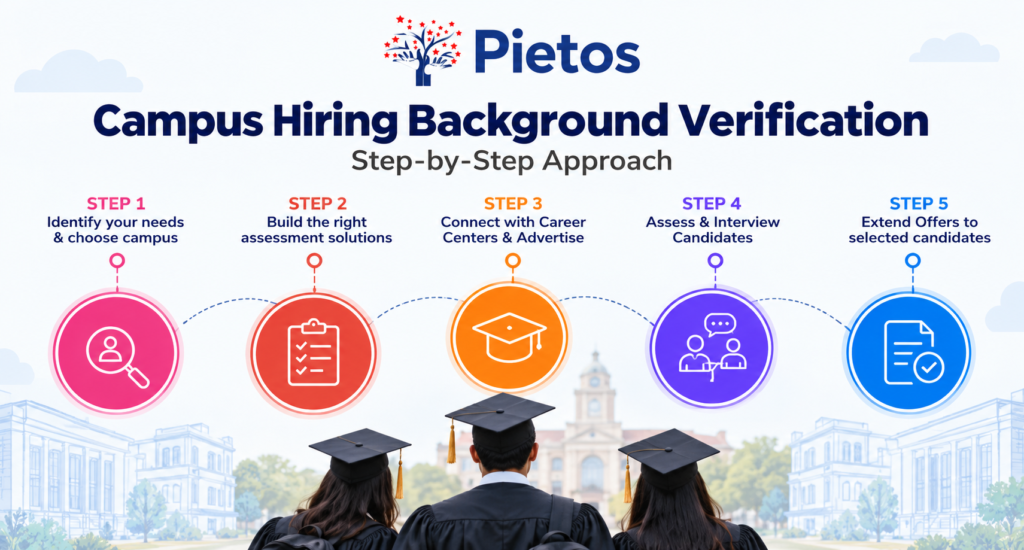
Campus hiring background verification decides whether your next batch becomes an asset or a liability. Each October, offer letters go out in bulk. Each January, joining dates arrive. Between those two dates, your team must verify thousands of freshers fast.
Most teams plan the offers well. Few plan the checks. Therefore, the verification queue explodes in the last three weeks before joining. Recruiters chase documents. Candidates miss emails. Clients ask for clearance letters. Meanwhile, risky profiles slip through.
This guide fixes that. You will learn a three-week method for fresher verification at scale. You will also see which checks matter, which tools help and where field verification still wins.
Key takeaways
- Fresher verification is a batch problem. Treat it like a project, not a queue.
- Education and identity checks carry the most weight for freshers.
- Tier your candidates by risk. Do not run every check on every person.
- Use NAD and DigiLocker first. Add manual checks only for exceptions.
- Start verification before the joining date, not after it.
Planning a large campus batch this season? Talk to Pietos about batch fresher verification and get a draft plan for your headcount.
Why Campus Hiring Background Verification Breaks at Scale
Verifying one candidate is simple. Verifying 5,000 is a different job. The steps stay the same. The volume, the timing and the exceptions change everything.
The volume trap
A typical experienced-hire process handles a few dozen cases a week. Campus season sends thousands in days. As a result, manual follow-ups collapse. One recruiter cannot chase 400 candidates for scanned marksheets.
The thin-file problem
Freshers have no employment history. Therefore, you cannot lean on previous employer checks. You must rely on education, identity, address and sometimes internship or reference checks. Each check carries more weight because there are fewer of them.
The deadline squeeze
Candidates finish exams late. Results arrive late. Degree certificates arrive even later. However, your joining date does not move. So HR teams verify provisional documents or wait for final ones. Both choices carry risk.
The dispersed-college problem
Campus hiring spreads across tier 1, tier 2 and tier 3 colleges. Some colleges upload records to national platforms. Others still run on paper registers. Consequently, one process cannot serve every candidate.
The Real Cost of Skipping Fresher Checks
Some leaders ask a fair question. Freshers have no history, so why verify them? The answer is simple. Freshers carry a different kind of risk.
Business risks you cannot see on an offer letter
- Fake or inflated degrees. A candidate may claim a degree from an unrecognised institution.
- Identity mismatch. A proxy may attend the assessment while another person joins.
- Forged marksheets. Cutoff percentages tempt candidates to edit scores.
- Client contract breaches. Many client contracts require verified staff from Day 1.
- Data and conduct risk. Freshers often get system access in the first week.
Cost of inaction
Consider what one bad hire costs. You pay for training, equipment, onboarding time and manager attention. Then you pay again to replace the person. Next, add client escalation if the person staffs a billable project.
Now multiply that across a batch. Even a small share of failed profiles turns into lakhs of rupees in wasted onboarding. Moreover, a single fraud case can trigger a client audit. That audit then touches every fresher you placed.
In short, the cost of verification is small next to the cost of reversing a bad joining.
Benefits of solving the problem early
- Lower attrition in the first 90 days. You remove mismatched profiles before training begins.
- Faster client clearance. Verified batches go to billable projects sooner.
- Stronger compliance posture. You hold consent records and verification trails.
- Better offer-to-join ratio. Early contact keeps candidates engaged.
- Cleaner audits. Your records show who verified what, and when.
What to Verify for Every Fresher
Do not copy the experienced-hire checklist. Build a fresher checklist instead. Focus on what a fresher can actually show.
Core checks for freshers
| Check | What it confirms | Priority |
|---|---|---|
| Identity (Aadhaar, PAN, or other government ID) | The person is who they claim to be | High |
| Highest education | Degree, institute, year and result are genuine | High |
| Institution recognition | The college or university holds valid recognition | High |
| Address | The candidate lives where they say they live | Medium |
| Criminal record | No disqualifying court records | Medium to high, by role |
| Internship or reference | Prior short-term work is real | Low to medium |
Identity verification
Start with identity. Everything else depends on it. First, collect consent. Next, match the government ID against the candidate’s photo or liveness check. Also confirm that the name on the ID matches the name on the degree.
Name mismatches are common. Marriage, spelling and initials all cause them. Therefore, set a clear rule for acceptable variations before the batch starts.
Education verification
Education is the heart of fresher verification. You verify four facts: the institution, the course, the pass year and the result. Furthermore, you confirm that the institution holds proper recognition. The next section shows how.
Address and criminal checks
Address checks matter for roles with field access, customer contact or asset handling. Criminal checks matter for roles in finance, security, healthcare and client-facing work. For back-office roles, many firms run a lighter check. This is where risk tiering helps. We cover it later.
Internship and reference checks
Some freshers list internships as experience. Verify these only if the role depends on them. Otherwise, a short reference call is enough.
Education Verification for Freshers: NAD, DigiLocker, UGC and AICTE
Education checks are where batch speed is won or lost. Indian government platforms now make digital checks possible for many records. Use them first. Use manual methods only when digital methods fail.
National Academic Depository (NAD)
The National Academic Depository is a government-backed digital store of academic awards. Institutions upload records. Candidates and verifiers can then access them. As a result, you can confirm a degree without writing to the college.
NAD works well when the institution participates. It works poorly when the college has not uploaded records. Therefore, treat NAD as a first pass, not a guarantee of coverage.
For a deeper look at how NAD and DigiLocker fit into a hiring workflow, read our startup BGV guide covering NAD and DigiLocker.
DigiLocker
DigiLocker lets candidates share government-issued documents directly with you. These documents come from the issuer. Therefore, they carry strong authenticity. Candidates give consent each time they share.
For fresher batches, DigiLocker offers three benefits:
- It removes scanned-copy fraud.
- It speeds up identity and education pulls.
- It creates a consent trail for each share.
However, not every board or university issues records there. Candidates who lack a DigiLocker account also need help. Plan a short support window for them.
Our DigiLocker 2026 HR guide explains setup, consent flows and common failure points in detail.
UGC recognition check
A real degree from an unrecognised institution still creates risk. The University Grants Commission publishes lists of recognised universities and of institutions it has flagged as fake. Check the institution against these lists. Do this for every unfamiliar college in your batch.
This step also matters for niche profiles. For example, online tutor verification relies heavily on the UGC recognised-institution check. Campus batches need the same discipline.
AICTE approval check
For engineering, management and technical programmes, check approval status with AICTE. The council maintains approved institution data. A degree from a programme without approval can cause trouble later, especially in client audits.
So, for technical freshers, run both checks. UGC covers the university. AICTE covers the programme.
A simple decision rule
- Try DigiLocker first.
- Try NAD if DigiLocker has no record.
- Check UGC and AICTE for every new or unfamiliar institution.
- Send a direct university or college verification request only if steps 1 to 3 fail.
This order saves the most time. Most of your batch should clear in steps 1 and 2.
The Three-Week Plan to Verify 5,000 Freshers
Now the practical part. This plan assumes 5,000 offers and a joining date three weeks out. Adjust the numbers to your headcount. The logic holds at 500 or at 20,000.
If you need broader context on digital workflows first, see our overview of digital background verification in India.
Week 1: Prepare, collect and consent
Week 1 sets the pace. Do not skip it.
- Freeze the check list. Decide which checks apply to which role tier.
- Clean the candidate file. Remove duplicates. Fix names, emails and phone numbers.
- Send consent requests. Use one clear message. Explain what you check and why.
- Open a candidate help desk. Offer a phone line and a WhatsApp or email channel.
- Set a collection deadline. Give candidates five working days.
Also brief your hiring managers. Tell them which candidates may face delays. Then they can plan project allocation with real dates.
Week 2: Run digital checks in bulk
Week 2 is the engine room.
- Run identity checks in batches. Process by college or by role tier.
- Pull education data. Use DigiLocker and NAD first.
- Check institution recognition. Run UGC and AICTE lookups for new colleges.
- Flag exceptions daily. Do not wait until Friday.
- Escalate stuck cases. Move non-responders to a second reminder, then a call.
Track progress on a simple dashboard. Show three numbers: cleared, in progress and flagged.
Week 3: Close exceptions and release clearances
Week 3 is about the tail.
- Resolve discrepancies. Call candidates. Request fresh documents.
- Run field checks where needed. Use physical verification for address or unresolved education cases.
- Review adverse findings. Let a senior HR reviewer make the final call.
- Release clearance in waves. Send cleared candidates to projects first.
- Archive the trail. Store consent, results and decisions with access controls.
Want this plan mapped to your own batch size and joining calendar? Request a campus verification plan from Pietos and we will share a week-by-week schedule.
Risk Tiering for Fresher Verification
Do not run every check on every fresher. That approach wastes money and time. Instead, group your batch by role risk. Then match checks to each group.
A three-tier model
| Tier | Typical roles | Checks |
|---|---|---|
| Tier 1: Standard | Back-office, internal support, trainee developers on internal projects | Identity, highest education, institution recognition |
| Tier 2: Elevated | Client-facing engineers, BPM agents with customer data, junior analysts | Tier 1 plus address and criminal record |
| Tier 3: Critical | Finance, banking operations, security, healthcare, roles with system admin rights | Tier 2 plus reference checks and enhanced court record search |
This model cuts cost without cutting safety. Moreover, it speeds up the largest group. Most freshers sit in Tier 1. They clear fast through digital sources.
How to assign tiers
Ask three questions for each role:
- Does the person touch client or customer data?
- Does the person handle money, assets or physical access?
- Does the client contract demand specific checks?
One yes moves the role up a tier. Two yeses usually mean Tier 3. Also record the logic. Auditors will ask for it.
Handling Exceptions and Discrepancies
Every large batch produces exceptions. Plan for them early. A good exception process separates a smooth campus season from a chaotic one.
Use a red, amber and green system
- Green: All checks match. Clear the candidate.
- Amber: A minor gap exists. Request a clarification or a fresh document.
- Red: A serious mismatch exists. Escalate to a senior reviewer.
This simple language helps recruiters, managers and clients read status at a glance.
Common exceptions and recommended responses
| Exception | Likely cause | Recommended action |
|---|---|---|
| Name mismatch between ID and degree | Spelling, initials, marriage | Ask for a gazette notice or an affidavit if the gap is large |
| Provisional certificate only | Result declared, degree not issued | Give conditional clearance. Re-verify the final degree within 90 days |
| Institution not on NAD or DigiLocker | College has not uploaded data | Send a direct university verification request |
| Institution not on UGC or AICTE lists | Unrecognised or newly approved | Escalate to a senior reviewer |
| Score mismatch | Typing error or edited marksheet | Request the original marksheet. Compare with the issuer record |
| Non-responsive candidate | Missed email, no DigiLocker account | Call the candidate. Offer help with setup |
Treat provisional documents with care
Many freshers join before the final degree arrives. Therefore, set a firm rule. Accept the provisional document for conditional clearance. Then diarise a follow-up. Also tell candidates that the offer stays conditional on the final degree.
This rule protects you. It also gives candidates a fair path.
Separate error from fraud
Not every mismatch is fraud. Spelling errors and data entry slips happen often. However, a pattern needs attention. For example, several candidates from one college may submit the same unusual document format. In that case, pause and review the source.
Therefore, give your reviewer clear guidance:
- Clerical issue: The correction is minor and the candidate can document it.
- Material gap: The facts differ and the candidate cannot explain them.
- Suspected forgery: The document fails issuer verification or looks altered.
First resolve clerical issues. Next review material gaps. Finally, escalate suspected forgery under your written policy.
Candidate Experience Matters in Campus Hiring
Freshers are anxious. They have exams, results and often several offers. If verification feels hostile, some will drop out. Therefore, design the process around them.
Five habits that raise completion rates
- Explain the why. Tell candidates that verification protects them and the company.
- Use plain language. Avoid legal jargon in consent emails.
- Give one link. Do not send five documents and three portals.
- Offer help. Staff a help desk with real people.
- Send reminders on mobile. Most freshers respond faster on phone than on email.
Also share a simple timeline. For example, tell candidates when to expect updates. Clear dates reduce anxious follow-up calls.
Keep your offer-to-join ratio healthy
Strong candidates often hold multiple offers. A slow, confusing check can tip them toward a rival. So treat verification as part of your employer brand. A quick and respectful process shows maturity.
DPDP Compliance for Fresher Data
Fresher verification collects identity numbers, addresses and academic records. Under the Digital Personal Data Protection Act, 2023, your company acts as a data fiduciary. That role carries duties.
What to do before the batch starts
- Collect clear consent. State the purpose, the data and the checks.
- Limit collection. Ask only for what each tier needs.
- Secure the data. Restrict access to the verification team.
- Share only with vetted vendors. Sign a data processing agreement.
- Set a retention rule. Decide how long you keep records for rejected and joined candidates.
Also keep a verification trail. Record who accessed what, and when. This trail protects you in audits and in disputes.
For a wider look at how national digital identity tools support lawful verification, read our guide to India Stack background verification.
Digital plus Field Verification: Where Each Wins
Digital checks handle most of a campus batch. However, they do not cover everyone. A hybrid model fills the gaps.
When digital verification works best
- Candidates from colleges that upload to NAD or DigiLocker
- Candidates with active government ID and DigiLocker accounts
- Large metro and tier 1 city batches
Digital methods run fast. They also scale without adding headcount.
When field verification works best
- Colleges in tier 2 and tier 3 cities with paper records
- Address checks that need a physical visit
- Cases where the digital record does not match the candidate’s claim
Field checks cost more and take longer. Therefore, use them only where digital methods fail. This approach keeps your cost per candidate low.
Why hybrid matters for campus hiring
Campus batches draw from across India. A purely digital vendor leaves gaps in smaller cities. A purely field vendor cannot match the speed. So choose a partner who runs both. Pietos runs digital and physical verification under one workflow, which suits tier 2 and tier 3 coverage.
A Worked Example: 5,000 Freshers, Three Weeks
The numbers below are illustrative. They show how the workflow behaves. They are not benchmarks from a real client. Use your own historical data to set targets.
Imagine a services company that hires 5,000 freshers from 120 colleges.
Step 1: Split by tier
The team assigns 3,800 freshers to Tier 1, 1,000 to Tier 2 and 200 to Tier 3.
Step 2: Run digital checks
DigiLocker and NAD clear a large share of Tier 1 within the first few days of Week 2. The team then queues the remaining profiles for direct college requests.
Step 3: Triage exceptions
The reviewer sorts flagged cases into red, amber and green. Most are clerical. A small number need deeper review.
Step 4: Release clearances in waves
HR releases cleared candidates to the project allocation team each Friday. Therefore, managers can plan around real data.
What this example shows
- Tiering protects cost.
- Digital sources protect speed.
- Exception handling protects quality.
Your numbers will differ. The shape of the workflow will not.
Buyer Objections and Straight Answers
HR and finance leaders raise the same doubts every season. Here are the common ones, with direct answers.
“Freshers have no history, so why verify?”
Because education and identity are all you can check. They also carry the most risk. A fake degree or a proxy candidate costs you far more than the check itself.
“We cannot afford three weeks of delay.”
You do not delay anything. You run verification in parallel with training prep. Moreover, early checks prevent late-stage cancellations.
“Candidates will drop out if we ask for documents.”
Some might, if the process feels clumsy. However, a clear and short process keeps most candidates engaged. Also, serious candidates expect verification.
“We already collect documents at joining.”
Document collection is not verification. A scanned marksheet proves nothing about its source. Verification checks the record with the issuer.
“Our client does not require it.”
Many clients ask for it during audits. Besides, clean records help you win and keep contracts. So do not wait for the request.
“Vendors cannot handle our volume.”
Ask for a pilot. A real vendor can show batch throughput, escalation paths and live dashboards. If a vendor cannot, choose another.
Metrics to Track During Campus Verification
What you measure shapes what you improve. Track a short list of numbers each week.
- Consent completion rate. How many candidates gave consent by the deadline?
- Cleared on first pass. How many cleared through digital checks alone?
- Average turnaround time. How long does each tier take?
- Exception rate. What share of cases needed manual review?
- Adverse finding rate. How many cases ended in red status?
- Candidate drop-off. How many left after the verification request?
- Cost per verified fresher. What does each cleared candidate cost, all in?
Review these every Friday. Then adjust reminders, staffing and vendor load.
How to Choose a Verification Partner for Campus Hiring
Use this checklist when you compare vendors. Score each point from 1 to 5.
- Batch capacity. Can the vendor handle your peak volume without delay?
- Digital coverage. Does the vendor integrate with DigiLocker and NAD?
- Field network. Can the vendor verify in tier 2 and tier 3 cities?
- Recognition checks. Does the vendor run UGC and AICTE lookups?
- Candidate support. Does the vendor offer a help desk and mobile-friendly flows?
- Reporting. Do you get a live dashboard and clear status codes?
- Compliance. Does the vendor follow DPDP rules and sign a data processing agreement?
- Escalation. Does the vendor assign a named contact for red cases?
Also ask for references from similar-sized hiring programmes. Then run a small pilot before you commit the full batch. For a wider view of how providers differ, our startup BGV guide covers selection criteria in more detail.
Why Teams Trust Pietos for Fresher Verification
Pietos is a background verification company built for the Indian mid-market. We serve NBFCs, growth-stage startups and global capability centres. Our model blends digital checks with physical verification. As a result, we cover the tier 2 and tier 3 gaps that purely digital vendors miss.
- One workflow for identity, education, address and criminal checks
- Government-source first methods through DigiLocker and NAD
- Field verification for unresolved and paper-based records
- Live status tracking with red, amber and green codes
- Consent and audit trails built for DPDP expectations
Key Takeaways
- Campus hiring background verification is a project. Plan it like one.
- Start in Week 1 with consent, clean data and a candidate help desk.
- Verify identity and education first. Then add checks by role risk.
- Use DigiLocker and NAD first. Check UGC and AICTE for unfamiliar colleges.
- Tier your candidates. Do not run the heaviest checks on everyone.
- Treat provisional documents with conditional clearance and a firm follow-up date.
- Respect candidates. A smooth process lifts your offer-to-join ratio.
- Choose a partner who runs both digital and field checks.
8. FAQ Section
Campus hiring background verification is the process of checking the identity, education and, where needed, address and criminal records of freshers before they join. Companies run it in batches because campus offers arrive in large numbers.
Freshers need identity verification and education verification at minimum. Roles with client data, money or physical access may also need address and criminal record checks.
Digital checks through DigiLocker and NAD can clear many candidates quickly. Direct college requests and field checks take longer. A three-week plan gives enough time for most batches.
Yes, with conditions. Give conditional clearance. Then re-verify the final degree within a fixed window, such as 90 days.
Check the institution on the UGC lists of recognised universities and fake institutions. For technical programmes, also check AICTE approval.
Yes. The DPDP Act, 2023 expects clear consent and purpose limits. Collect consent before you begin any check.
Send a direct verification request to the college or university. Use a vendor with a field network if the college is slow or uses paper records.
Campus season does not wait. Each week you delay raises the risk of a weak joining. Therefore, build your plan now.
Book a free campus verification consultation with Pietos. Share your headcount and joining date. We will return a tiered check plan, a three-week schedule and a pilot proposal within two working days.